The Agricultural Revolution
c. 10,000 BCE
The single most important paradigm shift in human history.
Read the full sourced page: The Agricultural Revolution
The Bargain That Built the Modern World
The Agricultural Revolution (sv-agriculture) is the hinge on which the human story turns. Before it, every member of our species lived as a forager; within a few thousand years of its onset, the descendants of those foragers would build cities, write laws, and eventually split the atom. Yet for all its consequence, it was less a single invention than a slow, hesitant negotiation between climate, plants, and an animal that had only recently become fully modern.
Deep Preconditions
Nothing about farming was inevitable. It required a planet warm and stable enough to reward staying in one place. That stability arrived only after the end of the Last Ice Age (sv-last-ice-age), roughly 12,000 years ago, when retreating glaciers and a warming climate let wild emmer, einkorn, and barley spread in dense stands across the Fertile Crescent. The grasses themselves were a deep inheritance: the first true trees and the spread of vascular plants in the Paleozoic had built the chemistry of terrestrial life long before any human stooped to harvest seed. And the harvester itself was a product of an immense lineage — the first mammals (sv-first-mammals) that survived the K-Pg extinction (sv-dinosaur-extinction), the first primates that followed, and finally the cognitive break of the human-chimpanzee split (sv-human-chimp-split). Strikingly, the impulse to gather in large numbers may have preceded the granary: Göbekli Tepe (sv-gobekli-tepe), built by hunter-gatherers around 9600 BC, hints that ritual congregation, not bread, first drew people together.
A Worldwide, Repeated Event
What makes agriculture so revealing is that it happened more than once, independently. As emmer and barley were being sown in the Levant around 9600 BC, people in China were cultivating rice and millet, and farming arose separately in Mesoamerica, the Andes, and New Guinea. This convergence suggests the transition was not a fluke of one clever culture but a threshold our species crossed wherever conditions allowed — a pattern that resonates with Kurzweil's later claim, in The Law of Accelerating Returns (sv-kurzweil-law), that information-bearing systems tend toward self-reinforcing growth.
The Faustian Bargain
The revolution's legacy is double-edged, and modern scholarship insists we hold both edges at once. Surplus grain meant denser populations and the world's first permanent settlements, but it did not, at first, mean better lives. Yuval Noah Harari calls it "history's biggest fraud": the average farmer worked harder and ate a narrower diet than the average forager, while the surplus translated, in his words, into "population explosions and pampered elites." Sedentary crowds living beside their livestock and refuse incubated the infectious diseases that have shadowed civilization ever since. Stored grain that could be counted, taxed, and seized produced the first durable hierarchies and concentrated wealth.
From that surplus and that stratification, the rest of recorded history unspools with astonishing speed. Granaries demanded record-keeping, giving us cuneiform (sv-cuneiform); the labor surplus and the cart gave us the wheel (sv-wheel); concentrated populations and divine kingship raised the Great Pyramids (sv-pyramids) and codified justice in the Code of Hammurabi (sv-hammurabi). Every later acceleration — the Industrial Revolution (sv-industrial-revolution) that mechanized the farm, and the looming Dawn of AGI (sv-ai-dawn) — rests on the original premise that a society can feed people who do not themselves grow food. The Neolithic farmer, trading freedom and leisure for security and surplus, struck the bargain that made the specialist, the scribe, the priest, and ultimately the scientist possible. We are all, still, living inside the terms of that ancient contract — eating its harvest and paying its hidden costs.
Global Context
The first cultivation in the Fertile Crescent (c. 9500 BCE) coincided with the end of the Pleistocene. The cold, dry Younger Dryas (c. 12,900–11,700 BP) gave way to the stable, warmer, wetter Holocene, the climatic precondition most archaeologists (e.g., Bar-Yosef) link to settling down. Sedentary Natufian foragers in the Levant already harvested wild cereals before domestication. This was not a single event but a polycentric process: rice and millet along the Yangtze and Yellow Rivers (c. 9000–7000 BCE), squash, manioc and later maize in Mesoamerica and Amazonia (teosinte domesticated c. 9000 BP), potatoes, quinoa and camelids in the Andes, sorghum and yams in Africa, and bananas and taro in highland New Guinea. Roughly contemporaneously, foragers at Göbekli Tepe in southeastern Anatolia (c. 9500 BCE) raised monumental stone enclosures before full farming. Across these regions, broadly similar Holocene conditions enabled humans, still anatomically identical to Ice Age hunters, to begin reshaping wild species into domesticates.
The Paradigm Shift
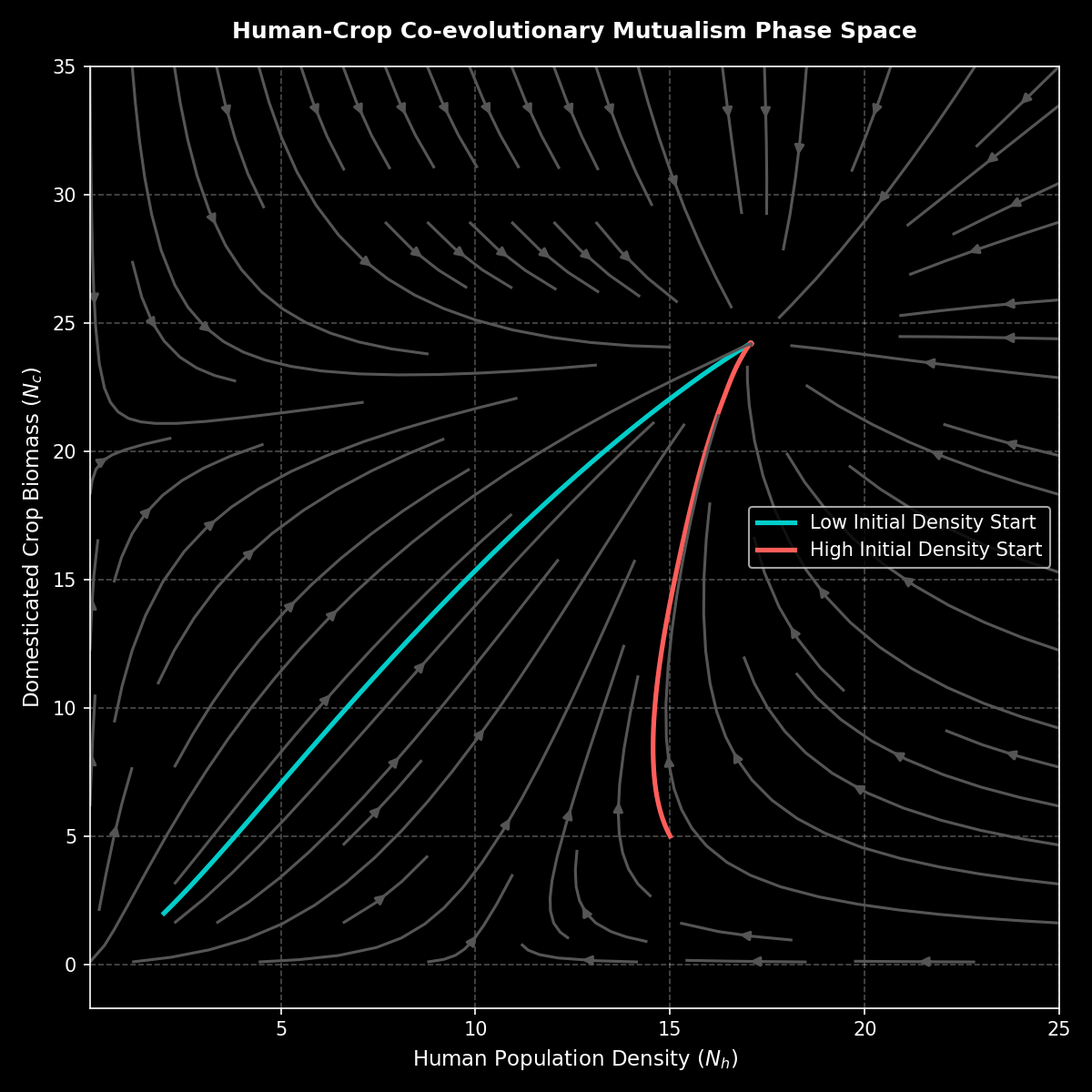
Domestication inverted the human-environment relationship: instead of adapting to ecosystems, humans began re-engineering plants, animals, and landscapes to feed themselves, initiating co-evolution that altered both species' genomes. V. Gordon Childe, who coined "Neolithic Revolution" in Man Makes Himself (1936), saw food production as the watershed enabling stored surplus, population growth, sedentism, property, and ultimately the craft specialization, social stratification, and cities of his later "Urban Revolution." Surplus underwrote non-food-producing classes—priests, soldiers, artisans, scribes—and the recording of debts and stores arguably drove early writing and the state. Demographically, farming triggered the Neolithic Demographic Transition, raising fertility and population density even as it lowered per-capita health. It also bound humans to a narrow set of staple crops and to the territories that grew them, making land itself the central economic and political prize. Every subsequent revolution—urban, literate, imperial, industrial—presupposes the agrarian surplus first generated in the Neolithic. It is, in narrative terms, the hinge between the Paleolithic and recorded civilization.
Counterfactual: What If It Had Gone Differently
Because agriculture arose independently in at least seven world regions across several millennia, the strong counterfactual—"what if it had never happened?"—is implausible: the broadly synchronous Holocene onset suggests powerful structural drivers, not a fluke. Diamond (Guns, Germs, and Steel, 1997) and the "Holocene window" argument imply that once climate stabilized and populations of harvestable grasses and tameable mammals existed, intensification was probable wherever such species occurred. A weaker counterfactual is more defensible: had domesticable founder crops and large-bodied mammals been absent (as in much of Australia or sub-Saharan Africa's tsetse zones), dense agrarian states would have been delayed or precluded, leaving complex foraging or pastoral societies dominant—plausibly indefinitely, as in Aboriginal Australia. Diamond's biogeographical thesis predicts Eurasia's east-west axis and rich domesticate suite gave it a head start that compounded into later conquest. Critics counter that this risks environmental determinism. The cautious conclusion: agriculture somewhere was near-inevitable in the Holocene; the cities, empires, and inequalities built atop it were contingent on which species lay to hand.
Scholarly Debate
Several debates remain live. (1) Cause: Braidwood's "hilly flanks" oasis-readiness, Binford and Flannery's demographic/marginal-zone pressure models, Bar-Yosef's climate-driven accounts, and Hodder's cognitive-symbolic reading of Çatalhöyük compete; most now favor multicausal explanations. (2) Was it progress or catastrophe? Jared Diamond's essay "The Worst Mistake in the History of the Human Race" (1987), drawing on George Armelagos's bioarchaeology, argues farming shortened stature and worsened dental and nutritional health and entrenched inequality—a view broadly corroborated by skeletal studies even as fertility rose. (3) Pace and agency: James C. Scott (Against the Grain, 2017) stresses a long gap between cultivation and grain states and casts states as parasitic on legible cereal surplus, while David Graeber and David Wengrow (The Dawn of Everything, 2021) reject any unilinear "revolution," emphasizing "play farming," reversibility, and Neolithic societies that consciously resisted hierarchy. Critics fault Graeber and Wengrow for selective evidence; the field increasingly favors a protracted, plural, non-teleological transition.
The Scholarly Picture
Scholars agree on the broad outline: cultivation began independently in several world regions, with the Fertile Crescent sequence best documented archaeologically. V. Gordon Childe, Man Makes Himself coined "Neolithic Revolution" in 1936 to describe the shift from foraging to food production as a technological and economic turning point comparable to the Industrial Revolution — the term stuck even as its content was revised repeatedly. Most researchers now treat the process as gradual and multicausal rather than a single invention, unfolding over centuries against the backdrop of Pleistocene-to-Holocene climate stabilization, as Bar-Yosef, The Natufian Culture in the Levant1520-6505(1998)6:5%3C159::AID-EVAN4%3E3.0.CO;2-7) lays out for the Natufian sequence that precedes true domestication.
The sharpest live debate concerns sequence and causation, not just which factor mattered but which came first. James C. Scott, Against the Grain argues sedentism itself predates domestication by millennia — favorable wetland niches supported settled, sometimes large (up to roughly 5,000-person) populations with little or no farming as early as 12,000 BC, and full domestication of founder crops and animals across the Near East had occurred by roughly 8000–6000 BC, yet grain-based states did not appear until nearly four thousand years after that. This inverts the older assumption, still implicit in Childe and in Braidwood's "hilly flanks" model, that domestication caused settlement. Scott adds a second claim that draws real pushback: that early states specifically needed grain — visible, storable, taxable — and coerced labor to sustain themselves, making the "state" itself a product of a narrow cereal ecology rather than farming's natural outcome.
A related dispute concerns whether "revolution" is even the right word. David Graeber and David Wengrow, The Dawn of Everything contend the foraging-to-farming transition stretched across roughly 3,000 years in some regions, which they call "far too long to constitute an 'Agricultural Revolution,'" and they reject both the progress narrative and the declension narrative (epitomized by Jared Diamond, The Worst Mistake in the History of the Human Race) as equally deterministic, insisting farming societies show far more variation in hierarchy and freedom than either camp allows.
Interpretation has shifted accordingly: Childe's diffusionist "revolution," Binford and Flannery's 1960s–70s systems-and-demography models, Bar-Yosef's climate-forcing accounts, and Hodder's symbolic reading of Çatalhöyük each explained cause; Scott and Graeber/Wengrow instead question the story's shape and moral, arguing against any single inevitable path from grain to state to civilization.
Key Claims & Sources
- Jared Diamond reports that average male height in Greece and Turkey fell from about 5'9" before farming to 5'3" after the shift to agriculture, a loss populations there had still not recovered by the late 20th century. — Jared Diamond, 'The Worst Mistake in the History of the Human Race' (Discover, 1987)
- At the Dickson Mounds site in Illinois, life expectancy dropped from about 26 years to about 19 years after the local population switched from foraging to intensive maize farming around A.D. 1150. — Jared Diamond, 'The Worst Mistake in the History of the Human Race' (Discover, 1987)
- James C. Scott argues that sedentism appeared in favorable ecological niches as early as 12,000 BC and that most Near Eastern founder crops and animals were domesticated by roughly 8000-6000 BC, yet the first agrarian states did not emerge until almost four thousand years later. — James C. Scott, Against the Grain (Yale University Press, 2017)
- David Graeber and David Wengrow note that the shift from foraging to farming in some regions took roughly 3,000 years, which they call 'far too long to constitute an Agricultural Revolution.' — David Graeber and David Wengrow, The Dawn of Everything (2021)
How It Connects
What Made It Possible
- The end of the last Ice Age and the onset of the warmer, wetter, and more climatically stable Holocene around 11,700 years ago created environmental conditions in which sustained plant cultivation became viable.
- The Younger Dryas cold snap (roughly 12,800 to 11,700 years ago) reduced the wild food staples that foragers in the Levant depended on, pressuring communities such as those at Abu Hureyra in Syria to begin deliberately cultivating plants like rye rather than relocate.
- The Fertile Crescent happened to host the wild progenitors of highly nutritious, easily storable founder crops, including wild emmer wheat, einkorn wheat, and barley, alongside domesticable animals such as sheep, goats, cattle, and pigs.
- Late Pleistocene and early Holocene foragers, especially the Natufian culture of the Levant, had already adopted semi-sedentary village life and intensive harvesting of wild grains before full domestication, providing the social and economic foundation for farming.
- Generations of hunter-gatherers had accumulated detailed knowledge of plant life cycles, seeds, and growing conditions through close observation of the wild species they gathered.
- The invention of ground-stone technology such as sickles, grinding slabs, and querns allowed people to efficiently harvest and process the hard seeds of cereal grasses, making grain a practical dietary staple.
Its Legacy
- A reliable, storable food supply supported far denser populations and higher fertility, because sedentary mothers no longer had to carry infants over long distances and could space births more closely than foragers.
- Agricultural surpluses freed a portion of the population from food production, enabling full-time craft and occupational specialization such as potters, weavers, metalworkers, priests, and traders.
- Storable, controllable grain surpluses underwrote durable social hierarchy and the rise of early states, producing a non-laboring elite, private property, taxation, and centralized political power in places like Sumer.
- The need to track stored grain, rations, and temple and palace transactions drove the invention of writing, with proto-cuneiform emerging in Uruk around 3200 BCE primarily as an accounting tool.
- Close, sustained contact with domesticated herd animals in dense settlements allowed animal pathogens to jump to humans, giving rise to crowd diseases such as measles (from cattle rinderpest), smallpox, tuberculosis, and influenza.
- Farming spread out of the Fertile Crescent and arose independently in regions including China, Mesoamerica, the Andes, and New Guinea, ultimately reshaping nearly all human societies and laying the groundwork for cities, monumental architecture, and civilization.
Myth vs. Reality
Myth: The Agricultural Revolution was a single sudden event or breakthrough invention.
Reality: Most archaeologists now reject the word "revolution." The shift from foraging to farming was a slow, multi-generational process unfolding over thousands of years, with mixed foraging-and-farming economies persisting for millennia and even temporary reversions to hunting and gathering. Plant and animal domestication emerged gradually through generations of observation and selection rather than as a deliberate discovery, which is why many scholars now prefer the term "Neolithic transition" over "Neolithic Revolution."
Myth: Agriculture was invented in one place and spread from there to the rest of the world.
Reality: Farming arose independently in at least seven separate centers ("hearths"), including the Fertile Crescent, East Asia, Sub-Saharan Africa, Mesoamerica, the Andes, and others. Archaeologists conclude these origins were genuinely independent because each region domesticated its own distinct crop-and-animal complex (e.g., wheat and barley in Southwest Asia, maize in Mesoamerica, rice and millet in East Asia) suited to local conditions, not borrowed from one another.
Myth: Early farmers were healthier and lived longer than the hunter-gatherers who preceded them.
Reality: Skeletal evidence frequently shows the opposite for the early transition: as populations adopted farming, average stature often declined and signs of nutritional stress, dental disease, and infection rose, with diets narrowing to a few staple crops. Adult life expectancy in the eastern Mediterranean did not improve and by some measures slightly fell across the transition. Farming supported far larger populations through higher fertility and food quantity, but more food did not initially mean better-nourished or healthier individuals.
Myth: People took up farming because foraging could not provide enough food.
Reality: Ethnographic and archaeological work, including Marshall Sahlins's "original affluent society" thesis from the 1966 "Man the Hunter" symposium, suggests many forager groups met their needs with relatively modest work and suffered fewer and shorter famines than early farmers. Why people adopted a more laborious, riskier subsistence remains genuinely debated among scholars rather than settled as a response to scarcity. (Sahlins's leisure estimates have themselves been criticized for undercounting food processing and domestic labor, so neither extreme is the full picture.)
Myth: Permanent settlements, monuments, and complex society only became possible after agriculture provided a food surplus.
Reality: The order is often reversed. Natufian groups in the Levant built year-round villages while still hunting and gathering wild cereals and gazelle, centuries before domestication. At Gobekli Tepe in southeastern Turkey, hunter-gatherers erected monumental stone structures during the Pre-Pottery Neolithic (roughly 9600 to 8200 BCE) before evidence of domesticated grains or permanent settlement at the site. Excavator Klaus Schmidt argued that communal ritual and gathering may have helped drive the move toward farming rather than simply resulting from it, though the interpretation remains debated.
Another Lens — Agriculture had no single cradle
The familiar story starts in the Fertile Crescent, but farming was not a one-time invention that radiated outward. It arose independently in at least half a dozen separate centers: the Near East (wheat and barley), China (rice and millet), Mesoamerica (maize, beans, and squash), the Andes (potato and quinoa), sub-Saharan Africa (sorghum and pearl millet), and New Guinea (taro and banana) — with farming in the Americas beginning only a thousand to two thousand years later than in the Old World. The move to agriculture was a recurring human response to a changing world, not a single Mesopotamian breakthrough.
Voices & Primary Sources
The adoption of agriculture, supposedly our most decisive step toward a better life, was in many ways a catastrophe from which we have never recovered.— Jared Diamond, "The Worst Mistake in the History of the Human Race," Discover magazine, 1987
The world's most primitive people have few possessions, but they are not poor. Poverty is not a certain small amount of goods, nor is it just a relation between means and ends; above all it is a relation between people. Poverty is a social status. As such it is the invention of civilization.— Marshall Sahlins, "The Original Affluent Society," in Stone Age Economics, 1972
We did not domesticate wheat. It domesticated us.— Yuval Noah Harari, Sapiens: A Brief History of Humankind, 2011 — a deliberately provocative framing
In Their Words
"In our hypothetical Neolithic stage there would be no specialisation of labour—at most a division of work between the sexes." — V. Gordon Childe, Man Makes Himself (1936), the work that coined "the Neolithic Revolution"
Data Visualization
References & Sources
- Neolithic Revolution — Wikipedia
- V. Gordon Childe, Man Makes Himself (London: Watts & Co., 1936)
- Jared Diamond, 'The Worst Mistake in the History of the Human Race,' Discover Magazine (1987); and Guns, Germs, and Steel (1997)
- James C. Scott, Against the Grain: A Deep History of the Earliest States (Yale University Press, 2017)
- David Graeber and David Wengrow, The Dawn of Everything: A New History of Humanity (2021)
- Ofer Bar-Yosef, 'The Natufian Culture in the Levant, Threshold to the Origins of Agriculture,' Evolutionary Anthropology (1998)