The First Star Formations
c. 13.6 Billion Years Ago (200 Million Years after Big Bang)
The cosmic forges that created the building blocks of life.
Read the full sourced page: The First Star Formations
The First Light: How the Cosmos Learned to Forge Itself
For roughly a hundred million years after The Big Bang (sv-big-bang), the universe was dark. The primordial fireball had cooled, electrons had joined nuclei into neutral atoms, and the cosmic microwave background streamed off into an expanding void. What remained was a fog of hydrogen and helium — the elements minted in the first three minutes — plus a whisper of lithium. There were no heavier elements at all, and crucially, no light. This was the Cosmic Dark Ages: a universe with all its raw material and none of its structure ignited.
The Deep Preconditions
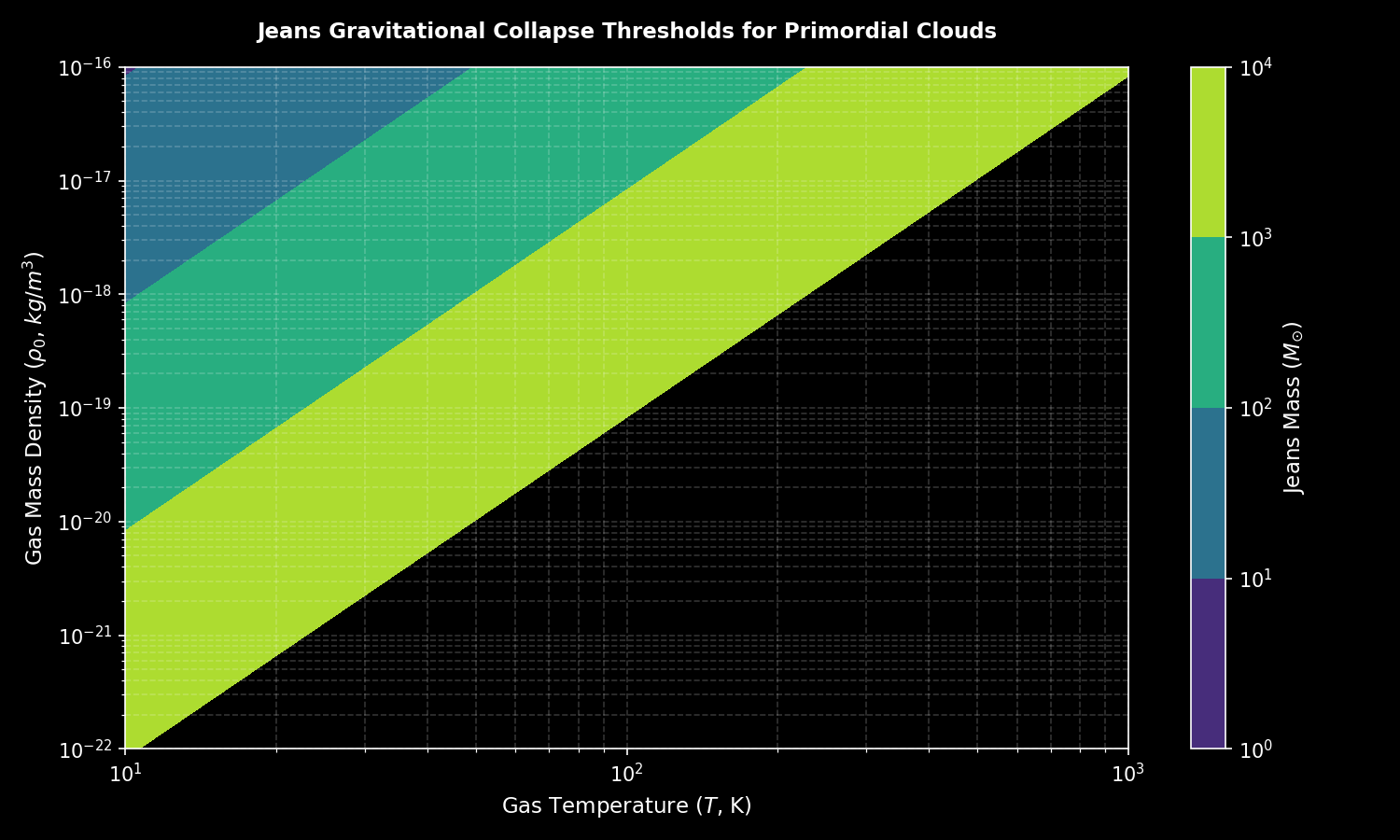
The first stars could not form until two things were ready. First, gravity needed seeds. Tiny density ripples imprinted on the infant cosmos — the same ripples we read in the microwave background left over from The Big Bang (sv-big-bang) — grew under the pull of dark matter into halos massive enough to draw gas inward. By a redshift of roughly z ~ 20–30, gas pooled in "minihalos" weighing between a hundred thousand and a few million solar masses. Second, that gas had to shed heat to collapse. With no metals to radiate energy efficiently, only trace molecular hydrogen could cool the clouds, and it cooled them poorly. The consequence shaped everything: inefficient cooling prevented fragmentation, so the gas collapsed into a few enormous bodies. These Population III stars were likely giants, many exceeding a hundred times the Sun's mass — far larger than anything common today.
What the First Stars Changed
When these stars ignited, they ended the Dark Ages and began Cosmic Dawn. But their deeper legacy was chemical. A pristine universe of hydrogen and helium cannot make planets, oceans, or biochemistry. Inside the cores of the first stars, nuclear fusion forged carbon, oxygen, silicon, and iron for the very first time — and then, in their violent deaths, scattered them outward. This is the hinge on which all later history turns. The First Supernovas (sv-first-supernova) seeded the surrounding gas with metals, and that enriched material made possible everything downstream: the Formation of the Solar System & Earth (sv-earth-formation) from a metal-laced molecular cloud, and ultimately The Origin of Life (sv-origin-of-life), which is built entirely from elements no Big Bang could produce. Carl Sagan's "we are made of star-stuff" is not poetry but literal cosmic accounting, and its ledger opens here.
The first stars also reshaped the physical cosmos. Their fierce ultraviolet radiation began stripping electrons back off the hydrogen fog — the epoch of cosmic reionization — flipping the universe from neutral to ionized and ending its longest period of darkness.
Threads Forward
Every later chapter inherits this one. The metals dispersed by the first stellar generations enriched succeeding generations, lowering the cooling threshold so that smaller, longer-lived stars like our Sun could form. Without that enrichment there is no rocky Earth, no liquid water, no path to the The Great Oxygenation Event (sv-great-oxygenation) when cyanobacteria first poisoned the atmosphere with oxygen, no The Cambrian Explosion (sv-cambrian-explosion) of complex animal body plans. The unbroken chain runs from these first furnaces all the way to minds capable of looking back and reconstructing the story — the same recursive arc that, in Ray Kurzweil's framing, culminates when matter organized by stars eventually wakes up and saturates the cosmos with intelligence in Epoch 6: The Universe Wakes Up (sv-kurzweil-epoch6).
We have never directly imaged a Population III star; they died too long ago and too far away, though the James Webb Space Telescope hunts their signatures and their fingerprints survive in the chemistry of the oldest, most metal-poor stars in our galaxy. Yet their importance is hard to overstate. The first stars were the universe's first act of self-creation — the moment a cosmos of inert gas began manufacturing the very atoms from which everything interesting, including us, would later be assembled.
Global Context
"This moment" is cosmological, not human, so "elsewhere in the world" means elsewhere in the young universe. The event occurs at redshift z ~ 20–30, roughly 100–250 million years after the Big Bang, during what astronomers call the cosmic dark ages. The cosmic microwave background had decoupled at z ~ 1100 (recombination, ~380,000 years after the Big Bang), leaving a neutral, dark, nearly uniform expanse of hydrogen and helium with trace lithium from Big Bang nucleosynthesis. Tiny density fluctuations seeded by primordial perturbations grew under gravity; cold dark matter collapsed into "minihalos" of ~10^5–10^6 solar masses (Tegmark et al. 1997). Inside these halos, molecular hydrogen (H2) — the only available coolant in metal-free gas — allowed the first baryonic clouds to cool and collapse. No galaxies, no heavy elements, no planets yet existed anywhere. The contemporaneous universe was simply a lattice of dark-matter halos beginning to light up in scattered, near-simultaneous bursts across the observable volume.
The Paradigm Shift
The first stars ended the cosmic dark ages and inaugurated cosmic chemistry. As Bromm & Larson (2004) frame it, their emergence "marks the final moments of the cosmic dark ages," transforming a simple, dark, hydrogen-helium universe into one of "increasing complexity." Three irreversible transitions follow. First, nucleosynthesis: Population III stars fused the first carbon, oxygen, and iron; their pair-instability and core-collapse supernovae dispersed these metals, enabling all subsequent (Population II/I) stars, planets, and ultimately biochemistry — every atom heavier than lithium in living things traces to such stellar interiors. Second, reionization: their hard ultraviolet photons began ionizing the intergalactic medium, the process completed by z ~ 6. Third, structure: metal enrichment introduced new cooling channels, shifting the stellar initial mass function from top-heavy (characteristic mass ≳ 100 solar masses, per Abel, Bryan & Norman 2002; Bromm et al. 2002) toward the lower-mass, long-lived stars of today. Their remnant black holes are candidate seeds for supermassive black holes. In short, this event begins the arrow from cosmic simplicity toward complexity, chemistry, and life.
Counterfactual: What If It Had Gone Differently
Counterfactuals here are physical, not contingent: given Lambda-CDM cosmology and standard nucleosynthesis, some first-star epoch is essentially inevitable once minihalos cool via H2. But the form matters. Had H2 cooling been suppressed — for instance by a strong Lyman-Werner background dissociating molecular hydrogen, the "minihalo starvation" scenario explored in direct-collapse black hole models (e.g., Bromm & Loeb 2003) — gas in atomic-cooling halos could have collapsed monolithically into massive black-hole seeds rather than stars, plausibly altering the timing of reionization and the assembly of supermassive black holes. Had the primordial IMF been bottom-heavy rather than top-heavy, low-mass, long-lived metal-free stars should survive to today; their non-detection in stellar-archaeology surveys (Frebel & Norris 2015) is itself evidence the first stars were predominantly massive and short-lived. Most consequentially, without early massive stars there is no prompt metal enrichment: the universe's transition to carbon-and-oxygen chemistry, and hence to planets and biology, would have been delayed or routed differently. The deep point is that complexity required this first generation, whatever its precise mass spectrum.
Scholarly Debate
A live debate concerns the primordial initial mass function and whether single, very massive stars or fragmented multiples dominated. Early three-dimensional simulations (Abel, Bryan & Norman 2002; Bromm, Coppi & Larson 2002) found a single ~100-solar-mass protostar per minihalo, implying a top-heavy IMF. Later higher-resolution and radiation-hydrodynamic work (Clark et al. 2011; Stacy, Greif & Bromm 2010; Greif et al. 2012) found that protostellar disks fragment, yielding multiple, sometimes lower-mass stars, and that radiative feedback caps accretion — softening the top-heavy picture. A second, observational debate concerns whether genuine Population III systems have been seen. Nakajima et al. (2025) argue LAP1-B at z = 6.6 is consistent with a small Pop III cluster, while strong HeII λ1640 emitters remain contested; critics note diagnostics only discriminate for stellar ages below ~1 Myr. A third strand, exemplified by the THESAN-ZOOM simulations (Zier et al. 2025), debates whether Pop III formation truly ended near z ~ 15 or persisted in pristine pockets down to the end of reionization (z ~ 6), reframing "the first stars" as a prolonged, not instantaneous, episode.
How It Connects
What Made It Possible
- Big Bang nucleosynthesis, in the first few minutes after the Big Bang, forged the primordial gas of roughly 75% hydrogen and 25% helium (plus trace lithium) that would become the raw material for the first stars, leaving the universe metal-free.
- About 380,000 years after the Big Bang, the epoch of recombination let atomic nuclei capture electrons to form neutral atoms, releasing the cosmic microwave background and allowing matter and radiation to decouple so gas could later collapse gravitationally.
- Tiny primordial density fluctuations, seeded by quantum effects during inflation, grew under gravity through the cosmic Dark Ages, clumping cold dark matter into structures that concentrated the diffuse baryonic gas.
- Within the Lambda-CDM framework, dark matter minihalos of roughly 10^5 to 10^6 solar masses formed at redshifts of about 20 to 30 and provided the localized gravitational wells where pristine gas could pool to sufficient density.
- Molecular hydrogen (H2) formed in the primordial gas and served as the essential coolant, radiating away thermal energy at temperatures below about 10,000 K so that the gas in minihalos could lose pressure support, fragment, and collapse to stellar densities.
- The minihalos had to exceed a minimum mass and reach gas temperatures of at least about 1,000 K for H2 formation and cooling to operate faster than the Hubble time, the threshold dividing halos that stayed starless from those that could ignite the first stars.
Its Legacy
- The first stars produced the universe's first ionizing ultraviolet photons, beginning the process of cosmic reionization that gradually transformed the surrounding neutral intergalactic hydrogen back into an ionized plasma.
- Acting as the first nucleosynthetic engines, Population III stars fused hydrogen and helium into the first heavier elements in their cores, ending the metal-free era and seeding the chemistry needed for later planets and life.
- When the most massive Population III stars (about 140 to 260 solar masses) died as energetic pair-instability supernovae, they violently ejected newly forged metals into surrounding gas clouds, driving the universe's first chemical enrichment.
- This injected metal enrichment raised local gas metallicity above a critical threshold near Z roughly 10^-5 to 10^-3.5 of solar, which changed how gas fragments and triggered the transition from Population III to the longer-lived, metal-bearing Population II and later stars.
- Very massive Population III stars above the pair-instability range collapsed directly into intermediate-mass black holes, which are leading candidate seeds for the supermassive black holes observed powering quasars by redshift 7.
- Population III supernova ejecta left a fossil chemical fingerprint in the most metal-poor stars surviving today, whose measured abundance patterns now let astronomers test theories of how the first stars lived, exploded, and enriched the cosmos.
Myth vs. Reality
Myth: The first stars formed right after the Big Bang.
Reality: Stars could not form for a long time after the Big Bang. Neutral atoms only assembled around 380,000 years after the Big Bang, and the first (Population III) stars did not begin to form until roughly 100 million years later, during what cosmologists call the 'cosmic dark ages.' Gravity needed time to pull pristine hydrogen and helium into dark-matter minihalos dense enough to collapse and ignite. Reionization, driven by these early stars, did not fully reshape the universe until several hundred million years after the Big Bang.
Myth: The first stars were all gigantic, solitary monsters hundreds of times the mass of the Sun.
Reality: Early analytic models did suggest the first stars formed essentially one enormous star per halo, often hundreds of solar masses. But high-resolution simulations over the past 15 years show that primordial gas clouds and protostellar accretion disks fragment, producing multiple stars with a broader range of masses, including objects of order ten solar masses. The modern consensus is that Population III stars had a diversity of masses rather than being uniformly supermassive, which also helps explain the absence of some expected chemical signatures.
Myth: We have already directly photographed or observed the universe's first stars.
Reality: No individual Population III star has been confirmed by direct observation. They remain theoretical predictions, and even JWST is generally expected to struggle to resolve isolated metal-free stars. There are intriguing recent candidates, such as a helium-rich signal near the galaxy GN-z11 and the lensed system LAP1-B, but these are tentative, indirect signatures of possible Population III populations, not confirmed detections of the first stars themselves.
Myth: The oldest stars we can see today, like the Methuselah star, are the first stars.
Reality: The most ancient stars actually observed, such as HD 140283 (the 'Methuselah star') and extremely metal-poor halo stars, are Population II stars, not Population III. They formed after the first stars had already lived and died, from gas already slightly enriched by that first generation's supernovae. Genuine Population III stars were massive and short-lived, lasting only a few million years, so none should still be shining today.
Myth: The first stars were the very first structures to form in the universe.
Reality: In the standard Lambda-CDM picture, dark-matter halos formed first. Small dark-matter overdensities collapsed at high redshift into minihalos of roughly a million solar masses, creating the gravitational potential wells into which ordinary gas then fell, cooled, and eventually condensed into the first stars. The stars were hosted by pre-existing dark-matter scaffolding, so they were not the earliest bound structures.
In Their Words
"The emergence of the first stars marks the final moments of the cosmic dark ages, when the simple conditions of the early Universe were transformed into a state of increasing complexity, owing to the production of ionizing photons and the initial enrichment with heavy chemical elements during the first billion years after the big bang." — Volker Bromm and Richard B. Larson, "The First Stars," Annual Review of Astronomy and Astrophysics, vol. 42 (2004), pp. 79–118 (opening of the abstract)
Data Visualization
References & Sources
- Stellar population — Wikipedia
- Volker Bromm & Richard B. Larson, 'The First Stars,' Annual Review of Astronomy and Astrophysics 42 (2004): 79–118
- Tom Abel, Greg L. Bryan & Michael L. Norman, 'The Formation of the First Star in the Universe,' Science 295 (2002): 93–98
- Volker Bromm, Paolo S. Coppi & Richard B. Larson, 'The Formation of the First Stars. I. The Primordial Star-forming Cloud,' Astrophysical Journal 564 (2002): 23–51
- Anna Frebel & John E. Norris, 'Near-Field Cosmology with Extremely Metal-Poor Stars,' Annual Review of Astronomy and Astrophysics 53 (2015): 631–688
- Kimihiko Nakajima et al., 'LAP1-B... a candidate Population III star cluster at z = 6.6,' Astrophysical Journal Letters (2025)