The Origin of Life
c. 3.8 Billion Years Ago (~800 Million Years after Earth Formed)
The most profound mystery in all of science.
Read the full sourced page: The Origin of Life
The Hinge of Cosmic History: When Chemistry Learned to Copy Itself
The origin of life is the strangest pivot in the whole story this timeline tells. For roughly nine billion years after the Big Bang (sv-big-bang), the universe ran on physics and chemistry alone — gravity gathering hydrogen, fusion forging heavier atoms, stars dying to scatter them. Then, on one wet rock, matter crossed a threshold and began to copy itself, to vary, and to be selected. Everything afterward — every shark, every cathedral, every line of code — descends from that single transition.
Deep Preconditions
Life could not have begun until the cosmos had manufactured its raw materials. The carbon, nitrogen, oxygen, and phosphorus of every cell were absent from the early universe; they were cooked inside the first generations of stars (sv-first-stars) and flung outward by the first supernovas (sv-first-supernova). Only after billions of years of this enrichment could a chemically rich planet form. The formation of the Solar System and Earth (sv-earth-formation) about 4.5 billion years ago supplied the second precondition: liquid water, a stable energy gradient, and minerals. Crucially, the gap between Earth's formation and life's appearance was short. The Nuvvuagittuq belt in Quebec preserves possible microfossils dated between 3.77 and 4.28 billion years old, and a major 2024 phylogenomic study (Moody et al., Nature Ecology & Evolution) placed the Last Universal Common Ancestor, LUCA, at roughly 4.2 billion years ago — a startlingly complex anaerobic microbe living just a few hundred million years after the planet cooled. Life, it seems, arose almost the instant conditions allowed.
How It Happened — and What We Still Don't Know
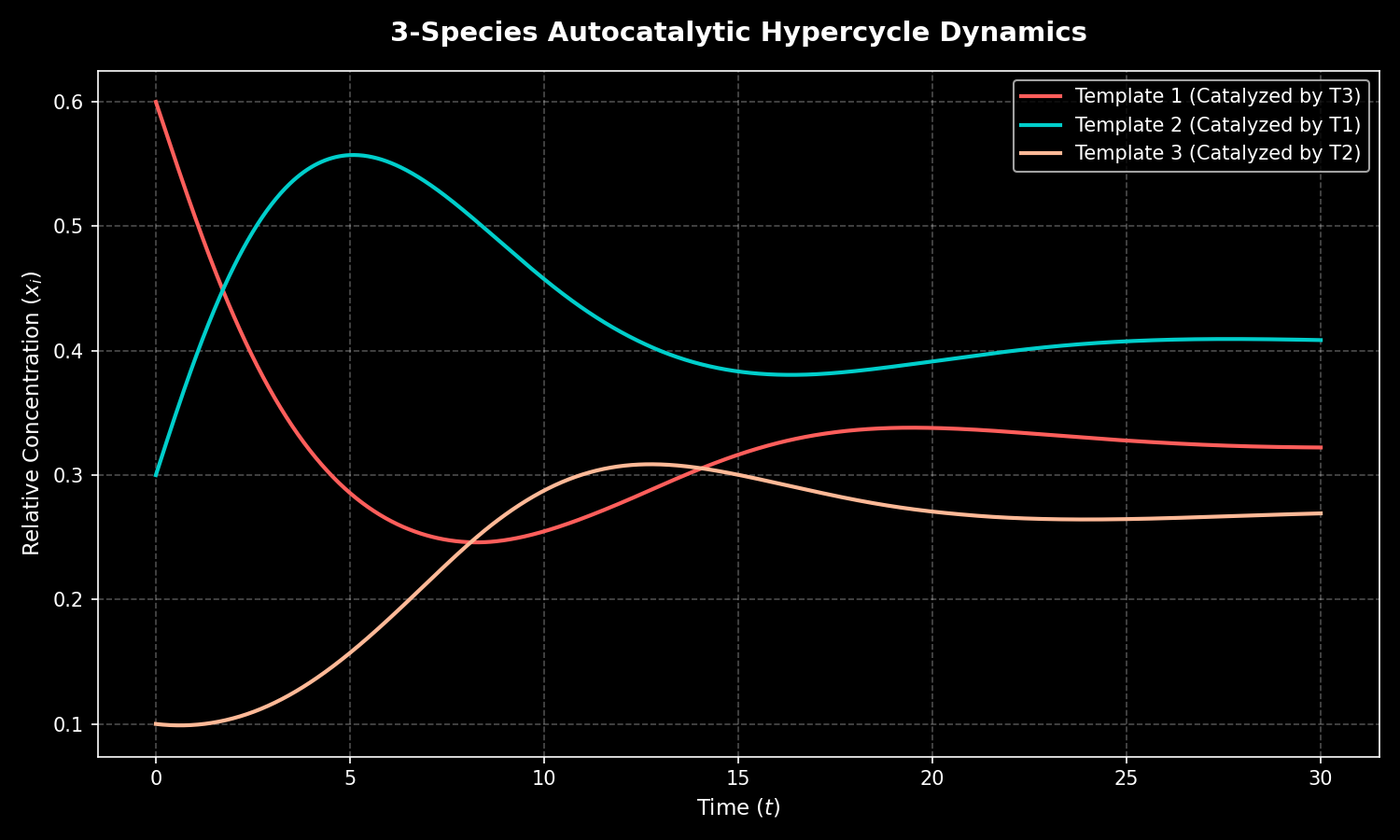
The leading framework is the RNA world: before DNA and proteins, RNA both stored information and catalyzed reactions, making self-replication possible. Where this chemistry assembled remains debated. Alkaline hydrothermal vents offer mineral catalysts and natural proton gradients resembling the energy machinery cells still use; warm little ponds and the classic Miller–Urey "primordial soup" remain live alternatives. What matters for the wider arc is the outcome: a system subject to heredity, variation, and selection. From that moment, Darwinian evolution — the engine Charles Darwin (sv-charles-darwin) would only describe four billion years later — took over from blind chemistry.
The Ripple Forward
LUCA was not the end but the trunk of the tree. Early metabolisms eventually invented oxygen-producing photosynthesis, triggering the Great Oxygenation Event (sv-great-oxygenation) that poisoned the old anaerobic world and rewrote the atmosphere. That oxygen budget later powered the energy-hungry first complex cells (sv-first-complex-cells), whose appearance opened the road to multicellularity and, eventually, the Cambrian Explosion (sv-cambrian-explosion). Every branch — the move onto land, the rise of mammals, the human lineage — hangs from the origin event. So does this very timeline's far horizon: Kurzweil's claim that "biology becomes information technology" (sv-kurzweil-genome) is, in a sense, the recognition that life was always information — RNA was the first code, and the digital intelligences at this timeline's end are merely its latest substrate.
Why It Belongs at the Center
The origin of life converts a universe of objects into a universe of agents. It is the precondition for meaning itself: without it there is no one to write the Epic of Gilgamesh (sv-gilgamesh), prove a theorem with Euclid (sv-euclid), or contemplate the cosmos that made them. In the grand sequence from inert hydrogen to artificial mind, this is the first link where the universe began, however dimly, to act on its own behalf.
Global Context
The origin of life is not a dated "event" but a planetary-chemical transition spanning the late Hadean and early Archean, roughly 4.4–3.8 billion years ago. There was no "world" in the human sense to situate it within: a single supercontinent had not yet stabilized, and the Moon, freshly formed from the Theia impact, loomed far closer, driving enormous tides. The Hadean Earth cooled enough for liquid-water oceans by perhaps 4.4 Ga (inferred from Jack Hills detrital zircons), yet endured ongoing bombardment from asteroids and comets. The atmosphere was anoxic, dominated by CO2, N2, and volcanic outgassing, with no ozone shield against ultraviolet flux. Against this backdrop, prebiotic chemistry unfolded in hydrothermal systems, tidal pools, and possibly impact-delivered organics. Moody et al. (2024) place the Last Universal Common Ancestor (LUCA)—already a complex prokaryote, not life's origin itself—near 4.2 Ga, implying abiogenesis preceded it and occurred remarkably fast. Life therefore emerged within a few hundred million years of the planet becoming habitable, while Earth itself remained geologically violent and biologically empty.
The Paradigm Shift
Abiogenesis is the foundational discontinuity of natural history: the transition from geochemistry to biology, after which matter began to replicate, mutate, and evolve under selection. It inaugurated Darwinian dynamics on Earth, transforming the planet from a passive chemical system into a self-modifying biosphere that would eventually oxygenate the atmosphere (the Great Oxidation Event, ~2.4 Ga) and reshape global geochemistry. Intellectually, recognizing life as a chemical phenomenon—rather than a special vital force—was as decisive as Darwin's common descent. The Oparin–Haldane "primordial soup" hypothesis (1924, 1929) and the Miller–Urey experiment (1953) reframed life's origin as a tractable laboratory problem, founding the field now called prebiotic chemistry and, later, astrobiology. The discovery that LUCA likely arose by ~4.2 Ga reframes life as a near-inevitable consequence of Earth-like conditions, sharpening the central question of whether biology is cosmically common or a fluke. Every subsequent milestone—eukaryogenesis, multicellularity, cognition, technology—is a downstream elaboration of this single unrepeated chemical bootstrapping.
Counterfactual: What If It Had Gone Differently
Counterfactual reasoning here is constrained by a sample size of one: we know of exactly one origin of life. Had abiogenesis not occurred, Earth would resemble a sterile, CO2-rich world—plausibly Venus- or Mars-like—since photosynthetic oxygenation, carbon burial, and biological weathering would never have modulated its climate; no observer would exist to note the absence. More tractable is whether life could have originated differently. If, as Wächtershäuser and Russell argue, metabolism preceded genetics, a "shadow biosphere" with alternative chemistry might have arisen, yet all surviving life traces to one LUCA, suggesting either a single successful origin or competitive exclusion of rivals. The 2024 dating of LUCA to ~4.2 Ga, and arguments (e.g., the 2025 statistical analysis of rapid abiogenesis on Earth-analogs) that life emerged swiftly, imply origination may be probabilistically easy given liquid water and disequilibrium energy. If true, the counterfactual "lifeless Earth" is improbable; if abiogenesis is instead a vanishingly rare fluke, our existence reflects extreme observational selection—a genuinely unresolved question with profound implications for the Fermi paradox.
Scholarly Debate
The deepest dispute is "replication-first" versus "metabolism-first." The RNA-world hypothesis (championed by Walter Gilbert, who coined the term in 1986, building on Carl Woese, Leslie Orgel, and Francis Crick) holds that self-replicating RNA, serving as both catalyst and information carrier, preceded DNA and proteins; the ribozyme core of the ribosome is its strongest evidence. Critics note RNA's instability and the difficulty of prebiotic nucleotide synthesis—partly answered by John Sutherland's 2009 cyanosulfidic syntheses. The rival camp, led by Günter Wächtershäuser (iron-sulfur world) and Michael Russell with Nick Lane and William Martin (alkaline hydrothermal vents), argues self-sustaining metabolic cycles powered by natural proton gradients came first, with genetics emerging later. A further axis concerns location: warm surface ponds favored by Sutherland and David Deamer (whose lipid-vesicle work supports wet–dry cycling) versus deep-sea vents. Lane has called the metabolism-vs-information dichotomy "silly," urging integration. Geneticists like Anthony Poole and the Moody et al. (2024) team contribute by reconstructing LUCA, but LUCA postdates the origin, leaving the earliest steps genuinely contested.
How It Connects
What Made It Possible
- Earth formed roughly 4.5 billion years ago and cooled enough after the Hadean to host stable liquid-water oceans, providing the solvent and stable surface environment that abiogenesis required.
- Prebiotic chemistry generated the molecular building blocks of life, as demonstrated by the 1953 Miller-Urey experiment, in which Stanley Miller and Harold Urey produced amino acids by passing electrical discharges through a simulated early-Earth atmosphere of water vapor, methane, ammonia, and hydrogen.
- Submarine alkaline hydrothermal vents, driven by serpentinization reactions between seawater and ocean crust, supplied continuous hydrogen, reactive minerals, and natural pH and temperature gradients that could power and concentrate organic synthesis.
- Self-replicating RNA molecules plausibly emerged as proposed by the RNA World hypothesis (advanced by Walter Gilbert, Carl Woese, and Alexander Rich), because RNA can both store genetic information and act as a catalyst, bridging the gap between bare chemistry and inheritance.
- Lipid molecules capable of spontaneously assembling into membranes allowed the formation of protocells, enclosing and concentrating reacting molecules so that a distinct chemistry could be sustained apart from the surrounding environment.
- The delivery and accumulation of carbon, nitrogen, phosphorus, and other essential elements through geochemical and possibly cometary sources stocked the early environment with the raw ingredients needed to build nucleic acids, proteins, and membranes.
Its Legacy
- A common biochemical ancestry was established that traces to LUCA, the Last Universal Common Ancestor, inferred from genomic studies to have lived around 4 billion years ago as an anaerobic, autotrophic prokaryote from which all bacteria, archaea, and eukaryotes descend.
- Microbial life had become widespread by roughly 3.5 to 3.7 billion years ago, as recorded by stromatolites and putative microfossils in ancient rocks such as Greenland's Isua belt and Australia's Pilbara region.
- Oxygenic photosynthesis evolved in cyanobacteria, triggering the Great Oxidation Event around 2.4 billion years ago, which permanently transformed Earth's atmosphere and oceans and enabled aerobic metabolism.
- Endosymbiosis produced complex eukaryotic cells, as an archaeal host engulfed a bacterium that became the mitochondrion (and later, in plant lineages, cyanobacteria became chloroplasts), a theory championed by Lynn Margulis.
- Complex multicellular organisms arose and ultimately diversified rapidly during the Cambrian explosion around 540 million years ago, giving rise to the major animal body plans.
- Life became subject to Darwinian natural selection across billions of years, an open-ended evolutionary process that eventually produced intelligent, technological humans capable of investigating their own origins.
Myth vs. Reality
Myth: The origin of life is part of the theory of evolution, so if abiogenesis is unproven, evolution falls with it.
Reality: Biological evolution and abiogenesis are distinct subjects. Evolution by natural selection describes how life diversifies once self-replicating organisms already exist; it starts with life and is among the best-evidenced theories in science. Abiogenesis asks the separate, far more speculative question of how the first life arose from non-living chemistry. Most biologists treat the origin of life as a frontier of chemistry and geology rather than a component of Darwinian theory, though some researchers argue the two may form one continuous physico-chemical process.
Myth: The Miller-Urey experiment showed how life was created from non-living matter.
Reality: Stanley Miller and Harold Urey's 1953 spark-discharge experiment produced several amino acids and other building-block molecules from simple gases and water, demonstrating that organic precursors can form abiotically. It did not produce proteins, a genetic code, metabolism, or anything resembling a living cell. Its assumed strongly reducing atmosphere (methane and ammonia) also differs from current models of early Earth, though later experiments under revised conditions still yield organic molecules. It was a proof of concept for prebiotic chemistry, not a recipe for life.
Myth: Pasteur disproved that life can come from non-living matter, so abiogenesis is impossible.
Reality: Louis Pasteur's 19th-century experiments refuted spontaneous generation, the idea that maggots, microbes, or mice routinely arise from non-living material under present-day conditions. This says nothing about whether life originally emerged from chemistry over millions of years on the early Earth. Scientists draw a sharp line between spontaneous generation (disproven) and abiogenesis (an open research question); the principle that all cells come from cells was never meant to cover life's ultimate origin.
Myth: Science has settled on a single accepted account of how life began, the warm primordial soup.
Reality: There is no consensus mechanism. Active, competing hypotheses include the RNA world (information/replication first), metabolism-first models at alkaline deep-sea hydrothermal vents such as Lost City, and the classic primordial-soup scenario, among others. Each faces unresolved problems; for example, RNA is most stable at mildly acidic pH yet alkaline-vent models invoke high pH. The field openly describes the origin of life as one of science's genuinely unsolved problems rather than a closed case.
Myth: LUCA, the last universal common ancestor, was the first living thing and marks the origin of life.
Reality: LUCA is the most recent organism from which all life on Earth today descends, reconstructed by working backward from modern genomes. It was already a fairly sophisticated cell with a genetic code, not a simple first replicator. Life originated earlier, before LUCA's lineage outcompeted or replaced other early forms. The earliest physical and chemical traces of life in rocks date to roughly 3.7 to 3.8 billion years ago or more, indicating life appeared within a few hundred million years of Earth becoming habitable, well before the LUCA that modern biology can glimpse.
In Their Words
"It is often said that all the conditions for the first production of a living organism are now present, which could ever have been present.— But if (& oh what a big if) we could conceive in some warm little pond with all sorts of ammonia & phosphoric salts,—light, heat, electricity &c present, that a protein compound was chemically formed, ready to undergo still more complex changes, at the present day such matter wd be instantly devoured, or absorbed, which would not have been the case before living creatures were formed." — Charles Darwin, letter to Joseph Dalton Hooker, 1 February 1871 (Darwin Correspondence Project, letter DCP-LETT-7471)
Data Visualization
References & Sources
- Abiogenesis — Wikipedia
- Moody, E. R. R. et al. (2024), 'The nature of the last universal common ancestor and its impact on the early Earth system,' Nature Ecology & Evolution 8:1654–1666
- Miller, S. L. (1953), 'A Production of Amino Acids Under Possible Primitive Earth Conditions,' Science 117:528–529
- Oparin, A. I. (1938), The Origin of Life (English trans. of Proiskhozhdenie zhizni, 1924)
- Lane, N. (2015), The Vital Question: Energy, Evolution, and the Origins of Complex Life
- Sutherland, J. D. (2017), 'Studies on the origin of life — the end of the beginning,' Nature Reviews Chemistry 1:0012