The Battle of Kadesh
c. 1274 BCE
Ancient geopolitics and the first peace treaty.
Read the full sourced page: The Battle of Kadesh
Two Empires, One Ford in the River: Kadesh and the Birth of Diplomacy
Around 1274 BC, on the floodplain of the Orontes in what is now Syria, the two superpowers of the Late Bronze Age collided. Pharaoh Ramesses II of Egypt and King Muwatalli II of the Hittite Empire (Hatti) hurled an estimated 5,000 to 6,000 chariots at one another in what is often called the largest chariot battle ever fought. It was, in a sense, a battle the deep past had been building toward for millennia — and one whose true legacy was not the killing but the parchment that followed it.
The long ramp to a chariot army
A clash of this scale was unthinkable without the slow accumulation of human capacities. Every soldier present was a great ape (sv-great-apes) on a branch that had split from chimpanzees (sv-human-chimp-split) some six million years earlier, now organized into states. Those states existed because the Agricultural Revolution (sv-agriculture) generated the grain surpluses that fed standing armies, and because the spoked wheel — descended from the original Mesopotamian Invention of the Wheel (sv-wheel) — had been refined into a light, fast war chariot. The empires could even threaten one another in writing: orders, troop musters, and boasts all flowed through the scribal technology born with Cuneiform (sv-cuneiform), the same medium that preserved the Code of Hammurabi (sv-hammurabi) and the Epic of Gilgamesh (sv-gilgamesh). Kadesh was a Stone-Age primate using Bronze-Age tools to fight an information-age war.
A draw dressed as a triumph
Militarily, Kadesh was a near-disaster turned stalemate. Hittite spies lured Ramesses forward, and a chariot ambush shattered one of his four divisions and nearly overran his camp before he rallied. Neither side held the field decisively, and Kadesh remained in Hittite hands. Yet Ramesses returned home and carved an overwhelming Egyptian victory across temple walls from Abydos to Nubia, in the linked texts Egyptologists call the Poem and the Bulletin. This is one of history's first great exercises in state propaganda — a ruler weaponizing the monumental record to manufacture consent, the same impulse that would later animate the self-glorifying inscriptions of Augustus (sv-augustus) and every regime since.
The Eternal Treaty and the architecture of peace
The decisive aftermath came roughly fifteen years later. Around 1259 BC, Ramesses and Muwatalli's successor Hattusili III concluded what they called the "Eternal Treaty" — the oldest surviving international peace treaty in human history, and the only ancient Near Eastern treaty preserved in versions from both parties. The Egyptian copy survives in hieroglyphs at Karnak; the Hittite copy survives on clay tablets in Akkadian cuneiform from Hattusa. Its terms are startlingly modern: non-aggression, mutual defense, recognition of each other's sovereignty, and the extradition of fugitives. A replica hangs today at the United Nations as an emblem of diplomacy's deep roots.
That settlement carved out a durable peace between two equals — but it could not save the system that produced it. Within a century, the interconnected palace economies of the Bronze Age, of which Egypt and Hatti were the twin pillars, unraveled in the Late Bronze Age Collapse (sv-bronze-collapse). Hatti vanished; Egypt contracted. The world that had remembered Kadesh in stone gave way to a darker age out of which new voices would eventually rise — the oral epics of Homer (sv-homer), themselves echoes of a vanished heroic chariot age. Kadesh thus marks a hinge: the high-water mark of the first international order, and the prototype of the negotiated peace that, however imperfectly, civilizations have reached for ever since.
Global Context
Kadesh was fought in the high Late Bronze Age, around the fifth regnal year of Ramesses II (most commonly dated to May 1274 BCE, though chronologies ranging from c. 1300 to 1275 BCE persist). It belonged to a tightly interconnected "club of great powers" — Egypt, Hatti, Assyria under Adad-nirari I and soon Shalmaneser I, Kassite Babylonia, and a faltering Mittani — whose rivalries the Amarna correspondence had already documented a century earlier. The contested prize was Syrian hegemony, especially the Orontes corridor and Amurru. Far to the east, Shang China was approaching the reign of Wu Ding, producing the oracle-bone script; in the Aegean, the palatial Mycenaean centers of Greece flourished at their zenith. Crucially, Kadesh fell roughly two generations before the systemic Late Bronze Age collapse (c. 1200-1150 BCE) that would destroy Hatti and the Mycenaean palaces. The battle thus represents the apex of a chariot-based, palace-centered international order on the eve of its disintegration.
The Paradigm Shift
Kadesh's lasting significance lies less in its inconclusive fighting than in what it generated: the Egyptian-Hittite treaty (c. 1259 BCE), the earliest surviving peace treaty preserved in both parties' versions — Akkadian tablets from Hattusa and hieroglyphic copies at Karnak and the Ramesseum. It codified non-aggression, mutual defense, dynastic legitimacy guarantees, and extradition, inaugurating a documented logic of formal interstate diplomacy; a replica hangs at UN headquarters as a symbolic ancestor of international law. Equally consequential is its place in the history of representation: Ramesses plastered the "Poem" (so-called Poem of Pentaur) and "Bulletin" across at least five temples, the most extensively recorded single event of the ancient world. Scholars from Miriam Lichtheim to Anthony Spalinger read it as a pivotal instance of state propaganda transmuting a strategic stalemate into theological triumph. Militarily, it furnishes the earliest pitched battle whose tactics, troop divisions (Amun, Re, Ptah, Seth), and chariot maneuvers can be reconstructed in detail.
Counterfactual: What If It Had Gone Differently
Had the ambush near Kadesh succeeded as Muwatalli intended — the Re division was caught strung out and routed, and Ramesses nearly captured — Egypt could have lost its pharaoh in the field and its grip on southern Syria. Yet the deeper structural counterfactual concerns the treaty rather than the battle. Trevor Bryce argues the 1259 accord owed less to Kadesh than to the rise of Assyria: with Shalmaneser I annexing Hanigalbat and threatening Hatti's eastern flank, Hattusili III needed a secure Egyptian frontier. Absent that rapprochement, a continued Egyptian-Hittite contest might have hastened both powers' exhaustion before the Sea Peoples and systemic collapse arrived. Conversely, the treaty arguably bought Egypt the stability that let Ramesses' long reign and building program flourish. One should resist over-determination: the Late Bronze collapse (c. 1200 BCE) had multiple causes — climate, migration, systems fragility — so even a different Kadesh outcome likely would not have spared Hatti's destruction by Suppiluliuma II's era.
Scholarly Debate
The central debate concerns outcome and the reliability of the sources. Ramesses' inscriptions proclaim a great personal victory, but most modern scholars (e.g., Trevor Bryce, Anthony Spalinger) judge the engagement a tactical draw and strategic Hittite success, since Kadesh and Amurru remained in Hatti's orbit afterward. A second debate concerns genre and intent: Spalinger and Hans Goedicke analyze the "Poem" and "Bulletin" as literary-ideological constructs whose narrative of the king saved by Amun cannot be read as straightforward reportage, against more event-reconstructive readings. The reconstruction of the battle itself — the role of the Ne'arin reinforcements, the timing of the chariot ambush, and troop numbers — remains contested, since the Egyptian reliefs are our near-sole source and the Hittite record is fragmentary. Finally, chronology is unsettled: the conventional Egyptian date of 1274 BCE depends on the disputed regnal dating of the Nineteenth Dynasty, with alternatives clustering around 1300, 1285, and 1275 BCE.
How It Connects
What Made It Possible
- The collapse of the Mitanni kingdom in the 14th century BC left a power vacuum in Syria that the expanding Hittite Empire under Suppiluliuma I filled, bringing Hatti into direct territorial competition with Egypt over Levantine vassal states.
- Pharaoh Seti I, Ramesses II's father, campaigned into Syria around 1300 BC and briefly captured Kadesh and Amurru, erecting a victory stela there, but the cities reverted to Hittite control after his army withdrew, leaving an unresolved dispute his son inherited.
- The defection of the kingdom of Amurru from Hittite vassalage to Egypt during Ramesses II's early reign provoked the Hittite king Muwatalli II and gave Ramesses both a pretext and a strategic foothold for marching north toward Kadesh.
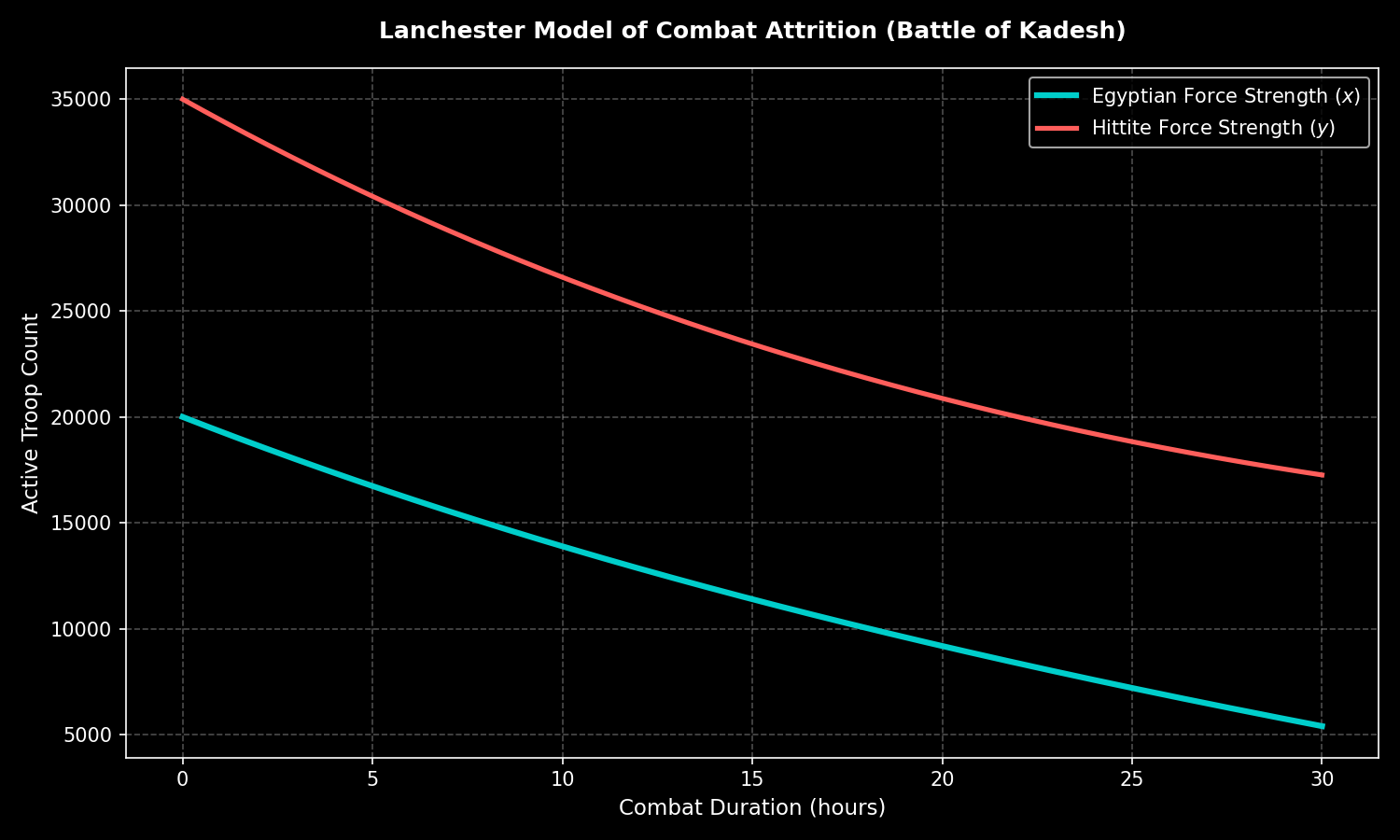
- The New Kingdom Egyptian state had developed a standing professional army organized into large divisions named for the gods Amun, Re, Ptah, and Set, giving Ramesses the institutional capacity to field roughly 20,000 men on a campaign far from Egypt.
- The widespread adoption of the light, spoke-wheeled war chariot across the Late Bronze Age Near East made massed chariotry the decisive striking arm, and both empires built their forces around thousands of these vehicles, which defined how the battle would be fought.
- Muwatalli II had fortified the city of Kadesh on the Orontes River and assembled a large coalition of Hittite vassals and allied states, turning the contested frontier town into a fortified strongpoint that Ramesses felt compelled to assault.
Its Legacy
- Because neither side won decisively, roughly fifteen years of continued conflict followed before Ramesses II and Muwatalli's successor Hattusili III signed the Egyptian-Hittite peace treaty around 1259 BC, the earliest surviving fully documented international peace treaty in human history.
- The treaty established formal terms of non-aggression, mutual defense against external enemies, and the extradition of political fugitives between the two great powers, creating a diplomatic precedent for negotiated parity between rival states.
- Surviving in parallel Egyptian hieroglyphic and Akkadian cuneiform versions, the treaty preserved a bilingual diplomatic record that lets modern historians compare how each empire framed the same agreement and study Late Bronze Age statecraft.
- Ramesses II turned the inconclusive battle into one of the most extensively recorded events of the ancient world, inscribing his version (the Poem and the Bulletin) on temple walls at Abydos, Karnak, Luxor, the Ramesseum, and Abu Simbel as monumental royal propaganda.
- The detailed Egyptian and Hittite accounts make Kadesh the earliest battle in history whose tactics, troop movements, and chronology can be reconstructed in fine detail, giving it a foundational place in the study of ancient military history.
- The treaty's enduring status as a symbol of diplomacy led the Republic of Turkey to present a copper replica of it to the United Nations in 1970, where it hangs near the Security Council as an emblem of international peacemaking.
Myth vs. Reality
Myth: Ramesses II won a great victory at Kadesh, smashing the Hittites as his temple inscriptions proclaim.
Reality: The battle (c. 1274 BC) is regarded by most modern historians as a draw or strategic stalemate, not an Egyptian triumph. Ramesses failed to take the city of Kadesh, which remained under Hittite control, and he withdrew to Egypt. The 'victory' is known almost entirely from Ramesses' own Poem (the so-called Poem of Pentaur) and Bulletin, which functioned as state propaganda displayed on temples such as Karnak, Luxor, the Ramesseum, and Abu Simbel. Some scholars even count it a Hittite success because Egypt did not achieve its objective.
Myth: Kadesh produced the world's first peace treaty, signed right after the battle by the two kings who fought it.
Reality: The surviving Egyptian-Hittite treaty was concluded around 1259 BC, roughly sixteen years after the battle, and not by the original adversaries: it was signed by Ramesses II and Hattusili III, the successor of the Hittite king Muwatalli II who actually commanded at Kadesh. The text does not even mention Kadesh. It is the oldest surviving written international treaty and the only ancient Near Eastern treaty for which both sides' versions exist, but the popular 'first peace treaty signed at Kadesh' shorthand compresses and distorts the real chronology. (Some scholars also note earlier inter-city agreements like the Umma-Lagash boundary settlement, though that is usually classed as a delimitation rather than a true peace treaty.)
Myth: The Egyptian account is a reliable, eyewitness record of what happened.
Reality: Egyptologists treat Ramesses' Poem and Bulletin as propaganda rather than balanced history. The texts exaggerate the pharaoh's personal heroism, claiming he faced thousands of enemy chariots almost single-handedly with divine aid, while omitting Egypt's heavy losses and Ramesses' own blunders, such as letting his four divisions become strung out, failing to verify captured intelligence, and camping near the enemy without adequate scouting. The discovery of Hittite cuneiform archives at Hattusa gave a contrasting account in which neither side claims a clear victory, confirming the inconclusive outcome.
Myth: Only Egypt claimed to have won; the Hittites quietly admitted defeat.
Reality: Both empires engaged in their own propaganda. Hittite records present Kadesh as a Hittite success, framing it as the containment of Egyptian aggression and the failure of Ramesses to seize the city. The two surviving versions of the later peace treaty also differ in emphasis, with the Egyptian copy at Karnak and the Ramesseum highlighting Egypt's role in securing peace. Claiming victory regardless of the actual result was standard royal practice for both powers.
Myth: We have firm, exact figures: 5,000 chariots and precisely sized armies clashed at Kadesh.
Reality: While Kadesh is often called the largest chariot battle in history, the specific numbers come largely from Ramesses' own inscriptions and are heavily debated. Egyptian sources give figures such as roughly 2,000 Egyptian and 2,500-3,500 Hittite chariots, and historians generally agree these counts are exaggerated and unreliable. The frequently repeated round totals (about 5,000-6,000 chariots) are estimates, not documented facts, and troop strengths on both sides remain uncertain.
In Their Words
"What ails thee, my father Amun? Hath a father indeed forgotten his son? Have I done anything without thee?... I call to thee, my father Amun, I am in the midst of a host of strangers; all countries are gathered against me, and I am alone by myself." — The "Poem of Pentaur," the official Egyptian account of the Battle of Kadesh inscribed under Ramesses II (Karnak, Luxor, Abu Simbel, the Ramesseum, etc.); translation by James Henry Breasted, Ancient Records of Egypt, vol. III (1906).
Data Visualization
References & Sources
- Battle of Kadesh — Wikipedia
- Trevor Bryce, The Kingdom of the Hittites, rev. ed. (Oxford University Press, 2005)
- Anthony J. Spalinger, War in Ancient Egypt: The New Kingdom (Blackwell, 2005)
- Miriam Lichtheim, Ancient Egyptian Literature, Vol. II: The New Kingdom (University of California Press, 1976)
- James Henry Breasted, Ancient Records of Egypt, Vol. III (University of Chicago Press, 1906)
- Mario Liverani, International Relations in the Ancient Near East, 1600-1100 BC (Palgrave, 2001)