The First True Trees
c. 385 Million Years Ago
The massive plants that accidentally triggered an ice age and mass extinction.
Read the full sourced page: The First True Trees
The Tower That Rewrote the Air
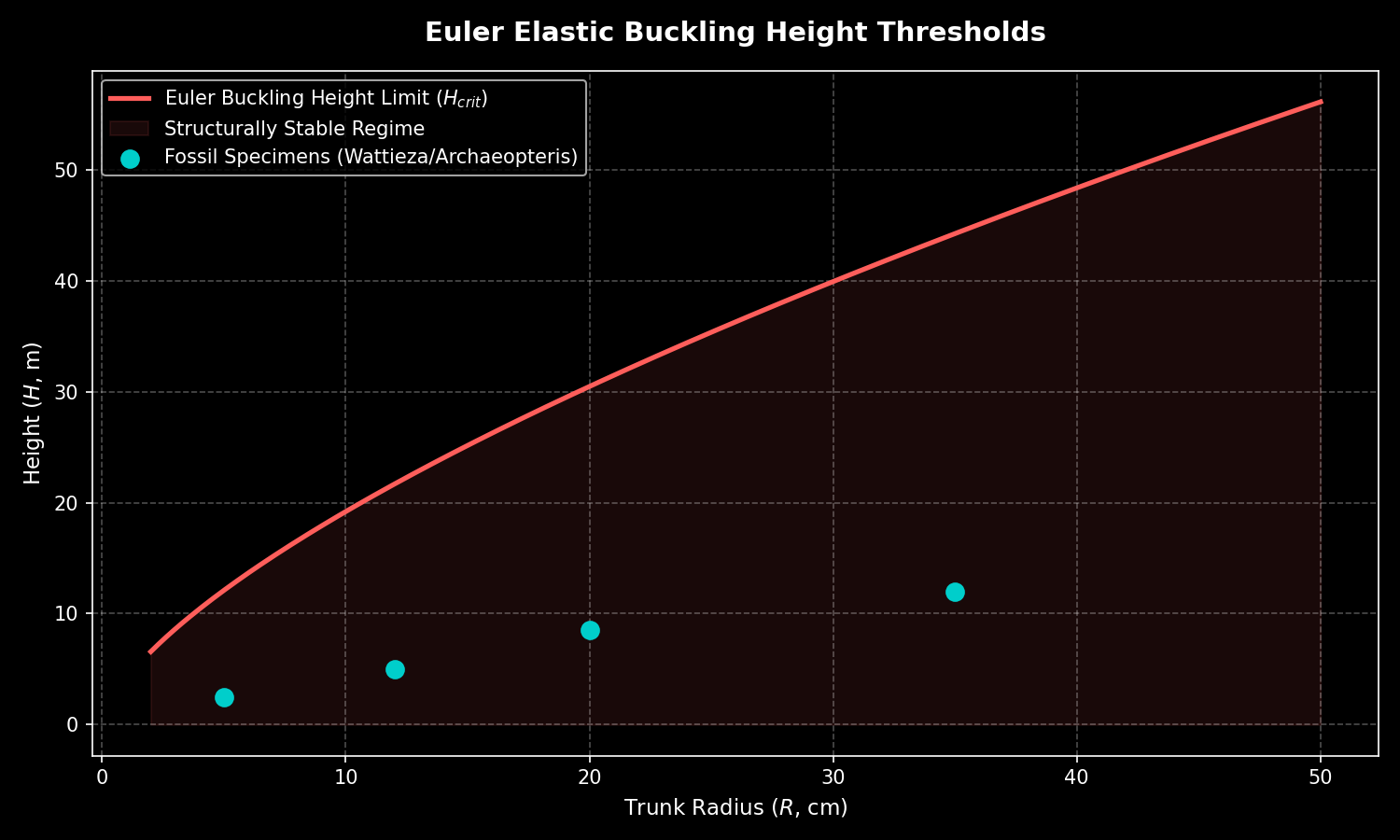
Roughly 385 million years ago, in the swampy lowlands of the Middle and Late Devonian, life solved an engineering problem that the planet had never faced: how to stand up. The first true trees — the fern-leaved, conifer-like The First True Trees (sv-first-trees) pioneer Archaeopteris, alongside the palm-trunked Eospermatopteris of the famous Gilboa stumps in New York and the earlier Wattieza — were not just bigger plants. They were a new geological force wearing bark. To understand why a tree is one of history's hinge events, you have to look both backward at the deep machinery that made it possible and forward at the world it manufactured.
The preconditions: oxygen, complexity, and the move to land
A tree is the end of a very long supply chain. It needs an oxygen-rich atmosphere, a legacy of The Great Oxygenation Event (sv-great-oxygenation) and the photosynthetic bacteria that preceded it. It needs the cellular toolkit of The First Complex Cells (Eukaryotes) (sv-first-complex-cells) and the genetic reshuffling unlocked by The Invention of Sexual Reproduction (sv-invention-of-sex), which let plant lineages adapt fast enough to colonize a hostile dry world. Above all, it needs a beachhead on land — the threshold crossed when lobe-finned vertebrates like Tiktaalik & The Move to Land (sv-tiktaalik) were hauling themselves onto shores already greened by low, creeping early plants. Trees were the vertical escalation of that invasion. The decisive innovations were lignin, the rigid polymer that let stems resist gravity and grow tall toward the sun, and deep roots, which let a plant anchor itself and mine water and minerals from rock.
The ripple effects: a planet remade by roots and wood
The consequences were staggeringly out of proportion to a single organism. Those deep roots cracked bedrock and accelerated chemical weathering, pulling carbon dioxide out of the atmosphere on a scale that helped tip Earth into an icehouse climate. The forests' fallen wood, built of a molecule that early microbes could barely digest, piled up and eventually became the vast coal seams of the following Carboniferous period — the buried Devonian sunlight that, hundreds of millions of years later, would power The Industrial Revolution (sv-industrial-revolution). Trees also built soil itself, creating the three-dimensional habitat that an exploding cast of land animals would exploit: the spread of forests is bound up with The First Insects (sv-earliest-insects), whose later relatives would grow giant in the oxygen-thick Carboniferous air the forests helped produce.
This was the deepening of a revolution that began with The Cambrian Explosion (sv-cambrian-explosion) in the seas and the soft-bodied experiments of The Ediacaran Biota (sv-ediacaran-biota) before it. Where those events filled the oceans, the trees terraformed the continents — turning bare, eroding mudflats into shaded, layered, living architecture.
The long thread forward
Every later chapter of terrestrial life is staged inside the world the first trees built. The forest floor and canopy gave evolutionary room to the lineages that produced The First True Mammals (sv-first-mammals), and the arboreal life of branches selected for the grasping hands and stereoscopic vision of The First Primates (sv-first-primates) and later The Rise of the Great Apes (sv-great-apes) — our own deep ancestry is, quite literally, a story written in trees. When humans finally arrived, wood became civilization's first universal material: fuel, tools, ships, the spokes of The Invention of the Wheel (sv-wheel), the timbered halls and pyres of every culture that followed.
The first tree is a quiet entry on a timeline that runs from The Big Bang (sv-big-bang) to artificial minds, easy to overlook beside supernovas and empires. But it marks the moment life stopped merely living on the planet and began rebuilding it — drawing down the sky, laying up the coal, and raising the green scaffolding on which nearly everything human would one day be made.
Global Context
The first trees arose in the Middle Devonian (Eifelian-Givetian, c. 393-383 Ma), an interval when continents were assembling toward Pangaea and Euramerica straddled the equator. The seas were dominated by stromatoporoid-tabulate coral reefs, brachiopods, trilobites, ammonoids, and armoured placoderm fish such as Dunkleosteus; the Devonian is justly called the "Age of Fishes." On land, vertebrates had not yet emerged—tetrapod transition forms like Tiktaalik (c. 375 Ma) and Acanthostega lay slightly ahead—so terrestrial ecosystems belonged to plants, arthropods, and early invertebrates. The earliest forests are documented at Gilboa and Cairo in New York and, more recently, in the Hangman Sandstone of Devon and Somerset (c. 390 Ma; Davies et al. 2024). Atmospheric CO2 remained high but was beginning a long Paleozoic decline; this same window preceded the Kellwasser (Frasnian-Famennian) and Hangenberg (end-Devonian) mass extinctions, among the "Big Five" Phanerozoic biotic crises that reshaped marine life.
The Paradigm Shift
Trees transformed Earth from a thinly vegetated planet into a forested one, restructuring the carbon, water, and sediment cycles. Wattieza (Middle Devonian, c. 385 Ma) achieved arborescent height through cladoxylopsid construction, but Archaeopteris—a progymnosperm with a bifacial vascular cambium yielding true secondary wood and the first laminate leaves—built the first canopy forests and deep root systems by the late Givetian-Frasnian. Deep, fracturing roots accelerated silicate weathering and pedogenesis, and the "Devonian plant hypothesis" (Algeo & Scheckler 1998) links this to a steep drawdown of atmospheric CO2 and global cooling across the later Paleozoic. Forests created the first stable soils, woody detritus, and complex terrestrial microhabitats, founding the modern terrestrial biosphere. They also enabled the evolution of seeds and, by sequestering carbon, helped raise atmospheric oxygen toward the Carboniferous coal-forest world. In effect, the rise of trees coupled the land surface to ocean and atmosphere chemistry for the first time at a planetary scale.
Counterfactual: What If It Had Gone Differently
Without deep-rooted arborescent plants, the Devonian's enhanced continental weathering—and its consequent nutrient delivery to epicontinental seas—would have been muted. Algeo and Scheckler (1998) and subsequent geochemical work (e.g., Smart et al. 2023) argue that expanding forests drove riverine eutrophication, algal blooms, and bottom-water anoxia implicated in the Kellwasser and Hangenberg crises; absent trees, the Late Devonian marine extinctions might have been less severe or differently timed. The long-term CO2 decline and cooling that the "Devonian plant hypothesis" attributes to silicate weathering would likely have been slower, plausibly delaying the lush Carboniferous coal forests and the great Paleozoic oxygen rise that supported giant arthropods. Critically, secondary wood (lignified xylem from a bifacial cambium) was the evolutionary key; had cladoxylopsids alone persisted without Archaeopteris-grade wood and roots, vertical canopies and deep rooting would have remained limited, and the feedbacks on climate and soils correspondingly weaker. Much remains uncertain, since extinction causation is multifactorial and contested.
Scholarly Debate
Several genuine debates persist. First, "what counts as the oldest forest" keeps shifting: Stein et al. (2007, 2012) elevated Gilboa; Stein et al. (2019, Current Biology) reported older, deep-rooted Archaeopteris at Cairo (c. 386 Ma); and Davies, McMahon & Berry (2024, Journal of the Geological Society) pushed the record to c. 390 Ma cladoxylopsid (Calamophyton) stands in the Hangman Sandstone of southwest England—each claim resting on differing criteria for "forest." Second, the causal role of trees in the Late Devonian mass extinctions is disputed: Algeo and Scheckler's land-plant/weathering-anoxia hypothesis is influential but challenged by those emphasizing volcanism, sea-level change, or oceanographic controls, and the magnitude of plant-driven CO2 drawdown is debated against models like GEOCARB. Third, the very definition of a "true tree" is contested—whether arborescence requires a bifacial cambium and true secondary wood (favouring Archaeopteris) or merely self-supporting woody stature (admitting cladoxylopsids like Wattieza and Calamophyton). These remain active, unsettled questions.
How It Connects
What Made It Possible
- The colonization of land by the first vascular plants in the Silurian, exemplified by the tiny dichotomously branching Cooksonia around 425-430 million years ago, established the rooted terrestrial lineage from which trees would later arise.
- The evolution of lignin and lignified tracheids gave plant cell walls the rigidity to resist collapse, conduct water under tension, and support erect bodies, supplying the structural chemistry that woody trunks would depend on.
- The origin of the vascular system of xylem and phloem (the hallmark of tracheophytes) created the internal plumbing needed to move water and sugars through a tall organism, a prerequisite for growing far above the ground.
- The innovation of a bifacial vascular cambium, which produces secondary xylem (wood) inward and secondary phloem outward, allowed plants to thicken their stems and grow outward as well as upward, the defining feature of true trees.
- The earlier Middle Devonian arborescent plant Eospermatopteris (the Cladoxylopsida preserved at the ~385-million-year-old Gilboa fossil forest in New York) created the first tree-like stands and prefigured the forest habit that Archaeopteris would perfect.
- The evolution of a deep, branching, modern-style root system in Archaeopteris, comparable to that of living seed plants, let the trees anchor large bodies, mine the substrate for water and nutrients, and build deep soils.
Its Legacy
- Archaeopteris spread across every continent during the Late Devonian (about 385-359 million years ago), colonizing floodplains and coastal lowlands to create Earth's first widespread forests with a shaded, multi-storied understory.
- The deep roots of these trees accelerated the chemical weathering of silicate rocks and helped lock carbon into soils and sediments, driving a major drawdown of atmospheric CO2 that contributed to long-term global cooling.
- Nutrients such as phosphorus released by forest-driven weathering washed into shallow seas, where many researchers argue the resulting eutrophication and ocean anoxia (recorded in black shales at the Kellwasser and Hangenberg events) helped trigger the Late Devonian mass extinctions.
- Forests built the first thick, widespread topsoils and stabilized riverbanks, which transformed landscapes and is thought to have shifted rivers toward more meandering, single-channel forms across the Devonian world.
- The tree habit set the stage for the Carboniferous coal swamps, where lycopsids like Lepidodendron and Sigillaria were buried faster than they could decay, sequestering vast carbon stores that became the world's great coal deposits.
- That runaway carbon burial pushed atmospheric oxygen toward roughly 35 percent in the Carboniferous, relaxing respiratory limits on arthropods and enabling giants such as the dragonfly-like Meganeura and the millipede Arthropleura.
Myth vs. Reality
Myth: Archaeopteris was the first tree, and it shows up in the fossil record as a fully modern-looking forest tree.
Reality: Archaeopteris (Late Devonian, ~385-359 Ma) was long treated as the first 'modern' tree because Charles Beck's 1960 work linked its fern-like fronds to woody trunks previously called Callixylon, revealing a tree with conifer-like wood. But it was not the first tree. The 2007 description by Stein, Mannolini, Hernick, Landing and Berry of Wattieza (a cladoxylopsid from Schoharie County, New York, ~385 Ma) reconstructed an even earlier tree, and Middle Devonian trees from Gilboa and the Hangman Sandstone of SW England are older still. Archaeopteris is better described as among the first trees with extensive modern-style root systems, not the first tree overall.
Myth: Archaeopteris was a kind of early bird, like Archaeopteryx.
Reality: The two names are routinely confused but refer to completely unrelated organisms. Archaeopteryx is the famous Late Jurassic feathered dinosaur/early bird; Archaeopteris is a Devonian plant, an extinct progymnosperm tree. Both names derive from Greek roots referencing 'ancient' and 'fern/wing' (pteris/pteryx), which is why they look similar, but Archaeopteris is a tree, not an animal.
Myth: These first trees reproduced with seeds, like modern trees.
Reality: The earliest trees did not have seeds. Archaeopteris belonged to the progymnosperms, a group anatomically closer to seed plants (it had wood built from tracheids and rays much like conifers) but which still reproduced by dispersing spores, like ferns. Some species such as Archaeopteris halliana were heterosporous, producing two spore sizes, a condition seen as a precursor to true seeds. Seed plants evolved later; the first trees were spore-bearers with wood, an evolutionary transitional form.
Myth: The first trees grew the way modern trees do, adding solid wood in concentric rings around a stable trunk.
Reality: The earliest cladoxylopsid trees such as Calamophyton grew in a fundamentally different way. As shown by Xu and colleagues in their 2017 PNAS study of silicified trunks from Xinjiang, China, these trees had hollow trunks built from many separate vertical strands of woody xylem connected by softer tissue, rather than a single solid woody cylinder. As the tree grew, the strands expanded and the connecting tissue tore, so the base of the trunk repeatedly split and self-repaired, effectively collapsing inward in a controlled way. This is unlike the uniform ring growth of modern trees.
Myth: There was a single, sudden 'first forest' that appeared in one place at one moment.
Reality: The rise of forests was a gradual, geographically spread-out process, and the trees were ecologically varied rather than uniform. The Cairo, New York site (~385 Ma) is currently among the oldest known forest floors and is roughly two to three million years older than the nearby Gilboa forest (~382 Ma), and comparably ancient fossil forests are now also documented in SW England. At Cairo, researchers identified multiple distinct tree types and root systems occupying different microhabitats, indicating that early Devonian forests, like modern ones, were heterogeneous communities rather than a single founding stand.
In Their Words
"The earliest known evidence for forests consists of fossil tree stumps, about 385 million years old, from Gilboa in upstate New York, known since the 1870s and assigned to the genus Eospermatopteris." — William E. Stein, Frank Mannolini, Linda VanAller Hernick, Ed Landing & Christopher M. Berry, "Giant cladoxylopsid trees resolve the enigma of the Earth's earliest forest stumps at Gilboa," Nature 446 (2007): 904-907 (opening of the abstract; paraphrased wording of the published abstract).
Data Visualization
References & Sources
- Gilboa Fossil Forest — Wikipedia
- Stein, W.E., Mannolini, F., Hernick, L.V., Landing, E. & Berry, C.M. (2007). Giant cladoxylopsid trees resolve the enigma of the Earth's earliest forest stumps at Gilboa. Nature 446: 904-907.
- Stein, W.E., Berry, C.M., Morris, J.L., Hernick, L.V., Mannolini, F., et al. (2019). Mid-Devonian Archaeopteris Roots Signal Revolutionary Change in Earliest Fossil Forests. Current Biology 30(3): 421-431.
- Davies, N.S., McMahon, W.J. & Berry, C.M. (2024). Earth's earliest forest: fossilized trees and vegetation-induced sedimentary structures from the Middle Devonian Hangman Sandstone Formation, Devon and Somerset, SW England. Journal of the Geological Society.
- Algeo, T.J. & Scheckler, S.E. (1998). Terrestrial-marine teleconnections in the Devonian: links between the evolution of land plants, weathering processes, and marine anoxic events. Philosophical Transactions of the Royal Society B 353: 113-130.
- Morris, J.L., Leake, J.R., Stein, W.E., Berry, C.M., et al. (2015). Investigating Devonian trees as geo-engineers of past climates. Palaeontology 58(5): 787-801.