The Epic of Gilgamesh
c. 2100–1200 BCE
Humanity's first great literary masterpiece.
Read the full sourced page: The Epic of Gilgamesh
The First Voice That Refused to Die
Around 2100 BC, scribes in the Sumerian city of Ur began pressing reed styluses into clay to record stories about a king named Gilgamesh of Uruk. Over the next seven centuries those scattered Sumerian poems were welded into a single Akkadian epic — the Old Babylonian version, Shūtur eli sharrī ("Surpassing All Other Kings"), dating to the 18th century BC — and later edited into the canonical twelve-tablet Standard Version attributed to the scholar-priest Sîn-lēqi-unninni around 1100 BC. This is, by common reckoning, the oldest great work of epic literature on Earth, predating Homer (sv-homer) by roughly a millennium and a half. It is the first time a human being's fear of death speaks to us across the gulf of time in something recognizably like a voice.
The preconditions of an epic
Gilgamesh could not have existed without a deep stack of prior inventions. Its raw medium descends from The Invention of Cuneiform (sv-cuneiform), which began as Uruk's accounting shorthand and was slowly bent toward poetry. Cuneiform in turn presupposes the surplus, cities, and labor specialization unleashed by The Agricultural Revolution (sv-agriculture), and the kingship the epic celebrates is the political crystallization of those crowded river-valley societies. Even the spiritual imagination Gilgamesh draws on — gods, sacred fear, the longing for transcendence — reaches back through monuments like the Great Pyramids of Giza (sv-pyramids) to the first communal sanctuaries at Göbekli Tepe (sv-gobekli-tepe). The poem is the literary harvest of everything the Neolithic had made possible.
What the epic reshaped
Its ripple effects run through the entire Western canon. The most consequential thread is Tablet XI, where the flood survivor Utnapishtim recounts how the gods drowned the world and how he built a boat to outlast them — a narrative interpolated from the older Atrahasis tradition. When the self-taught Assyriologist George Smith read this tablet at the British Museum in 1872 — recovered from the seventh-century library of Ashurbanipal at Nineveh — he recognized a flood story older than Genesis, and the discovery detonated Victorian assumptions about the Bible's originality. Gilgamesh thus became a founding document of comparative mythology, demonstrating that sacred stories migrate and mutate across cultures rather than descending uncorrupted from heaven.
Just as important is the epic's subject matter. Gilgamesh is the first hero to grieve — his friend Enkidu dies, and the king, terrified, sets out to defeat death itself, only to lose the plant of immortality to a serpent and return home having learned that the city walls he built are the only immortality humans get. That tragic structure — heroic striving humbled into wisdom — prefigures Achilles in the Iliad and echoes forward into the cosmogonic moralizing of Hesiod (sv-hesiod). The same Mesopotamian civilization that produced the poem soon codified its values into law in The Code of Hammurabi (sv-hammurabi), pairing literature and jurisprudence as the twin instruments by which Babylon ordered human life.
The longest thread of all
Read against the full arc of this timeline, Gilgamesh marks a phase transition as real as any biological one. Life had been recording information in DNA since The Origin of Life (sv-origin-of-life), but with cuneiform poetry, information for the first time escaped the body and the single lifespan, persisting in clay for four thousand years. The deepest irony is that Gilgamesh failed his quest and succeeded anyway: he sought eternal life and found it not in flesh but in text. That is precisely the wager underlying the modern dream of substrate-independent mind, the throughline running toward The Singularity Is Near (sv-singularity-near). The first story ever told was a story about defeating death through what we would now call information technology — and we have been telling versions of it ever since.
Global Context
The Gilgamesh tradition spans nearly a millennium, so its "moment" is plural. Its Sumerian seed-poems about Bilgames of Uruk circulated under the Third Dynasty of Ur (c. 2100 BCE), as Mesopotamian scribal culture flowered alongside the cylinder seal and ziggurat. The integrated Akkadian "Old Babylonian" version (incipit Shutur eli sharri, "Surpassing all other kings") emerged c. 1800 BCE, contemporary with Hammurabi's law code, Minoan palace culture on Crete, and the rise of the Indus and early Shang-precursor cultures in China. The Standard Babylonian recension associated with the scribe Sin-leqi-unninni (c. 1300-1000 BCE) coincides with the Late Bronze Age internationalism of Egypt's New Kingdom, the Hittite empire, and Mycenaean Greece. The best-preserved tablets come from Ashurbanipal's seventh-century library at Nineveh, a Neo-Assyrian imperial moment roughly contemporary with the composition of much Hebrew scripture and the dawn of Greek epic in Homer.
The Paradigm Shift
Gilgamesh is conventionally called the world's oldest surviving epic, and its rediscovery reshaped modern understanding of human culture twice over. In antiquity it crystallized the epic form itself: a sustained narrative of a heroic individual confronting mortality, friendship (Enkidu), and the limits of kingship, themes that echo through later Near Eastern and Greek literature. Its most consequential modern impact came on 3 December 1872, when George Smith announced to the Society of Biblical Archaeology that a cuneiform tablet from Nineveh contained a flood narrative strikingly parallel to Genesis. This demonstrated that the Hebrew Bible drew on, or shared, older Mesopotamian traditions, decisively redirecting biblical studies toward comparative and historical-critical methods. It helped birth modern Assyriology and the documentary study of scripture, undermining naive readings of Genesis as a uniquely original revelation and establishing the Ancient Near East as the indispensable context for understanding the Bible and the deep history of literature.
Counterfactual: What If It Had Gone Differently
Had Smith's flood tablet never been deciphered, the comparative revolution in biblical scholarship would still have come, but later and less dramatically. The Nineveh tablets were already in the British Museum; recovery of the Mesopotamian flood tradition was likely within a generation as Assyriology matured under figures like Rawlinson and Hincks. More radical is the counterfactual of the epic's ancient transmission. Andrew George stresses how fragile survival was: the Standard Babylonian text reaches us through scattered, damaged tablets, and significant portions remain lost. Without the scribal canonization plausibly tied to Sin-leqi-unninni and the preservation afforded by Ashurbanipal's library, the integrated twelve-tablet poem might have vanished entirely, leaving only disconnected Sumerian Bilgames episodes. We would then possess no continuous Bronze Age meditation on mortality and would likely overstate Homer's originality. The deeper point, argued by George and others, is that "the" epic is a moving target: any single recension's loss would have reshaped, not erased, the tradition.
Scholarly Debate
A central debate concerns authorship and textual unity. Mesopotamian colophons credit the Standard Babylonian version to Sin-leqi-unninni, but scholars dispute whether he was a genuine editor of c. 1300-1000 BCE, a much earlier figure, or a quasi-legendary ancestor claimed by a scribal lineage; Andrew George treats him cautiously as a probable redactor rather than an "author" in the modern sense. A second debate concerns the relationship to Genesis: whether the biblical flood derives from Mesopotamian sources (the older "Babel-Bibel" position controversially pressed by Friedrich Delitzsch around 1902), reflects shared regional tradition, or, as Tigay's classic study of the epic's evolution suggests, illustrates broader patterns of literary growth and borrowing. Third, interpreters contest the poem's meaning: is it primarily about the fear of death and acceptance of human limits, about civilization versus wildness (Enkidu), or about kingship and the social order? George and Jeffrey Tigay emphasize the mortality theme, while others read it as political and civilizational ideology.
How It Connects
What Made It Possible
- The Sumerians invented cuneiform writing in southern Mesopotamia around 3000 BCE, creating the durable clay-tablet medium on which a long literary epic could first be recorded and transmitted.
- A historical king named Gilgamesh is thought to have ruled the city-state of Uruk during the Early Dynastic period (generally placed between roughly 2800 and 2500 BCE) and was later listed among the kings of Uruk in the Sumerian King List, giving the legend a real royal figure to grow around.
- Five independent Sumerian poems about Gilgamesh, including 'Gilgamesh and Huwawa,' 'Gilgamesh and the Bull of Heaven,' and 'The Death of Gilgamesh,' circulated as separate stories and supplied the raw narrative material later woven into the combined epic.
- The court of the Third Dynasty of Ur in the 21st century BCE, under literary patron Shulgi, sponsored a revival of older literature and established scholarly academies at Ur and Nippur, fostering the environment in which the Sumerian Gilgamesh poems were composed and preserved.
- Old Babylonian scribal schools copied and studied Sumerian Gilgamesh material as part of their training, keeping the separate tales alive and circulating until they could be integrated into a single work.
- The earlier Mesopotamian flood tradition, including the Atrahasis epic, supplied the cataclysmic-deluge story that was incorporated into the epic as the tale of Utnapishtim's survival.
Its Legacy
- Around the 18th century BCE the separate Sumerian tales were fused into a single Akkadian poem known by its incipit 'Shutur eli sharri' ('Surpassing All Other Kings'), the first known integrated version of the epic and a model for long-form narrative literature.
- Sometime in the late second millennium BCE (often placed around 1300-1000 BCE) the scribe and exorcist Sin-leqi-unninni gave the work its fixed Standard Babylonian form beginning 'He who saw the deep,' an unusually attributed text that became the canonical version copied across Mesopotamia.
- Copies of the epic were preserved in the great library of the Assyrian king Ashurbanipal at Nineveh (who reigned 668-627 BCE), the cache from which the surviving Standard Babylonian tablets were later recovered.
- The flood narrative of Utnapishtim is widely held by scholars to lie behind the biblical Noah story in Genesis, with striking shared motifs such as the ark grounding on a mountain, the sending out of birds, and a post-flood sacrifice whose smell pleases the deity.
- In 1872 George Smith identified the flood tablet among the Nineveh fragments and presented it to the Society of Biblical Archaeology, a sensational rediscovery that revealed an extra-biblical deluge account older than Genesis and helped launch modern Assyriology.
- Since Peter Jensen's 1902 thesis, scholars have argued that the epic influenced later Greek literature, drawing parallels such as Gilgamesh's meeting with Siduri to Odysseus's stay with Calypso, framing Gilgamesh as a foundational ancestor of the Western epic tradition and the archetypal heroic quest for immortality.
Myth vs. Reality
Myth: The Epic of Gilgamesh is the oldest written story ever.
Reality: It is among the oldest surviving long literary works, but the blanket claim oversimplifies. The Standard Babylonian epic was standardized only around 1200 BCE, and even the earlier Sumerian Gilgamesh poems (composed during the Third Dynasty of Ur, c. 2100 BCE) sit alongside other early Sumerian narrative poems such as 'Inanna's Descent into the Underworld' and 'Enmerkar and the Lord of Aratta,' whose dates are likewise uncertain. Scholars treat Gilgamesh as one of the earliest known epics rather than provably 'the first story.'
Myth: Gilgamesh was a purely fictional or mythological invention.
Reality: Most historians regard Gilgamesh as a genuine historical king of Uruk who likely ruled during the Early Dynastic Period, with Stephanie Dalley noting the dates are generally placed between roughly 2800 and 2500 BCE. He appears in the Sumerian King List, and inscriptions credit him with building Uruk's walls; contemporary records confirm associated rulers like Enmebaragesi and Aga of Kish. The epic mythologizes him as a demigod, but a historical core is widely accepted.
Myth: The biblical flood story was copied directly from the Epic of Gilgamesh.
Reality: Scholars see a shared Mesopotamian tradition rather than direct borrowing from Gilgamesh. The flood account in Gilgamesh Tablet XI itself draws on the older Atrahasis epic, versions of which survive from the seventeenth century BCE, predating the standardized Gilgamesh. The common view is that Genesis and Gilgamesh both inherited a much older Mesopotamian flood tradition (Atrahasis being a key source), not that one was lifted straight from the other.
Myth: A single author named Sin-leqi-unninni wrote the Epic of Gilgamesh.
Reality: Sin-leqi-unninni, who likely flourished around 1100 BCE, was an editor who gave the Standard Babylonian version its fixed form, not its sole creator. The multiple second-millennium versions show many hands shaped the written epic before him, and it built on still-earlier Sumerian poems and oral tradition. Babylonians later credited him as 'author,' much as the Greeks attributed their epics to a single Homer, but his role was redactional.
Myth: The epic survives as a complete, intact text.
Reality: The work is reconstructed from fragmentary clay tablets, many incomplete. George Smith rediscovered it in 1872 from broken pieces in the British Museum, recognizing the flood account on a fragment of Tablet XI, then excavated at Nineveh seeking more. Modern translations are pieced together from multiple damaged copies across centuries, and gaps remain; new tablet fragments have continued to fill in missing lines, so any reading is a scholarly reconstruction rather than a single whole manuscript.
Another Lens — The flood story as Mesopotamian inheritance, not Israelite invention
Assyriologist Guy Darshan and others argue the Genesis flood narrative is not an independent revelation but a reworking of a much older Mesopotamian tradition: the Gilgamesh Tablet XI flood, itself drawn from the earlier Atrahasis and Sumerian flood myths, predates the biblical text by roughly a millennium. The shared motifs (a warned hero, a sealed boat, the grounding on a mountain, the sequential release of birds, and a sacrifice the gods 'smell') indicate a common Near Eastern stock rather than coincidence. This reframes Noah's flood as the Hebrew branch of a regional literary family, raising questions about cultural transmission during and after the Babylonian exile rather than about literal history.
Voices & Primary Sources
When the seventh day dawned the storm from the south subsided, the sea grew calm, the flood was stilled; I looked at the face of the world and there was silence, all mankind was turned to clay.— Utnapishtim describing the aftermath of the flood, Epic of Gilgamesh, Tablet XI (Standard Babylonian version). Translation by N. K. Sandars, The Epic of Gilgamesh (Penguin Classics, 1960). These are the words of the epic's flood-hero, not an authorial narrator.
The seventh day when it came, I brought out a dove, I let it loose: off went the dove but then it returned, there was no place to land, so back it came to me. I brought out a swallow, I let it loose: off went the swallow but then it returned, there was no place to land, so back it came to me. I brought out a raven, I let it loose: off went the raven, it saw the waters receding, finding food, bowing and bobbing, it did not come back to me.— Utnapishtim sending out birds from the ark, Epic of Gilgamesh, Tablet XI. Translation by Andrew R. George, The Epic of Gilgamesh (Penguin Classics, 1999/2000). The bird-release sequence closely parallels Genesis 8:6-12.
The life that you seek you never will find: when the gods created mankind, death they dispensed to mankind, life they kept for themselves.— Spoken by Shiduri (Siduri), the tavern-keeper, advising Gilgamesh on his quest for immortality; Old Babylonian Sippar tablet. Translation by Andrew R. George, The Epic of Gilgamesh (Penguin Classics). This is the wisdom-figure's counsel, not Gilgamesh's own words.
In Their Words
"He who saw the Deep, the country's foundation, who knew the proper ways, was wise in all matters! ... He saw what was secret, discovered what was hidden, he brought back a message from the antediluvian age." — Opening lines of the Standard Babylonian Epic of Gilgamesh, Tablet I (Akkadian sha naqba imuru), in Andrew George's translation, The Epic of Gilgamesh (Penguin Classics, 1999/2003)
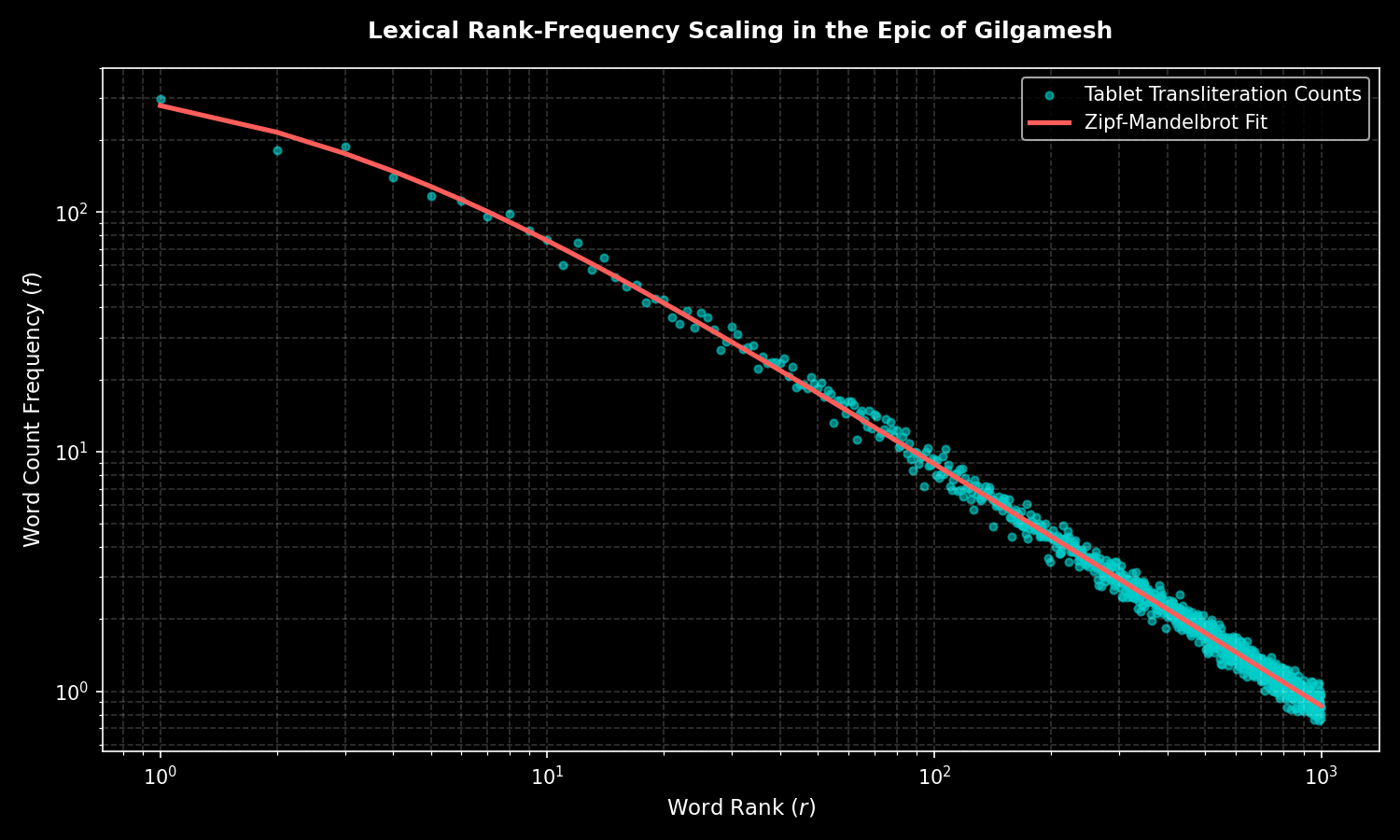
Data Visualization
References & Sources
- Epic of Gilgamesh — Wikipedia
- Andrew R. George, The Babylonian Gilgamesh Epic: Introduction, Critical Edition and Cuneiform Texts (Oxford University Press, 2003)
- Andrew George, The Epic of Gilgamesh: A New Translation (Penguin Classics, 1999; rev. 2003)
- Jeffrey H. Tigay, The Evolution of the Gilgamesh Epic (University of Pennsylvania Press, 1982)
- David Damrosch, The Buried Book: The Loss and Rediscovery of the Great Epic of Gilgamesh (Henry Holt, 2007)
- George Smith, 'The Chaldean Account of the Deluge,' Transactions of the Society of Biblical Archaeology (1873)