The Human-Chimpanzee Split
c. 7 Million Years Ago
The moment our lineage diverged from our closest living relative.
Read the full sourced page: The Human-Chimpanzee Split
The Branch That Looked Back
Roughly six to seven million years ago, somewhere in the woodlands of Africa, a population of apes ceased exchanging genes with the lineage that would become chimpanzees and bonobos. No fanfare marked the moment — speciation rarely announces itself. Yet this quiet divergence, the Human-Chimpanzee Split, is the hinge on which the entire human story turns. It is the last branching before the line that would eventually invent cuneiform (sv-cuneiform), split the atom at Hiroshima (sv-hiroshima-nagasaki), and build the machines that now write essays about their own origins.
The Long Inheritance
This split inherited nearly four billion years of accumulated machinery. Every cell in that ancestral ape ran on the chemistry first assembled at the origin of life (sv-origin-of-life), breathed oxygen made abundant by the Great Oxygenation Event (sv-great-oxygenation), and was built from the complex, nucleated cells whose arrival defined the eukaryotic threshold (sv-first-complex-cells). The ape's very body plan — bilateral, limbed, vertebrate — descended from the explosion of animal forms in the Cambrian (sv-cambrian-explosion) and the vertebrate crawl onto land embodied by Tiktaalik (sv-tiktaalik). Its warm blood and nurturing biology came from the first true mammals (sv-first-mammals), who waited in the shadows until the K-Pg extinction (sv-dinosaur-extinction) cleared the dinosaurs and opened the forest canopy to the first primates (sv-first-primates) and, in time, the rise of the great apes (sv-great-apes).
A Difference Measured in Fractions
What makes the split so arresting is how small the genetic gap is. Humans and chimpanzees share roughly 98.5 percent of their DNA — a closer kinship than many pairs of bird species. The molecular clock places the divergence between about 5.5 and 7 million years ago, though some genetic estimates, recalibrated using slower observed mutation rates in wild apes, push it toward 7–8 million or even older. Reconciling this clock with fossils has been a decades-long puzzle. Candidates for the earliest members of our line — Sahelanthropus tchadensis ("Toumaï," from Chad, dated to roughly 6–7 million years ago), Orrorin, and the later Ardipithecus ramidus — sit tantalizingly near the boundary, though no fossil of the true last common ancestor has ever been found. Tellingly, the ancestor was not chimp-like: Ardipithecus suggests a creature with a varied repertoire of climbing and walking, neither knuckle-walker nor modern human.
A signature of the split is written in our chromosomes. Chimpanzees, gorillas, and orangutans all carry 24 pairs; humans carry 23. The difference is human chromosome 2, an end-to-end fusion of two ancestral ape chromosomes — a fossil event preserved in our own genome.
The Rift and the Road Ahead
Why did the lineages part? The classic "East Side Story" credits the East African Rift, whose tectonic fragmentation of forest into mosaic habitats may have isolated populations and nudged one toward open-country bipedalism. Walking upright freed the hands, and over millions of years those hands and the brains directing them set the human line on a runaway course. Every later milestone presupposes this branch: the megafauna world of the Last Ice Age (sv-last-ice-age) that our ancestors hunted, the ritual monuments of Göbekli Tepe (sv-gobekli-tepe), and the Agricultural Revolution (sv-agriculture) that birthed cities. Darwin (sv-charles-darwin) intuited this deep kinship in 1871, long before genetics could confirm it; the molecular data simply revealed how thin the dividing line truly is. The Human-Chimpanzee Split is not where humanity arrived — it is where the road forked, and only one branch looked back to ask how it began.
Global Context
The split is dated to the late Miocene, roughly 7-8 million years ago, an epoch of profound global change. Antarctic ice volume was expanding, benthic foraminiferal oxygen-isotope ratios rising toward the Messinian; deep-ocean cooling tracked a worldwide trend toward aridity. Across Africa and Asia, atmospheric and monsoonal shifts drove the great late-Miocene expansion of C4 grasslands, with C4 dominance spreading between roughly 7 and 5 Ma, fragmenting closed Miocene forests into mosaic woodland-savanna. The Mediterranean would soon undergo the Messinian Salinity Crisis (c. 5.96-5.33 Ma), nearly desiccating that basin. This was the twilight of Africa's diverse Miocene apes (Dryopithecus, Ouranopithecus, Sahelanthropus's relatives); most ape lineages were contracting as monkeys radiated. No "moment" or place is pinpointable: the divergence was a gradual population-genetic process spread over a vast, climatically restless landscape stretching from Chad (Sahelanthropus tchadensis, c. 7 Ma) to Kenya's Tugen Hills (Orrorin, c. 6 Ma).
The Paradigm Shift
This divergence inaugurated the hominin lineage, the branch that would eventually produce Homo sapiens, language, agriculture, and technological civilization. But its intellectual paradigm shift came in the 20th century. Vincent Sarich and Allan Wilson's 1967 immunological work (Science, "Immunological Time Scale for Hominid Evolution") used serum-albumin distances to date the human-African ape split at roughly 5 million years, shattering the prevailing paleontological consensus that placed it deep in the Miocene, 15-30 Ma, anchored by misidentified Ramapithecus. By calibrating a molecular clock, they made biochemistry an arbiter of phylogeny, subordinating fossils to genes and launching molecular anthropology. Subsequent genomic work (the 2005 chimpanzee genome; the 2012 gorilla genome) confirmed humans and chimpanzees share roughly 98.8% of aligned DNA and diverged 6-8 Ma. The recognition that our closest relatives are chimpanzees and bonobos, and that "human" is one twig on the African ape bush, reframed humanity's self-understanding more decisively than perhaps any finding since Darwin's Descent of Man (1871).
Counterfactual: What If It Had Gone Differently
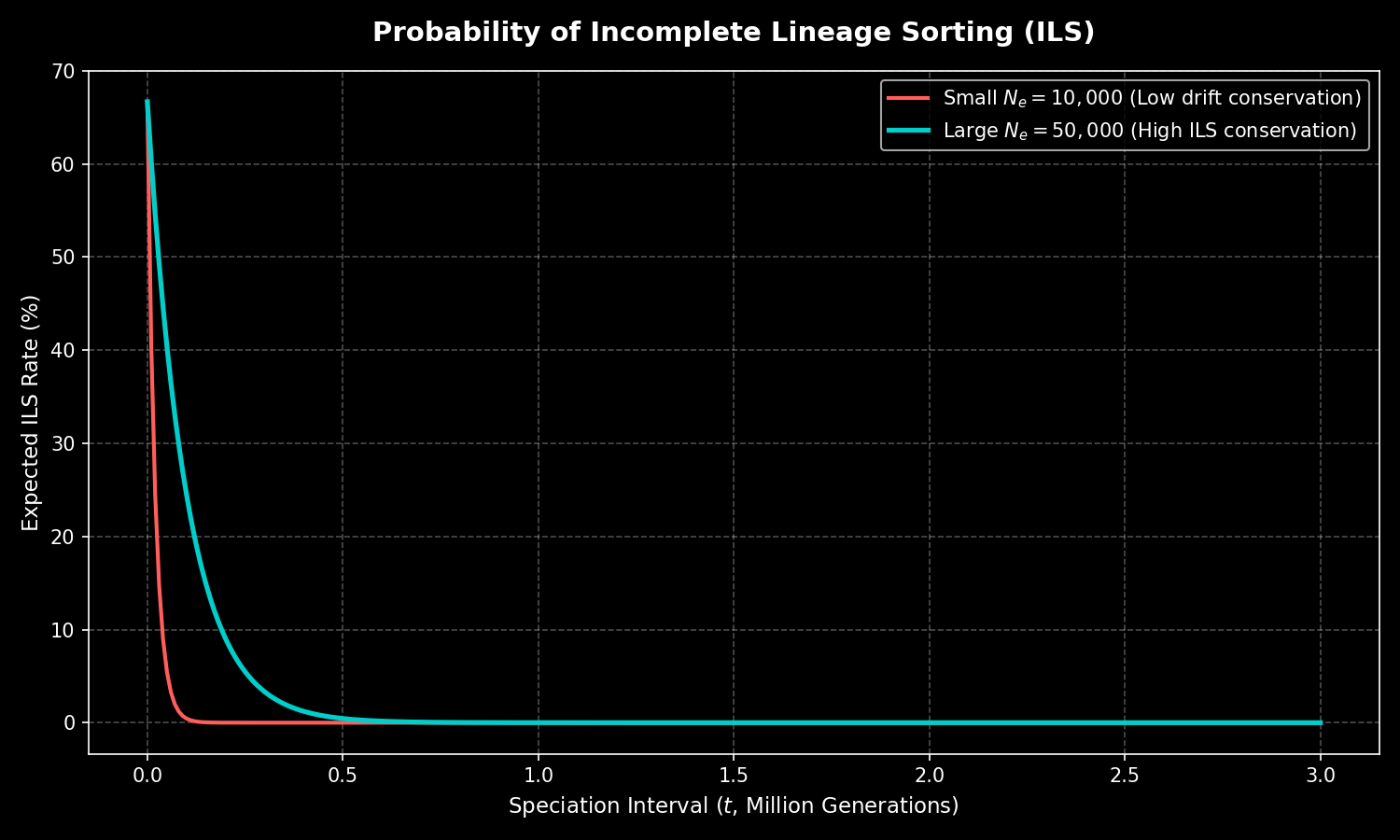
Counterfactuals here are biological, not contingent on human choice. Had the ancestral late-Miocene ape population never become reproductively isolated, no separate hominin lineage, and thus no humans, would exist. More tractably, consider the timing: had molecular and fossil evidence not converged on a recent (5-8 Ma) split, the "long-chronology" Ramapithecus hypothesis, championed by Elwyn Simons and David Pilbeam into the early 1970s, might have persisted, delaying recognition of African (not Asian) origins and of chimpanzees as our sister taxon. Sarich's provocative dictum that no fossil older than the molecular date could be a hominin (later overstated) forced paleontologists to re-examine specimens; without it, the reinterpretation of Ramapithecus as a relative of Sivapithecus/orangutans (Pilbeam, 1982) might have come decades later. Had the divergence been genuinely "clean" rather than protracted, the incomplete-lineage-sorting signal, whereby in roughly 30% of the genome gorilla is closer to human or chimp than they are to each other (Scally et al. 2012), would be absent, and Patterson et al.'s complex-speciation debate could never have arisen.
Scholarly Debate
Two live debates persist. First, the mode of speciation: Nick Patterson, David Reich and colleagues (Nature 2006, "Genetic evidence for complex speciation of humans and chimpanzees") argued that anomalously low X-chromosome divergence implies a protracted split with a late hybridization/introgression event, a "complex speciation." This was sharply contested by John Wakeley (2008) and by Soraya Bhatt, Daven Presgraves and others, who showed that incomplete lineage sorting plus selective sweeps on the X (Dutheil et al. 2015, PLOS Genetics) can explain the pattern under simple allopatric speciation without hybridization; Yu, Bhaskar and others found "no genetic evidence for complex speciation" in autosomal analyses. Second, the fossil status of the earliest candidates: whether Sahelanthropus tchadensis (Michel Brunet, 2002), Orrorin (Senut & Pickford, 2001), and Ardipithecus are true hominins, near the last common ancestor, or apes, hinges on contested bipedalism evidence (e.g., the 2022 femoral study versus Macchiarelli, Wood and Bergeron's skepticism). The genealogical relationship of these taxa to the Pan-Homo split remains genuinely unresolved.
How It Connects
What Made It Possible
- The Early and Middle Miocene 'golden age' of apes produced an enormous radiation of hominoids in Africa, with an estimated 80-100 species, supplying the ancestral ape stock from which the chimpanzee and human lineages would eventually emerge.
- The genetic divergence of the orangutan lineage and then the gorilla lineage from the other great apes left a single ancestral African ape population whose descendants would later split specifically into the chimpanzee and human branches.
- Establishment of the steady molecular substitution rate ('molecular clock') in primate genomes is what later let researchers date the human-chimpanzee divergence to roughly 5-8 million years ago, calibrated against the ape-Old World monkey split.
- Late Miocene climatic cooling and drying in Africa fragmented continuous forest into mosaic woodland and savanna, creating the ecological pressures that would differentiate the emerging lineages' habitats.
- A large, genetically diverse ancestral population that never passed through a severe bottleneck preserved deep genetic variation, producing the ~1% incomplete lineage sorting later seen across the genome.
- An end-to-end fusion of two ancestral ape chromosomes (corresponding to chimp 2A and 2B) into a single human chromosome 2 reduced the chromosome count from 48 to 46, a structural change traceable in the human genome's fusion-site telomeric repeats.
Its Legacy
- The split was not a clean break: genetic evidence for complex speciation, with different chromosomes diverging across as much as a 4-million-year window and possible late hybridization around 6.3-5.4 million years ago, made 'messy' speciation appear to be the rule rather than the exception among large primates.
- Candidate early hominins appeared near or after the divergence, including Sahelanthropus tchadensis (~7-6 million years ago), Orrorin tugenensis (~6.0-5.7 million years ago), and Ardipithecus, all argued to be hominins on the basis of reduced canines and increasing bipedal capacity.
- By about 3.2 million years ago Australopithecus afarensis (Lucy) and the Laetoli footprints confirmed that habitual upright bipedalism evolved in the human lineage long before any major brain expansion.
- Australopithecus afarensis is proposed as the ancestral stock that gave rise to both the Homo lineage and the robust Paranthropus group before about 2.5 million years ago.
- Within the genus Homo, progressive encephalization began with Homo habilis and accelerated through Homo erectus, whose cranial capacity rose from roughly 600-800 cm3 to well over 1000 cm3 alongside Acheulean handaxe technology and the first hominin dispersal out of Africa.
- The two lineages' genomes remained about 98.8% identical, yet pinpointed differences such as the two human-specific amino-acid changes in the FOXP2 protein became central evidence for the genetic basis of human traits like speech and language.
Myth vs. Reality
Myth: Humans evolved from chimpanzees — chimps are our ancestors.
Reality: Modern chimpanzees are not our ancestors but our cousins. Both lineages descend from a now-extinct common ancestor that lived roughly 6-8 million years ago, and chimpanzees have been evolving along their own branch ever since. As the Smithsonian's Human Origins Program puts it, humans and chimps are 'two divergent lineages' from a shared ancestor, neither one descended from the other. Modern chimps are therefore just as 'evolved' as we are, not a frozen snapshot of our past.
Myth: The last common ancestor looked basically like a modern chimpanzee.
Reality: Researchers long pictured a chimp-like creature, but the chimpanzee body plan has itself changed substantially since the split, so chimps are not a reliable model of the ancestor. The 4.4-million-year-old Ardipithecus ramidus, described by Tim White and colleagues in Science (2009), had an intermediate anatomy that walked neither like a human nor like a knuckle-walking chimp — suggesting the common ancestor was its own distinct animal rather than a living chimp with a few tweaks.
Myth: Humans and chimps share about 98-99% of their DNA, so we are 'almost identical.'
Reality: The ~98.8% figure refers mainly to single-nucleotide substitutions in alignable regions. The 2005 Nature chimpanzee genome paper found a 1.23% single-nucleotide divergence, but also that insertions and deletions (indels) make roughly 3% more of each genome lineage-specific — about 35 million single-base changes plus around 5 million indel events. Counting structural differences, the genomes differ by several percent, and the raw percentage says little about the functional gulf driven by gene regulation.
Myth: The split was a single clean moment when one species instantly became two.
Reality: Genomic data show speciation was messy and drawn out. Because human, chimp, and gorilla lineages branched close together in time, about 15% of the genome makes humans look closer to gorillas and another 15% makes chimps closer to gorillas — a phenomenon called incomplete lineage sorting, mapped in detail in a 2023 Science study. Patterson et al. (2006, Nature) even argued the human and chimp lineages may have split, then interbred again before fully separating; while that specific hybridization model remains debated, it underscores that 'the split' was a prolonged, complicated process, not an instant.
Myth: There is a single 'missing link' fossil marking the human-chimp divergence.
Reality: Paleoanthropologists reject the 'missing link' framing; human ancestry is a branching bush of many species, not a ladder with one pivotal fossil. Early forms like Sahelanthropus tchadensis ('Toumaï,' ~7 million years old) sit near the divergence, but whether it is a true hominin or an ape is genuinely contested, partly because its age brushes up against molecular estimates for the split. Evolution is documented by a series of transitional fossils collectively, with no one specimen serving as the link.
In Their Words
"The calibration of that [evolutionary] clock, that is, the elucidation of the relationship between [immunological] index of dissimilarity and time, would allow us to calculate the time of divergence between apes and man." — Vincent M. Sarich and Allan C. Wilson, "Immunological Time Scale for Hominid Evolution," Science 158 (1967): 1200-1203, at p. 1202.
Data Visualization
References & Sources
- Chimpanzee–human last common ancestor — Wikipedia
- Vincent M. Sarich and Allan C. Wilson, 'Immunological Time Scale for Hominid Evolution,' Science 158 (1967): 1200-1203
- Nick Patterson, Daniel J. Richter, Sante Gnerre, Eric S. Lander, David Reich, 'Genetic evidence for complex speciation of humans and chimpanzees,' Nature 441 (2006): 1103-1108
- Aylwyn Scally et al., 'Insights into hominid evolution from the gorilla genome sequence,' Nature 483 (2012): 169-175
- Michel Brunet et al., 'A new hominid from the Upper Miocene of Chad, Central Africa,' Nature 418 (2002): 145-151
- Julien Y. Dutheil et al., 'Strong Selective Sweeps on the X Chromosome in the Human-Chimpanzee Ancestor Explain Its Low Divergence,' PLOS Genetics 11(8) (2015): e1005451