The Great Pyramids of Giza
c. 2600 BCE
The ultimate monument to centralized human organization and belief in eternity.
Read the full sourced page: The Great Pyramids of Giza
The Mountain Built by Bookkeeping
The Great Pyramid of Giza is usually remembered as a feat of stone — 2.3 million limestone blocks raised around 2560 BC for the Fourth Dynasty pharaoh Khufu, the tallest structure on Earth for nearly four millennia. But the more revealing story is not how the blocks were stacked; it is what kind of society could decide to stack them at all. The pyramid is less a monument to one king than the first time a human collective successfully aimed millions of coordinated hours at a single, useless, magnificent goal.
Deep preconditions
Every prerequisite for Giza was laid down long before the first block was cut. The annual Nile flood — itself an inheritance from the planet's deep chemistry and water, traceable to the Formation of the Solar System & Earth and the Origin of Life that filled the river with fertile silt — produced something no hunter-gatherer band ever had: a reliable grain surplus. That surplus was the dividend of the Agricultural Revolution, and surplus is the raw material of civilization, because it lets some people stop farming and start specializing.
But surplus alone builds nothing. What turned grain into a mountain was administration. Khufu's Egypt could only mobilize a workforce of perhaps twenty thousand because it could count, ration, and command them — and counting on that scale required writing. The same impulse that produced Cuneiform in Mesopotamia produced Egypt's hieroglyphic bureaucracy, and the connection is no longer speculative. The 2013 discovery at Wadi al-Jarf of the Diary of Merer — the oldest inscribed papyri ever found — gives us an actual mid-ranking inspector logging boatloads of Tura limestone ferried to Giza. The pyramid, in other words, was built on bookkeeping. The wheel turning on the carts and the river barges hauling stone tie it quietly to the Invention of the Wheel and to a logistics state that prefigures every empire to come.
What it reshaped
Giza proved that a centralized state could concentrate human energy at a scale that looked, to everyone who saw it, like the work of gods. That proof echoed forward. The same logic of monumental authority would later raise the Colosseum and inscribe the Code of Hammurabi — power made visible in stone and law. And the pyramid's gravitational pull on the imagination never faded: when Alexander's general founded a new Greek capital on Egyptian soil, the prestige of pharaonic antiquity helped make the Ptolemaic Kingdom and its Great Library of Alexandria a magnet for Mediterranean learning. The Egyptian priest Manetho, writing for those Greek rulers, would organize the very dynasties Khufu belonged to into the framework historians still use.
There is a deeper thread, too. The pyramid is a machine for defeating death — a tomb engineered so a king might persist into eternity. That same refusal to accept mortality runs from the religious dawn at Göbekli Tepe, through the death-haunted Epic of Gilgamesh, and forward into the modern technological version of the same dream: the projected Longevity Escape Velocity in which medicine, not masonry, is supposed to outrun the grave. Khufu and the transhumanist want the same impossible thing.
The thread to now
What makes Giza the hinge it is, on a Big Bang–to–AGI timeline, is that it is the first overwhelming demonstration of organized collective intelligence — thousands of minds and bodies, coordinated by writing and hierarchy, producing something none could imagine alone. Every later leap in coordinated human capacity, from the Industrial Revolution to the planetary information layer of the World Wide Web, is a descendant of the realization made concrete on the Giza plateau: that information, surplus, and command can be fused into a force that reshapes the physical world. The pyramid is where civilization first learned how powerful it could be.
Global Context
The Great Pyramid rose c. 2560 BCE under Khufu (reigned c. 2589–2566 BCE), at the apex of Egypt's Fourth Dynasty, in a world of multiple, largely independent early states. In southern Mesopotamia, the Sumerian Early Dynastic city-states—Ur, Uruk, Lagash—were thriving with cuneiform administration, decades before Sargon of Akkad's empire (c. 2334 BCE). The mature Harappan phase of the Indus Valley Civilization was emerging c. 2600 BCE, with planned cities at Mohenjo-daro and Harappa. In Britain, Stonehenge's great sarsen circle was raised roughly contemporaneously, c. 2500 BCE, though its earliest earthworks predate the pyramid. China remained pre-dynastic, in late Longshan cultures preceding any historically secure state. Egypt itself, recently unified and administered through a centralized bureaucracy by an absolute, divine king, possessed a uniquely concentrated capacity to mobilize labor, grain, and stone. The pyramid is thus best understood not as an isolated marvel but as the most extreme expression of a broader Bronze Age moment of urbanism, literate statecraft, and monumental construction.
The Paradigm Shift
The Great Pyramid marks a watershed in the demonstrated capacity of a centralized state to organize labor, resources, and engineering knowledge at unprecedented scale. Roughly 2.3 million blocks averaging 2.5 tons, raised to 146.6 meters with a base deviating from a true square by only centimeters and near-cardinal alignment, evidence sophisticated surveying, quarrying, logistics, and project management sustained across two decades. As Mark Lehner and others argue, the pyramid project was itself a state-building engine: it created the administrative apparatus, provisioning systems, and skilled workforce that consolidated Old Kingdom kingship. Ideologically, it fixed the pyramid as the canonical royal mortuary form, encoding solar theology and the king's apotheosis in stone. For later antiquity it became the archetype of human achievement—the sole surviving member of the classical Seven Wonders—shaping Greek, Roman, and Arab conceptions of Egypt. In the modern era it helped found Egyptology and archaeology as disciplines, and remains a benchmark against which claims about ancient technical capability are measured.
Counterfactual: What If It Had Gone Differently
Had Khufu not built at Giza's scale, Egyptian kingship would likely still have expressed itself monumentally—the precedent ran from Djoser's Step Pyramid (c. 2670 BCE) through Sneferu's three pyramids at Meidum and Dahshur, where the geometry of the true pyramid was perfected. The Great Pyramid is thus the culmination of a trajectory, not a singular accident; absent Khufu, the form would plausibly have peaked elsewhere. More consequential is the counterfactual loss of its cultural afterlife. Without so overwhelming a survival, the Seven Wonders tradition, Herodotus's Egyptian ethnography, and the European fascination that drove Napoleon's 1798 expedition—and through it Champollion's 1822 decipherment of hieroglyphs—might have taken different shape. Lehner's work suggests the converse counterfactual is sharper: had the project NOT generated its provisioning bureaucracy and labor towns, Old Kingdom centralization itself might have been weaker. The pyramid's true indispensability lies less in the monument than in the state-forming machinery its construction demanded and left behind.
Scholarly Debate
The central modern debate concerns who built the pyramid and how. Herodotus (Histories 2.124) reported 100,000 slaves toiling in three-month relays, and this image dominated popular and Hollywood imagination. Excavations from 1988 onward by Mark Lehner at Heit el-Ghurab (the "Lost City" of the workers) and by Zahi Hawass at the adjacent workers' cemetery overturned it: the builders were a state-organized workforce—a permanent core plus rotating conscripted peasants—who were fed beef and bread, received medical care, and were honorably buried, not chattel slaves. A separate, unresolved technical debate concerns the lifting method: external ramps (straight or wrapping), an internal spiral ramp (championed by architect Jean-Pierre Houdin), or lever-based systems. Pierre Tallet's 2013 discovery of the Wadi al-Jarf papyri—the logbook of the official Merer documenting Tura limestone transport—provided unprecedented administrative detail but does not settle the lifting question. Fringe "lost civilization" and extraterrestrial claims persist publicly but command no scholarly support.
How It Connects
What Made It Possible
- The Nile's annual flood deposited fertile silt that produced reliable grain surpluses, which fed and paid a non-farming workforce of scribes, builders, and overseers during the off-season when the river was navigable for hauling stone.
- Centuries of mastaba tomb-building established the rectangular, flat-roofed stone burial form that pyramids would later stack and refine into monumental scale.
- Around 2670 BCE, the vizier Imhotep designed the Step Pyramid of Djoser at Saqqara, the world's first large-scale cut-stone monument, which proved that piled mastaba layers could create a towering royal tomb.
- Under Sneferu, founder of the 4th Dynasty and father of Khufu, Egyptian engineers learned the geometry of true smooth-sided pyramids through trial and error at Meidum, the Bent Pyramid, and the successful Red Pyramid at Dahshur.
- Sneferu consolidated a highly centralized state administered from Memphis, with the taxation, granary stores, and bureaucratic control needed to mobilize and supply tens of thousands of laborers for a single project.
- Mastery of copper tools, limestone and granite quarrying, Nile-barge transport of multi-ton blocks, and precise surveying and astronomical alignment gave the Egyptians the technical means to lay out and raise the Great Pyramid with remarkable accuracy.
Its Legacy
- The Great Pyramid stood roughly 146 meters tall and remained the tallest human-made structure on Earth for nearly 4,000 years, setting a benchmark of monumental ambition unmatched until the medieval cathedrals.
- Ancient Greek writers including Herodotus in the 5th century BCE described and measured the pyramid, and it was later canonized as one of the Seven Wonders of the Ancient World, the only one still substantially intact today.
- The pyramid drew visitors for millennia, from Greco-Roman travelers to the 9th-century caliph Al-Ma'mun who tunneled into it, anchoring Giza as one of the most enduring tourist destinations on Earth, drawing millions of visitors annually.
- Napoleon's 1798 expedition brought scores of savants who surveyed the monuments and produced the multi-volume Description de l'Egypte, helping launch modern Egyptology and igniting a wave of European Egyptomania.
- Excavations led by Mark Lehner and Zahi Hawass uncovered the Heit el-Ghurab workers' town with its bakeries, breweries, barracks, and cemetery, overturning the slave-labor myth and revealing an organized, well-fed, state-supported workforce.
- The pyramid became a permanent symbol of human engineering and ancient civilization, recurring in scholarship, esoteric speculation, national identity, and popular culture as a touchstone for what a coordinated society can build.
Myth vs. Reality
Myth: Hebrew (or other) slaves built the Great Pyramid under the lash.
Reality: Archaeology contradicts this. Excavations of the workers' settlement at Giza by Mark Lehner and Zahi Hawass (begun in the 1980s-90s) revealed organized barracks, bakeries, breweries, and large quantities of cattle, sheep, and goat bones, showing laborers were well fed. Workers were buried in honored tombs beside the pyramid with their job titles inscribed, which Hawass argued slaves would never have received. The consensus in Egyptology is that the builders were paid Egyptian laborers and skilled craftsmen, including farmers rotating in during the Nile flood season. The Israelite-slave version also fails on chronology: the pyramid predates any plausible Exodus setting by roughly a thousand years.
Myth: The pyramids were so advanced that aliens or a lost super-civilization must have built them.
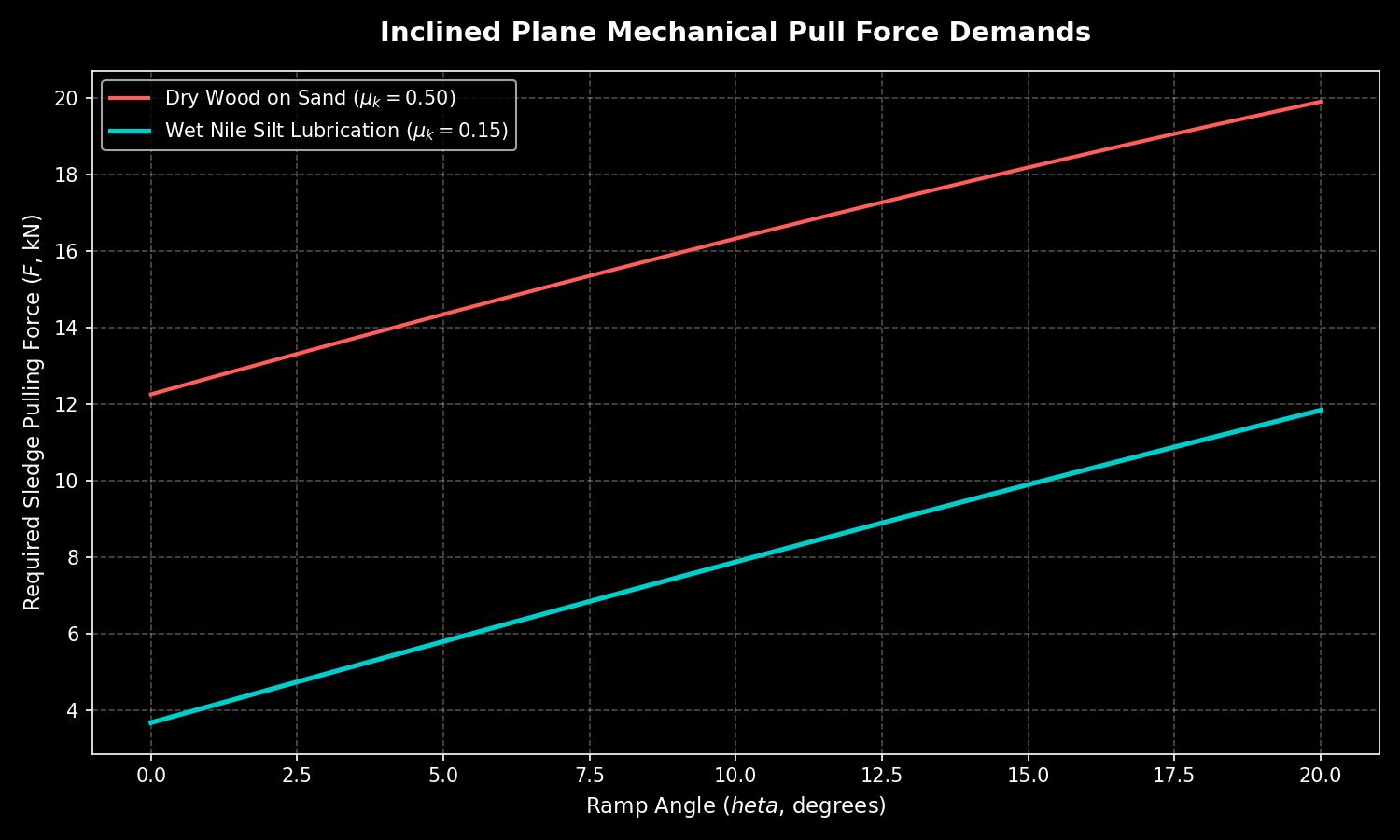
Reality: Decades of archaeology and experimental work have reconstructed plausible Bronze Age methods. Builders quarried roughly 2.3 million limestone blocks, much of it locally on the Giza Plateau, using copper chisels, dolerite pounding stones, and wooden wedges. Remains of construction ramps survive at several pyramid sites, and depictions show large statues hauled on sledges over wetted sand. A 2024 study identified a now-buried branch of the Nile that once ran beside the plateau, easing transport of stone. The work reflects extraordinary organization and labor, not technology beyond its era.
Myth: The Great Pyramid always looked like the bare, step-sided stone structure we see today.
Reality: When completed around 2560 BC it was sheathed in finely cut, polished white Tura limestone casing stones that gave it smooth, gleaming sloped faces, not visible steps. Most of this casing was stripped over the centuries, particularly after a 1303 AD earthquake loosened it, and reused as building material in Cairo. A few original casing stones survive at the base of the pyramid and in museum collections, confirming the smooth, bright original finish.
Myth: There is some hidden, exotic purpose for the Great Pyramid (granary, power plant, observatory) beyond being a tomb.
Reality: Egyptologists are confident it was built as the tomb and funerary monument of the Fourth Dynasty pharaoh Khufu (Cheops). It contains the King's Chamber with a granite sarcophagus, sits within a complex of mortuary and valley temples, causeways, and subsidiary tombs typical of royal burials, and fits a well-documented evolution of Egyptian pyramid-building. The 'granary' idea traces to a medieval misreading (the biblical Joseph's granaries) and the power-plant notions are modern pseudo-archaeology with no supporting evidence.
Myth: The Great Pyramid sits in the deep, almost unreachable past, with little of recorded history standing between it and figures like Cleopatra.
Reality: The opposite is closer to true: the pyramid was already ancient by the time of Egypt's famous later rulers. It was built around 2560 BC, while Cleopatra VII lived 69-30 BC, roughly 2,500 years later. Cleopatra is therefore chronologically closer to the 1969 Moon landing (about 2,000 years) than to the building of the Great Pyramid. The monument also held the record as the tallest human-made structure on Earth for some 3,800 years, until medieval cathedrals such as Lincoln Cathedral's spire surpassed it around 1311 AD.
Another Lens — Egyptology's verdict on Herodotus: a flawed witness, not an eyewitness
Although Herodotus is the oldest surviving narrative source for the Great Pyramid, Egyptologists treat his account as unreliable hearsay rather than testimony. He wrote around 430 BCE, some two millennia after Khufu's reign, and depended on Greek-speaking guides and priests. Specialists judge his 100,000-worker figure 'certainly excessive,' note his dimensions are inflated, and observe that he anachronistically imports Greek leveraging techniques into the construction method; his roughly twenty-year build time is one of the few estimates considered plausible.
Voices & Primary Sources
for he shut up all the temples, and having first kept them from sacrificing there, he then bade all the Egyptians work for him.— Herodotus, Histories, Book 2, §124 (on King Cheops/Khufu), G. C. Macaulay translation (1890). NOTE: Herodotus wrote c. 430 BCE, roughly 2,000 years after the pyramid was built, recording hearsay he was told by Egyptian priests/informants.
they worked by a hundred thousand men at a time, for each three months continually... For the making of the pyramid itself there passed a period of twenty years.— Herodotus, Histories, Book 2, §124, G. C. Macaulay translation (1890). The two clauses are joined here with an ellipsis from the same continuous passage. NOTE: the 100,000-men figure is regarded by modern Egyptologists as 'certainly excessive'; Herodotus relied on hearsay.
No way would they have been buried so honorably if they were slaves.— Zahi Hawass, then Egypt's chief archaeologist, speaking to reporters at the Giza workers'-tombs excavation, quoted by the Associated Press, 11 January 2010 (via CBS News). A direct quote of Hawass reported by the AP, not Hawass's own published writing.
In Their Words
"...and they worked by a hundred thousand men at a time, for each three months continually. Of this oppression there passed ten years while the causeway was made by which they drew the stones..." — Herodotus, Histories, Book II, ch. 124 (G. C. Macaulay translation), describing the building of Cheops's (Khufu's) pyramid
Data Visualization
References & Sources
- Giza pyramid complex — Wikipedia
- Mark Lehner, The Complete Pyramids (Thames & Hudson, 1997)
- Zahi Hawass, Mountains of the Pharaohs: The Untold Story of the Pyramid Builders (Doubleday, 2006)
- Pierre Tallet & Mark Lehner, The Red Sea Scrolls: How Ancient Papyri Reveal the Secrets of the Pyramids (Thames & Hudson, 2021)
- Herodotus, The Histories, Book II (trans. G. C. Macaulay; also Robin Waterfield, Oxford World's Classics)
- I. E. S. Edwards, The Pyramids of Egypt (rev. ed., Penguin, 1993)