Tiktaalik & The Move to Land
c. 375 Million Years Ago
The incredible "fishapod" that first hauled itself out of the water.
Read the full sourced page: Tiktaalik & The Move to Land
The Fish That Learned to Lean: Tiktaalik and the Conquest of the Continents
Roughly 375 million years ago, in the swampy floodplains of the Late Devonian, a flat-headed predator with the scales of a fish and the shoulders of something else propped itself up in shallow, oxygen-starved water. We know it as Tiktaalik roseae, unearthed in 2004 on Ellesmere Island by Neil Shubin, Edward Daeschler, and Farish Jenkins, and described in 2006. Tiktaalik is not literally "the" ancestor of all land vertebrates, but it is the most eloquent witness we have to the single most consequential migration in the history of complex life: the move from water to land.
The Long Runway
Tiktaalik could only exist because the planet had been preparing the ground for billions of years. The breathable air it gulped was the legacy of the Great Oxygenation Event (sv-great-oxygenation), when cyanobacteria first poisoned the atmosphere with free oxygen, and of the photosynthetic machinery inherited from the first complex cells (sv-first-complex-cells). The body plan that made limbs even thinkable was forged in the Cambrian Explosion (sv-cambrian-explosion), which gave vertebrates their backbone and bilateral symmetry. And crucially, the land was no longer barren rock. The first true trees (sv-first-trees) had built the world's earliest forests, and the earliest insects (sv-earliest-insects) had already colonized the shorelines. There was, for the first time, a terrestrial ecosystem worth crawling toward—food on the banks, and oxygen-rich shallows where heavy lobed fins outperformed delicate ray fins.
A Body in Transition
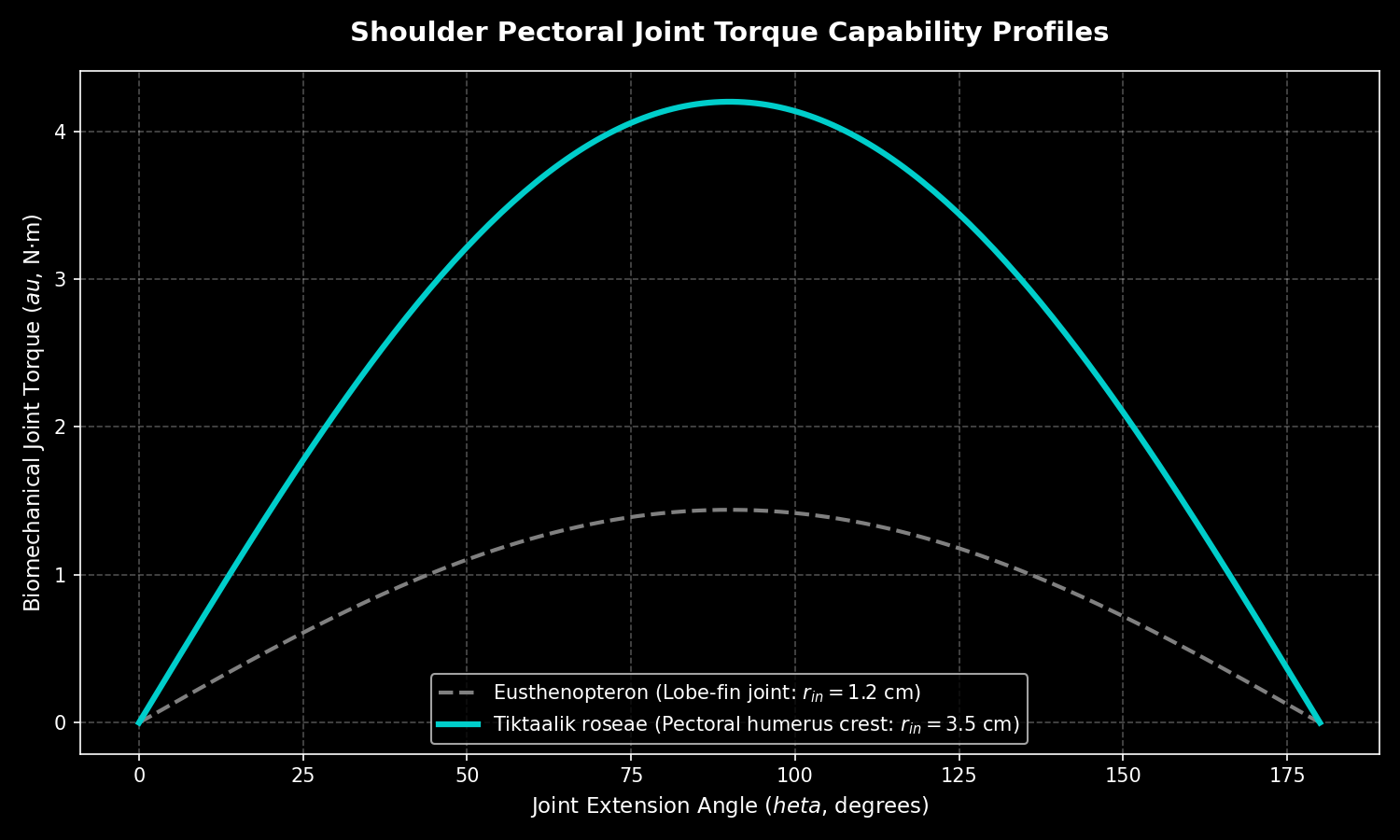
What makes Tiktaalik so persuasive is its mosaic anatomy. It kept the gills, scales, and fins of a fish, but it had grown lungs, a mobile neck unhitched from its shoulders, sturdy ribs, and—most famously—fins containing the bones of a primitive wrist. It could do a push-up. Shubin called it a "fishapod," a creature caught mid-sentence between two grammars of life. Modern research has complicated the romance: those early limbs likely evolved for propping and paddling in shallows, not striding across dry land, which came later with forms like Acanthostega and Ichthyostega. The conquest of land was a slow drift, not a heroic leap. But the architecture Tiktaalik pioneered—four weight-bearing limbs anchored to a load-bearing spine—is the chassis every vertebrate since has inherited.
The Inheritance
Everything with a recognizable face and four limbs traces its scaffolding to this moment. The tetrapod body plan ran forward through the first true mammals (sv-first-mammals), survived the cataclysm of the K-Pg extinction (sv-dinosaur-extinction), and flowered into the first primates (sv-first-primates). The wrist that let a Devonian fish do a push-up is the same joint, deeply modified, that would one day knap flint, after the human-chimpanzee split (sv-human-chimp-split), and eventually type these words. This is the buried thesis of Shubin's Your Inner Fish: our anatomy is a Devonian hand-me-down. Hiccups, hernias, and the path of our nerves are all legible as the scar tissue of a fish refitted for land.
A Thread in the Larger Weave
On a Big Bang-to-AGI timeline, Tiktaalik marks the point where intelligence acquired a body that could one day act upon a world rather than merely drift through it. Limbs are the precondition for tools, and tools are the precondition for the Agricultural Revolution (sv-agriculture) and everything that followed. There is a strange symmetry worth noting: a lineage that crawled out of the water to grasp the land may yet, through its descendants, build minds that outgrow biology entirely. The same restless impulse that drove a fish onto a muddy bank—reach a little further, breathe a little freer—runs straight through the arc of this history.
Global Context
The animal Tiktaalik roseae inhabited a subtropical river-delta system roughly 375 million years ago, during the Frasnian age of the Late Devonian, when Ellesmere Island lay near the equator on the southern margin of the Old Red Sandstone continent (Laurussia). This was the world's first forested moment: Archaeopteris, the earliest true trees, were spreading along floodplains, deepening soils, drawing down atmospheric CO2, and shedding woody debris that choked warm, shallow waters. Arthropods and early land plants had already greened the margins. Contemporary or near-contemporary vertebrates pushing toward land include the elpistostegalians Panderichthys and Elpistostege, and the slightly later limbed tetrapods Acanthostega, Ichthyostega, and Hynerpeton (the last from Pennsylvania). The Devonian's "Age of Fishes" was peaking with armored placoderms like Dunkleosteus. This ecological exuberance preceded the catastrophic end-Frasnian (Kellwasser) extinction, one pulse of the Late Devonian mass extinctions, which would soon devastate reef and marine ecosystems even as vertebrate experiments with land continued.
The Paradigm Shift
Tiktaalik crystallized the fish-to-tetrapod transition from an inferred sequence into a tangible morphological mosaic. Described in two 2006 Nature papers (Daeschler, Shubin, and Jenkins on the body; Shubin, Daeschler, and Jenkins on the pectoral fin), it combined fish traits (scales, gills, fin webbing) with tetrapod-grade features: a mobile neck freed from the shoulder girdle, robust ribs, flattened crocodile-like skull with dorsal eyes, and—decisively—a pectoral fin containing functional shoulder, elbow, and proto-wrist joints capable of supporting the body. It thereby relocated the origin of weight-bearing, jointed limbs to the water, reframing limbs as elaborations of pre-existing fin elements rather than novel terrestrial inventions. Beyond anatomy, Tiktaalik became a textbook demonstration of predictive evolutionary science: the team deliberately targeted Frasnian-age freshwater Devonian strata of the right environment, a methodological vindication of phylogeny and stratigraphy as discovery tools. It also dissolved the rhetorical force of "missing link" arguments, securing a central place in evolutionary biology pedagogy and the public understanding of macroevolution.
Counterfactual: What If It Had Gone Differently
Had the 2004 expedition failed, the conceptual picture would still have emerged, because Tiktaalik occupies a node already bracketed by Panderichthys (more fish-like) and Acanthostega/Ichthyostega (limbed). Karen Sea and Greenland tetrapods, intensively studied by Jennifer Clack and Per Ahlberg since the late 1980s–1990s, had already shown that digited limbs evolved in water, in animals retaining gills and tail fins. Tiktaalik's real counterfactual significance is evidentiary and rhetorical rather than strictly theoretical: without so complete, joint-bearing a fin from so precisely predicted a context, the "fishapod" would lack its uniquely persuasive demonstration that limb-like function arose before terrestriality, and creationist "no transitional forms" claims would have retained more rhetorical traction in public debate. Conversely, the 2010 Zachelmie trackways imply digited tetrapods existed ~18 million years earlier than Tiktaalik; if those tracks are validated, Tiktaalik is a late-surviving "relict" of its grade rather than a literal ancestor—diminishing its phylogenetic centrality while preserving its anatomical importance as an exemplar of the transitional body plan.
Scholarly Debate
The sharpest live debate concerns timing and the status of trackway evidence. Grzegorz Niedźwiedzki, Per Ahlberg, and colleagues (Nature, 2010) reported digited tetrapod trackways at Zachelmie Quarry, Poland, dated to the early Middle Devonian (~390–397 Ma)—predating Tiktaalik and all elpistostegalian body fossils by roughly 10–18 million years. If accepted, this implies "ghost lineages" of tetrapods long before Tiktaalik, recasting it as a transitional grade persisting alongside, not ancestral to, true tetrapods. Critics initially questioned the tracks' biological identity (versus fish nest-digging or feeding traces) and their supposedly shallow-marine setting; subsequent work (Qvarnström et al., 2018) reinterpreted the environment as ephemeral non-marine lakes, strengthening the tetrapod reading. A second debate concerns Tiktaalik's exact phylogenetic placement among elpistostegalians relative to Elpistostege (Cloutier et al., 2020, which described a near-complete Elpistostege with finger-like digits). Both disputes leave Tiktaalik's transitional anatomy uncontested while unsettling its precise position and whether the body-fossil record adequately samples the transition's true tempo.
How It Connects
What Made It Possible
- Lobe-finned fishes (sarcopterygians) evolved fleshy, bony-supported fins during the Devonian, supplying the developmental and skeletal raw material from which limb-like appendages with internal humerus, radius, and ulna bones could later emerge.
- A sequence of tetrapodomorph fishes such as Eusthenopteron (~385 million years ago) and the shallow-water predator Panderichthys progressively evolved flattened skulls, skull-roof bones, and bodies suited to muddy shallows, establishing the elpistostegid lineage that was Tiktaalik's immediate evolutionary context.
- The Devonian 'greening' of the continents by spreading vascular plants and the first forests created shallow, oxygen-poor, weed-choked swamps and shorelines, the marginal habitats that favored air-breathing and limb-supported movement.
- Arthropods such as myriapods, arachnids, and early insects colonized land first, beginning by at least the Silurian and expanding during the Devonian, seeding terrestrial ecosystems with prey and primitive soils before any vertebrate ventured ashore.
- Spikes in atmospheric oxygen during the Devonian, including a phase beginning around 370 million years ago, supported air-breathing physiology and made survival in oxygen-poor shallow waters and on land more viable for early vertebrates.
- Neil Shubin, Ted Daeschler, and Farish Jenkins used evolutionary theory to predict that a fin-to-limb intermediate should lie in late Devonian (~375-million-year-old) freshwater strata, and deliberately targeted exposed rocks of that age on Ellesmere Island, a successful prediction that led to the 2004 discovery.
Its Legacy
- Tiktaalik filled a major gap in the fossil record between fish and limbed vertebrates, providing direct anatomical evidence (a fin containing shoulder, elbow, and functional wrist-like joints) for how the tetrapod limb originated and reinforcing evolution's predictive power.
- Its mosaic of features, fish-like scales, fins, and gills combined with tetrapod-like ribs, a mobile neck, and lungs, became a textbook example of a transitional form and a touchstone for teaching evolutionary biology.
- Within a few million years the lineage gave rise to the first true tetrapods such as Acanthostega and Ichthyostega (~365 million years ago), which bore weight-bearing limbs ending in up to seven or eight digits.
- These early tetrapods founded the entire land-vertebrate radiation, ultimately splitting into amphibians (anamniotes) and amniotes, the latter diverging into sauropsids (reptiles, dinosaurs, and birds) and synapsids (the lineage leading to mammals, including humans).
- The 2014 discovery of Tiktaalik's pelvic girdle and hind fin overturned the 'front-wheel drive' hypothesis, showing that enlarged, mobile hind appendages and pelvic-propelled locomotion began in fish rather than originating only after vertebrates reached land.
- Tiktaalik became a cultural and scientific icon through Shubin's book and PBS series 'Your Inner Fish,' illustrating how features of the human body, from limb bones to the neck, trace back to this fish-to-land transition.
Myth vs. Reality
Myth: Tiktaalik was a fish that crawled up onto dry land, the very first creature to leave the water.
Reality: Tiktaalik (~375 million years ago) was a still-largely-aquatic lobe-finned 'fishapod' that lived in shallow streams and floodplains, not a land animal. Its robust, jointed fins with shoulder, elbow and wrist-like joints could prop its body up against the bottom or in shallow water, but it had fins with fin rays rather than true legs with digits and feet. Neil Shubin's own team frames it as having limb-like fins that worked in water; the actual colonization of land came tens of millions of years later in fully limbed tetrapods. The 'fish climbing onto a beach' image is a popular cartoon, not what the fossil shows.
Myth: Tiktaalik is our direct ancestor, the single 'missing link' between fish and humans.
Reality: Scientists who study the transition explicitly reject the 'missing link' framing. The University of Chicago, home of Shubin's lab, notes that the term carries 'unfounded notions of evolutionary progress' and that Tiktaalik may not be our direct ancestor at all, that role could belong to one of its close relatives, with Tiktaalik representing a side branch that illustrates the kind of intermediate body plan that existed. The fish-tetrapod transition is documented by a whole series of forms (Panderichthys, Tiktaalik, Acanthostega, Ichthyostega), not one pivotal specimen.
Myth: Tiktaalik proves fish evolved legs in order to escape drying ponds and survive on land.
Reality: This 'drying-pool' hypothesis is an outdated 20th-century idea. Berkeley's Understanding Evolution and Harvard OEB summarize the modern view: limb-like appendages and even digit-bearing limbs evolved while these animals were still aquatic, used for maneuvering in shallow, weedy water, and were only later co-opted for walking on land. A 2021 study found that early in the transition, changes to the skull and feeding outpaced changes to the limbs; full terrestrial adaptation of legs came at a later, more terrestrial stage of tetrapod evolution.
Myth: Tiktaalik was the oldest tetrapod-like animal, so it captures the exact moment the move to land began.
Reality: Fossilized tetrapod-style trackways from the Zachelmie Quarry in Poland, described in Nature in 2010, are dated to roughly the early Middle Devonian (Eifelian), about 390+ million years ago, some 18 million years before Tiktaalik's body fossils. The authors wrote that the tracks 'force a radical reassessment of the timing, ecology and environmental setting of the fish-tetrapod transition.' Tiktaalik is therefore best understood as a beautifully preserved snapshot of an intermediate body plan, not the literal first step or oldest evidence of the transition.
Myth: Tiktaalik was an accidental find, just lucky digging in the Arctic.
Reality: Tiktaalik is a textbook case of a successful, falsifiable scientific prediction. Daeschler, Shubin and Jenkins reasoned that a fin-to-limb intermediate should occur in Late Devonian rocks of the right age and freshwater setting, then deliberately targeted ~375-million-year-old exposed strata on Ellesmere Island, Canada. After four largely fruitless field seasons, the fifth (2004) produced Tiktaalik exactly where and when the hypothesis said it should be, a confirmed prediction rather than a chance discovery.
In Their Words
"We designed this expedition with the goal of finding this exact fossil... we used the tools of evolution and geology as discovery tools to make a prediction about where to look." — Neil Shubin, paleontologist and co-discoverer of Tiktaalik roseae (University of Chicago), describing the 2006 discovery; consistent with his account in Your Inner Fish (2008).
Data Visualization
References & Sources
- Tiktaalik — Wikipedia
- Daeschler, E.B., Shubin, N.H., & Jenkins, F.A. (2006). 'A Devonian tetrapod-like fish and the evolution of the tetrapod body plan.' Nature 440: 757–763.
- Shubin, N.H., Daeschler, E.B., & Jenkins, F.A. (2006). 'The pectoral fin of Tiktaalik roseae and the origin of the tetrapod limb.' Nature 440: 764–771.
- Shubin, N. (2008). Your Inner Fish: A Journey into the 3.5-Billion-Year History of the Human Body. Pantheon Books.
- Niedźwiedzki, G., Szrek, P., Narkiewicz, K., Narkiewicz, M., & Ahlberg, P.E. (2010). 'Tetrapod trackways from the early Middle Devonian period of Poland.' Nature 463: 43–48.
- Clack, J.A. (2012). Gaining Ground: The Origin and Evolution of Tetrapods, 2nd ed. Indiana University Press.