Leo the Great
The Pope who confronted Attila the Hun and defined Christ at Chalcedon.
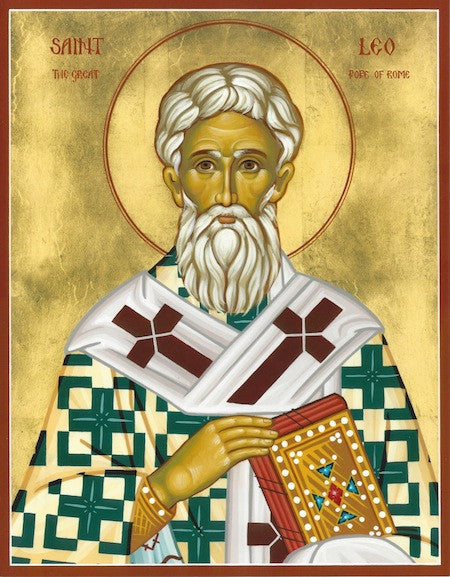
Pope Leo I, the first pope to be called "the Great," transformed the papacy from a primarily spiritual office into a major political institution. His "Tome" (449 CE) defined the orthodox understanding of Christ's two natures and was adopted by the Council of Chalcedon (451 CE).
Open in interactive timeline →Verified Facts
- In 452 CE, he personally rode out to meet Attila the Hun on the banks of the Mincio River and persuaded him to turn back from invading Italy. The exact details are debated, but the image of a pope stopping a barbarian warlord with words alone became legendary.
- His "Tome of Leo" (a letter to Patriarch Flavian of Constantinople) articulated the doctrine that Christ has two complete natures—fully divine and fully human—united in one person "without confusion, without change, without division, without separation." This became the Chalcedonian Definition.
- He successfully argued that the Bishop of Rome held supreme authority over all other bishops, deriving his power directly from the Apostle Peter. His sermons on papal primacy laid the theological groundwork for the medieval papacy.
- When the Vandals sacked Rome in 455 CE, Leo negotiated with their king Gaiseric. He couldn't stop the sack, but he reportedly convinced the Vandals not to burn the city or massacre its inhabitants.
Frequently Asked Questions
Who was Leo the Great?
Pope Leo I, the first pope to be called "the Great," transformed the papacy from a primarily spiritual office into a major political institution. His "Tome" (449 CE) defined the orthodox understanding of Christ's two natures and was adopted by the Council of Chalcedon (451 CE).
When did Leo the Great live?
Leo the Great: c. 400–461 CE.
Why does Leo the Great matter?
The Pope who confronted Attila the Hun and defined Christ at Chalcedon.
Sources & Further Reading
Cite This Page
AskHistoryAI. “Leo the Great.” AskHistoryAI — Interactive Timeline of Everything. Updated 2026-09-11. https://askhistoryai.com/event/cf-leo-great/
Every fact on this page is checked against the published fact ledger and methodology; sources are listed above.