The Mechanical Clock
Severing human life from the sun.
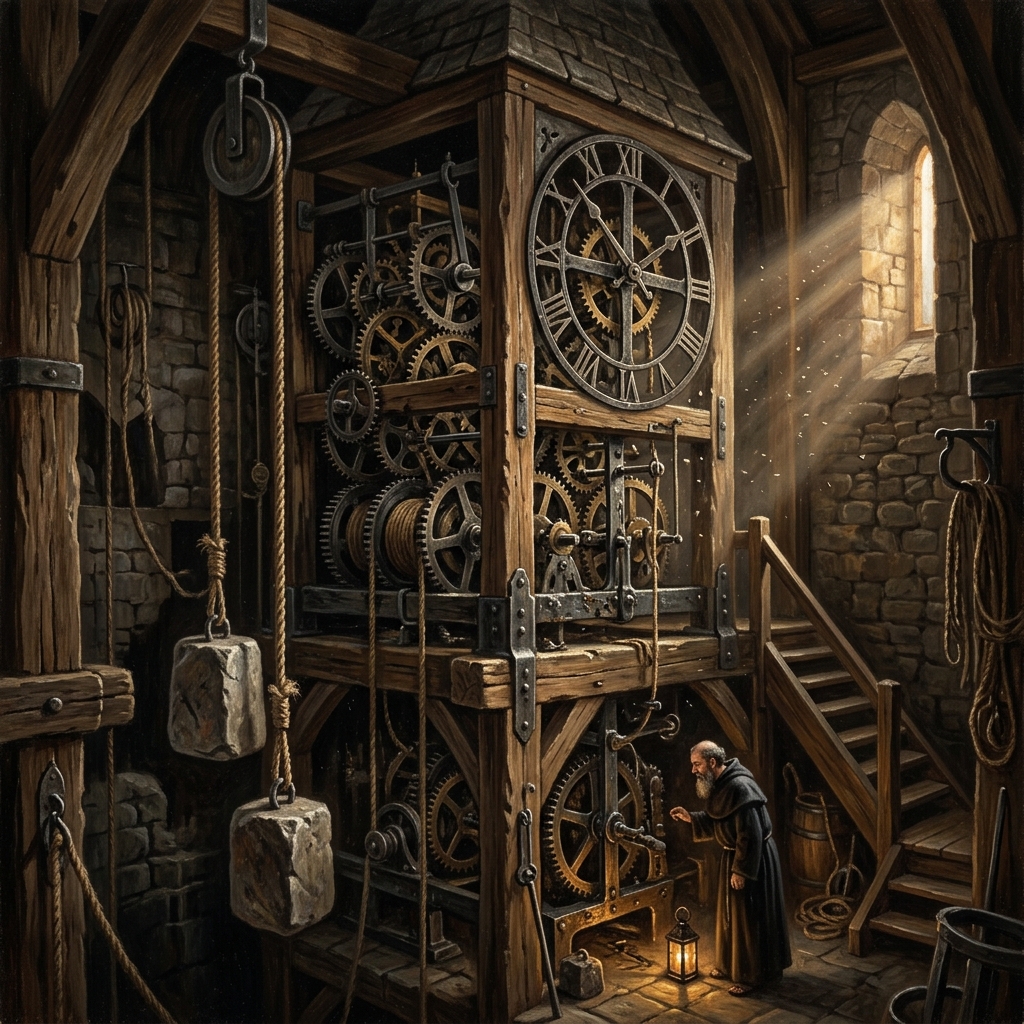
The weight-driven mechanical clock, utilizing a verge escapement, was developed in European monastery towers in the late 13th century. It allowed humans to measure time with mathematical precision, fundamentally changing how society organized itself.
Open in interactive timeline →Verified Facts
- Before mechanical clocks, humanity lived on "solar time"—an hour in the summer was literally longer than an hour in the winter, and the day ended when the sun went down.
- Monasteries drove the invention because monks needed a reliable way to know when to ring the bells for their strict prayer schedules, even in the middle of the night or in heavy fog.
- By chopping time into equal, mathematical units, the clock laid the psychological groundwork for the scientific revolution and the industrial work day.
Frequently Asked Questions
What was The Mechanical Clock?
The weight-driven mechanical clock, utilizing a verge escapement, was developed in European monastery towers in the late 13th century. It allowed humans to measure time with mathematical precision, fundamentally changing how society organized itself.
When did The Mechanical Clock happen?
The Mechanical Clock: c. 1300 CE.
Why does The Mechanical Clock matter?
Severing human life from the sun.
Sources & Further Reading
Cite This Page
AskHistoryAI. “The Mechanical Clock.” AskHistoryAI — Interactive Timeline of Everything. Updated 2026-09-11. https://askhistoryai.com/event/inv-clock/
Every fact on this page is checked against the published fact ledger and methodology; sources are listed above.