The Big Bang
The absolute beginning of space, time, and matter.
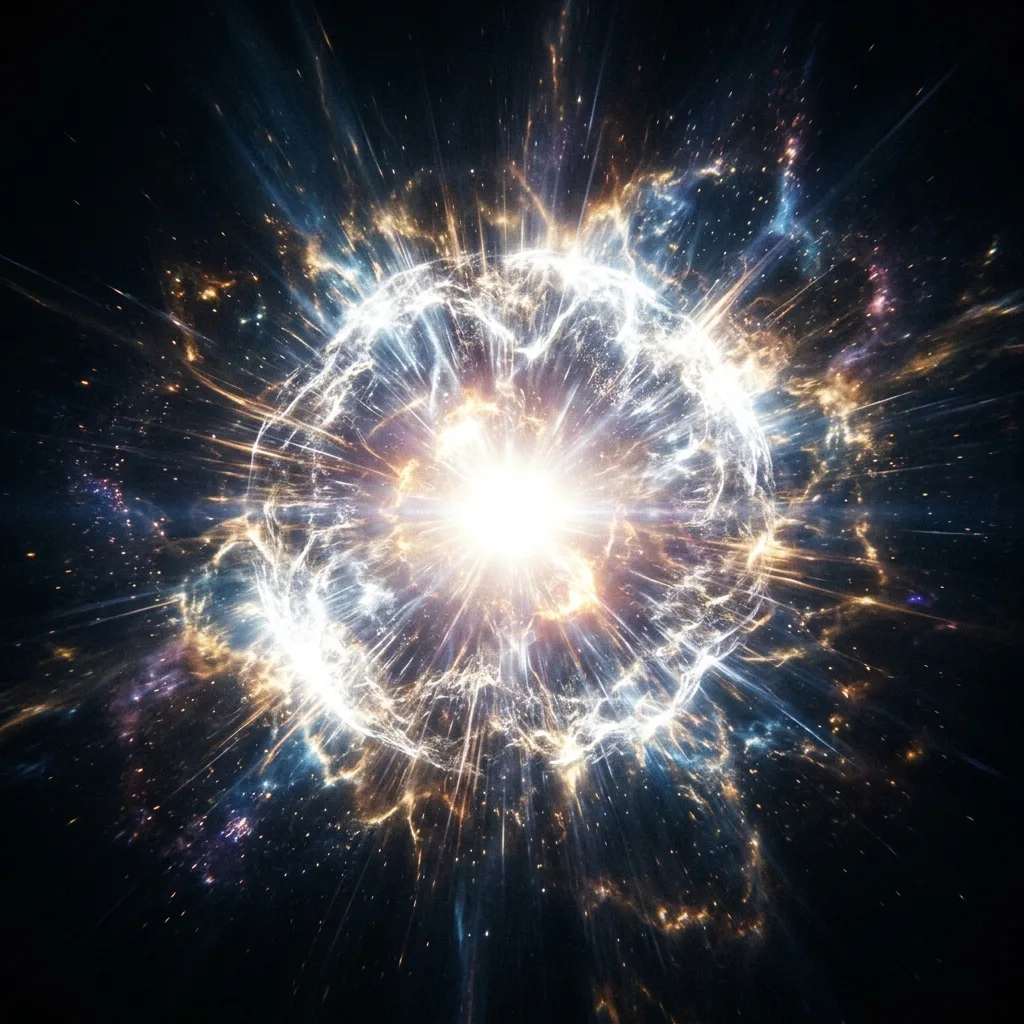
The universe explosively expands from an infinitely dense and hot singularity. In a fraction of a second, the fundamental forces of physics are established, and the expansion of the cosmos begins.
Open in interactive timeline →Key Numbers
- Age of universe
- 13.8 billion years
- Observable universe
- ~93 billion light-years across
- First nuclei forged
- Within ~3 minutes
- CMB released
- ~380,000 years after
- Ordinary matter
- Just ~5% of cosmos
Verified Facts
- The Big Bang was not first imagined by an atheist but by a Catholic priest: Belgian astronomer and ordained monsignor Georges Lemaitre, who in 1927 derived the expansion of the universe from Einstein's general relativity and proposed it began from a single dense 'primeval atom.'
- Lemaitre worked out the distance-velocity relation for receding galaxies two years before Edwin Hubble's famous 1929 paper, but published it in an obscure Belgian journal; in 2018 the International Astronomical Union formally renamed 'Hubble's Law' the 'Hubble-Lemaitre Law' to credit him.
- The name 'Big Bang' was coined mockingly by astronomer Fred Hoyle, a leading opponent of the theory who favored a rival 'steady-state' model, during a BBC radio broadcast in 1949; the derisive label stuck and became the theory's permanent name.
- The theory's strongest proof came by accident in 1965, when Bell Labs radio astronomers Arno Penzias and Robert Wilson detected an unexplained microwave hiss in their horn antenna in New Jersey; it turned out to be the cosmic microwave background (CMB), the relic radiation of the Big Bang, earning them the 1978 Nobel Prize in Physics.
- Within roughly the first three minutes, Big Bang nucleosynthesis forged the lightest elements, fixing the universe's ordinary matter at about 75% hydrogen and 25% helium by mass plus trace lithium, a ratio still observed today that the theory predicts precisely.
- For its first ~380,000 years the universe was an opaque ionized plasma; only when it cooled enough for electrons to bind into neutral atoms (an event called recombination) did light travel freely, and that released light is the CMB we still detect.
- NASA's COBE satellite confirmed the CMB is an almost perfect blackbody and, in 1992, mapped its tiny temperature ripples (anisotropies)—the seeds of galaxies—work that won John Mather and George Smoot the 2006 Nobel Prize in Physics.
- The European Space Agency's Planck satellite, collecting data from 2009 to 2013, pinned the age of the universe at about 13.8 billion years and measured its composition as roughly 4.9% ordinary matter, 26.8% dark matter, and 68.3% dark energy.
- In 1980 physicist Alan Guth proposed cosmic inflation, a burst of exponential expansion in the first tiny fraction of a second (roughly 10^-36 to 10^-32 seconds) during which the universe ballooned by a factor of around 10^26, explaining why the cosmos looks so uniform and flat.
- Modern cosmology faces an unresolved crisis called the 'Hubble tension': measurements of the universe's expansion rate from the early-universe CMB (Planck's ~67.4 km/s/Mpc) and from the local distance ladder (SH0ES's ~73.0 km/s/Mpc in 2022) disagree at greater than 5-sigma significance, hinting the standard model may be incomplete.
The World at This Moment
As a physical event, the Big Bang ~13.8 billion years ago has no "elsewhere": it is the origin of space, time, matter, and energy themselves, so there is no contemporaneous world to situate it against — the first stars, galaxies, and the cosmic web all emerged from it over the subsequent billions of years. As a human discovery, however, its context is sharply datable. Lemaître proposed his expanding universe in 1927 and the "primeval atom" in 1931, amid a ferment in physics: Hubble's 1929 redshift-distance law at Mount Wilson, the consolidation of quantum mechanics (Heisenberg, Schrödinger, Dirac, 1925–1928), and Einstein's general relativity (1915), whose field equations Friedmann (1922) and Lemaître independently solved for a dynamic cosmos. This unfolded against the Great Depression, the rise of fascism in Europe, and a Catholic priest-physicist working in Louvain. The decisive confirmation came in 1964–65, during the Space Race and Cold War, when Penzias and Wilson's Bell Labs antenna stumbled on the relic radiation.
The Paradigm Shift
The Big Bang dismantled the assumption — held from Aristotle through Newton to Einstein — of an eternal, static cosmos. Einstein himself had inserted a cosmological constant in 1917 to keep the universe still; Lemaître's expanding solution, vindicated by Hubble, made cosmic history itself a scientific object. For the first time the universe had an age, a beginning, and an evolutionary trajectory open to physical inquiry. This birthed physical cosmology as a quantitative discipline: Gamow, Alpher, and Herman's 1940s work on primordial nucleosynthesis explained cosmic helium abundance and predicted relic radiation, later found as the cosmic microwave background. The framework unified particle physics with the largest scales, since the early universe became the ultimate high-energy laboratory. It also reframed deep questions — origins, finitude, the arrow of time — as empirical rather than purely metaphysical, while provocatively echoing creation narratives, a resonance Lemaître himself carefully kept distinct from theology.
In Their Own Words
"The evolution of the world can be compared to a display of fireworks that has just ended: some few red wisps, ashes and smoke. Standing on a well-chilled cinder, we see the slow fading of the suns, and we try to recall the vanished brilliance of the origin of the worlds." — Georges Lemaître, concluding passage of "The Primeval Atom" (L'Hypothèse de l'atome primitif, 1946; the imagery dating to his 1931 work on the expanding universe)
We could conceive the beginning of the universe in the form of a unique atom, the atomic weight of which is the total mass of the universe.
Georges Lemaitre, in the journal Nature, 9 May 1931 — the origin of his "primeval atom" hypothesis — source
[This is] the hypothesis that all the matter of the universe was created in one big bang at a particular time in the remote past.
Fred Hoyle, BBC radio broadcast, 28 March 1949 — the first recorded use of "big bang," coined by a skeptic who favored the rival steady-state theory — source
In Depth
The First Cause: How Everything Begins in a Hot, Dense Instant
Every event on this timeline is, in the most literal sense, a downstream consequence of the one described here. The Big Bang is not an explosion in space but the expansion of space itself, beginning roughly 13.8 billion years ago from a state so hot and dense that the four fundamental forces, particles, and even the geometry of spacetime had not yet taken their familiar forms. It is the single event with no preconditions inside the timeline, because it is the precondition for all the rest.
The Deep Causes We Cannot See
The honest scholar must concede that the Big Bang marks the edge of explanation. General relativity, run backward, predicts a singularity, but physicists treat this less as a literal infinity than as a signal that quantum gravity—a theory we do not yet possess—is required. What caused it, or whether "cause" even applies before time existed, remains open. What the evidence does establish is overwhelming: the recession of galaxies, the relative abundances of light elements, and above all the Cosmic Microwave Background—the faint afterglow released about 380,000 years after the beginning, when the cooling universe first became transparent and electrons settled onto nuclei. That ancient light is still arriving, the oldest signal in existence, and it is the closest thing we have to a photograph of the world's first chapter.
How It Reshaped Everything After
In the first three minutes, nuclear fusion forged the primordial recipe: roughly three-quarters hydrogen, one-quarter helium, and a whisper of lithium. Crucially, it made no carbon, oxygen, iron, or gold. The cosmos was handed only the lightest ingredients, and everything heavier—the calcium in bone, the iron in blood—had to be manufactured later inside stars. This scarcity is the engine of cosmic history. Slight density ripples imprinted in those first moments became the seeds around which gravity pulled gas into the first collapsing clouds, igniting The First Star Formations (sv-first-stars). Those stars, dying violently as The First Supernovas (sv-first-supernova), seeded space with the heavy elements that would later assemble into the Formation of the Solar System & Earth (sv-earth-formation).
From there the chain is unbroken. Planetary chemistry made possible The Origin of Life (sv-origin-of-life); life's long elaboration produced The Cambrian Explosion (sv-cambrian-explosion), the primates, and eventually minds capable of looking back. When the Pre-Socratic Philosophers (sv-presocratics) first asked what the world was made of, and when Democritus & the Atom (sv-democritus) proposed indivisible particles, they were unknowingly reaching toward the very physics that describes this event. The arc bends forward, too: thinkers like The Singularity Is Near (Kurzweil) (sv-singularity-near) envision Epoch 6: The Universe Wakes Up (sv-kurzweil-epoch6), in which intelligence saturates the cosmos that began here—matter, after 13.8 billion years, becoming aware of its own origin.
A Thread Through the Whole Tapestry
What makes the Big Bang the keystone of any history is its role as a constraint, not just a start. The hydrogen it made still burns in every star. The expansion it began still stretches the sky. The element scarcity it imposed still dictates why biology is rare and precious. Albert Einstein & the Theory of Relativity (sv-einstein) gave us the equations that first revealed an expanding, non-eternal universe—a conclusion Einstein himself initially resisted, inserting a "cosmological constant" to keep the cosmos static before conceding the data.
To stand at the Big Bang is to stand at the headwaters of contingency. Every battle, scripture, invention, and equation downstream inherits its raw materials from those opening minutes. It is the rarest of events: one that explains everything after it, while remaining, itself, the deepest unsolved question we have.
Causes & Consequences
What led to it
- Einstein's 1915 general theory of relativity provided the field equations governing spacetime, gravity, and the dynamics of the cosmos as a whole, making a mathematical model of an expanding universe possible for the first time.
- Alexander Friedmann (1922) and Georges Lemaître (1927) derived solutions to Einstein's equations describing a non-static, expanding universe, with Lemaître proposing in 1931 that it began from a dense 'primeval atom' that disintegrated.
- Vesto Slipher's measurements of galactic redshifts and Edwin Hubble's 1929 observation that more distant galaxies recede faster supplied the empirical evidence that the universe is expanding, implying a denser, hotter past.
- The four fundamental forces (gravity, electromagnetism, and the strong and weak nuclear forces) and the laws of quantum physics constituted the physical framework within which the earliest fractions of a second could unfold.
- George Gamow, Ralph Alpher, and Robert Herman's 1948 work on a hot early universe predicted both the synthesis of the light elements and a relic background radiation, giving the model testable physical consequences.
- Quantum fluctuations in the very early universe, plausibly stretched to cosmic scale by a brief epoch of inflationary expansion, seeded the tiny density variations that the model required for later structure.
What it set in motion
- Within roughly the first three minutes, Big Bang nucleosynthesis forged the universe's primordial chemical inventory of about 75% hydrogen and 25% helium by mass, plus trace deuterium and lithium, supplying the raw material for everything that followed.
- About 380,000 years later, the universe cooled enough for electrons and nuclei to combine into neutral atoms (recombination), releasing the relic light that survives today as the cosmic microwave background discovered by Penzias and Wilson in 1965.
- Primordial density fluctuations grew under gravity into the first stars roughly 100–200 million years after the Big Bang, and these massive early stars produced ultraviolet radiation that drove the epoch of reionization.
- Successive generations of stars fused and dispersed heavier elements such as carbon, oxygen, and iron, chemically enriching the cosmos and providing the materials needed to build planets and, ultimately, life.
- Matter assembled hierarchically into galaxies, galaxy clusters, and the vast filamentary cosmic web of large-scale structure that defines the observable universe's architecture.
- The expansion set in motion at the Big Bang continues today and was found in 1998 to be accelerating under dark energy, shaping the long-term fate of the cosmos.
The Live Academic Debate
No serious cosmologist disputes the hot Big Bang itself, but vigorous debate surrounds what preceded or accompanied it. The sharpest concerns cosmic inflation, the 1980s proposal (Guth, Linde, Albrecht-Steinhardt) of exponential expansion in the first instant. Strikingly, Paul Steinhardt — an inflation pioneer — now argues with Anna Ijjas and Avi Loeb that eternal inflation predicts a multiverse producing "anything and therefore nothing," rendering it untestable; defenders like Alan Guth, Andrei Linde, and David Kaiser counter that inflation remains the best-evidenced account of the CMB's flatness and fluctuation spectrum. Alternatives include Steinhardt and Turok's ekpyrotic/cyclic "bounce" models and Roger Penrose's conformal cyclic cosmology, both rejecting a singular beginning. Separately, the "Hubble tension" — a persistent ~9% discrepancy between early-universe (Planck CMB) and late-universe (SH0ES supernova) measurements of the expansion rate, championed by Adam Riess versus more cautious CMB cosmologists — may signal new physics beyond standard ΛCDM, an unresolved and intensely active controversy.
The rival that almost won — steady-state cosmology
From 1948 into the mid-1960s the Big Bang faced a serious competitor: the steady-state theory of Fred Hoyle, Hermann Bondi, and Thomas Gold, which held that the universe had no beginning and stayed on the whole unchanging in time, with new matter continuously created as it expanded. Ironically, it was Hoyle, the steady-state champion, who gave the rival theory its enduring name. The 1965 discovery of the cosmic microwave background by Penzias and Wilson is generally regarded as the decisive evidence for a hot, dense early universe, after which steady-state cosmology lost mainstream support.
The Counterfactual
Had Lemaître not synthesized relativity, redshifts, and quantum decay into the primeval-atom idea, expanding-universe cosmology would still likely have emerged — Friedmann's 1922 solutions and Hubble's 1929 data made the trajectory overdetermined — but its interpretation could have stalled. Through the 1950s the steady-state theory of Hoyle, Bondi, and Gold offered a serious, eternal-universe rival, and absent decisive evidence the field might have remained genuinely bifurcated for decades longer. The true contingency lies in confirmation: had Penzias and Wilson in 1964 dismissed their 3.5 K antenna noise as instrumental (they initially blamed pigeon droppings), or had Dicke and Peebles' independent Princeton prediction not surfaced simultaneously, the cosmic microwave background's recognition could have been delayed. Yet COBE (1989), WMAP, and Planck would eventually have forced the issue. What was not inevitable was the precise standard ΛCDM model; different observational sequences might have entrenched alternative interpretive frameworks for a generation.
Myth vs. Reality
Myth: The Big Bang was a giant explosion that hurled matter outward from a single point into pre-existing empty space.
Reality: On the standard cosmological account, the Big Bang was not an explosion in space but an expansion of space itself, happening at every point at once. As cosmologists Charles Lineweaver and Tamara Davis explain in Scientific American (2005), galaxies are not flying through a void like shrapnel; rather, the distances between them are stretching. There was no surrounding emptiness for the universe to expand 'into.' Physicist Matt Strassler frames it the same way: 'expansion, not explosion.'
Myth: The Big Bang happened at a specific location, so the universe has a center that everything is moving away from.
Reality: There is no center. Because space itself expanded everywhere simultaneously, every observer sees distant galaxies receding from their own vantage point, and none is privileged. In the standard balloon analogy used by cosmologists, no point on the balloon's surface is the center of its expansion. This holds whether the universe is finite or infinite. The question 'where did the Big Bang happen?' has the answer: everywhere, including where you are now.
Myth: Galaxies receding faster than light would violate Einstein's relativity, so this can't really happen.
Reality: Distant galaxies genuinely recede from us faster than light, and this violates nothing. As Davis and Lineweaver showed in their peer-reviewed paper 'Expanding Confusion' (Publications of the Astronomical Society of Australia, 2004), recession velocity is caused by the expansion of space, not motion through space, so it is not bound by special relativity's light-speed limit, which applies only to objects moving within a local inertial frame. Roughly a thousand observed galaxies (those at redshift above about 1.5) are receding superluminally.
Myth: The Big Bang theory explains the origin of the universe — how everything came from nothing.
Reality: The theory describes the evolution of the universe from an extremely hot, dense early state onward; it does not address time zero itself or 'what came before.' Extrapolating back to a true initial singularity pushes general relativity past the point where it applies, so most physicists treat the singularity as a breakdown of the model rather than a real physical event. Matt Strassler likens it to extrapolating a person's life back to a single cell: the model stops being valid before you reach zero.
Myth: Fred Hoyle coined the term 'Big Bang' to mock and ridicule the theory.
Reality: Hoyle did introduce the phrase in a 1949 BBC radio broadcast, and he did favor the rival Steady State model, but the claim that he meant it derisively is itself a myth. Historians Helge Kragh and Robert Smith ('What's in a Name,' 2013) found no evidence of pejorative intent; Hoyle later said he used the vivid image simply to contrast an expanding universe with a static one for a general audience. The theory's actual originator was Georges Lemaitre, who in the 1930s proposed the expanding universe from a 'primeval atom.'
Current Scholarship
Almost no working cosmologist doubts that the observable universe expanded from an extremely hot, dense state roughly 13.8 billion years ago. That figure is not a round guess: combining measurements of the universe's expansion rate with the cosmic microwave background gives an estimate of 13.787 ± 0.02 billion years, as the current synthesis on the Big Bang reports. The decisive evidence came by accident in 1965, when Arno Penzias and Robert Wilson, testing a radio antenna at Bell Labs, kept picking up a faint, uniform microwave hiss they could not explain away as instrument noise. Their report, A Measurement of Excess Antenna Temperature at 4080 Mc/s, turned out to describe the cooled afterglow of the hot early universe, and its confirmation is what converted the Big Bang from a live contender into the working model of cosmology.
Where real, sustained argument has occurred is over credit and historical framing, not over whether expansion happened. Georges Lemaître derived the equations for an expanding universe in 1927, two years before Edwin Hubble published his observational data in 1929, a priority Jean-Pierre Luminet's history of the episode traces in detail, noting that "most of the ingredients of the present-day standard cosmological model... had been anticipated by Georges Lemaître, although his articles remain mostly unquoted." For decades no one understood why Lemaître's own English translation of that 1927 paper, printed in 1931, was missing his numerical estimate of the expansion rate. The mystery was only resolved in 2011, when astrophysicist Mario Livio established that Lemaître had cut the passage himself, apparently to let Hubble's later, sharper measurement stand as the reference figure, per the account in Lemaître's Wikipedia biography. Dominique Lambert's biography, The Atom of the Universe, treats that act of self-effacement as one reason Lemaître was written out of the theory's popular history even as "his" model became standard.
The theory's status shifted just as sharply on the physics side. Through the late 1940s and 1950s the expanding hot-universe picture associated with Lemaître and George Gamow competed on roughly equal footing with Fred Hoyle, Hermann Bondi, and Thomas Gold's rival steady-state universe, a rivalry Helge Kragh's Cosmology and Controversy documents as a genuine, evenly matched scientific fight rather than a foregone conclusion — the name "Big Bang" itself began as Hoyle's dismissive label for the idea he opposed. The 1965 Penzias-Wilson detection, a natural prediction of the hot model with no steady-state analogue, ended that contest within a few years and moved the debate from "did it happen" to the questions about inflation and what preceded it that occupy cosmologists today.
Key sourced claims
- Combining expansion-rate and cosmic-microwave-background data places the Big Bang at 13.787 ± 0.02 billion years ago. (Big Bang — Wikipedia)
- Arno Penzias and Robert Wilson's 1965 paper reported an unexplained excess antenna temperature that was later identified as the relic radiation of the Big Bang. (Penzias and Wilson, 'A Measurement of Excess Antenna Temperature at 4080 Mc/s' (1965))
- Georges Lemaître derived the equations for an expanding universe in 1927, two years before Edwin Hubble published the observational evidence in 1929. (Luminet, 'Lemaître's Big Bang' (2015))
- In 2011, astrophysicist Mario Livio discovered that Lemaître had personally removed his own 1927 estimate of the universe's expansion rate from the 1931 English translation of his paper, ceding priority to Hubble's later measurement. (Georges Lemaître — Wikipedia)
Frequently Asked Questions
How old is the universe according to the Big Bang theory?
Current measurements put the age of the universe at about 13.8 billion years. This figure comes primarily from the European Space Agency's Planck mission, which mapped the cosmic microwave background between 2009 and 2013 and yielded an age of roughly 13.82 billion years. Independent observations, including those from the Atacama Cosmology Telescope in Chile, have since confirmed this estimate.
What is the evidence for the Big Bang?
The strongest evidence is the cosmic microwave background (CMB), the faint afterglow of heat from the early universe, discovered accidentally by Arno Penzias and Robert Wilson in 1965 and preserving a snapshot of the cosmos about 380,000 years after the Big Bang. A second pillar is the expansion of the universe, observed by Edwin Hubble in 1929 when he found that distant galaxies are receding from us. A third is Big Bang nucleosynthesis: the theory predicts the universe should be roughly 75% hydrogen and 25% helium by mass, which matches what astronomers observe.
Did the Big Bang actually explode, and where did it happen?
No. Despite the name, the Big Bang was not an explosion of matter into pre-existing empty space, but rather an expansion of space itself happening everywhere at once. Because of this, the universe has no single center and no specific location where it occurred. In a real sense the answer to "where did the Big Bang happen?" is: everywhere, including the spot where you are right now.
Who came up with the Big Bang theory and who named it?
The foundational idea was proposed by Belgian Catholic priest and physicist Georges Lemaitre, who described an expanding universe originating from a "primeval atom," and it was later championed by physicist George Gamow. Ironically, the term "Big Bang" was coined by Fred Hoyle, an opponent of the theory, during a BBC radio talk on March 28, 1949, while he was promoting his rival steady-state model. The catchy name stuck even though Hoyle meant it dismissively.
What happened before the Big Bang?
Science currently cannot answer this with certainty. Our physical theories break down before the Planck time, roughly 5.39 x 10^-44 seconds after the Big Bang, the smallest interval that makes physical sense in known physics. One leading idea, cosmic inflation, proposes the universe underwent a brief burst of exponential expansion in its first fraction of a second, but inflation also tends to erase evidence of whatever preceded it. As cosmologists candidly note, it is doubtful we will ever know what came before, and the question may lie permanently beyond the reach of science.
How do scientists know the universe is expanding?
In 1929 Edwin Hubble published observations showing that galaxies are moving away from us, and that more distant galaxies recede faster, a relationship now called Hubble's law. He measured this through redshift, a stretching of light toward longer (redder) wavelengths as objects move away. Running this expansion backward in time implies the universe was once far denser and hotter, which is the core insight behind the Big Bang model.
Sources & Further Reading
- Big Bang — Wikipedia
- Helge Kragh, Cosmology and Controversy: The Historical Development of Two Theories of the Universe (Princeton University Press, 1996)
- Dominique Lambert, The Atom of the Universe: The Life and Work of Georges Lemaître (Copernicus Center Press, 2015)
- Jean-Pierre Luminet, 'Lemaître's Big Bang' (arXiv:1503.08304, 2015)
- A. A. Penzias and R. W. Wilson, 'A Measurement of Excess Antenna Temperature at 4080 Mc/s,' Astrophysical Journal 142 (1965)
- Anna Ijjas, Paul J. Steinhardt and Abraham Loeb, 'Inflationary Paradigm in Trouble after Planck2013,' Physics Letters B 723 (2013)
- NASA: Universe 101
Cite This Page
AskHistoryAI. “The Big Bang.” AskHistoryAI — Interactive Timeline of Everything. Updated 2026-09-11. https://askhistoryai.com/event/sv-big-bang/
Every fact on this page is checked against the published fact ledger and methodology; sources are listed above.