The First Supernovas
The violent deaths that seeded the universe with heavy elements.
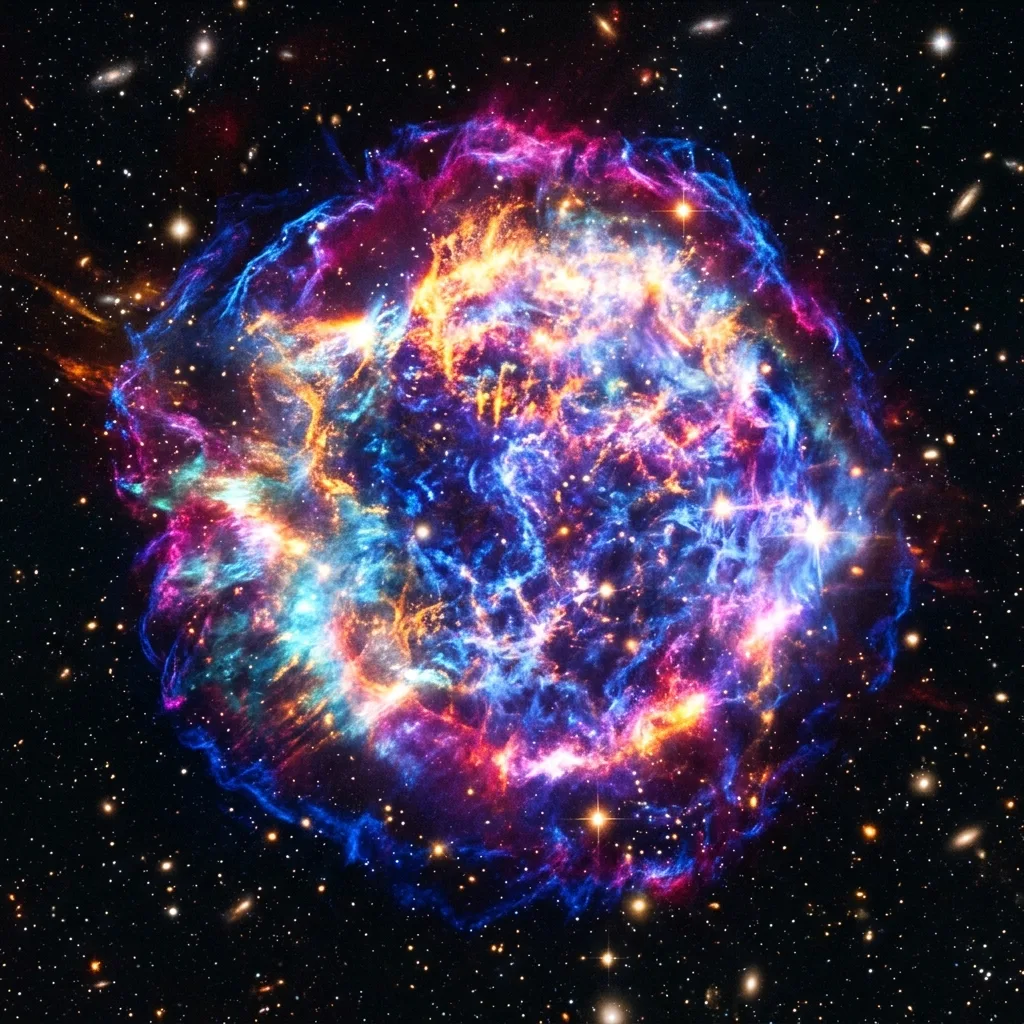
Because the very first stars were so incredibly massive, they burned through their nuclear fuel in just a few million years. Their inevitable deaths resulted in the first supernova explosions in the universe.
Open in interactive timeline →Key Numbers
- When (after Big Bang)
- ~100-200 million yrs (z~20-30)
- Progenitor mass
- Tens to ~260 M☉ (Pop III)
- Stellar lifetime
- ~1-3 million years
- PISN explosion energy
- Up to ~10^53 erg (~100x normal SN)
- Metals ejected
- Up to ~100 M☉ of iron per star
Verified Facts
- The first supernovae were the death throes of Population III stars: the universe's first generation of stars, formed from pristine hydrogen-and-helium gas with essentially zero heavier elements, beginning roughly 100-200 million years after the Big Bang (redshift z ~ 20-30).
- Because they formed from metal-free gas that could not cool efficiently, Population III stars are believed to have been extraordinarily massive — with mean masses of 100 solar masses or more, and some models reaching many hundreds of solar masses — far larger than typical stars forming today.
- Their enormous mass meant blistering short lives: a massive Pop III star burned through its nuclear fuel in only about 1-3 million years (a star 60 times the Sun's mass lasts under a million years) before exploding, so the first supernovae followed the first starlight almost immediately on cosmic timescales.
- Pop III stars between roughly 140 and 260 solar masses died as pair-instability supernovae (PISNe), where core temperatures grew so high that gamma-ray photons converted into electron-positron pairs, robbing the core of pressure, triggering collapse and a runaway thermonuclear explosion that obliterated the entire star — leaving no neutron star or black hole behind.
- Pair-instability supernovae are among the most energetic explosions in the cosmos, releasing up to about 10^53 erg — roughly 100 times the energy of an ordinary core-collapse supernova — and a single such event could forge and hurl up to about 100 solar masses of iron into surrounding space.
- These first explosions performed the universe's foundational act of chemical enrichment: they scattered the first carbon, oxygen, silicon and iron — elements made by stellar nucleosynthesis — into a cosmos that previously held only hydrogen, helium and a trace of lithium, seeding the raw material for later stars, planets and life.
- Pop III stars below about 140 and above about 8 solar masses ended as more conventional core-collapse supernovae, while the very most massive stars (and those above ~260 M☉) likely collapsed directly into black holes with little or no explosion, making the supernova outcome strongly mass-dependent.
- No first-generation supernova has been directly observed, but evidence is mounting indirectly: in 2023 a team using China's LAMOST survey reported the metal-poor Milky Way halo star J1010+2358 (published in Nature), whose unusual abundance pattern — very low sodium and cobalt — was argued to match enrichment by a ~250-260 solar-mass pair-instability supernova, though this interpretation has since been contested by other groups.
- The best directly observed pair-instability supernova candidate to date is SN 2018ibb, a slowly-evolving superluminous supernova at redshift z = 0.166 whose light curve required 25-44 solar masses of radioactive nickel-56 from a star with a helium core of 120-130 solar masses — a modern analog of the explosions thought to have ended the first stars.
- Astronomers hope the James Webb Space Telescope (JWST) may catch the actual light or chemical fingerprints of these first stars and their supernovae, since detecting Population III objects directly at high redshift remains one of the major open frontiers of early-universe astronomy.
The World at This Moment
There was no "world" yet in any human or geological sense. The first supernovae detonated within the first few hundred million years after the Big Bang, during the epoch astronomers call Cosmic Dawn, at redshifts of roughly z = 15-30. Their progenitors, Population III stars, condensed from pristine hydrogen-helium gas (plus trace lithium) inside dark-matter "minihalos" of about 10^5-10^6 solar masses, cooled inefficiently by molecular hydrogen. Lacking metal-line cooling, these clouds fragmented poorly and produced unusually massive stars, plausibly tens to hundreds of solar masses. The contemporaneous cosmos contained no planets, no rocky bodies, no carbon, oxygen, or iron in significant quantity, and a still largely neutral intergalactic medium. The cosmic microwave background had already decoupled (around 380,000 years), and the universe was emerging from the "Dark Ages." These first stellar deaths overlapped with the onset of reionization, as ultraviolet photons from the first luminous sources began ionizing intergalactic hydrogen. No Earth, Sun, or Milky Way existed; they lay over nine billion years in the future.
The Paradigm Shift
The first supernovae inaugurated cosmic chemical evolution: the universe's transition from a near-pure hydrogen-helium plasma to a chemically diverse cosmos capable of forming planets, rock, and eventually life. Big Bang nucleosynthesis had produced essentially only hydrogen, helium, and trace lithium; every atom of carbon, oxygen, iron, and heavier element in existence was forged in stars and dispersed by their explosions, beginning with these first events. By ejecting freshly synthesized metals into the surrounding gas, the first supernovae enabled metal-line and dust cooling, which let subsequent gas clouds fragment into the smaller, longer-lived stars of Population II and beyond, plausibly establishing the stellar initial mass function we observe today. They also injected mechanical energy and may have triggered or quenched nearby star formation, while contributing ionizing radiation to reionization. In the framework articulated by Volker Bromm, Naoki Yoshida, and collaborators, this single class of events bridges the featureless early universe and the structured, element-rich cosmos, making the chemistry of stars, planets, and biology possible.
In Their Own Words
"A single supernova with an original mass about 60 times that of the Sun (and a remnant of less than 6 solar masses) is the only model capable of reproducing the abundance pattern of this star." — S. C. Keller et al., "A single low-energy, iron-poor supernova as the source of metals in the star SMSS J031300.36-670839.3," Nature 506, 463-466 (2014)
In Depth
The Forge That Seeded the Universe
Every atom of calcium in your bones, iron in your blood, and oxygen in the breath you just took was assembled inside a dying star and scattered by an explosion. The First Supernovas mark the moment the cosmos stopped being a sterile bath of hydrogen and helium and began manufacturing the raw material of planets, life, and minds. Nothing that came afterward—not Earth, not biology, not the reader of this sentence—was chemically possible before this event.
The Precondition: A Universe of Only Three Elements
The deep cause reaches back to the very beginning. The Big Bang (sv-big-bang) produced almost nothing but hydrogen, helium, and a trace of lithium. For roughly a hundred million years the universe was a "dark age," a cooling fog with no light source beyond the fading afterglow of creation. Then gravity, working on dark-matter halos, drew that pristine gas into the first knots dense enough to ignite—The First Star Formations (sv-first-stars). These Population III stars were monsters: with no heavier elements to radiate away heat and fragment the collapsing gas, they grew to tens or even hundreds of times the mass of our Sun. Such stars live fast and burn furiously. Within only a few million years, the most massive among them reached the end of their fuel and detonated. Stars in the range of roughly 140 to 260 solar masses are thought to have died in "pair-instability supernovae," among the most energetic thermonuclear explosions the universe has ever staged, blowing themselves apart so completely that no remnant was left behind.
The Transformation: Chemistry Is Born
The significance of these explosions is almost impossible to overstate. Inside their progenitor stars, fusion had forged carbon, oxygen, silicon, calcium, and iron from primordial hydrogen. The supernovae hurled this enriched material outward, seeding the intergalactic medium with the first "metals" (the astronomer's term for every element heavier than helium). This single act rewired the rules of star formation. Gas laced with even a trace of these new elements could cool far more efficiently, fragmenting into smaller clumps. The next generations of stars were therefore cooler, smaller, longer-lived, and—crucially—able to host orbiting disks of dust and rock. Astronomers now hunt for the chemical fingerprints of these first deaths in the strange abundance patterns of the oldest, most metal-poor stars still visible today, reading them like fossils of a vanished epoch. The First Supernovas thus made possible the Formation of the Solar System & Earth (sv-earth-formation), because rocky worlds simply cannot condense out of pure hydrogen and helium.
The Ripples: From Stardust to Self-Awareness
The thread runs unbroken from these explosions to everything that matters to us. The carbon and oxygen they dispersed became the chemical backbone of The Origin of Life (sv-origin-of-life). The oxygen later flooded into Earth's atmosphere during The Great Oxygenation Event (sv-great-oxygenation), enabling the energy-hungry metabolisms that produced The First Complex Cells (Eukaryotes) (sv-first-complex-cells) and, eventually, the explosion of animal diversity in the Cambrian Explosion (sv-cambrian-explosion). Iron forged in these and later stellar deaths became the heme that carries oxygen in animal blood.
There is a recursive beauty here that Ray Kurzweil gestures toward in his vision of Epoch 6: The Universe Wakes Up (sv-kurzweil-epoch6). The First Supernovas were the universe's first act of building complexity from simplicity—scattering the toolkit from which atoms became molecules, molecules became cells, and cells, across billions of years, became creatures capable of looking up, naming these explosions, and understanding that they are made of their ash. Carl Sagan's phrase was not poetry but literal physics: we are starstuff, and this is the event where the stuff was first made.
Causes & Consequences
What led to it
- Big Bang nucleosynthesis in the first few minutes forged the universe's primordial gas of hydrogen, helium, and trace lithium, leaving a metal-free chemical baseline from which the first stars would later condense.
- Around 380,000 years after the Big Bang, the epoch of recombination let nuclei capture electrons to form neutral atoms, making the universe transparent and ending the radiation-dominated era so matter could clump freely.
- Quantum density fluctuations imprinted during cosmic inflation seeded the initial matter perturbations that grew under gravity into the dark matter minihalos (around a million solar masses) that became the cradles of the first stars.
- Molecular hydrogen (H2) formed in these collapsing primordial clouds and acted as the only available coolant, radiating away heat so the metal-free gas could fragment and contract toward densities high enough to ignite fusion.
- Within dark matter minihalos at redshifts of roughly z ~ 20-30, primordial gas collapsed in the dark matter gravity wells to form the metal-free Population III stars, which were typically very massive and short-lived.
- Population III stars fused hydrogen and helium into progressively heavier elements, building up a degenerate iron core that could no longer release energy by fusion, setting the stage for catastrophic gravitational collapse.
What it set in motion
- The first core-collapse explosions, occurring in stars roughly 10 to 40 solar masses, ejected freshly synthesized elements up to iron, polluting the previously pristine universe with carbon, oxygen, and the first heavy metals.
- This seeding of the interstellar medium with metals enabled efficient gas cooling and the formation of the second generation of lower-mass, longer-lived Population II stars, beginning the chemical evolution that leads to planets and life.
- Very massive first stars (roughly 140 to 260 solar masses) exploded as pair-instability supernovae that converted nearly the entire helium core into metals, releasing 10^51 to 10^53 ergs and dispersing enormous quantities of newly made elements.
- Population III supernova ejecta condensed the first cosmic dust grains, providing the solid particles that would later seed planet formation and reshape gas cooling and chemistry in subsequent star-forming clouds.
- The collapsed remnants of massive Population III stars left black holes of order 100 solar masses that are a leading candidate for the 'seeds' which grew into the supermassive black holes observed in high-redshift quasars.
- The chemical fingerprints of these first explosions are preserved in ancient carbon-enhanced metal-poor stars in the Milky Way's halo, which serve as fossil records letting astronomers reconstruct the yields of the very first supernovae.
The Live Academic Debate
A central, active debate is whether the first stars commonly died as pair-instability supernovae (PISNe) at all, and where their chemical fingerprints survive. PISNe produce a strong odd-even nucleosynthetic pattern and essentially no neutron-capture elements, yet for years no metal-poor Galactic star clearly matched, prompting arguments that very massive Pop III stars were rare or that their ejecta were diluted away. In 2023, Xing Qian-Fan and colleagues (Nature) claimed LAMOST J1010+2358 was the first bona fide PISN descendant. This was promptly contested: Skuladottir, Thibodeaux, and others, using higher-resolution spectra, detected sodium, scandium, and strontium above Xing's upper limits, weakening the odd-even signal, while Jeena, Heger, and collaborators argued a combination of a normal Population II core-collapse supernova plus a Pop III event fits better than a pure 260-solar-mass PISN. Separately, Keller et al. (2014) interpreted SMSS J0313-6708 as enriched by a single low-energy, iron-poor fallback supernova of roughly 60 solar masses, exemplifying the competing "faint supernova" paradigm. The mass distribution and explosion modes of the first stars remain genuinely unsettled.
The Counterfactual
Counterfactual reasoning here is constrained by physics rather than contingency: given a universe with the same physical constants, some first generation of stars and their deaths is essentially inevitable once minihalos cool and collapse. The meaningful "what if" concerns the mode of those first explosions, because the yield depends sharply on progenitor mass. Models (Heger and Woosley; Nomoto and collaborators) predict that non-rotating stars of roughly 140-260 solar masses end as pair-instability supernovae, which leave no remnant and eject enormous masses of metals with a distinctive "odd-even" abundance pattern, whereas lower-mass stars undergo core-collapse, often as faint, fallback-dominated events yielding little iron. Had the first stars been dominated by pair-instability explosions, the early intergalactic medium would have been enriched faster and with a different chemical fingerprint, and the present Galactic halo should be littered with stars bearing that signature. Its near-absence (see the scholarly debate) suggests core-collapse channels dominated, shaping the comparatively iron-poor, carbon-enhanced abundance patterns of the oldest surviving stars.
Myth vs. Reality
Myth: The first supernovae happened at, or right after, the Big Bang.
Reality: Supernovae require stars that first have to form and then die, neither of which happened immediately. The universe went through a starless 'cosmic dark ages' of neutral hydrogen and helium gas; the first (Population III) stars only condensed inside dark-matter halos roughly 100-400 million years after the Big Bang. Because those massive stars burned through their fuel in just a few million years, the very first supernovae followed shortly after the first starlight, still hundreds of millions of years after the Big Bang itself, not at its instant.
Myth: Every first-generation star exploded as a supernova.
Reality: A star's fate depended sharply on its mass. Models indicate Pop III stars of roughly 10-40 solar masses ended as core-collapse supernovae, those near 40-140 solar masses largely collapsed directly into black holes (some with pulsational pair instability) leaving little or no explosion, the 140-260 solar-mass range detonated as pair-instability supernovae, and stars above about 260 solar masses collapsed straight into black holes without exploding. So a large fraction of the first stars locked their newly made elements inside black holes rather than scattering them.
Myth: All the first stars were enormous, hundreds of solar masses, and died as pair-instability supernovae.
Reality: Pair-instability supernovae only occur in the narrow 140-260 solar-mass window, and modern simulations suggest the first stars spanned a broad initial mass function centered on the order of tens of solar masses rather than uniformly hundreds. Tellingly, abundance patterns in most extremely metal-poor 'fossil' stars are best matched by Pop III progenitors below about 40 solar masses (often ~25-solar-mass hypernova models), implying ordinary core-collapse explosions, not pair-instability events, dominated the chemical enrichment of the early universe.
Myth: We have directly photographed or observed a first supernova.
Reality: No Population III supernova has ever been directly observed; they are still a target for facilities like JWST and the Roman Space Telescope. The evidence is indirect, read from the chemical 'fingerprints' preserved in ancient, extremely metal-poor stars. The strongest case is LAMOST J1010+2358, reported in Nature in June 2023, whose unusual abundance pattern (including very low sodium and cobalt) matches the yields expected from a pair-instability supernova of an roughly 260-solar-mass first star, evidence of such an explosion, not a sighting of one.
Myth: The first supernovae forged all of the universe's heavy elements, including gold.
Reality: The first supernovae did seed the previously pristine hydrogen-helium gas with the first elements heavier than helium, such as carbon, oxygen, and iron. But the heaviest 'r-process' elements like gold, platinum, and much of the silver and europium are now understood to come largely from neutron-star mergers, confirmed observationally by the 2017 kilonova GW170817/AT2017gfo, rather than ordinary supernovae. The earliest explosions enriched the cosmos, but they did not single-handedly produce the full periodic table.
Frequently Asked Questions
When did the first supernovas explode?
The first supernovas are thought to have exploded just a few hundred million years after the Big Bang, when the universe was less than 5% of its current age. Because the first stars (Population III) were extremely massive, they burned through their fuel in only about 1 to 10 million years before detonating. Models place the first stars forming at redshifts of roughly z = 10 to 30, with the earliest stellar explosions following soon after. The exact timing remains an active research question, since the onset of Population III star formation is still being constrained observationally.
What caused the very first supernovas?
The first supernovas were the deaths of Population III stars, the first generation of stars, which formed from pristine hydrogen and helium left over from the Big Bang. Lacking heavy elements to help them cool and fragment, these clouds collapsed into unusually massive stars, often well over 100 solar masses. The most massive of them, in roughly the 140 to 260 solar mass range, are predicted to have died as pair-instability supernovae, among the most energetic thermonuclear explosions in the universe. In a pair-instability event, core gamma-ray photons convert into electron-positron pairs, dropping the pressure supporting the star and triggering runaway collapse and explosion.
Why were the first supernovas so important?
The first supernovas seeded the universe with its first heavy elements. Stars forge elements like carbon, oxygen, and iron in their cores, and supernova explosions are what violently scatter those newly made metals into surrounding gas. Before these explosions the cosmos consisted almost entirely of hydrogen, helium, and trace lithium, so the first supernovas marked the beginning of cosmic chemical enrichment. This injection of metals added new coolants to the gas and helped shift star formation away from the high-mass Population III mode toward the lower-mass Population II stars that followed.
What is a pair-instability supernova?
A pair-instability supernova is an extreme explosion that occurs in very massive stars, predicted especially for the first stars in the range of roughly 140 to 260 solar masses. In the star's hot core, energetic gamma-ray photons convert into electron-positron pairs, which suddenly reduces the radiation pressure that holds the star up. The core contracts and heats further, igniting explosive thermonuclear burning that can completely unbind the star, leaving no remnant behind. The 2023 discovery of the chemically peculiar star J1010+2358 by the LAMOST survey has been proposed as the most promising candidate descendant of such a primordial pair-instability supernova.
Have astronomers actually observed any of the first supernovas?
Astronomers have not yet confirmed a direct observation of a true Population III supernova, but they are getting closer. The James Webb Space Telescope has pushed the supernova frontier dramatically: in 2025 a team reported the earliest known supernova, one that exploded when the universe was roughly 730 million years old, flagged by a gamma-ray burst. JWST has also found strong candidate signatures of Population III stars near the early galaxy GN-z11. Detecting a genuine first-generation supernova would let astronomers directly probe the masses of the universe's earliest stars for the first time, and remains a key goal for JWST and upcoming surveys.
Are we made from the first supernovas?
Not directly from the very first supernovas, but they began the long chain that built the elements in our bodies. The earliest stars produced only the first heavier elements and dispersed them when they exploded, seeding later generations of stars that forged the rest of the periodic table. Nearly every element on Earth heavier than hydrogen has been processed inside stars and scattered by stellar explosions, and any element in your body heavier than iron has passed through at least one supernova. In that sense, the first supernovas were the opening act of the cosmic recycling that eventually made planets and life possible.
Sources & Further Reading
- Stellar population — Wikipedia
- Volker Bromm & Naoki Yoshida, 'The First Galaxies,' Annual Review of Astronomy and Astrophysics 49, 373-407 (2011)
- S. C. Keller et al., 'A single low-energy, iron-poor supernova as the source of metals in the star SMSS J031300.36-670839.3,' Nature 506, 463-466 (2014)
- A. Heger & S. E. Woosley, 'The Nucleosynthetic Signature of Population III,' Astrophysical Journal 567, 532-543 (2002)
- Q.-F. Xing et al., 'A metal-poor star with abundances from a pair-instability supernova,' Nature 618, 712-715 (2023)
- A. Skuladottir et al. / A. K. Jeena, A. Heger et al., 2024 analyses re-examining the pair-instability supernova origin of LAMOST J1010+2358 (ApJ Letters)
- Wikipedia: Supernova nucleosynthesis
- NASA: What is a Supernova?
Cite This Page
AskHistoryAI. “The First Supernovas.” AskHistoryAI — Interactive Timeline of Everything. Updated 2026-09-11. https://askhistoryai.com/event/sv-first-supernova/
Every fact on this page is checked against the published fact ledger and methodology; sources are listed above.