Formation of the Solar System & Earth
The chaotic, fiery birth of our local cosmic neighborhood.
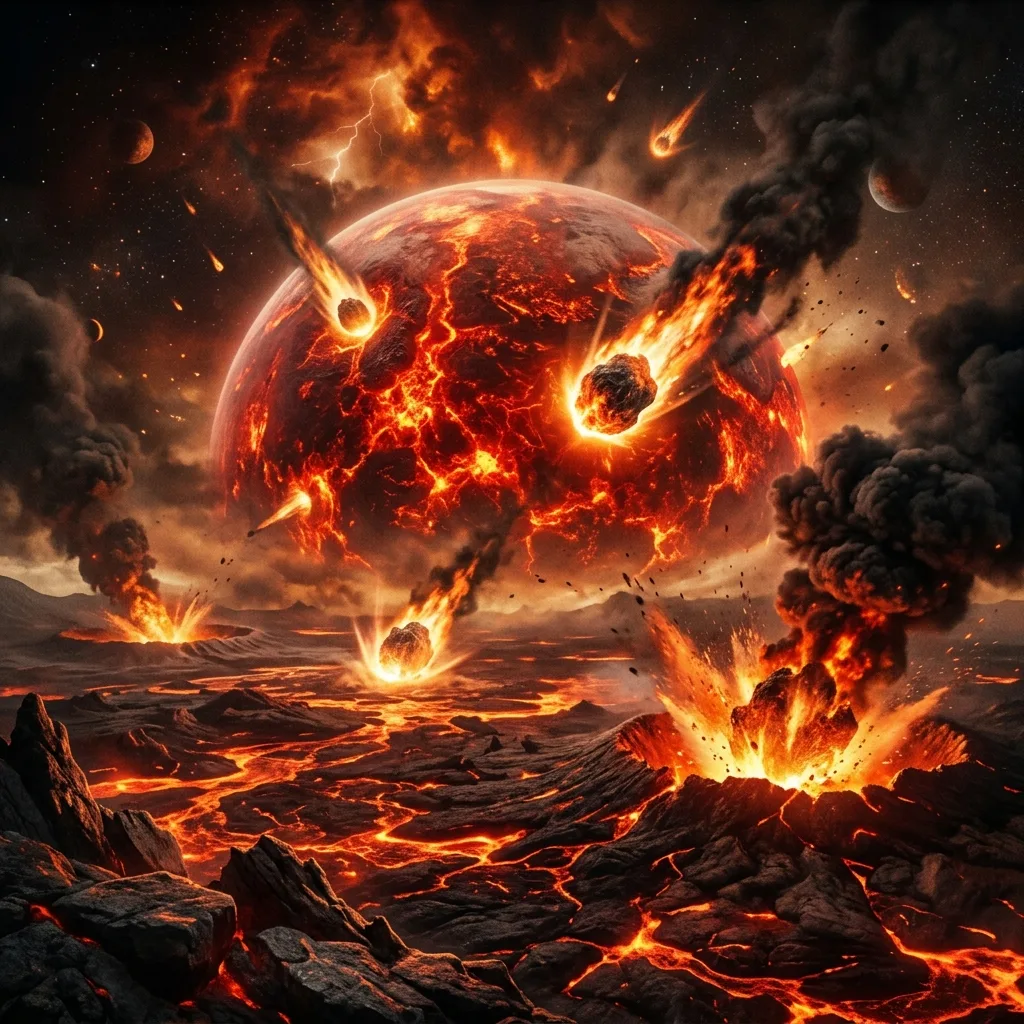
A giant molecular cloud of gas and dust (enriched by billions of years of previous supernova explosions) collapses under gravity. The center ignites to form our Sun, while the remaining debris swirls into a protoplanetary disk, violently smashing together to form the planets.
Open in interactive timeline →Key Numbers
- Age of Solar System
- 4.568 billion yrs
- Age of Earth
- 4.54 billion yrs (±1%)
- Sun's share of system mass
- 99.86%
- Earth accretion time
- ~30-100 million yrs
- Moon-forming impact
- ~60-100 Myr after birth
Verified Facts
- The oldest dated solids in the Solar System are calcium-aluminium-rich inclusions (CAIs), millimetre-to-centimetre grains found in meteorites that condensed at temperatures above ~1,300 K near the young Sun; uranium-lead dating puts their formation at about 4.568 billion years ago, pinning the Solar System's birth.
- Lawrence Livermore-led isotopic work (2020) found that the bulk of CAIs formed over an astonishingly brief window of roughly 40,000 to 200,000 years, implying the Sun's molecular cloud collapsed and the disk's first solids condensed in under 200,000 years.
- The modern accepted age of Earth, 4.54 billion years with under 1% uncertainty, traces to Clair Patterson, who in 1956 measured lead isotopes in the troilite phase of the Canyon Diablo iron meteorite and published 'Age of Meteorites and the Earth,' yielding 4.55 ± 0.07 billion years, a figure essentially unchanged since.
- The Sun holds 99.86% of the Solar System's mass; of the tiny remainder, Jupiter dominates so heavily (about 318 Earth masses) that it makes up roughly two-thirds of everything that is not the Sun, while all other planets, moons, asteroids and comets combined are a rounding error.
- The leading explanation for the Moon is the giant-impact hypothesis: a Mars-sized protoplanet named Theia (after the Greek Titan mother of the Moon-goddess Selene) struck the proto-Earth an oblique, low-velocity blow roughly 60-100 million years after Solar System formation, and debris re-accreted into the Moon.
- Key evidence for the giant impact includes the Earth-Moon system's high angular momentum, the Moon's anomalously tiny iron core, signs the Moon was once molten to great depth, and the near-identical oxygen-isotope signatures of lunar and terrestrial rock.
- Earth's accretion was not instantaneous: hafnium-182/tungsten-182 isotope chronometry indicates roughly 30 to 100 million years elapsed between the Solar System's start and the completion of Earth's growth, with core formation among the final major events.
- Early Earth was largely molten; in a global magma ocean, dense iron droplets rained out and sank to form the metallic core within tens of millions of years, leaving an oxidized silicate mantle, an irreversible chemical reorganization of the planet.
- The 'frost line' (or snow line) beyond the present asteroid belt set the system's architecture: inside it only high-melting metals and silicates condensed, building the rocky terrestrial planets, while beyond it water, ammonia and methane ices survived, letting the giant planets grow massive enough to capture hydrogen and helium.
- The oldest known fragment of Earth itself is a zircon crystal from the Jack Hills of Western Australia, dated by uranium-lead to about 4.4 billion years (4,404 ± 8 million years); its oxygen isotopes suggest interaction with liquid surface water, supporting a surprisingly 'cool early Earth' with oceans soon after the crust solidified.
The World at This Moment
There was no "world" yet in any human sense; the relevant context is galactic and stellar. By ~4.567 Gya the Milky Way was already an evolved disk galaxy of roughly 9 billion years' standing, chemically enriched by generations of stars whose supernovae and AGB winds had seeded the interstellar medium with carbon, oxygen, silicon, and iron. The Sun condensed within a giant molecular cloud, likely a clustered star-forming region akin to today's Orion complex. A widely discussed trigger is a nearby massive star: short-lived radionuclides preserved as decay products in primitive meteorites—aluminum-26 (half-life ~0.717 Myr), iron-60, calcium-41—imply fresh nucleosynthetic injection, possibly from a core-collapse supernova or Wolf-Rayet winds, within ~1 Myr of incorporation. Calcium-aluminum-rich inclusions (CAIs), the first solids to condense, are Pb-Pb dated to 4567.30 ± 0.16 Myr, defining "time zero." Iron-meteorite parent bodies accreted within ~1 Myr thereafter, while Earth's principal accretion and the Moon-forming impact unfolded over the following tens of millions of years.
The Paradigm Shift
This is the foundational paradigm shift in the literal sense: it created the physical stage—a star, a habitable planet, the elements organized into a differentiated world—on which every later event in the timeline depends. Intellectually, understanding it redirected cosmology and geology. The nebular hypothesis of Kant (1755) and Laplace (1796) replaced ad hoc or providential origins with a lawful, gravitational, naturalistic account of planetary formation, making the Solar System a problem in physics rather than theology. The twentieth-century synthesis—radiometric dating of meteorites (Patterson's 1956 4.55-Gyr figure), the solar-nebula disk model, core accretion, and the Hartmann–Davis/Cameron–Ward giant-impact hypothesis (1975–76)—established that planets are a generic by-product of star formation. That insight underwrites modern exoplanet science and astrobiology: if disks and accretion are ubiquitous, terrestrial worlds should be common. Earth's formation thus reframed humanity's place from cosmic exception to predictable outcome of stellar birth, a Copernican deepening of the principle of mediocrity.
In Their Own Words
The result, therefore, of our present enquiry is, that we find no vestige of a beginning,–no prospect of an end.
James Hutton, concluding line of "Theory of the Earth" (read to the Royal Society of Edinburgh 1785; published 1788). His own words. — source
The most accurate method (Pb207/Pb206) gives an age of 4.55 ± 0.07 × 10^9 yr. ... It is therefore believed that the age for the earth is the same as for meteorites. This is the time since the earth attained its present mass.
Clair C. Patterson, abstract of "Age of meteorites and the earth," Geochimica et Cosmochimica Acta, vol. 10 (1956), pp. 230–237. Patterson's own published words (the figure ± isotope notation is verbatim from the abstract). — source
In the beginning God created the heaven and the earth. ... This beginning of time, according to our chronology, happened at the start of the evening preceding the 23rd day of October in the year ... 710 [of the Julian Period].
James Ussher, opening of Annals of the World — quoted from the posthumous 1658 English translation, NOT Ussher's original 1650 Latin (Annales Veteris Testamenti). Year 710 of the Julian Period = 4004 BC. — source
In Depth
A Cinder From the Furnace: How Earth Inherited Deep Time
The Solar System has a birthday written in stone — literally. The oldest solids in primitive meteorites, the calcium-aluminum-rich inclusions, date to about 4.567 billion years ago, and Earth itself assembled within the following few tens of millions of years. To stand on the planet is therefore to stand on a recovered fragment of cosmic history, and the formation of the Solar System & Earth (sv-earth-formation) is the hinge on which the abstract physics of the early universe became a concrete, habitable world.
The Inheritance
Earth was built from secondhand atoms. The Big Bang (sv-big-bang) forged essentially only hydrogen, helium, and a trace of lithium — none of the silicon, iron, oxygen, or carbon that a rocky planet requires. Those elements were manufactured later, inside the nuclear furnaces of The First Star Formations (sv-first-stars) and scattered across space by The First Supernovas (sv-first-supernova) and by generations of dying stars after them. Our Solar System condensed from a molecular cloud already salted with this enrichment. The evidence is held in the rock itself: meteorites carry presolar grains — microscopic crystals with bizarre isotopic signatures that can only have formed in other stars before the Sun existed — and short-lived radioisotopes whose decay products hint that a nearby supernova shock may have helped trigger the cloud's collapse. Earth is, in the most precise sense, a recycled star.
Becoming a World
Gravity did the rest. A slowly rotating cloud core collapsed, flattened into a spinning disk, and ignited a star at its center; the leftover debris accreted into planetesimals and then planets. The young Earth was a hell of molten rock. Then, around 4.5 billion years ago, a Mars-sized body called Theia struck it at an oblique angle, vaporizing crust and flinging a disk of debris into orbit that coalesced into the Moon. This was not mere violence. The impact gave Earth its large stabilizing satellite, its axial tilt, and likely much of its early heat budget — the very conditions that would later make the planet hospitable. The lunar samples returned by Apollo 11 (sv-apollo11) clinched the story, because their isotopic chemistry matches Earth's mantle so closely that the two bodies must share an origin.
What It Made Possible
Everything biological that this timeline records is downstream of this moment. A stable, watery, tectonically active planet became the stage for The Origin of Life (sv-origin-of-life), and from there the long unfolding ran through The Great Oxygenation Event (sv-great-oxygenation), the appearance of The First Complex Cells (Eukaryotes) (sv-first-complex-cells), and ultimately the lineage that produced the species now reading this. The same accretionary geology — plate tectonics, volcanism, a churning iron core generating a protective magnetic field — kept the surface chemically alive and shielded across billions of years.
There is a deeper continuity worth naming. The atoms that compose every human body, every cathedral, every line of code, were assembled in stars and delivered here by the same process that built the ground underfoot. When Galileo Galilei (sv-galileo) first turned a telescope on the heavens and saw that Earth was one body among many, he opened a question this event answers: we are not separate from the cosmos but a local condensation of it. The arc that this timeline traces toward The Singularity Is Near (Kurzweil) (sv-singularity-near) and The Dawn of AGI (sv-ai-dawn) — intelligence emerging from matter — begins with the matter itself cooling into a planet. Earth's formation is the moment the universe acquired, in one small place, the raw material and stable workshop it would need to eventually wake up and think about its own beginning.
Causes & Consequences
What led to it
- Generations of earlier massive stars lived and died, forging the heavier elements through stellar nucleosynthesis and seeding interstellar space with the carbon, oxygen, silicon, and iron that would later build the rocky planets.
- A giant molecular cloud of gas and dust, composed mostly of hydrogen and helium with roughly one percent heavier elements, accumulated in a region of interstellar space and provided the raw material reservoir for the entire Solar System.
- A nearby supernova shock wave is thought to have compressed part of this molecular cloud, injecting short-lived radioactive isotopes (such as aluminum-26 and beryllium-10 detected in primitive meteorites) and triggering the gravitational collapse of the protosolar nebula around 4.6 billion years ago.
- Conservation of angular momentum during the collapse flattened the infalling material into a rotating protoplanetary disk around the growing proto-Sun, setting up the orbital plane in which the planets would later form.
- Dust grains in the disk condensed and stuck together, forming the calcium-aluminum-rich inclusions (CAIs) dated to about 4,567 million years that mark the oldest solids and fix the Solar System's birth date.
- Kilometer-scale planetesimals grew through pebble accretion and collisional sticking, then coalesced into Mars-sized protoplanets that swept up material along their orbits in the inner disk.
What it set in motion
- Accretion built Earth to roughly its final size over tens of millions of years, capped by a glancing giant impact with the Mars-sized body Theia that melted the planet and ejected the debris from which the Moon coalesced.
- Heat from accretion, core formation, and radioactive decay drove the iron catastrophe, in which molten iron and nickel sank to the center to form Earth's metallic core while lighter silicates rose, differentiating the planet into core, mantle, and crust.
- Convection in the resulting liquid outer core generated Earth's global magnetic field, evidence for which appears in zircons by at least 4.2 billion years ago, shielding the surface from solar and cosmic radiation.
- Volatiles delivered during accretion and later impacts, combined with outgassing from the cooling mantle, supplied the water that condensed into Earth's early oceans once the crust cooled below water's boiling point.
- The stabilized, differentiated, magnetically shielded planet with liquid water provided the conditions for abiogenesis, with the oldest widely accepted microfossils appearing by about 3.7 billion years ago.
- The large Moon helped stabilize Earth's axial tilt and gave the planet a long-term climatic steadiness, while the Sun at the system's center supplied the sustained energy that life would later harness, ultimately enabling the evolution of complex organisms and humanity.
The Live Academic Debate
Two live debates dominate. First, the Moon's "isotopic crisis": the canonical giant-impact model (Cameron–Ward, Canup) predicts the Moon should be made largely of impactor (Theia) material, yet lunar and terrestrial oxygen, titanium, and tungsten isotopes are nearly identical. Competing resolutions include high-energy/high-angular-momentum impacts producing a vaporized, well-mixed "synestia" (Lock & Stewart), post-impact equilibration through a silicate-vapor disk (Pahlevan & Stevenson), or a near-perfect Theia–Earth isotopic match—each contested. Second, the architecture of inner-system formation: the Grand Tack scenario (Walsh, Morbidelli, Raymond) versus alternatives such as a low-mass primordial asteroid belt with pebble accretion and early planetesimal formation (Levison, Kretke; Drążkowska), and the related dispute over the timing and existence of the giant-planet (Nice-model) instability—early versus late (Nesvorný, Morbidelli). Underlying both is whether terrestrial planets grew chiefly by collisions of planetesimals/embryos or by accretion of inward-drifting pebbles, an unresolved question central to current planet-formation theory.
The historian-of-science defense of Ussher (deep time vs. biblical chronology)
Paleontologist Stephen Jay Gould, in his 1991 essay "Fall in the House of Ussher" (Natural History magazine; reprinted in Eight Little Piggies, 1993), pushed back on mocking Ussher's 4004 BC date as mere foolishness. Gould wrote that "Ussher represented the best of scholarship in his time. He was part of a substantial research tradition, a large community of intellectuals working toward a common goal under an accepted methodology." He framed the usual ridicule as "a lamentable small-mindedness based on mistaken use of present criteria to judge a distant and different past" — reframing the clash between biblical chronology and geological deep time as a story of evolving methods rather than smart science versus dumb religion.
The Counterfactual
Counterfactuals here are constraints on habitability, well-grounded in dynamical modeling. Had the giant planets formed or migrated differently, the inner system would look unrecognizable. The Grand Tack model (Walsh, Morbidelli, Raymond, O'Brien, Mandell 2011) argues that Jupiter's inward-then-outward migration truncated the inner disk near 1 AU, explaining Mars's small mass and stocking the asteroid belt; without that "tack," Mars-region embryos might have grown into a super-Earth, and water delivery from C-type bodies could have failed. Had no giant impact occurred, Earth might lack its large stabilizing Moon, plausibly yielding more chaotic obliquity and a different climate history (Laskar et al. 1993, though the magnitude is debated). Had the natal cloud lacked aluminum-26, planetesimals would have melted and degassed less, potentially leaving wetter—or, per Grossman/Lichtenberg arguments, differently volatile-depleted—planets. Absent the supernova-enriched metallicity of the late Milky Way, no rocky planet of Earth's bulk composition forms at all. Each branch underscores how contingent terrestrial habitability was.
Myth vs. Reality
Myth: The planets, including Earth, were flung off or condensed out of the already-formed Sun.
Reality: In the modern nebular hypothesis, the Sun and planets formed together from the same collapsing, rotating cloud of gas and dust (the solar nebula) about 4.6 billion years ago. Most of the mass fell to the center to form the Sun, while leftover material in the surrounding disk accreted into planetesimals and then planets. The planets did not break off a pre-existing molten Sun. The older idea that planets were torn from the Sun by a near-collision with a passing star (the tidal or collision hypothesis) was abandoned because the nebular model better explains the disk-shaped, co-orbiting structure of the system.
Myth: Earth slowly congealed into a cool, solid planet right from the start, then gradually warmed up.
Reality: Early Earth was largely molten, not cool. Heat from rapid accretion, radioactive decay, and especially the Moon-forming giant impact left the young planet covered by a magma ocean during the Hadean eon. Models indicate the surface stayed above water's boiling point and partly molten for anywhere from tens of thousands to roughly 100 million years before cooling enough to form a stable crust and allow liquid water. Earth cooled from a hot start rather than warming from a cold one.
Myth: The Moon was captured by Earth's gravity or simply formed alongside Earth from the same disk.
Reality: The leading explanation is the giant-impact hypothesis: roughly 4.5 billion years ago a Mars-sized body, often called Theia, struck the proto-Earth, and debris from the collision coalesced into the Moon. This is favored over capture or co-formation partly because lunar rocks are isotopically almost identical to Earth's mantle, which simple capture of an independently formed body would not predict. Most estimates place the Moon's formation between about 4.35 and 4.51 billion years ago, tens of millions of years after the solar system began.
Myth: Earth formed already wet, with its oceans present from the beginning.
Reality: Much evidence suggests Earth largely accreted from comparatively dry inner-solar-system material and acquired much of its surface water afterward. Water was both outgassed from the mantle by volcanism and delivered by water-bearing asteroids. Isotopic 'fingerprints' point more to asteroids than to comets: samples returned from asteroid Ryugu by Hayabusa2 match the hydrogen isotope ratio of Earth's oceans, whereas comets measured by missions like Giotto and Rosetta generally do not. The picture remains debated, with some researchers arguing Earth retained more of its own primordial water than once thought.
Myth: The age of Earth has long been known, and we measured it directly from the oldest rocks on Earth's surface.
Reality: The modern figure of about 4.54 billion years was established only in 1956, when Clair Patterson dated meteorites (including the Canyon Diablo iron meteorite) by lead-isotope ratios and got roughly 4.55 billion years. The age comes from meteorites, not Earth's own rocks, because plate tectonics and erosion have recycled nearly all of Earth's earliest crust. Meteorites are leftover building blocks from the same formation event, and Earth's lead isotopes fit that same system. Before Patterson, common estimates were far lower, on the order of a few billion years.
Frequently Asked Questions
How old is the Solar System and Earth?
The Solar System is about 4.567 billion years old, a value derived chiefly from lead-lead radiometric dating of calcium-aluminum-rich inclusions (CAIs) in meteorites, which are the oldest solids known to have condensed in the solar nebula. Earth itself finished accreting slightly later, and its commonly cited age is 4.54 billion years, with an uncertainty of less than about 1% (roughly plus or minus 50 million years). Both figures come from radiometric analysis of meteorites, lunar samples, and ancient terrestrial minerals.
How did the Solar System form?
The Sun and planets formed together about 4.6 billion years ago from a vast cloud of gas and dust called the solar nebula. The collapse of this nebula was likely triggered by a shock wave, possibly from a nearby supernova, causing material to fall inward and grow hotter and denser at the center, where the Sun ignited. In the surrounding flattened disk, dust grains collided and stuck together, building up into ever-larger planetesimals that eventually became the planets.
How did Earth form?
Earth grew through accretion, in which dust and rock in the solar nebula collided and clumped into planetesimals, which then merged into protoplanets through repeated impacts and gravity. This process took roughly 100 million years from the start of the Solar System, and the energy from countless collisions and gravitational compression left early Earth a hot, molten body. Heavy metals such as iron and nickel then sank to form the core while lighter material rose, a process called differentiation.
How did the Moon form?
The leading explanation is the giant-impact hypothesis, which proposes that a Mars-sized body often named Theia struck the young Earth at an oblique angle about 4.5 billion years ago. The collision vaporized and ejected huge amounts of rock into orbit, and this debris gradually coalesced into the Moon. The theory accounts for the Moon's small iron core and its close compositional similarity to Earth's mantle, although the near-identical isotopic match between Earth and Moon remains an active area of research.
How do scientists know how old the Earth is?
Because Earth's surface is constantly recycled by plate tectonics, its oldest intact rocks are younger than the planet itself, so scientists date meteorites that formed alongside Earth from the same solar nebula. Radiometric dating works by measuring radioactive isotopes like uranium-238 that decay into stable daughter products such as lead-206 at known half-lives. Cross-checking ages from meteorites, lunar rocks, and the oldest Earth minerals yields a consistent age of about 4.54 billion years.
What is the oldest material found on Earth?
The oldest known terrestrial materials are tiny zircon crystals from the Jack Hills region of Western Australia, dated to about 4.4 billion years old. Zircons are extremely durable and reject lead while trapping uranium when they crystallize, making them excellent natural time capsules even when the rock around them has eroded. Chemical clues within these crystals suggest Earth had cooled enough for liquid water, and possibly dry land, surprisingly early in the Hadean Eon.
Sources & Further Reading
- Formation and evolution of the Solar System — Wikipedia
- J. N. Connelly et al., 'The Absolute Chronology and Thermal Processing of Solids in the Solar Protoplanetary Disk,' Science 338 (2012): 651–655
- W. K. Hartmann & D. R. Davis, 'Satellite-Sized Planetesimals and Lunar Origin,' Icarus 24 (1975): 504–515; A. G. W. Cameron & W. R. Ward, 'The Origin of the Moon,' LPSC (1976)
- K. J. Walsh, A. Morbidelli, S. N. Raymond, D. P. O'Brien & A. M. Mandell, 'A Low Mass for Mars from Jupiter's Early Gas-Driven Migration,' Nature 475 (2011): 206–209
- C. C. Patterson, 'Age of Meteorites and the Earth,' Geochimica et Cosmochimica Acta 10 (1956): 230–237
- S. J. Lock et al., 'The Origin of the Moon Within a Terrestrial Synestia,' JGR Planets 123 (2018): 910–951
- National Geographic: History of Earth
This era predates humanity, so these are modern scientific findings and Enlightenment-era voices rather than ancient primary sources.
Cite This Page
AskHistoryAI. “Formation of the Solar System & Earth.” AskHistoryAI — Interactive Timeline of Everything. Updated 2026-09-11. https://askhistoryai.com/event/sv-earth-formation/
Every fact on this page is checked against the published fact ledger and methodology; sources are listed above.