IBM 7090: The Discrete Transistor Paradigm
The fourth paradigm: the end of the vacuum tube.
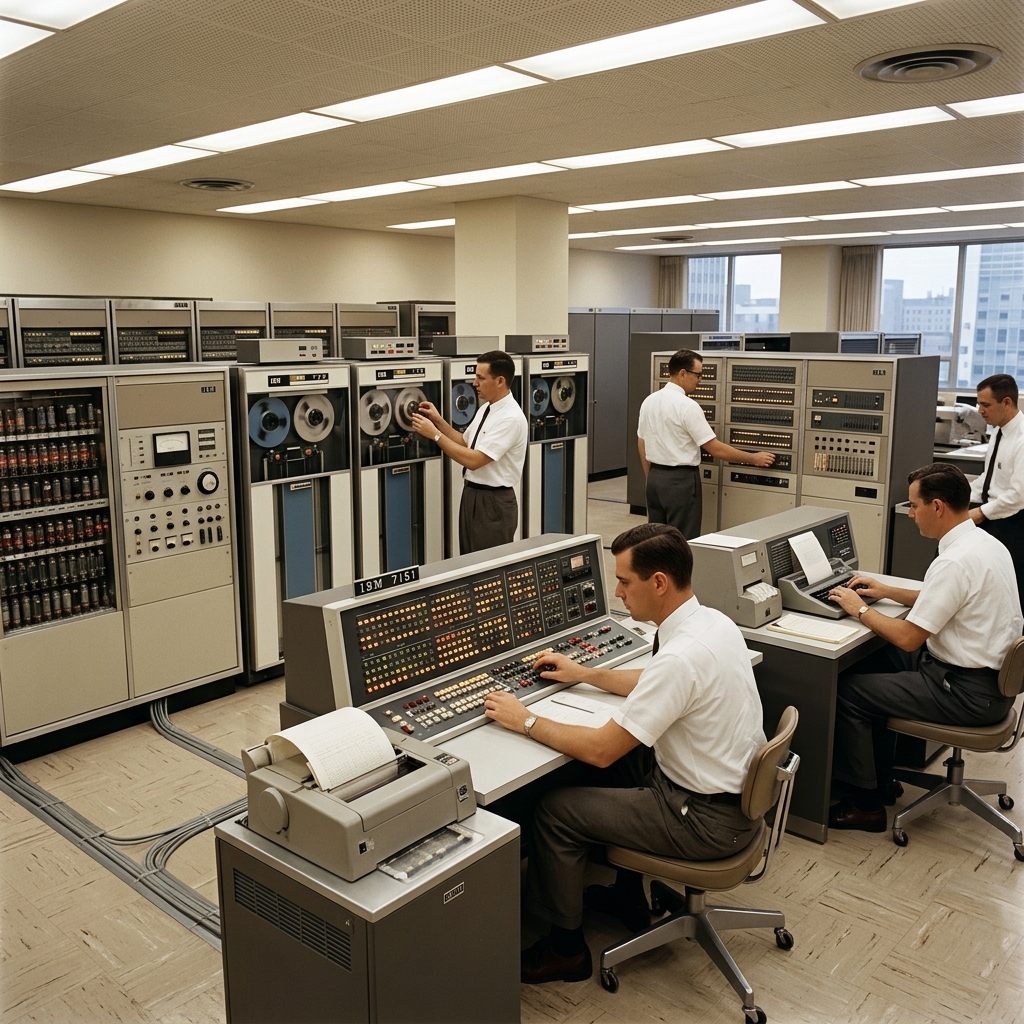
The IBM 7090 was one of the first commercially successful fully transistorized mainframe computers. It represents Kurzweil's Fourth Paradigm, replacing massive, hot, fragile vacuum tubes with tens of thousands of individual, discrete transistors wired together on circuit boards.
Open in interactive timeline →Verified Facts
- It was six times faster than its vacuum-tube predecessor, yet required significantly less power and space.
- The 7090 was the computer used by NASA to control the Mercury and Gemini space flights.
- It was also the computer used in 1961 to synthesize the first computer-generated human voice singing "Daisy Bell"—the exact inspiration for HAL 9000 singing the same song in 2001: A Space Odyssey.
Frequently Asked Questions
What was IBM 7090: The Discrete Transistor Paradigm?
The IBM 7090 was one of the first commercially successful fully transistorized mainframe computers. It represents Kurzweil's Fourth Paradigm, replacing massive, hot, fragile vacuum tubes with tens of thousands of individual, discrete transistors wired together on circuit boards.
When did IBM 7090: The Discrete Transistor Paradigm happen?
IBM 7090: The Discrete Transistor Paradigm: 1959 CE.
Why does IBM 7090: The Discrete Transistor Paradigm matter?
The fourth paradigm: the end of the vacuum tube.
Sources & Further Reading
Cite This Page
AskHistoryAI. “IBM 7090: The Discrete Transistor Paradigm.” AskHistoryAI — Interactive Timeline of Everything. Updated 2026-09-11. https://askhistoryai.com/event/tech-ibm-7090/
Every fact on this page is checked against the published fact ledger and methodology; sources are listed above.