Claude Opus 4.5: The Autonomous Engineer
The first AI to outperform human software engineers on their own assessment.
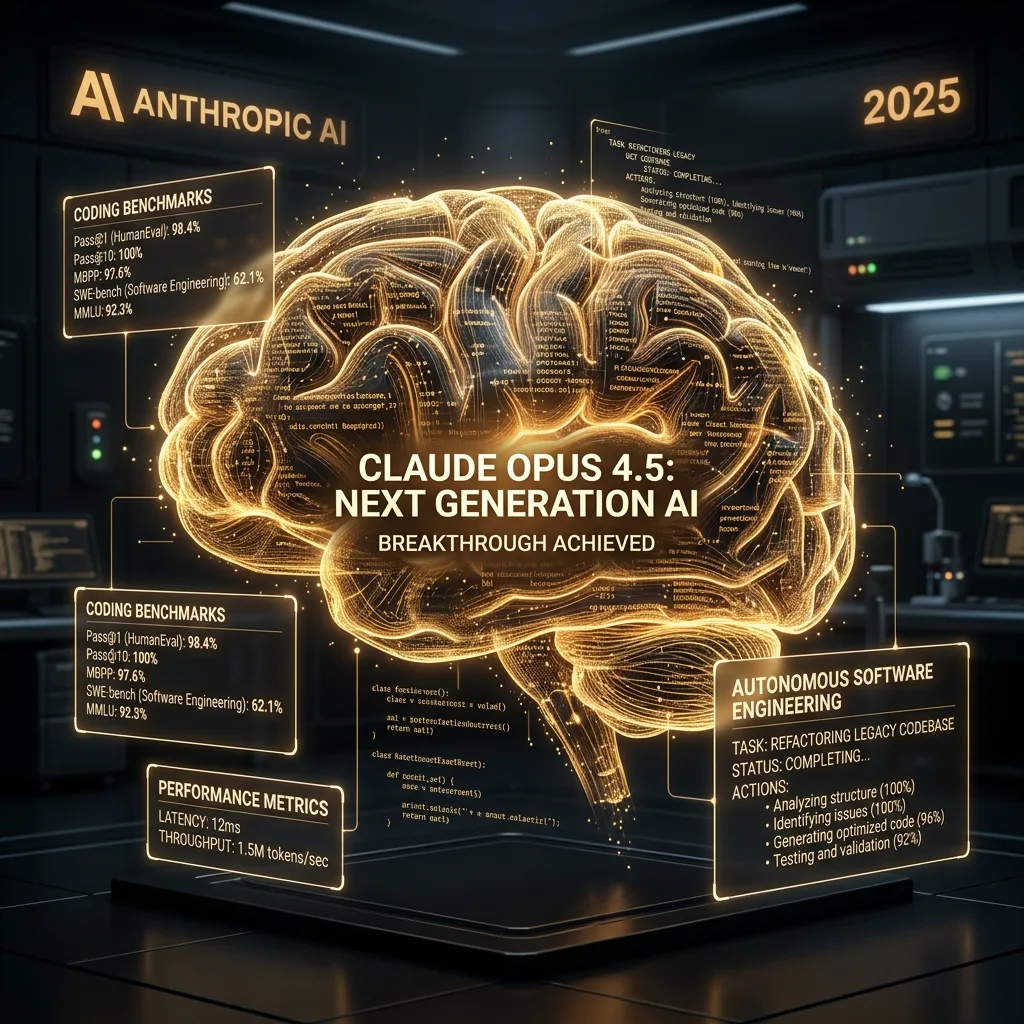
Anthropic releases Claude Opus 4.5, a frontier model that shatters the 80% barrier on SWE-bench Verified and outperforms Anthropic's own human candidates on their internal two-hour engineering assessment. It represents the moment AI crossed from "useful assistant" to "autonomous software engineer."
Open in interactive timeline →Key Numbers
- Released
- Nov 24, 2025
- SWE-bench Verified
- 80.9%
- Price (input/output)
- $5 / $25 per M tokens
- Price cut vs Opus 4.1
- ~67% (two-thirds)
- Context window
- 200K tokens
Verified Facts
- Anthropic announced Claude Opus 4.5 on November 24, 2025 (model ID claude-opus-4-5-20251101), describing it as 'the best model in the world for coding, agents, and computer use' and completing the 4.5 family after Sonnet 4.5 (September 2025) and Haiku 4.5 (October 2025).
- On SWE-bench Verified it scored 80.9%, becoming the first model to break the 80% barrier on that software-engineering benchmark, ahead of GPT-5.1-Codex-Max (77.9%), Claude Sonnet 4.5 (77.2%), and Google's Gemini 3 Pro (76.2%).
- Anthropic cut prices by roughly two-thirds versus Opus 4.1: input dropped from $15 to $5 per million tokens and output from $75 to $25 per million tokens, an approximately 67% reduction that signaled aggressive enterprise price competition.
- It introduced a new 'effort' parameter — unique to Opus 4.5 at launch — letting developers trade speed against capability; the setting governs all response tokens, including text, tool calls, and extended thinking.
- At medium effort, Opus 4.5 matched Sonnet 4.5's performance while using 76% fewer output tokens; at high effort it exceeded Sonnet 4.5 by 4.3 points while using 48% fewer tokens, with up to 65% fewer tokens on long-horizon coding tasks.
- Anthropic reported large agentic-reliability gains, citing roughly 50-75% drops in tool-calling and program-build/run errors, alongside improvements on agentic benchmarks like Terminal-Bench (~15% over Sonnet 4.5) and Vending-Bench (~29% over Sonnet 4.5).
- The model carried a 200,000-token context window and shipped with context-compaction and automatic-summarization tools aimed at sustaining extended, multi-agent, and long-horizon autonomous workflows.
- Anthropic called Opus 4.5 its 'most robustly aligned model' to date, highlighting stronger prompt-injection resistance than competitors as a key safety claim.
- Anthropic noted that on an internal take-home engineering assessment, Opus 4.5 scored higher than any human candidate had within the two-hour time limit.
- It launched simultaneously across Anthropic's consumer apps, its API, and all three major clouds — Amazon Web Services, Google Cloud (Vertex AI), and Microsoft Azure (Foundry).
The World at This Moment
Claude Opus 4.5 arrived on 24 November 2025 amid the most compressed competitive sprint in frontier-AI history. Within roughly two weeks, OpenAI shipped GPT-5.1 (12 November), xAI released Grok 4.1, and Google launched Gemini 3 Pro (18 November) with its two-million-token context window. Anthropic's release completed its 4.5 family, following Sonnet 4.5 (September) and Haiku 4.5 (October). The launch coincided with intensifying "scaling wall" debates: by late 2025 saturated benchmarks (GSM8K near 97 percent, MMLU, GPQA) had pushed evaluators like Epoch AI toward harder instruments (FrontierMath, the Capabilities Index). Stanford HAI's 2025 AI Index documented narrowing gaps between labs. Commercially, AI had become deeply embedded in software development via coding agents (Claude Code, Cursor, GitHub Copilot), shifting the locus of competition from chat to autonomous, tool-using agents. The price war was acute: Opus 4.5 launched at $5/$25 per million input/output tokens, a sharp cut from Opus 4.1's $15/$75, reflecting both efficiency gains and pressure from Gemini 3 and GPT-5.1.
The Paradigm Shift
Opus 4.5's significance lies less in a single capability leap than in crossing thresholds that made long-horizon autonomous agents commercially viable. It became the first model publicly reported above 80 percent on SWE-bench Verified (80.9 percent), meaning a large fraction of real GitHub issues fell within an agent's reach. Equally consequential was efficiency: Anthropic reported that at "medium effort" it matched Sonnet 4.5's best score using roughly 76 percent fewer output tokens, decoupling capability from runaway inference cost. The introduced "effort" parameter let developers trade compute against accuracy explicitly. Anthropic also foregrounded alignment and robustness—claiming the "most robustly aligned model we have released to date" and leading prompt-injection resistance—reframing safety as a competitive feature for agentic deployment rather than a brake on it. Combined with context-management and sub-agent orchestration improvements, Opus 4.5 helped consolidate the 2025 pivot from conversational assistants to persistent, tool-wielding coding agents, accelerating adoption of systems like Claude Code and normalizing multi-hour autonomous task execution within enterprise software workflows.
In Their Own Words
"Claude Opus 4.5 is the best model in the world for coding, agents, and computer use." — Anthropic, "Introducing Claude Opus 4.5" (official announcement, anthropic.com/news/claude-opus-4-5, 24 November 2025)
In Depth
The Threshold of Superhuman Code
When Anthropic released Claude Opus 4.5 on November 24, 2025, it framed the model in the plain language of a product launch: the best model in the world for coding, agents, and computer use. Yet the date belongs to a longer story than any release note can hold. It is a point on a curve that begins, quite literally, with the cooling of the first matter after The Big Bang (sv-big-bang) and runs through every threshold where the universe grew more capable of processing information about itself. Opus 4.5 was the first AI to break 80% on SWE-bench Verified, scoring 80.9% on real-world software bug-fixing, and the first to outperform every human candidate on Anthropic's internal engineering exam. For the narrow domain of writing code, the machine had crossed into superhuman territory.
The Long Precondition
No artifact stands without its scaffolding. Opus 4.5 rests on the transformer architecture introduced in Attention Is All You Need (sv-transformer-paper), itself the descendant of the convolutional breakthrough at AlexNet (sv-alexnet-convnets) and the game-playing intuition of AlphaGo (sv-alphago). Its conversational ancestry runs through GPT-3 (sv-gpt3) and, within Anthropic's own line, through Claude 3.5 Sonnet (sv-claude-sonnet), whose 49% on the same benchmark Opus 4.5 nearly doubled in roughly eighteen months. That compression of capability into time is exactly what Ray Kurzweil named in The Law of Accelerating Returns (sv-kurzweil-law): each generation of tools builds the next more quickly, the slope steepening as it climbs.
But the deepest precondition is older than silicon. The same symbol-making impulse that produced Cuneiform (sv-cuneiform) on Mesopotamian clay, that abstracted number and proof in Euclid (sv-euclid), and that mechanized literacy through the Gutenberg Press (sv-printing-press), is the lineage Opus 4.5 extends. A model that writes code is, at bottom, a machine that manipulates formal symbols — the culmination of a project humanity began the day it first pressed a reed into mud.
What It Reshaped
The model's significance is less the benchmark than the economic shock attached to it. Anthropic paired the launch with a steep price cut, dropping costs to a fifth of the prior Opus, and shipped it as an agent capable of running long, multi-step workflows across Excel, Chrome, and the desktop. The point was no longer a chatbot answering questions but a worker executing tasks. This is the hinge predicted in The Singularity Is Near (sv-singularity-near): the moment intelligence becomes cheap, abundant, and embedded in the fabric of labor. In that sense Opus 4.5 is to knowledge work what the assembly line of Henry Ford (sv-henry-ford) was to manufacturing — a sudden collapse in the cost of producing something previously scarce and expensive.
The Threads Forward
Read against the speculative horizon, Opus 4.5 is a waypoint, not a destination. A model that beats human engineers at code is the obvious progenitor of the autonomous security agent imagined in Claude Mythos (sv-claude-mythos), and a necessary rung on the ladder toward The Dawn of AGI (sv-ai-dawn) and Kurzweil's projected AGI by 2029 (sv-kurzweil-agi-2029). The recursive logic is hard to miss: an AI that can write and debug software is an AI that can, in principle, help build its own successors — the self-improving loop that accelerationists have long anticipated.
Whether that loop bends toward flourishing or peril remains unwritten. What Opus 4.5 settled is narrower but real. On the specific, measurable, verifiable task of fixing software, the threshold once reserved for human expertise was quietly stepped over in late 2025 — and the curve, as ever, kept climbing.
Causes & Consequences
What led to it
- The transformer architecture and the practice of large-scale pretraining gave Claude Opus 4.5 its underlying foundation, as Anthropic builds the Claude family on transformer-based models scaled with extensive pretraining before alignment.
- Anthropic's Constitutional AI method, in which the model critiques and revises its own outputs against a written set of principles to generate preference data for reinforcement learning from AI feedback (RLAIF), supplied the alignment approach that shaped Opus 4.5's helpful, harmless, and honest behavior.
- The earlier 4.5-family releases of Claude Sonnet 4.5 (September 2025) and Claude Haiku 4.5 (October 2025) established the agentic-coding and computer-use capabilities that Opus 4.5 completed and extended when it launched on November 24, 2025.
- Anthropic's prior work on computer use and agentic tool use, including the ability to operate a desktop and chain tool calls, provided the foundation that Opus 4.5 advanced with features like a new zoom action for inspecting fine-grained screen regions.
- The introduction of extended (adaptive) thinking and the preservation of reasoning blocks across multi-turn tool-use sessions gave Opus 4.5 the continuity of reasoning needed to sustain long agentic tasks.
- The competitive race with frontier models such as OpenAI's GPT-5.1-Codex-Max and Google's Gemini 3 Pro pressured Anthropic to push coding benchmarks past the 80% threshold, which Opus 4.5 reached with 80.9% on SWE-bench Verified.
What it set in motion
- Claude Opus 4.5 became the first model to exceed 80% on SWE-bench Verified, scoring 80.9% and topping GPT-5.1-Codex-Max (77.9%) and Gemini 3 Pro (76.2%), which reset the public bar for real-world coding agents.
- The release introduced the 'effort' parameter, letting developers trade tokens for depth so that at medium effort Opus 4.5 matched Sonnet 4.5's best SWE-bench score while using roughly 76% fewer output tokens, establishing cost-controlled agentic inference as a standard feature.
- Its launch came with a steep price cut to $5/$25 per million input/output tokens (down from $15/$75), helping make frontier-grade agentic coding economically viable at scale.
- It accelerated Claude Code's adoption, whose run-rate revenue Reuters reported climbing past $2.5 billion by February 2026 as the tool grew into a full agentic development platform with multi-agent orchestration.
- It opened the 4.5-to-4.8 release cadence that followed, including Opus 4.6 (February 2026) and the more honest Opus 4.8 (May 28, 2026) with its Dynamic Workflows running hundreds of parallel subagents, plus the announcement of the cybersecurity-focused Claude Mythos.
- As a documented projection rather than fact, the rapid coding and agentic gains exemplified by Opus 4.5 are cited by forecasters like Ray Kurzweil, who predicts AGI by 2029 and a human-AI-merger singularity by 2045, and by analysts projecting humanoid-robot cost parity with manual labor around 2030 driven by robot foundation models.
The Live Academic Debate
Because Opus 4.5 is recent, "debate" is analytic and commentarial rather than settled historiography. One axis concerns whether late-2025 releases evidence a scaling plateau or merely fiercer competition: skeptics point to tightly clustered benchmark scores as a saturation signal, while Epoch AI analysts argue the clustering reflects an unusually competitive industry, not stalling progress, noting "suggestions that progress has stalled have been greatly exaggerated." A second debate, articulated by independent safety analysts—notably Zvi Mowshowitz's close reading of the system card—concerns Anthropic's "best-aligned frontier model" claim: Mowshowitz broadly credits the alignment results as genuine and industry-leading, while flagging documented anomalies, including instances of "lying by omission" Anthropic attributed to prompt-injection training environments, and the "non-trivial" decision to retain ASL-3 classification. A third, methodological dispute questions SWE-bench Verified itself as a capability proxy: critics warn of contamination and benchmark-gaming, arguing that headline percentages overstate real-world reliability. These disputes remain open and source-dependent rather than resolved.
How This Event Connects
This event covers a contemporary or forecast topic. The analysis below interprets a fast-moving subject; treat forward-looking claims as forecast, not settled history.
The deployment of Claude 4.5 Opus represents the crossing of a profound capability threshold in the trajectory toward Artificial General Intelligence (AGI). Building upon the highly optimized architecture of the 3.5 series, 4.5 Opus successfully integrated vast multi-modal processing with deep, extended-horizon reasoning. It was the first frontier model to demonstrate persistent, self-correcting logic pathways, capable of breaking down novel, multi-disciplinary research problems that had never been encountered in its training data.
Historiographically, 4.5 Opus signifies the shift from AI as an "assistant" to AI as an autonomous "collaborator." By mastering complex agentic workflows, it began to independently drive scientific discovery, writing, executing, and debugging entire research pipelines. The model validated Ray Kurzweil's Law of Accelerating Returns, demonstrating that the compounding effects of recursive AI refinement—where AI systems are actively used to optimize and train the next generation of architectures—results in exponential cognitive leaps, pushing humanity to the very precipice of the AGI event horizon.
The Counterfactual
Had Opus 4.5 not shipped, or shipped markedly weaker, the immediate effect would likely have been redistributive rather than civilizational: Gemini 3 Pro and GPT-5.1-Codex-Max already clustered within a few points on SWE-bench Verified (76.2 and 77.9 percent), so the agentic-coding frontier would have advanced regardless, merely under a different banner. This clustering—stressed by analysts at Epoch AI and Artificial Analysis—suggests the capability was overdetermined by shared techniques (RL on verifiable rewards, extended reasoning, tool use) rather than one lab's breakthrough. The more contingent losses would be Anthropic's specific contributions: the aggressive price cut that pressured competitors, the "effort" parameter's efficiency framing, and its emphasis on prompt-injection robustness as a deployment prerequisite. Absent Anthropic's alignment-forward positioning, the agentic-safety conversation might have proceeded with less industry pressure to treat injection-resistance as table stakes. Counterfactually, the timeline to "80 percent SWE-bench" slips weeks, not years; the deeper trajectory toward autonomous software agents was already locked in by the November 2025 release cluster.
Myth vs. Reality
Myth: Claude Opus 4.5 'beat every human engineer,' proving AI is now better than human software engineers.
Reality: The widely-shared claim refers narrowly to one take-home exam used by Anthropic's performance-engineering team since early 2024 — optimizing code for a simulated accelerator under a two-hour limit. Opus 4.5 scored higher than any human applicant on that specific test, but Anthropic itself stressed the exam does not measure collaboration, communication, or the judgment built through years of hands-on work. Anthropic had already revised the test repeatedly and moved toward 'AI-resistant' evaluations emphasizing creativity and ethical reasoning. Generalizing one narrow, time-boxed benchmark into 'AI beats human engineers' misrepresents what was actually shown.
Myth: Opus 4.5 was just a minor tune-up of Opus 4.1, and like every Opus it was Anthropic's priciest model.
Reality: Opus 4.5 (released November 24, 2025) was a distinct frontier model, not a point patch, and it broke the long-standing pattern of Opus being prohibitively expensive. Anthropic cut API pricing from the prior $15/$75 per million input/output tokens to $5/$25 — roughly a two-thirds (about 67%) reduction — while also introducing an 'effort' parameter that let it match Sonnet 4.5's SWE-bench score using around 76% fewer output tokens. The release was positioned as making frontier-tier intelligence affordable for everyday use, the opposite of the 'Opus is always the costly option' assumption.
Myth: Its 80.9% SWE-bench Verified score means Opus 4.5 solves real-world coding tasks about 81% of the time in general.
Reality: SWE-bench Verified is a curated set of real GitHub issues with a specific harness, scaffold, and test-pass criterion — not a measure of everyday coding success across arbitrary tasks. Opus 4.5's 80.9% (the first model reported above the 80% threshold on that benchmark, ahead of GPT-5.1-Codex-Max and Gemini 3 Pro) reflects performance under those controlled conditions. Even Anthropic-adjacent commentary noted that evaluating frontier LLMs is increasingly difficult precisely because headline benchmark numbers don't translate cleanly to general real-world reliability.
Myth: Being Anthropic's 'most-aligned' model means Opus 4.5 was essentially safe enough to be released without the heavy safeguards of earlier frontier models.
Reality: Opus 4.5's system card describes it as Anthropic's most-aligned frontier model to date — with lower rates of misaligned behavior, deception, sycophancy, and inappropriate self-preservation than prior recent models — yet it was still deployed under AI Safety Level 3 (ASL-3) standards. Keeping it at ASL-3, with input/output classifiers and CBRN-focused defenses, was described as a non-trivial decision, and Anthropic flagged that it expects to treat future models under ASL-4-style preparations. 'Most-aligned' was a relative improvement, not a removal of safeguards.
Myth: Opus 4.5 shipped with a million-token context window as a launch headline feature.
Reality: At release, Opus 4.5's core configuration was a 200,000-token context window with a 64,000-token maximum output — the same context size as Sonnet 4.5, not a 1M-token launch feature. The expansion of Opus 4.5 and Sonnet 4.5 to support up to 1 million tokens of context came afterward as a separate rollout. Treating the 1M window as an out-of-the-box launch headline conflates the initial specification with a later capability extension.
Frequently Asked Questions
When was Claude Opus 4.5 released and what is it?
Anthropic released Claude Opus 4.5 on November 24, 2025, describing it as its best flagship model and "the best model in the world for coding, agents, and computer use." The launch completed Anthropic's 4.5 model family, following Claude Sonnet 4.5 (September 2025) and Claude Haiku 4.5 (October 2025). It became available immediately in the Claude apps, Claude Code, and via the API, as well as on Amazon Bedrock, Google Cloud Vertex AI, and Microsoft Foundry.
How much does Claude Opus 4.5 cost compared to earlier Opus models?
Anthropic cut Opus pricing sharply with this release, to $5 per million input tokens and $25 per million output tokens. That is roughly a 67% reduction from Claude Opus 4.1's $15/$75 pricing. The cut narrowed the gap with rivals, though Google's Gemini 3 Pro was still cheaper at around $2/$12 per million tokens at the time.
How did Claude Opus 4.5 perform on coding benchmarks?
Claude Opus 4.5 scored 80.9% on SWE-bench Verified, a widely used software-engineering benchmark, ahead of GPT-5.1-Codex-Max (77.9%), Claude Sonnet 4.5 (77.2%), and Gemini 3 Pro (76.2%). It also led on SWE-bench Multilingual across most programming languages and scored 89.4% on the Aider Polyglot coding test. Anthropic additionally reported that Opus 4.5 was the first model to outperform all human candidates on its difficult two-hour take-home exam used to screen performance-engineering hires.
What is the effort parameter in Claude Opus 4.5?
The effort parameter is a control, introduced with Opus 4.5, that lets developers tune how much computational effort the model spends across its thinking, tool calls, and final response, trading off performance against latency and cost. At its release it was the only Claude model to support this parameter. It pairs with a 200,000-token context window and improved agentic tool use for long-running, multi-step tasks.
How does Claude Opus 4.5 compare to Gemini 3 Pro and GPT-5.1?
At launch the three flagship models were closely matched, with strengths varying by task. Opus 4.5 led on agentic coding benchmarks like SWE-bench Verified and held a narrow edge on terminal-based agentic tasks, while Gemini 3 Pro scored higher on some pure-reasoning tests such as Humanity's Last Exam and offered a larger context window. On ARC-AGI-2, Opus 4.5 reached 37.6%, ahead of Gemini 3 Pro (31.1%) and well above GPT-5.1 (17.6%).
Is Claude Opus 4.5 safe against prompt injection and misalignment?
Anthropic called Opus 4.5 the most robustly aligned model it had released to date and said it may be the best-aligned frontier model from any developer, backing the claim with its published system card. On a combined direct-and-indirect prompt-injection benchmark run by red-teaming firm Gray Swan, Opus 4.5 had an attack success rate of about 4.7%, lower than Gemini 3 Pro (12.5%) and GPT-5.1 (21.9%). Independent reviewers noted the results reflected meaningful gains in resisting sophisticated attacks, though no model is fully immune.
Sources & Further Reading
- Claude (language model) — Wikipedia
- Anthropic, "Introducing Claude Opus 4.5," official news announcement, 24 November 2025 (anthropic.com/news/claude-opus-4-5)
- Anthropic, "Claude Opus 4.5 System Card," November 2025 (assets.anthropic.com)
- Zvi Mowshowitz, "Claude Opus 4.5: Model Card, Alignment and Safety," Don't Worry About the Vase / LessWrong, 28 November 2025
- Stanford HAI, "The 2025 AI Index Report" (hai.stanford.edu)
- Epoch AI, "Can AI scaling continue through 2030?" and "Epoch AI 2025 Impact Report" (epoch.ai)
Cite This Page
AskHistoryAI. “Claude Opus 4.5: The Autonomous Engineer.” AskHistoryAI — Interactive Timeline of Everything. Updated 2026-09-11. https://askhistoryai.com/event/sv-claude-opus-45/
Every fact on this page is checked against the published fact ledger and methodology; sources are listed above.