Deep Blue Defeats Kasparov
The moment a machine outthought humanity's greatest chess mind.
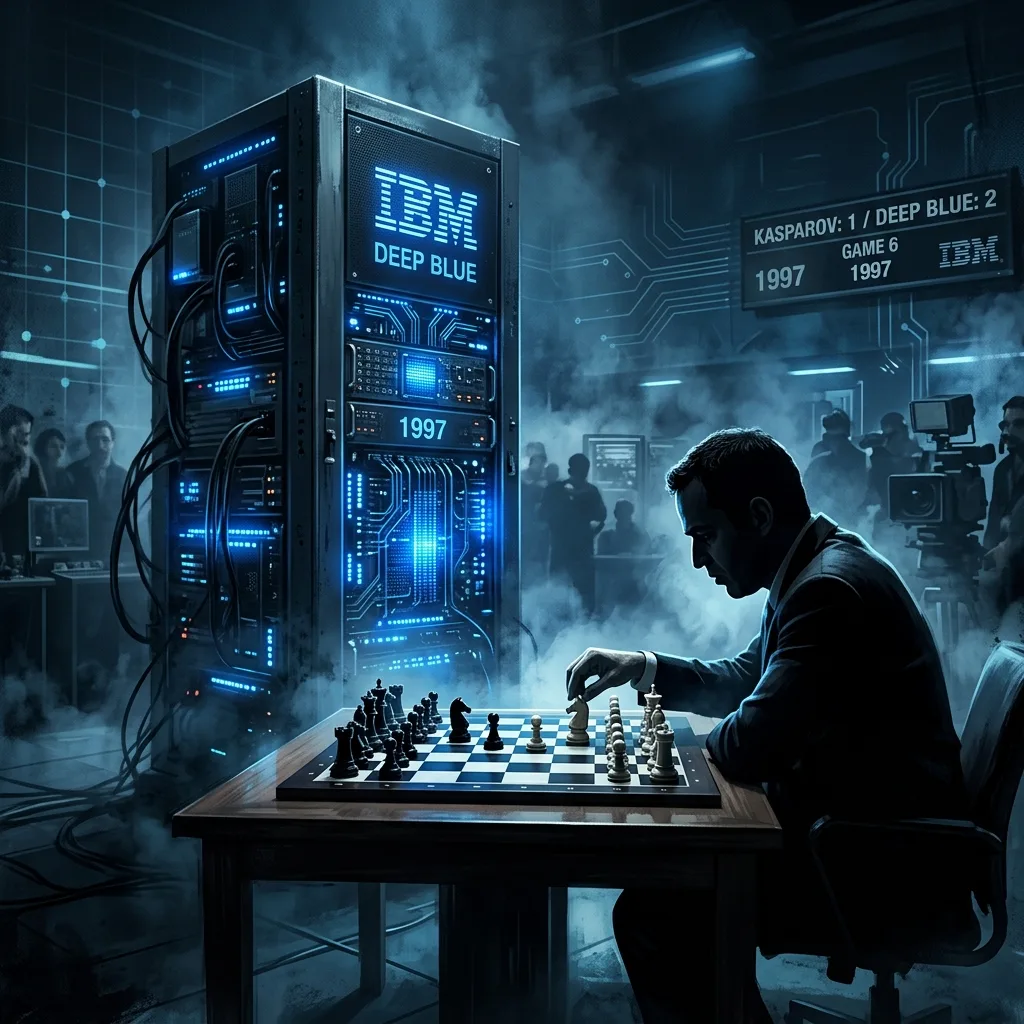
IBM's Deep Blue supercomputer defeats reigning world chess champion Garry Kasparov in a six-game match, becoming the first computer system to defeat a world champion under standard tournament conditions. The event stunned the world and forced humanity to confront the reality that machines could outperform humans in domains once considered the pinnacle of human intellect.
Open in interactive timeline →Key Numbers
- Final score (1997)
- Deep Blue 3.5 – 2.5 Kasparov
- Positions per second
- ~200 million
- Processors
- 30 nodes + 480 chess chips
- Game 6 length
- 19 moves
- Winner's prize
- $700,000 (of $1.1M fund)
Verified Facts
- The decisive rematch ran May 3–11, 1997, in New York City; Deep Blue clinched it by winning Game 6 to take the six-game match 3.5–2.5, becoming the first computer to beat a reigning world champion under standard tournament time controls.
- This was a rematch: in the first encounter in Philadelphia in February 1996, Garry Kasparov won 4–2, though Deep Blue won Game 1 of that match — the first time a computer beat a world champion in a single game under tournament conditions.
- The 1997 machine was an IBM RS/6000 SP massively parallel system with 30 PowerPC 604e 200 MHz processors augmented by 480 custom VLSI 'chess chips,' letting it evaluate roughly 200 million chess positions per second.
- Game 6, the clincher, lasted only 19 moves: Kasparov played the Caro-Kann Defence and walked into a known knight sacrifice (Nxe6) that shattered his position, forcing one of the shortest resignations of his career.
- Game 2 became the match's central controversy — Kasparov was so unsettled by a subtle, 'human-like' positional move (the program declined to grab a pawn with 36.axb5) that he came to suspect human intervention and never recovered psychologically.
- In Game 1 of 1997, Deep Blue's 44th move was later revealed to be the product of a software bug: unable to choose, the program fell back to a random move; team members suggested this odd move may have fed Kasparov's later suspicions about the machine's strength.
- The project traces to Feng-hsiung Hsu's 'ChipTest' and 'Deep Thought' machines at Carnegie Mellon in the late 1980s; IBM hired Hsu and Murray Campbell and renamed the effort 'Deep Blue' in 1991.
- Kasparov accused IBM of cheating and demanded a rematch; IBM declined, retired Deep Blue, and partly dismantled it — keeping the $700,000 winner's share of the $1.1 million prize fund (Kasparov received $400,000 as runner-up).
- The match is widely cited as a milestone in computing history and an early demonstration of brute-force, massively parallel search applied to a problem long held up as a benchmark of human intellect, foreshadowing later AI achievements.
The World at This Moment
The rematch ran 3-11 May 1997 in the Equitable Center, New York, amid a triumphalist moment for American information technology. The dot-com boom was accelerating: Amazon had IPO'd days earlier (15 May), and the web was moving from novelty to infrastructure. IBM, recovering from its early-1990s near-collapse under Lou Gerstner, staged the match partly as marketing; its stock reportedly rose after the win. In AI proper, the field was in the long "AI winter" thaw, dominated not by neural networks but by symbolic methods and brute-force search—the paradigm Deep Blue embodied. Statistical machine learning was ascendant in research labs, but the deep-learning revolution lay a decade off (AlexNet, 2012). Contemporaneously, Dolly the sheep (announced February 1997) symbolized biotechnology's frontier, and the Mars Pathfinder landed that July. Kasparov himself, then 34 and arguably the strongest player in history, was at his peak. The spectacle drew enormous global media coverage, framed as "man versus machine," a narrative IBM cultivated and Kasparov, by his own later account, found psychologically destabilizing.
The Paradigm Shift
Deep Blue's victory was the first defeat of a reigning world champion by a machine in a classical match under tournament conditions, and it punctured a symbolic boundary that had stood since Turing and Shannon speculated about chess as an AI benchmark in the 1950s. Yet its deeper significance is paradoxical. Deep Blue won not through anything resembling human cognition but through specialized hardware evaluating roughly 200 million positions per second via alpha-beta search over a grandmaster-tuned evaluation function. As Kasparov later argued in Deep Thinking (2017), it was "brute force," not insight. The lesson the field absorbed—articulated by figures like Murray Campbell and later by researchers reflecting on AlphaGo—was that beating humans at a hard task does not require replicating human thought. This reframed AI's ambitions: away from emulating the mind, toward exploiting computation and, eventually, learning from data. The match also seeded the "big data"/scaling intuition that machine performance climbs with raw computational throughput, a conviction that would underwrite deep learning and, later, large language models.
In Their Own Words
"I have been asked, 'Did Deep Blue cheat?' more times than I could possibly count, and my honest answer has always been 'I don't know.' After twenty years of soul-searching, revelations, and analysis, my answer is now 'no." — Garry Kasparov, Deep Thinking: Where Machine Intelligence Ends and Human Creativity Begins (2017)
In Depth
The Machine That Out-Calculated a King
On May 11, 1997, in a Manhattan high-rise, world chess champion Garry Kasparov resigned after nineteen moves against IBM's Deep Blue, losing the six-game rematch 3.5–2.5. It was the first time a reigning world champion had been defeated by a machine in a classical match under standard time controls. The moment was small in motion — a man pushing back from a board — but vast in meaning: a domain humans had taken as the very emblem of intellect for over a thousand years had been conquered by silicon.
The Long Road to 200 Million Positions a Second
Deep Blue was not a sudden miracle but the endpoint of a deep chain of preconditions. Its logic descended from the formal reasoning of Aristotle (sv-aristotle) and the geometric rigor of Euclid (sv-euclid), whose proof-based thinking taught the West that knowledge could be mechanized into rules. The physical machine was a child of the Industrial Revolution (sv-industrial-revolution) and the electrical age opened by Michael Faraday (sv-michael-faraday) and Nikola Tesla (sv-nikola-tesla) — without harnessed electromagnetism there is no transistor, no clock cycle, no compute. Deep Blue did not think as Kasparov thought. It evaluated roughly 200 million positions per second through brute-force search, an avalanche of calculation no human could match. Where Kasparov pruned the tree with intuition honed over a lifetime, the machine simply looked at almost everything. It was the triumph of scale over insight — a quiet rehearsal of a lesson the field would learn again and again.
What It Broke, and What It Started
Symbolically, Deep Blue closed an era. Chess had been a benchmark for machine intelligence since the field's founding, and its fall punctured the assumption that calculation-heavy mastery was uniquely human. Yet philosophically the victory was hollow in a revealing way: Deep Blue knew nothing of chess as meaning. It did not learn; it was programmed, hand-tuned by grandmasters and engineers. This was the high-water mark of "good old-fashioned AI" — intelligence as explicit rules and exhaustive search.
That very hollowness set up everything after. The next paradigm would not out-calculate humans but out-*learn* them. When AlphaGo (sv-alphago) defeated Lee Sedol in 2016, it did so in Go — a game with more positions than atoms in the observable universe, where brute force is impossible. AlphaGo's "Move 37," a stone no human had played in 2,500 years, demonstrated something Deep Blue never could: creativity emerging from learning rather than enumeration. The lineage runs straight through AlexNet (sv-alexnet-convnets) and the deep-learning revolution, into the Transformer (sv-transformer-paper) and the GPT-3 (sv-gpt3) insight that scale itself yields capability — the same scale-over-insight bargain Deep Blue struck, now applied to learning systems.
A Node in the Acceleration
Deep Blue arrived the same decade as the World Wide Web (sv-www), twin signs that computation was moving from tool to actor. To Ray Kurzweil it was a data point on the Law of Accelerating Returns (sv-kurzweil-law) — exponential progress carrying toward AGI by 2029 (sv-kurzweil-agi-2029) and beyond. Tellingly, Kasparov did not retreat into despair. He pioneered "advanced chess," human and machine in partnership, foreshadowing the collaborative future that systems like Claude 3.5 Sonnet (sv-claude-sonnet) now inhabit. Deep Blue proved a machine could win. The harder, stranger question it opened — whether a machine could understand — is the one history is still answering.
Sources: HISTORY, The Conversation, Wikipedia: Deep Blue versus Garry Kasparov.
Causes & Consequences
What led to it
- Claude Shannon's 1950 paper 'Programming a Computer for Playing Chess' laid the theoretical foundation by proposing the minimax search algorithm and distinguishing 'Type A' brute-force search from 'Type B' selective search, the framework all later chess engines built upon.
- The alpha-beta pruning technique, first formulated by John McCarthy around the 1956 Dartmouth conference and refined in the following decades, made deep game-tree search computationally feasible by discarding branches that could not affect the outcome.
- Beginning in 1985, Carnegie Mellon doctoral student Feng-hsiung Hsu, with collaborators Thomas Anantharaman, Murray Campbell, Mike Browne and Andreas Nowatzyk, built the ChipTest and Deep Thought machines, with ChipTest winning the 1987 North American Computer Chess Championship.
- In the early 1990s IBM hired Hsu, Campbell and Anantharaman, renaming the project 'Deep Blue' in 1993 (a blend of 'Deep Thought' and IBM's 'Big Blue' nickname) and backing it with corporate resources and custom silicon.
- IBM engineers designed purpose-built VLSI 'chess chips' and a massively parallel RS/6000 SP supercomputer; the 1997 machine used 30 PowerPC 604e processors driving 480 custom chess chips to evaluate roughly 200 million positions per second.
- Kasparov's 4-2 victory over an earlier Deep Blue in Philadelphia in February 1996 (in which the machine won the first game) exposed the engine's weaknesses and directly motivated the hardware and evaluation upgrades that produced the stronger 1997 rematch version.
What it set in motion
- On May 11, 1997, Deep Blue won the final game and the six-game rematch 3.5-2.5, becoming the first computer to defeat a reigning world chess champion under standard tournament time controls, a result widely reported as a milestone in artificial intelligence.
- The victory fulfilled Ray Kurzweil's documented prediction in his 1990 book 'The Age of Intelligent Machines' that a computer would beat the world chess champion by 2000, lending credibility to his later projections of human-level AI by 2029 and a technological Singularity.
- It cemented IBM's reputation as an AI innovator and helped pave the way for IBM's Watson system, which used machine learning and natural-language processing to defeat Jeopardy! champions Ken Jennings and Brad Rutter in 2011.
- Deep Blue's reliance on brute-force search highlighted the limits of hand-engineered systems and helped motivate a shift toward learning-based approaches, exemplified when DeepMind's AlphaGo defeated Go champion Lee Sedol in 2016 using deep neural networks and reinforcement learning.
- The match became a cultural touchstone for the 'man versus machine' narrative, and Kasparov publicly retracted in 2016 his earlier suspicion that human intervention had aided Deep Blue, later becoming an advocate for human-AI collaboration ('centaur') models.
- The 1997 result is frequently cited as an early data point in projections that machines will progressively match or exceed human capability across domains, foreshadowing later debates about artificial general intelligence, large language models such as Claude, and forecasts of humanoid-robot parity with human dexterity (claims that remain documented predictions rather than established fact).
The Live Academic Debate
The central dispute is interpretive: did Deep Blue's win signify genuine machine "intelligence," or merely the triumph of specialized brute-force search? Critics in the philosophy of AI—echoing Hubert Dreyfus and John Searle—hold that Deep Blue understood nothing, lacking intentionality; it was an engineering feat, not a cognitive one. Kasparov himself converged on this view, calling it calculation rather than insight. A second, factual controversy concerns the 1997 result's integrity. Kasparov initially alleged human intervention, likening a Game 2 move to Maradona's "Hand of God"; the IBM team (Feng-hsiung Hsu, Murray Campbell) denied it. Nate Silver and others argue the decisive psychological blow came from a Game 1 bug—a random fail-safe move Kasparov misread as superhuman depth—a reading Campbell has endorsed. Notably, Kasparov retracted the cheating charge in Deep Thinking (2017). Historians of AI (e.g., contributors framing the match as launching "big data" thinking) further debate whether 1997 was a genuine turning point or a media-amplified symbol of trends already underway.
How This Event Connects
The 1997 chess match between IBM's Deep Blue and reigning World Champion Garry Kasparov stands as a monumental psychological threshold in the history of artificial intelligence. For decades, chess was viewed as the ultimate benchmark of human intellectual superiority, a game requiring intuition, strategic foresight, and creativity. Deep Blue's victory shattered this anthropocentric assumption, proving that brute-force computational power and sophisticated heuristics could outmaneuver the pinnacle of human cognitive strategy in a closed system.
Historiographically, the match highlighted the divergence between human and machine intelligence. Deep Blue did not "understand" chess; it evaluated 200 million positions per second using alpha-beta search algorithms and custom VLSI chips. This demonstrated that highly complex, seemingly intuitive tasks could be mathematically decomposed and solved via massive parallel computation. The psychological impact on Kasparov, who alleged IBM cheated because he perceived "human-like" creativity in the machine's moves, foreshadowed the modern profound unease humanity faces as generalized AI models begin to exhibit emergent, inscrutable behaviors.
The Counterfactual
Had Kasparov drawn or won—as he had in 1996 (4-2) and nearly did in 1997, where Game 2 and his final-game collapse proved decisive—the immediate symbolic shock would have been deferred, but not the underlying trajectory. Chess engines' exponential improvement was structural; by the early 2000s programs running on commodity hardware (Fritz, later Rybka and Stockfish) surpassed all humans regardless of the 1997 result. So the "machines beat humans at chess" milestone was overdetermined; only its date and dramatic framing hinged on this match. The more contingent loss was institutional: IBM retired Deep Blue and refused a rematch, denying a controlled re-test. Counterfactually, a Kasparov win might have prolonged public faith in human supremacy and dampened IBM's appetite for showcase "grand challenge" AI—arguably delaying the lineage that ran through Watson (2011). Nate Silver's account (The Signal and the Noise, 2012) suggests a still narrower contingency: a Game 1 software bug producing a baffling move may have psychologically rattled Kasparov, plausibly altering the outcome.
Myth vs. Reality
Myth: Deep Blue's 1997 win was the first time a computer ever beat the reigning world chess champion.
Reality: The historic first came a year earlier. In the 1996 match in Philadelphia, Deep Blue won Game 1, the first time a computer defeated a reigning world champion in a single game under standard tournament time controls. Kasparov went on to win that 1996 match overall, 4-2. What made 1997 different was that Deep Blue won the entire six-game match (3.5-2.5), not just one game. The 'first computer to beat the world champion' headline conflates two distinct milestones a year apart.
Myth: Deep Blue crushed Kasparov, winning decisively.
Reality: The 1997 match was extremely close: 3.5-2.5 over six games. Counting only decisive games, the score was nearly even. Kasparov won Game 1, Deep Blue won Game 2, Games 3, 4 and 5 were drawn (Kasparov did not win Game 5; it was a draw), and Deep Blue won the deciding Game 6, which lasted under 20 moves after Kasparov fell into a known opening trap. The outcome hinged on a single game and a single blunder, not a dominant performance.
Myth: Deep Blue was an artificial intelligence that learned chess and thought like a human.
Reality: Deep Blue did not learn or use machine learning in the modern sense. As described by its own creators Feng-hsiung Hsu, Murray Campbell and A. Joseph Hoane in their published technical papers, it was a massively parallel, special-purpose system that searched by brute force, evaluating roughly 200 million positions per second across custom chips, guided by a hand-tuned evaluation function and grandmaster-curated opening and endgame data. It is a landmark in computing, but it embodied search-and-heuristics, not neural-network learning of the kind associated with later systems like AlphaZero.
Myth: Kasparov's strange loss in Game 1 of the rematch proved Deep Blue had superhuman insight, and Kasparov maintained IBM cheated.
Reality: A widely cited account (drawn from interviews with the Deep Blue team, including in Nate Silver's reporting) holds that on move 44 of Game 1, Deep Blue, unable to choose, fell back to a safety routine and played a near-random move. Kasparov reportedly read deep strategy into the inexplicable move and was rattled. Kasparov suspected human intervention and asked for the machine's logs, which IBM initially withheld. However, in a 2016 interview Kasparov walked back his cheating accusations, saying his earlier conclusions had been mistaken.
Myth: It is an established fact that IBM cheated by having a grandmaster secretly guide Deep Blue's moves.
Reality: No credible evidence has ever shown that a human chose Deep Blue's moves during play. The match rules did permit IBM's team to adjust the program between games, which they used to patch weaknesses, and IBM's secrecy around the logs and machine fueled reasonable suspicion among players and journalists. But the historical and technical consensus is that the cheating claim is unproven; the controversy is better understood as one about transparency and rule ambiguity than as demonstrated fraud.
Frequently Asked Questions
When did Deep Blue beat Garry Kasparov, and what was the final score?
IBM's Deep Blue defeated world chess champion Garry Kasparov on May 11, 1997, when Kasparov resigned the sixth and final game of the rematch in New York City. The match, which began on May 3, 1997, ended 3.5–2.5 in Deep Blue's favor. It was the first time a computer defeated a reigning world champion in a full match under standard tournament time controls.
Didn't Kasparov beat Deep Blue the first time they played?
Yes. In their first match, held in Philadelphia in February 1996, Kasparov won 4–2. However, Deep Blue won the very first game of that 1996 match, marking the first time a reigning world champion lost a game to a computer under tournament conditions. IBM then upgraded the machine for the 1997 rematch, which Deep Blue won.
How powerful was Deep Blue and who built it?
In its 1997 configuration, Deep Blue was a massively parallel IBM RS/6000 SP-based system using 30 processing nodes augmented with 480 special-purpose VLSI chess chips, capable of evaluating about 200 million chess positions per second. It was developed by an IBM research team that grew out of Carnegie Mellon University, led by Feng-hsiung Hsu and Murray Campbell, among others. Hsu's earlier machines, ChipTest and Deep Thought, were the project's direct ancestors.
Did Kasparov accuse IBM of cheating?
Yes. Kasparov was rattled by a move in Game 2 (move 36) that struck him as too subtle and human-like, and he suggested a grandmaster might have intervened, famously implying a human operator was behind the machine. He demanded Deep Blue's computer logs and IBM declined a rematch, fueling his suspicions. Years later, Kasparov walked back the accusation; the IBM team has explained that a software bug, not human cheating, produced some of the puzzling behavior he observed.
Was Deep Blue actually intelligent, or did it just use brute force?
Deep Blue relied primarily on brute-force search, evaluating hundreds of millions of positions per second combined with handcrafted evaluation functions and opening and endgame databases, rather than learning or general reasoning. It had no understanding of chess as a concept and could not, for example, discuss the game it was playing. For this reason many scholars argue it demonstrated raw computational power rather than human-like intelligence, a distinction that contrasts sharply with later machine-learning systems.
What happened to Deep Blue after the match, and why does it matter?
IBM declined Kasparov's request for a rematch and retired the Deep Blue project shortly after the 1997 victory; one of its two racks is now held by the Smithsonian. The match is widely regarded as a landmark in computing history, a symbolic moment when a machine surpassed the best human in a domain long associated with intelligence. It helped popularize massively parallel computing and is often cited as a precursor to later AI milestones in fields from big data to game-playing systems like AlphaGo.
Sources & Further Reading
- Deep Blue versus Garry Kasparov — Wikipedia
- Garry Kasparov, Deep Thinking: Where Machine Intelligence Ends and Human Creativity Begins (PublicAffairs, 2017)
- Feng-hsiung Hsu, Behind Deep Blue: Building the Computer That Defeated the World Chess Champion (Princeton University Press, 2002)
- Nate Silver, The Signal and the Noise: Why So Many Predictions Fail—but Some Don't (Penguin, 2012), ch. 9
- Murray Campbell, A. Joseph Hoane Jr., and Feng-hsiung Hsu, 'Deep Blue,' Artificial Intelligence 134, nos. 1-2 (2002): 57-83
- Bruce Weber, 'Swift and Slashing, Computer Topples Kasparov,' The New York Times, May 12, 1997
- IBM: Deep Blue
Cite This Page
AskHistoryAI. “Deep Blue Defeats Kasparov.” AskHistoryAI — Interactive Timeline of Everything. Updated 2026-09-11. https://askhistoryai.com/event/sv-deep-blue/
Every fact on this page is checked against the published fact ledger and methodology; sources are listed above.