The Edict of Caracalla
Every free person in the Roman Empire becomes a citizen overnight.
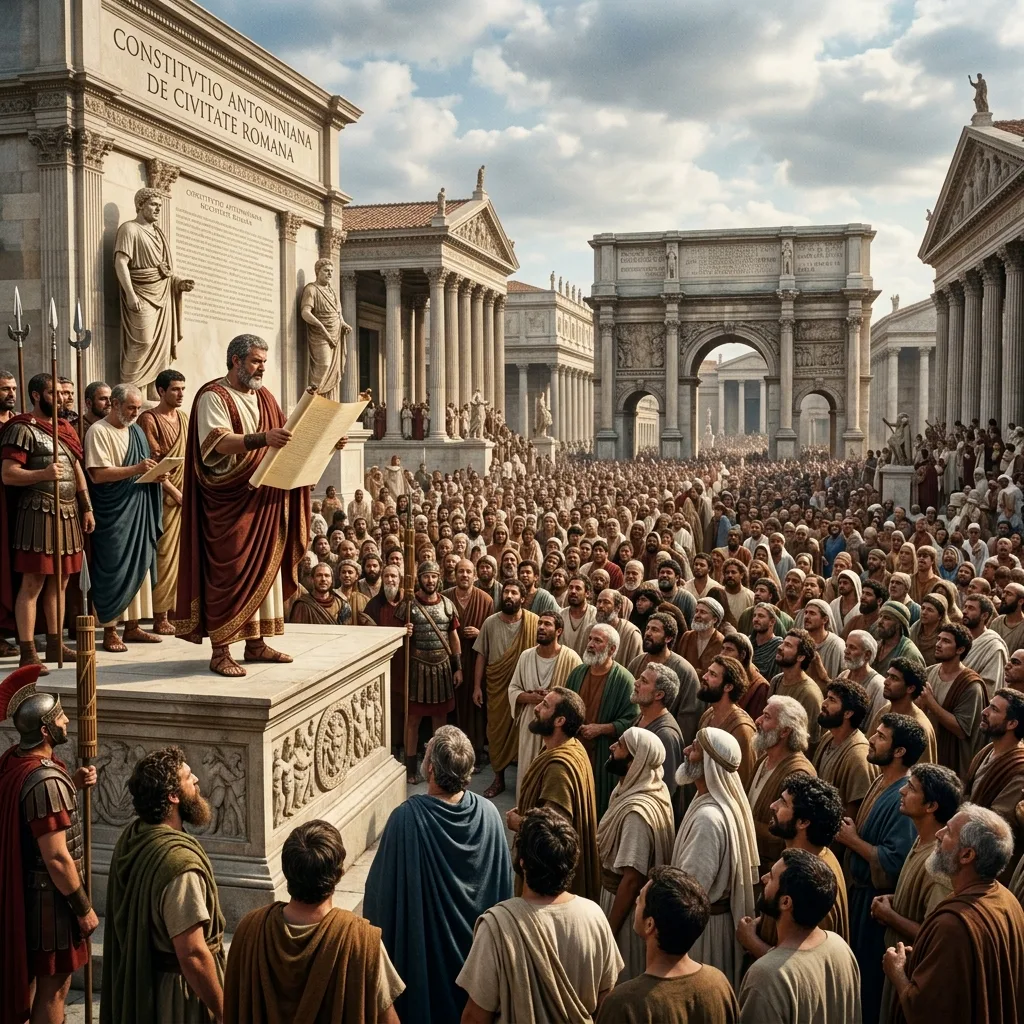
Emperor Caracalla issues the Constitutio Antoniniana, granting Roman citizenship to virtually every free person living within the borders of the empire—from Britain to Egypt to Syria. Millions of people who were previously just "subjects" suddenly gain full legal rights, protections, and obligations as Roman citizens.
Open in interactive timeline →Key Numbers
- Year issued
- 212 AD
- New citizens
- ~30 million provincials
- Empire population
- ~59-76 million
- Inheritance tax
- 5% → 10% (doubled)
- Continents unified
- 3 (Europe, Africa, Asia)
Verified Facts
- In 212 AD the emperor Caracalla (born Lucius Septimius Bassianus, officially styled Marcus Aurelius Antoninus) issued the Constitutio Antoniniana, granting full Roman citizenship to nearly all free inhabitants of the empire in a single stroke.
- Before the edict, full citizenship was largely confined to Italians, Roman colonists and their descendants, certain privileged cities, and a thin layer of provincial elites; the vast majority of the empire's roughly 30-million-plus provincials were non-citizens, so the decree transformed the legal status of most people in the Roman world overnight.
- The empire's total population in the 2nd and early 3rd centuries is estimated by demographers at roughly 59 to 76 million, meaning citizens had been a minority before 212 and became the overwhelming majority after it.
- The decree explicitly excluded the dediticii — a category understood as those who had taken up arms against Rome and surrendered, along with certain freed slaves of penal status — who remained barred from the new universal citizenship.
- Our fullest surviving text of the edict comes from a damaged Greek papyrus, Papyrus Gissensis 40 (P.Giss. 40), held in Giessen, Germany, whose mutilated lines leave the precise scope of the dediticii exclusion a subject of ongoing scholarly debate.
- The contemporary senator and eyewitness historian Cassius Dio, who despised Caracalla, attributed the grant to a single cynical motive: by making everyone a citizen, Caracalla widened the base of those subject to citizen-only taxes.
- Caracalla doubled the vicesima hereditatium (the 5% inheritance tax) and the manumission tax to 10%, and by converting the whole free population into citizens he made these levies — previously applicable only to citizens — bite across the entire empire.
- Vast numbers of the newly enfranchised adopted the name 'Aurelius' in honor of the emperor whose full name was Marcus Aurelius Antoninus, leaving a striking epigraphic fingerprint of the edict across 3rd-century inscriptions.
- The edict was issued in the immediate aftermath of Caracalla's murder of his co-emperor and brother Geta in late 211, a fratricide followed by a sweeping purge of Geta's supporters that Dio's tradition numbers in the tens of thousands.
- UNESCO inscribed the Constitutio Antoniniana on its Memory of the World register, recognizing it as a landmark in the history of civil and human rights for establishing a single shared citizenship across three continents.
- The nickname 'Caracalla' was never his official title but a soldiers' byname derived from the caracallus, a hooded Gallic-style cloak he favored; he reigned jointly with his father Septimius Severus from 198, then alone from 211 until his assassination near Carrhae in 217.
The World at This Moment
In 212 CE the Roman Empire, fresh from Septimius Severus's death (211) and Caracalla's murder of his brother Geta, spanned three continents from Britain to the Euphrates. The Severan dynasty, of Punic-Syrian extraction, embodied an empire increasingly governed by provincial elites; the Antonine Plague's demographic scars still lingered. Beyond Rome's frontiers, the Parthian Arsacids were weakening—within a decade the Sasanian Ardashir I would overthrow them (224), reshaping the eastern threat. In Han China the dynasty was fragmenting toward the Three Kingdoms (the Yellow Turban revolt had erupted in 184). In South Asia the Kushan Empire under successors of Kanishka linked Rome, India, and China via Silk Road and Indian Ocean trade. Rabbinic Judaism was consolidating: the Mishnah's compilation under Judah ha-Nasi belongs to roughly this generation. Christianity, still illicit, was producing Tertullian in Carthage and the catechetical school of Alexandria. Caracalla's universal grant must be read against this cosmopolitan, multi-ethnic empire where "Roman" had already become a juridical rather than ethnic category.
The Paradigm Shift
The edict severed citizenship from ethnicity and locality, completing a centuries-long expansion (from Latin allies to Italians after the Social War to provincial elites) by making civitas a near-universal status of the free population. Its deepest consequence was juridical. Once nearly everyone held Roman citizenship, Roman private law—not the patchwork of local customary law—became the common framework across the empire, accelerating the legal universalism later codified by the Severan jurists Papinian, Ulpian, and Paulus, whose excerpts dominate Justinian's Digest (533). The old binary of citizen versus peregrine collapsed; in its place a new, more consequential division hardened between honestiores and humiliores, status grades determining punishment and privilege. The grant also reframed Roman identity itself: belonging now flowed from law and emperor rather than birth in Italy, anticipating the medieval and modern idea of citizenship as a legal bond between individual and state. Caracalla thereby helped transform Rome from a city-state ruling subjects into a territorial polity of co-citizens.
In Their Own Words
"This was the reason why he made all the people in his empire Roman citizens; nominally he was honouring them, but his real purpose was to increase his revenues by this means, inasmuch as aliens did not have to pay most of these taxes." — Cassius Dio, Roman History, Book 78 (77).9.5, trans. Earnest Cary (Loeb Classical Library)
In Depth
One Empire, One People: The Day Rome Dissolved the Foreigner
In 212 AD the emperor Caracalla issued a single short decree, the Constitutio Antoniniana, that did something no conqueror before him had dared: it made nearly every free inhabitant of the Roman world a Roman citizen. With a stroke of the imperial pen, the legal chasm between cives and peregrini—between the privileged Roman and the merely conquered subject—was abolished across three continents. Only the dediticii, a marginal class of surrendered peoples and certain freedmen, were excluded. It is the most sweeping extension of legal status in the ancient record, and we know it largely from a single battered Greek copy, the Giessen papyrus (P.Giss. 40).
The Deep Preconditions
The edict was the culmination of a logic baked into Rome from its founding. The Roman Republic (sv-roman-republic) had always treated citizenship as a tool of integration rather than a closed ethnic birthright, gradually enfranchising Italians after the Social War. When Augustus (sv-augustus) converted that republic into a Mediterranean empire, citizenship became a slow-spreading reward for service and loyalty, dripping outward through the army, the colonies, and provincial elites for two centuries. By Caracalla's day, this had already produced provincial-born emperors and a deeply cosmopolitan imperial culture—the world of Stoic philosophers like Seneca (sv-seneca) and Marcus Aurelius (sv-marcus-aurelius), who wrote of a single human community spanning the empire. The edict simply legislated, all at once, what generations of gradual assimilation had been approaching.
Motives: Money, Murder, and the Gods
Ancient and modern observers disagree on why. The senator-historian Cassius Dio, hostile to Caracalla, insisted the motive was fiscal: by multiplying citizens, the emperor multiplied the people liable for the citizen-only taxes on inheritances and manumissions—taxes he had also doubled. Caracalla needed the revenue badly to fund the army on which his shaky regime depended. The Giessen papyrus, however, frames the grant in the language of piety: gratitude to the immortal gods for saving the emperor from "great danger." That danger was almost certainly the murder of his brother and co-emperor Geta in 211, which Caracalla justified as self-defense. The edict thus reads as a vast public thank-offering—a way to bind a fractured empire to a fratricidal ruler by enrolling all its peoples in the Roman family at once.
The Ripple Effects
The consequences outran the intent. Once everyone was a citizen, citizenship stopped marking a person's place in society, and a new line hardened in its stead—between the honestiores (the privileged) and the humiliores (the lowly), now distinguished by wealth and rank rather than legal status. This was a quiet revolution in how Roman law treated bodies, and it would echo through later constitutional history.
The universalizing of Roman law also universalized a problem of conscience: if everyone was Roman, everyone owed the state's gods Roman worship. That collision would become acute for the empire's monotheists, sharpening the conflicts that ran from the Fall of the Second Temple (sv-second-temple) and the Bar Kokhba Revolt (sv-hadrian-bar-kokhba) toward the persecutions endured by thinkers like Origen of Alexandria (sv-origen). A century later, when Constantine (sv-constantine-legal) chose Christianity rather than crushing it, he was governing a single juridical people the Constitutio Antoniniana had helped forge—a continuous citizen-body that made an empire-wide official religion conceivable in the first place.
In the long arc, Caracalla's edict belongs in the lineage of foundational rights documents that the modern world canonizes—a distant ancestor of the charters that would culminate in the American Revolution (sv-american-revolution). It was issued by a tyrant, for tangled reasons of cash and guilt. Yet it remains the moment the ancient world first imagined, however imperfectly, that the line between citizen and stranger could simply be erased.
Causes & Consequences
What led to it
- The Social War of 91-88 BC forced Rome to enfranchise its rebelling Italian allies through the Lex Julia (90 BC) and Lex Plautia Papiria (89 BC), establishing the precedent that citizenship could be extended en masse to whole populations rather than granted individually.
- For over two centuries under the Principate, Rome incrementally widened the citizen body by granting it to retiring auxiliary soldiers (recorded on bronze military diplomas after 25 years' service) and to provincial communities holding Latin rights, so that universal citizenship was the logical endpoint of a long expansionary trend.
- The accession of the provincial-born Severan dynasty, founded by Septimius Severus of Leptis Magna in North Africa and married to the Syrian Julia Domna, normalized non-Italian leadership of the empire and weakened the privileged status of Italy over the provinces.
- Caracalla's murder of his co-emperor brother Geta in late 211 and the resulting damnatio memoriae left him needing to consolidate sole rule and burnish his legitimacy, which a sweeping populist grant of citizenship could help accomplish.
- Caracalla had recently doubled the inheritance tax (vicesima hereditatium) from 5 to 10 percent, a levy that fell only on Roman citizens, creating a strong fiscal incentive to convert the empire's non-citizen provincials into taxable citizens.
- By the early third century the legal and practical distinction between citizen legionaries and non-citizen auxiliaries had eroded, and the spread of Roman law and Latin culture through the provinces meant a vast non-citizen population was already partly Romanized and primed for formal enfranchisement.
What it set in motion
- The edict made nearly all free inhabitants of the empire subject to Roman private law, accelerating the 'provincialization' of Roman law and laying groundwork for the later comprehensive codifications that culminated in Justinian's Corpus Juris Civilis in the sixth century.
- Because legal equality among citizens became impractical across so vast a population, Roman jurists hardened the distinction between honestiores (the privileged) and humiliores (the lowly), who became subject to corporal and capital punishments once reserved for slaves, entrenching a new status hierarchy.
- The grant broadened the tax base for the inheritance and manumission taxes, as the contemporary senator Cassius Dio charged, helping fund Caracalla's military pay raises and shaping the fiscal pressures of the third century.
- By removing citizenship as a reward for army service, the edict diminished a key recruitment incentive and contributed over the following century to the army's growing reliance on recruiting non-citizen 'barbarians' and, by the fourth century, foederati from beyond the frontiers.
- The universalization of citizenship dissolved the old legal divide between Roman and provincial and fostered a more unified imperial identity, a step later historians of rights count as an early ancestor in a documentary lineage running through Magna Carta (1215) and the Declaration of the Rights of Man (1789).
- The papyrus P.Giss. 40, a Greek copy of the edict found in Egypt, became a key surviving witness to the decree and to its puzzling exception of the dediticii, fueling enduring scholarly debate over the edict's exact scope and Caracalla's true motives.
The Live Academic Debate
Debate centers on motive and meaning. Cassius Dio, a contemporary senator, attributed the grant to fiscal greed—extending inheritance and manumission taxes (which he raised) to former non-citizens. Many historians long accepted this cynical reading, while A. N. Sherwin-White (The Roman Citizenship, 1973) downplayed the edict as a near-accidental capstone of evolution. A rival tradition, articulated by Kostas Buraselis (Theia Dorea, 2007), foregrounds the religious-ideological dimension preserved in P.Giss. 40: Caracalla frames enfranchisement as a "gift" rendering thanks to the gods, enlarging the body of worshippers after Geta's murder. Alex Imrie (The Antonine Constitution, 2018) synthesizes these, situating the act within Severan dynastic propaganda, pietas, and legitimation rather than any single cause. A persistent technical controversy concerns the dediticii excepted in the papyrus—whether they were a marginal group of surrendered peoples or a substantial category—and Peter van Minnen's argument that P.Giss. 40 dates the edict precisely to 11 July 212. The text's lacunae keep all these questions live.
The Counterfactual
Had Caracalla not issued the grant, the gradual extension of citizenship would likely have continued piecemeal, as it had under the Antonines, but more slowly and unevenly. The empire would have retained sharper legal distinctions between citizens and the peregrine majority well into the third century, complicating the homogenization of provincial law. Yet most scholars now doubt the edict was independently transformative. A. N. Sherwin-White famously called universal citizenship something of an "accident," and revisionists argue the grant ratified an existing trend rather than inventing it; daily life and tax obligations changed modestly for many. Counterfactually, the honestiores/humiliores stratification—rooted in wealth and rank, not citizenship—would probably have emerged regardless, since the practical value of citizenship was already eroding. The strongest counterfactual concerns law: without empire-wide citizenship, the classical jurists' assumption of a shared Roman legal subjecthood would have been weaker, plausibly slowing the consolidation that fed into the Theodosian Code and Justinian's Corpus Iuris Civilis, foundations of the later European legal tradition.
Myth vs. Reality
Myth: The edict freed slaves or gave rights to everyone living in the empire.
Reality: The Constitutio Antoniniana extended citizenship only to free inhabitants (peregrini) of the empire; the enslaved were entirely outside its scope and remained property. The surviving text (Papyrus Giessen 40) and later Roman jurists also record an exclusion for the dediticii, a class of technically free people lacking full citizen or Latin rights, most often read as covering certain freedmen with a penal status. Citizenship was a status of free persons, so the grant changed the legal standing of free provincials, not the institution of slavery.
Myth: Caracalla acted out of egalitarian idealism, making him a pioneer of universal human rights.
Reality: Our main literary source, the senator Cassius Dio, states bluntly that Caracalla's aim was fiscal: by making provincials citizens he expanded the pool liable for citizen taxes such as the inheritance and manumission levies, which he had also just doubled. Dio is hostile to Caracalla, so historians treat the 'pure greed' charge cautiously, and the Giessen papyrus frames the act as religious thanksgiving to the gods and imperial magnificence. But no ancient source presents it as a charter of equal rights; modern scholars (e.g. Arnaud Besson's 2020 study) read it as administrative and ideological unification, not a rights revolution.
Myth: It transformed the empire overnight by giving the masses real political power and the vote.
Reality: By 212 CE, citizenship had largely lost its old Republican political content. Popular voting assemblies had long ceased to matter under the emperors, so the grant conferred no meaningful franchise. Its practical effects were legal and fiscal, bringing provincials under Roman private law and citizen taxes, rather than empowering them politically. Scholars note its day-to-day impact on most people's lives was far more limited than its sweeping language suggests.
Myth: Universal citizenship made everyone legally equal across the empire.
Reality: The opposite trend accelerated. As the citizen/non-citizen line dissolved, Roman law increasingly stratified people by social rank into honestiores (the privileged, including senators, equestrians, decurions, veterans) and humiliores (the common poor). Humiliores became subject to harsher penalties once reserved for non-citizens or slaves, such as corporal punishment, torture, and degrading forms of execution. The edict thus coincided with a shift from a citizenship-based to a class-based system of legal privilege.
Myth: It was the first time Rome ever extended citizenship widely, a sudden break from a closed-off system.
Reality: Rome had been expanding citizenship for centuries before Caracalla. Citizenship was granted to Italian allies after the Social War (early first century BCE), and emperors steadily enfranchised provincial elites, soldiers' families, and whole communities; the Tabula Banasitana and other evidence show ongoing individual and collective grants. The Antoniniana was the culmination and universalization of a long-running process rather than its invention, and the value of citizenship had been gradually diffusing for generations.
Frequently Asked Questions
What was the Edict of Caracalla?
The Edict of Caracalla, formally known as the Constitutio Antoniniana (Antonine Constitution), was a decree issued in AD 212 by the Roman emperor Caracalla. It granted full Roman citizenship to nearly all free men across the Roman Empire and extended the rights of Roman women to all free women, with the notable exception of a class called the dediticii. Because an estimated 80% of the empire's free population had previously lacked citizenship, the edict instantly transformed the legal status of millions of provincials. Its text survives in part through a Greek papyrus copy, Papyrus Giessen 40 (P.Giss. 40).
Why did Caracalla grant citizenship to everyone in the empire?
Caracalla's motives are debated. The contemporary historian Cassius Dio, a political opponent of the emperor, claimed the real purpose was fiscal: more citizens meant more people liable for citizen-only taxes such as the inheritance tax (vicesima hereditatium), which Caracalla had recently doubled from 5% to 10%. However, the surviving papyrus copy frames the grant as an act of piety and gratitude to the gods for preserving the emperor, suggesting a religious or propagandistic motive as well. Most scholars now see a mix of motives, noting that few of the newly enfranchised were wealthy, so taxation alone cannot fully explain it.
What year was the Constitutio Antoniniana issued?
The Constitutio Antoniniana was issued in AD 212. Some sources cite a specific date of 11 July 212, though the exact day is reconstructed and not certain. The principal surviving copy of the edict's text, the Greek-language Papyrus Giessen 40, dates to around 215 CE, a few years after the original promulgation.
Who were the dediticii, and who was excluded from the edict?
The dediticii were the one group the edict explicitly excluded from the new universal citizenship, though the exact reading of this clause in the damaged papyrus (line 9) remains debated by scholars. The term broadly covered defeated peoples who had surrendered unconditionally to Rome, as well as certain freed slaves (libertini) manumitted under penal or informal conditions that barred them from the citizenship normally granted upon manumission. Free women were not excluded; they received the same rights as existing Roman women. Slaves, however, remained outside citizenship entirely, since the grant applied only to free inhabitants.
What were the long-term effects of the Edict of Caracalla?
By eliminating the legal divide between citizens and non-citizens, the edict accelerated the spread of Roman law across the provinces, narrowing the gap between provincial and Italian private law. Paradoxically, as citizenship became universal it lost much of its prestige as a marker of elite status, and a new social hierarchy hardened in its place. This was the growing legal distinction between the honestiores (the privileged upper classes) and the humiliores (the common people), with the latter increasingly subject to harsher penalties once reserved for slaves or non-citizens. Scholars debate how much the edict caused versus catalyzed these shifts, but it is widely seen as a major turning point in the social and legal history of the later Roman Empire.
Did the Edict of Caracalla cause the decline of the Roman Empire?
No serious historian credits the edict as a primary cause of Rome's decline. The empire entered the turbulent Crisis of the Third Century shortly after 212, but that upheaval stemmed from military, economic, and succession problems rather than from extending citizenship. Some scholars argue the edict catalyzed certain social tensions, such as the deepening honestiores-humiliores divide, without causing the broader crisis. The diluted prestige of citizenship may have weakened a traditional source of imperial cohesion, but this was one contributing thread among many, not a singular trigger of collapse.
Sources & Further Reading
- Constitutio Antoniniana — Wikipedia
- A. N. Sherwin-White, The Roman Citizenship, 2nd ed. (Oxford: Clarendon Press, 1973)
- Kostas Buraselis, Theia Dorea: Das göttlich-kaiserliche Geschenk. Studien zur Politik der Severer und zur Constitutio Antoniniana (Vienna, 2007)
- Alex Imrie, The Antonine Constitution: An Edict for the Caracallan Empire, Impact of Empire 29 (Leiden: Brill, 2018)
- Cassius Dio, Roman History, Books 71-80, trans. Earnest Cary, Loeb Classical Library
- P.Giss. 40 (Papyrus Giessen 40); see the Judaism and Rome project commentary on the Constitutio Antoniniana
- Wikipedia: Caracalla
Cite This Page
AskHistoryAI. “The Edict of Caracalla.” AskHistoryAI — Interactive Timeline of Everything. Updated 2026-09-11. https://askhistoryai.com/event/sv-edict-caracalla/
Every fact on this page is checked against the published fact ledger and methodology; sources are listed above.