Diamonds Get Their Facets
A polishing wheel makes symmetrical facets possible.
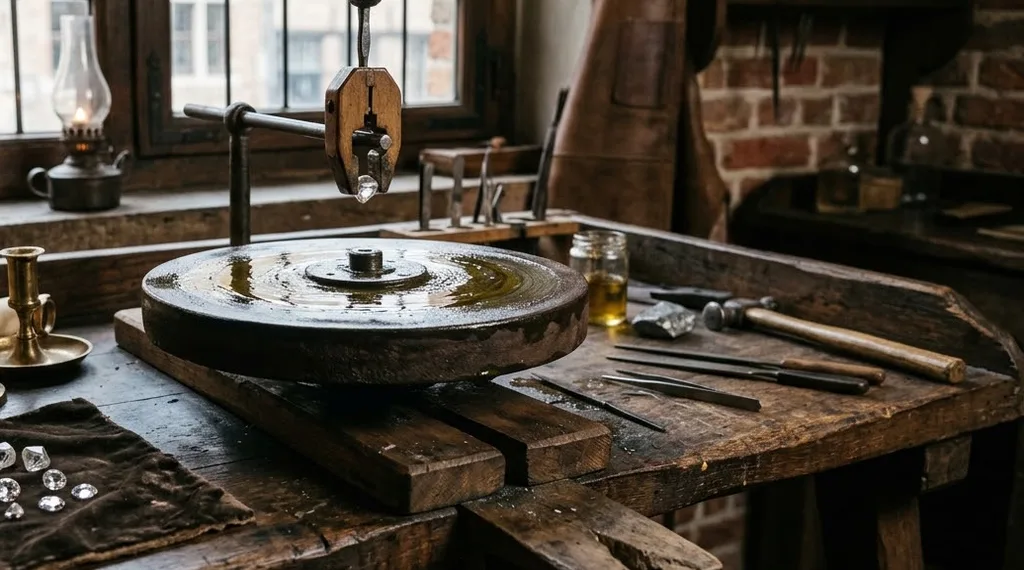
Around 1476 Lodewyk van Bercken of Bruges is credited with the scaif, a polishing wheel charged with olive oil and diamond dust, and with placing a diamond's facets in perfect symmetry. Faceting had begun a century earlier with the point cut; his wheel led on to the rose cut, the first brilliants and, eventually, the round diamonds worn today.
Open in interactive timeline →Key Numbers
- Cutters' Guild
- 1375, Nuremberg
- The Scaif
- c. 1476, Bruges
- Florentine Diamond
- 137 carats
- Peruzzi Brilliant
- 33 crown facets
Verified Facts
- The first guild of diamond cutters and polishers was formed in 1375 in Nuremberg. The first major development in cutting was the point cut, in the later 14th century, which follows the natural octahedral shape of a diamond crystal.
- Around 1476 Lodewyk van Bercken of Bruges introduced absolute symmetry in the placement of facets, using a device of his own invention: the scaif, a polishing wheel infused with olive oil and diamond dust.
- Charles the Bold, Duke of Burgundy, became his patron and in the 1470s commissioned him to cut a 137-carat stone that later became known as the Florentine Diamond.
- The rose cut was introduced in Antwerp in the mid-16th century. The first brilliants, called Mazarins, came in the mid-17th century with 17 crown facets; the Venetian polisher Vincent Peruzzi later raised that to 33.
Myth vs. Reality
Myth:
Reality: The first faceted diamonds, the point cut of the later 14th century, just polished the natural crystal. Symmetrical facets came with van Bercken's scaif around 1476, and the modern round brilliant only in the 20th century.
Frequently Asked Questions
When did gemstone faceting begin?
With diamond in 14th-century Europe. The first guild of diamond cutters formed in Nuremberg in 1375, and the first major cut, the point cut of the later 14th century, polished the faces of the natural crystal.
Who invented the diamond polishing wheel?
Lodewyk van Bercken of Bruges is credited with inventing the scaif, a polishing wheel infused with olive oil and diamond dust, around 1476. It let cutters place facets symmetrically, and it is still used today.
What is a rose cut diamond?
A cut with triangular facets in a symmetrical, radiating pattern and a flat bottom, essentially a crown without a pavilion. It was introduced in Antwerp in the mid-16th century.
How much of a diamond is lost in cutting?
Even with modern techniques, cutting and polishing a diamond crystal loses about 50% of its weight.
Sources & Further Reading
Cite This Page
AskHistoryAI. “Diamonds Get Their Facets.” AskHistoryAI — Interactive Timeline of Everything. Updated 2026-10-08. https://askhistoryai.com/event/sv-gem-faceting/
Every fact on this page is checked against the published fact ledger and methodology; sources are listed above.