The Great Oxygenation Event
Bacteria accidentally poisoned the entire planet and changed everything.
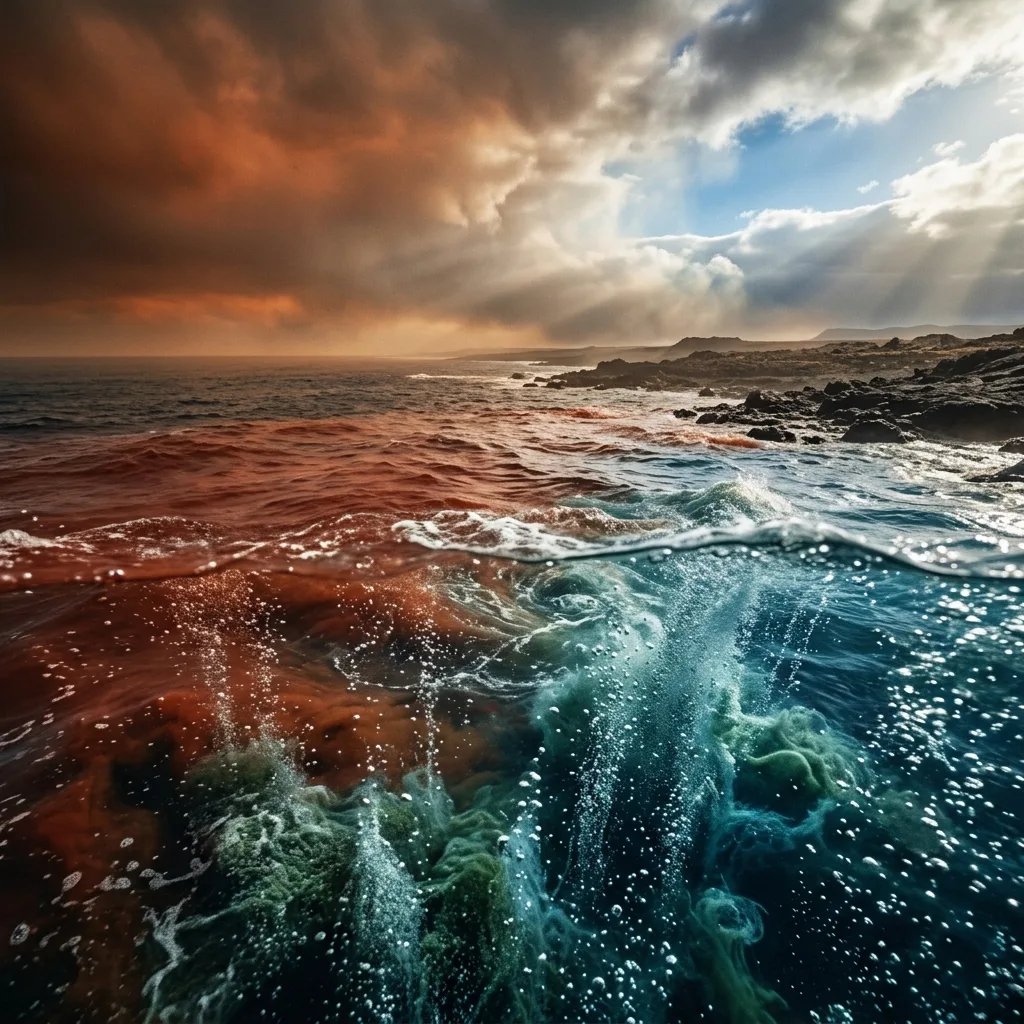
Cyanobacteria (blue-green algae) evolve the revolutionary ability to perform photosynthesis—converting sunlight and CO2 into energy, and releasing oxygen as a waste product. This floods the atmosphere with oxygen, which was toxic to nearly all existing life.
Open in interactive timeline →Key Numbers
- When
- ~2.43-2.06 Ga
- Atmospheric O2 rise
- <10^-5 to ~1-10% PAL
- Inferred biosphere collapse
- >80%
- Huronian ice ages
- ~2.45-2.22 Ga
- Cyanobacteria lead time
- ~hundreds of Myr
Verified Facts
- The Great Oxidation Event is conventionally dated to roughly 2.43-2.33 billion years ago (with effects extending to ~2.06 Ga), making it the first time free oxygen accumulated permanently in Earth's atmosphere after billions of years of an essentially anoxic world.
- The smoking-gun evidence is the disappearance of mass-independent fractionation of sulfur isotopes (S-MIF, measured as anomalous Delta-33S values): rocks older than ~2.4 Ga preserve large positive and negative anomalies from oxygen-free SO2 photochemistry, while younger rocks cluster tightly around zero. This signal was discovered and tied to atmospheric oxygenation by James Farquhar and colleagues in a landmark 2000 study.
- Before the event, atmospheric oxygen was below roughly 10^-5 of the present atmospheric level (PAL); during the GOE it rose to an estimated 1-10% of PAL, a jump of several orders of magnitude that fundamentally reset surface chemistry.
- The oxygen was produced by cyanobacteria performing oxygenic photosynthesis, but these microbes had likely been making oxygen for hundreds of millions of years before the GOE; oxygen only accumulated once geological and biological 'sinks' (such as reduced volcanic gases and dissolved iron) were finally overwhelmed.
- Because oxygen was toxic to the anaerobic organisms that dominated early Earth, the event is also nicknamed the 'Oxygen Catastrophe,' 'Oxygen Crisis,' or 'Oxygen Holocaust'; isotope data from sulfate minerals have been interpreted as a decrease in the size of the biosphere of greater than 80% around the end of the GOE.
- Rising oxygen is thought to have destroyed atmospheric methane (a potent greenhouse gas), collapsing the greenhouse effect and helping trigger the Huronian glaciation, a series of ice ages bracketing roughly 2.45-2.22 Ga that is among the most severe and possibly a 'Snowball Earth' global glaciation.
- Banded iron formations (BIFs) - layered rocks recording dissolved ferrous iron precipitating as oxygen rose - peaked around 2.5 Ga and these massive deposits today supply the bulk of the world's iron ore, a direct economic legacy of early oxygenation.
- Following the GOE came the Lomagundi-Jatuli Event (~2.2-2.06 Ga), the largest and most prolonged positive carbon-isotope excursion in Earth's history, reflecting a major pulse of organic-carbon burial; recent 2025 work in PNAS links it to volcanic CO2 forcing.
- Recent research complicates the once-clean picture: a 2018 Nature Communications study showed the S-MIF disappearance was globally asynchronous (differing between South Africa, North America, and Australia) with 'whiffs' and reversals, suggesting oxygenation was a stuttering, multi-episode transition rather than a single abrupt switch.
- The GOE is widely regarded as one of the most consequential events in the history of life: by making the atmosphere oxygen-bearing, it set the stage hundreds of millions to billions of years later for aerobic respiration, the ozone layer, and ultimately complex multicellular life.
The World at This Moment
The GOE unfolded entirely in a microbial world. There were no animals, plants, fungi, or even unambiguous eukaryotes; life was prokaryotic—bacteria and archaea—inhabiting oceans beneath a hazy, methane-rich, largely anoxic atmosphere. Oxygenic photosynthesis, the metabolic innovation behind the event, had evolved in cyanobacteria perhaps hundreds of millions of years earlier (estimates range widely, from ~3.0 to ~2.5 Ga), yet O2 long remained confined to local "oxygen oases" rather than the global atmosphere. The Archean–Proterozoic boundary (2.5 Ga) sits squarely in this interval. Tectonically, this was an era of cratonic stabilization and large igneous provinces, including the ~2.43–2.42 Ga Ongeluk volcanism of the Transvaal craton (southern Africa) and the Huronian Supergroup deposition in Canada. Banded iron formations were still accumulating on continental shelves. The Sun was roughly 15–20% fainter than today (the "faint young Sun"), so greenhouse gases—especially methane—were essential to keeping Earth from freezing, a balance the rise of oxygen would soon catastrophically upset.
The Paradigm Shift
The GOE is arguably the single greatest environmental transformation in Earth's history, restructuring the planet's surface chemistry, climate, and biology. Geochemically, it is marked by the disappearance of mass-independent fractionation of sulfur isotopes (S-MIF), the signature Farquhar, Bao, and Thiemens (2000) established as a fingerprint of an oxygen-free atmosphere; its loss constrains O2 surpassing roughly 10^-5 of present levels. The consequences cascaded. Free oxygen oxidized atmospheric methane, collapsing the greenhouse that warmed the faint-young-Sun Earth and helping trigger the Huronian glaciations—possibly a "Snowball Earth"—the planet's first global ice ages. Oxidative weathering reshaped the sulfur, iron, nitrogen, and trace-metal cycles and vastly expanded the diversity of minerals on Earth. Biologically, oxygen was a poison to existing anaerobes (the "oxygen catastrophe") yet opened the door to aerobic respiration, an energetically far richer metabolism that later underwrote eukaryotic and ultimately multicellular complexity. In short, oxygenic photosynthesis by humble cyanobacteria permanently bent the trajectory of the biosphere toward the oxygen-dependent world we inhabit.
In Depth
The Poisoning of the World That Made the World
Roughly 2.4 billion years ago, the Earth committed the first great act of planetary self-transformation: a single metabolic invention, fermented in the cells of cyanobacteria, rewrote the chemistry of the entire sky. We call it the Great Oxygenation Event, but it might better be named the first catastrophe of progress — a story in which life nearly destroyed itself by succeeding too well, and in doing so built the chemical foundation for every breathing creature that would ever follow.
Deep Preconditions
The GOE was the inheritance of everything that came before it. The carbon, iron, and oxygen atoms involved had been forged in the cores of the earliest stars (sv-first-stars) and scattered across space by the first supernovas (sv-first-supernova), the only furnaces hot enough to make elements heavier than helium left over from the Big Bang (sv-big-bang). Those atoms condensed into the rock and water of a young planet during the formation of the Solar System and Earth (sv-earth-formation). When life appeared (sv-origin-of-life), it lived for over a billion years in an anoxic world, breathing sulfur and iron. The decisive turn came when cyanobacteria evolved oxygenic photosynthesis — splitting water with sunlight and exhaling oxygen as waste. Oxygen is a corrosive, reactive gas; to the anaerobic microbes that then dominated the planet, it was poison. For hundreds of millions of years that poison was absorbed by dissolved iron in the oceans, which rusted out of solution and settled as the great striped seams of banded iron formations — the literal red ledger of an oxygenating sea, and the source of most of the iron humans would one day mine for the Industrial Revolution (sv-industrial-revolution).
Reshaping What Came After
Only when the oceans' iron sinks were saturated did free oxygen finally escape into the air. The consequences cascaded with brutal logic. Atmospheric oxygen reacted with methane, a powerful greenhouse gas, stripping it from the sky and collapsing the planet's warmth. The result, paired with a faint young Sun, was the Huronian glaciation — plausibly the deep-time prelude and mechanistic cousin to the later Snowball Earth (sv-snowball-earth) freezes. The GOE was thus the first documented mass extinction, an apocalypse for the anaerobes, even as it created the conditions for a richer biology. Oxygen's energy yield is vastly higher than that of anaerobic metabolism, and that surplus made possible the first complex cells (sv-first-complex-cells), whose mitochondria are descended from oxygen-burning bacteria swallowed whole.
Threads Forward
Everything ambitious in the history of life draws on the oxygen bank the GOE opened. The recombinatory power of the invention of sexual reproduction (sv-invention-of-sex), the soft strange bodies of the Ediacaran biota (sv-ediacaran-biota), and the sudden riot of forms in the Cambrian explosion (sv-cambrian-explosion) all required the energy budget that only an oxygenated world could underwrite. So did the first trees (sv-first-trees), whose later proliferation drove oxygen to even higher levels, and ultimately the metabolically expensive brains that would compose the Epic of Gilgamesh (sv-gilgamesh) and, eventually, contemplate building minds of their own.
The Great Oxygenation Event is the founding parable of this entire timeline. It demonstrates that life does not merely adapt to its planet — it remakes it, often violently, and that the same act which dooms one world order seeds the next. Long before any human asked whether a powerful new technology might prove too disruptive to survive, a humble blue-green microbe had already run the experiment, nearly extinguished itself, and bequeathed to its destroyers the very air they would need to think.
Sources: NASA Astrobiology, ASM, PNAS, Timing and tempo of the GOE, Springer: GOE and Snowball Earth
Causes & Consequences
What led to it
- The evolution of oxygenic photosynthesis in cyanobacteria, which split water using sunlight and released free oxygen as a byproduct, was the central biological innovation that made the event possible.
- Cyanobacteria are estimated to have emerged hundreds of millions of years before the event (some studies place their origin around 2.9 billion years ago), giving oxygen production a long running start before atmospheric accumulation began around 2.4 billion years ago.
- An earlier manganese-oxidizing photosystem, evidenced by manganese enrichments in ~2.4-billion-year-old South African strata deposited before oxygen was present, served as an evolutionary stepping-stone toward the water-splitting complex of photosystem II.
- Throughout the Archean, abundant reduced gases from volcanism and dissolved ferrous iron (Fe2+) in the oceans acted as oxygen sinks that had to be progressively saturated before free oxygen could accumulate in the air.
- A reduced early atmosphere rich in methane (likely 100-1000 ppmv, versus ~1.8 ppmv today) and hydrogen kept conditions anoxic, and the long-term escape of hydrogen to space irreversibly oxidized the Earth, tipping the balance toward an oxygen-tolerant surface.
- A proposed decline in the flux of oxidizable volcanic gases, tied to changes in the oxygen fugacity of the Archean mantle, reduced the planetary sink for oxygen and helped allow O2 to finally build up.
What it set in motion
- Dissolved iron in the oceans reacted with the new oxygen to precipitate iron oxides on the seafloor, producing the massive banded iron formations laid down across the Proterozoic.
- Free oxygen oxidized atmospheric methane, a potent greenhouse gas, collapsing the greenhouse effect and helping trigger the Huronian glaciation, one of Earth's earliest and most severe global ice ages.
- Rising oxygen enabled aerobic respiration, which through oxidative phosphorylation yields far more ATP per glucose molecule than anaerobic metabolism, providing the energy budget that later powered complex life.
- The event set the stage for the endosymbiotic origin of mitochondria from an aerobic bacterium engulfed by an anaerobic host, a partnership foundational to the eukaryotic cell.
- Oxygen accumulation devastated obligate anaerobes, confining them to extreme low-oxygen niches and permanently restructuring the planet's microbial ecology and surface geochemistry.
- Atmospheric oxygen allowed an ozone layer to build up over subsequent eons, eventually shielding the surface from harmful UV radiation and enabling life to colonize the land hundreds of millions of years later.
The Live Academic Debate
Several live debates surround the GOE. First, tempo: the classic view of a single, relatively rapid step near 2.4 Ga (associated with Holland and refined by Gumsley et al. 2017, who dated onset to ~2.43 Ga via U-Pb on the Ongeluk LIP) is challenged by Poulton, Bekker, and colleagues (2021), whose reappearing S-MIF signals imply O2 oscillated through multiple oxic-anoxic transitions until permanent oxygenation only ~2.22 Ga, prompting calls to redefine the event's duration. Second, the "whiff" controversy: Anbar, Lyons, and co-authors (2007) read molybdenum and rhenium-osmium data at ~2.5 Ga as transient pre-GOE oxygen, but Slotznick et al. (2022) reinterpreted that interval as recording an anoxic ocean with later alteration, drawing a rebuttal from Anbar's group. Third, causation: whether oxygenation was driven primarily by the evolutionary advent of cyanobacteria, by declining volcanic/mantle reductant fluxes, by enhanced organic-carbon burial and nutrient (phosphorus) dynamics, or by a tectonic shift in continental weathering remains unsettled, with competing models (e.g., Kump and Barley; Catling; Lenton) emphasizing different drivers.
The Counterfactual
Had oxygenic photosynthesis never arisen, or never overwhelmed the planet's reductant sinks, Earth would plausibly have remained a microbial, anaerobic world indefinitely. Aerobic respiration yields roughly an order of magnitude more energy per unit of organic carbon than anaerobic pathways; without that surplus, the energetic ceiling on cellular complexity stays low. Nick Lane and others argue that without abundant O2 the bioenergetic threshold for large, complex eukaryotic cells—and thus animals—would likely never have been crossed. Free oxygen also enabled the stratospheric ozone shield that later permitted land colonization. A counterfactual no-GOE Earth therefore probably hosts no plants, no animals, no observers. The timing and tempo matter too: had O2 risen more gradually, the methane greenhouse might have eroded without the abrupt Huronian glaciations, decoupling oxygenation from "Snowball" climate crises. Conversely, the long, fluctuating, billion-year lag between photosynthesis evolving and oxygen accumulating (Lyons, Reinhard, Planavsky 2014) suggests oxygenation was contingent on geological and biogeochemical thresholds, not metabolic inevitability—implying complex life may be cosmically rare.
Myth vs. Reality
Myth: Cyanobacteria evolved oxygenic photosynthesis and the atmosphere filled with oxygen at essentially the same time.
Reality: There is strong evidence for a long lag between the origin of oxygen-producing cyanobacteria and the actual rise of atmospheric oxygen. Geochemical and fossil signals suggest cyanobacteria (or at least localized oxygen production) existed well before 2.9-3.0 billion years ago, while the Great Oxidation Event - the persistent accumulation of atmospheric O2 - is dated to roughly 2.45-2.32 billion years ago. For hundreds of millions of years the oxygen produced was consumed by reaction with reduced minerals, volcanic gases, and dissolved iron, so it persisted only in local 'oxygen oases' rather than building up globally. Scholars actively debate whether the GOE closely followed the first cyanobacteria or came much later, possibly tied to ecological or morphological innovations.
Myth: The Great Oxidation Event made Earth's air breathable, roughly like today's atmosphere.
Reality: Oxygen rose from essentially nothing to only a small fraction of modern levels. Estimates for the GOE and the following Proterozoic put atmospheric O2 well below 1 percent - and by some analyses less than 0.1 percent - of the present 21 percent. Oxygen then stayed trapped at these low levels for over a billion years (the so-called 'Boring Billion') before the later Neoproterozoic oxygenation. The air would have been unbreathable for an animal; the GOE marks the first persistent presence of free oxygen, not a breathable atmosphere.
Myth: Oxygen rose in one smooth, sudden, permanent step.
Reality: Recent geochemistry shows the transition was protracted and oscillatory rather than a single clean jump. Sulfur-isotope and other records from roughly 2.3-2.2 billion years ago indicate multiple oxic-to-anoxic swings, and studies find oxygen fluctuations both before and after the main event, including a probable post-GOE 'oxygen overshoot' followed by a crash. One 2024 study concluded the GOE itself spanned over 200 million years, longer than older textbook accounts implied, and climate-driven models show glaciations could push atmospheric O2 back and forth between pre- and post-GOE levels.
Myth: The GOE was Earth's first mass extinction, a global die-off that wiped out anaerobic life.
Reality: Oxygen was toxic to many obligate anaerobes and likely caused significant losses, and the event is sometimes nicknamed the 'Oxygen Catastrophe.' But the extinction was not total and is not formally counted among the recognized mass extinctions, which are defined within the much later Phanerozoic. Anaerobes were not eliminated; they retreated to low-oxygen refuges such as deep ocean sediments and anoxic muds, where their descendants thrive today. Because Precambrian microfossils are scarce and hard to identify, researchers cannot reliably quantify which lineages were actually lost.
Myth: Cyanobacteria producing oxygen is the whole story - it single-handedly caused both the oxygen rise and the resulting ice ages.
Reality: Cyanobacterial photosynthesis is central, but the GOE depended on a balance of many factors. Whether oxygen accumulated also hinged on sinks and sources such as volcanic and metamorphic reductant fluxes, hydrogen escape to space, and burial of organic carbon - a tipping point in planetary geochemistry, not merely biological output. Likewise, the linked Huronian glaciations are attributed to oxygen destroying atmospheric methane (a potent greenhouse gas) combined with a fainter young Sun, with additional proposed contributors like anaerobic methane-oxidizing archaea. The standard model treats the GOE as the product of coupled biological, geochemical, and tectonic dynamics.
Frequently Asked Questions
When did the Great Oxygenation Event happen?
The Great Oxygenation Event (GOE), also called the Great Oxidation Event, is generally dated to roughly 2.4 to 2.1 billion years ago, with the initial rise often pinned near 2.4 billion years ago. The clearest geochemical marker is the disappearance of mass-independent fractionation of sulfur isotopes from the rock record, which fades out between about 2.45 and 2.3 billion years ago and signals atmospheric oxygen rising above roughly one millionth of present levels. Exact timing is still debated, and recent studies suggest oxygen fluctuated for tens of millions of years before becoming a permanent feature of the atmosphere.
What caused the Great Oxygenation Event?
The GOE was driven by cyanobacteria, the only prokaryotes capable of oxygenic photosynthesis, a process that uses water as an electron donor and releases oxygen as a waste product. Cyanobacteria had likely evolved hundreds of millions of years earlier (around 2.7 billion years ago), but the oxygen they produced was at first consumed by chemical 'sinks' such as dissolved iron and atmospheric methane. Only once those sinks were saturated could free oxygen begin to accumulate in the oceans and then escape into the atmosphere.
How is the Great Oxygenation Event connected to banded iron formations?
Before the GOE, the oceans held large amounts of dissolved ferrous iron (Fe2+). As cyanobacteria released oxygen, it reacted with this iron to form insoluble ferric oxides that settled to the seafloor in alternating layers, creating banded iron formations (BIFs). These distinctive striped rock deposits are among the most important geological evidence that oxygen was being produced, and they record the long interval during which oxygen was absorbed by the oceans before it could build up in the air.
Did the Great Oxygenation Event cause a mass extinction?
Yes. Oxygen was toxic to most of the anaerobic microorganisms that dominated early Earth, and the rise in free oxygen is thought to have wiped out many of them, which is why the GOE is sometimes called the 'oxygen catastrophe' or 'oxygen holocaust.' Many researchers regard it as Earth's first major extinction event. Surviving anaerobes were largely pushed into oxygen-free refuges such as deep sediments and hydrothermal settings, while organisms that could tolerate or use oxygen gained an advantage.
How did the Great Oxygenation Event trigger a global ice age?
As free oxygen accumulated, it reacted with atmospheric methane, a powerful greenhouse gas, converting it into carbon dioxide and water, which trap far less heat. Removing methane is thought to have sharply cooled the planet and helped trigger the Huronian glaciation, often described as one of the longest 'Snowball Earth' episodes, which began around 2.4 billion years ago and is estimated to have lasted on the order of 300 million years. This links the biological rise of oxygen directly to a dramatic shift in Earth's climate.
How much oxygen did the atmosphere have after the Great Oxygenation Event compared to today?
Far less than today's 21 percent. Estimates vary widely because the GOE marked a rise from essentially no oxygen to only a small fraction of modern levels: older estimates suggested roughly 10 to 40 percent of present-day oxygen, while many newer studies favor levels closer to about 1 to 10 percent of today's, and some argue the rise was even more modest at first. Oxygen would not climb toward modern concentrations until a second major rise, the Neoproterozoic oxygenation event, hundreds of millions of years later.
Why was the Great Oxygenation Event important for the evolution of complex life?
Oxygen enabled aerobic respiration, which extracts far more energy from food than anaerobic metabolism, providing the energy budget that more complex cells and, eventually, multicellular life would require. This shift is widely viewed as a key precondition for the later rise of eukaryotic cells (with structures like mitochondria) and complex organisms. The accumulating oxygen also began forming a stratospheric ozone layer that shields the surface from harmful ultraviolet radiation, further opening Earth to more diverse life.
Sources & Further Reading
- Great Oxidation Event — Wikipedia
- Farquhar, J., Bao, H., Thiemens, M. (2000). 'Atmospheric Influence of Earth's Earliest Sulfur Cycle.' Science 289: 756–758.
- Anbar, A.D., Duan, Y., Lyons, T.W., et al. (2007). 'A Whiff of Oxygen Before the Great Oxidation Event?' Science 317: 1903–1906.
- Lyons, T.W., Reinhard, C.T., Planavsky, N.J. (2014). 'The rise of oxygen in Earth's early ocean and atmosphere.' Nature 506: 307–315.
- Gumsley, A.P., Chamberlain, K.R., Bleeker, W., et al. (2017). 'Timing and tempo of the Great Oxidation Event.' PNAS 114: 1811–1816.
- Poulton, S.W., Bekker, A., Cumming, V.M., et al. (2021). 'A 200-million-year delay in permanent atmospheric oxygenation.' Nature 592: 232–236.
- National Geographic: Great Oxidation Event
Cite This Page
AskHistoryAI. “The Great Oxygenation Event.” AskHistoryAI — Interactive Timeline of Everything. Updated 2026-09-11. https://askhistoryai.com/event/sv-great-oxygenation/
Every fact on this page is checked against the published fact ledger and methodology; sources are listed above.