Verneuil Grows Rubies in a Flame
A flame turns powder into ruby.
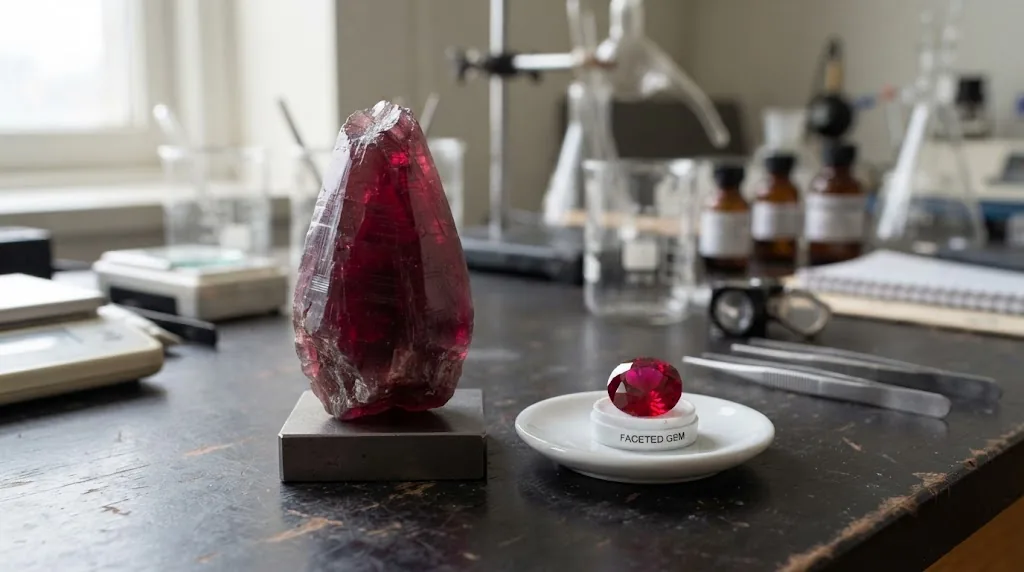
In 1902 Auguste Verneuil announces a way to grow ruby: drop powdered alumina through a flame of at least 2,000 °C and a single crystal builds up below it. Within a decade factories were turning out tonnes of lab ruby and sapphire, the first gems anyone could grow, and the source of the tiny jewels inside mechanical watches.
Open in interactive timeline →Key Numbers
- Method Announced
- 1902
- Flame Temperature
- At least 2,000 °C
- Output in 1907
- 1,000 kg
- Output by 1980
- 200,000 kg
Verified Facts
- The French chemist Auguste Verneuil recorded his work in sealed documents during the 1890s, announced flame fusion publicly in 1902 and published the details in 1904.
- Finely ground alumina with a little chromium oxide is melted by a flame of at least 2,000 °C and recrystallises below it into a single crystal called a boule.
- So-called Geneva rubies sold by an unknown merchant in 1885 were judged artificial at the time and are now believed to be the first flame-fusion rubies, years before Verneuil.
- Output grew from 1,000 kg in 1907 to 3,200 kg in 1912 and about 200,000 kg by 1980. The method also makes sapphire and spinel, and its stones became the jewels in watches.
Myth vs. Reality
Myth:
Reality: Flame-fusion ruby is corundum coloured by chromium, the same material as a mined ruby. It is synthetic, not imitation; what differs is the origin, not the chemistry.
Myth:
Reality: The Geneva rubies sold in 1885 are now believed to be earlier flame-fusion stones. Verneuil perfected the method and published it, which is why it carries his name.
Frequently Asked Questions
Who invented lab-grown rubies?
Auguste Verneuil, a French chemist, announced the flame-fusion method in 1902 and published it in 1904. Earlier Geneva rubies sold in 1885 are now believed to have been made by an early form of the same process.
How does the Verneuil method work?
Finely ground alumina with chromium oxide is dropped through a flame of at least 2,000 °C. The molten droplets recrystallise on a support below the flame into a single crystal called a boule.
Are synthetic rubies real rubies?
Chemically, yes: they are corundum coloured by chromium, like mined ruby. They are labelled synthetic or lab-grown because of how they were made.
What are synthetic rubies used for besides jewellery?
Bearings and jewels in mechanical watches and instruments. During the Second World War these jewels were in high demand for military timepieces.
Sources & Further Reading
Cite This Page
AskHistoryAI. “Verneuil Grows Rubies in a Flame.” AskHistoryAI — Interactive Timeline of Everything. Updated 2026-10-08. https://askhistoryai.com/event/sv-verneuil-ruby/
Every fact on this page is checked against the published fact ledger and methodology; sources are listed above.