Colossus: The Vacuum Tube Paradigm
The third paradigm: electrons replace physical motion.
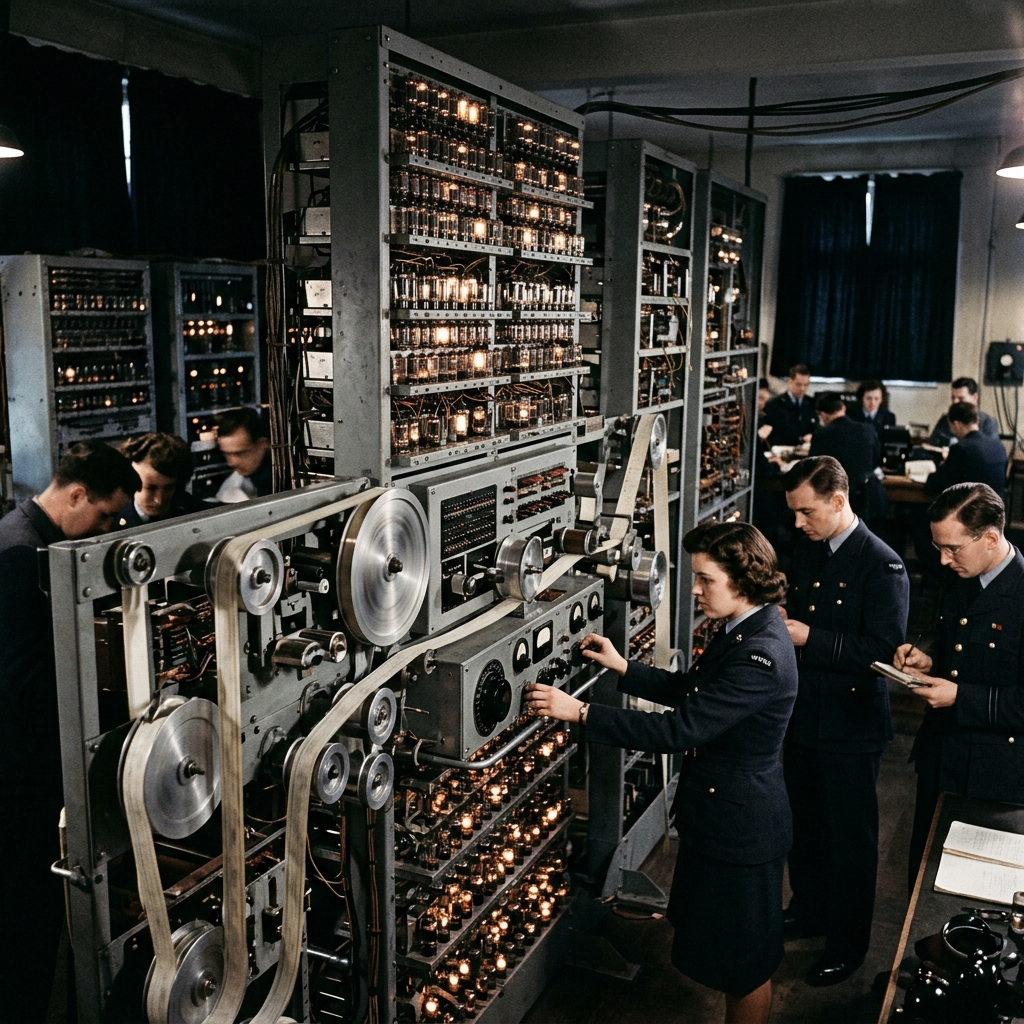
Designed by Tommy Flowers at Bletchley Park, Colossus was the world's first programmable, electronic, digital computer. It represents Kurzweil's Third Paradigm, replacing slow physical relays with purely electronic vacuum tubes that had no moving parts.
Open in interactive timeline →Verified Facts
- By using electrons instead of physical switches, Colossus was exponentially faster than relay machines, processing 5,000 characters per second to break German Lorenz ciphers.
- Because its existence was kept highly classified by the UK government for decades, Colossus was left off of historical computing timelines (including early versions of Kurzweil's graphs) until it was declassified.
- After the war, Winston Churchill ordered the machines to be broken into pieces no larger than a man's fist to keep the technology secret.
Frequently Asked Questions
What was Colossus: The Vacuum Tube Paradigm?
Designed by Tommy Flowers at Bletchley Park, Colossus was the world's first programmable, electronic, digital computer. It represents Kurzweil's Third Paradigm, replacing slow physical relays with purely electronic vacuum tubes that had no moving parts.
When did Colossus: The Vacuum Tube Paradigm happen?
Colossus: The Vacuum Tube Paradigm: 1943 CE.
Why does Colossus: The Vacuum Tube Paradigm matter?
The third paradigm: electrons replace physical motion.
Sources & Further Reading
Cite This Page
AskHistoryAI. “Colossus: The Vacuum Tube Paradigm.” AskHistoryAI — Interactive Timeline of Everything. Updated 2026-09-11. https://askhistoryai.com/event/tech-colossus/
Every fact on this page is checked against the published fact ledger and methodology; sources are listed above.