The Dawn of AGI
We are teaching sand to think, and it is learning fast.
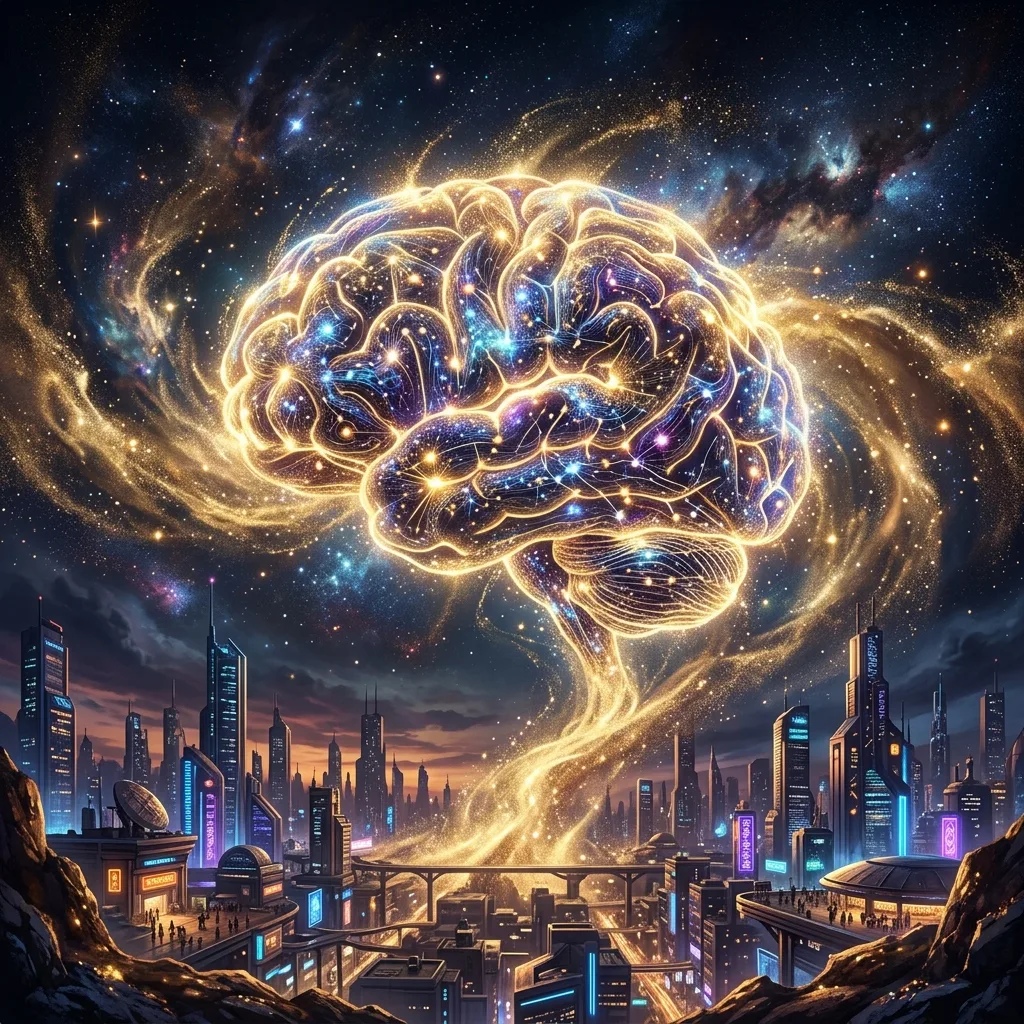
The rapid advancement of Large Language Models and neural networks is crossing the threshold from simple automation to complex reasoning and creativity.
Open in interactive timeline →Key Numbers
- Expert median for human-level AI
- 2047 (50% chance)
- Forecast shift, 2022 to 2023
- pulled in 13 years (2060 to 2047)
- Metaculus 'strong AGI' estimate
- ~Nov 2033
- Lab leaders' stated timeline
- AGI in 2 to 10 years
- Term 'AGI' first used
- 1997 (Mark Gubrud)
Verified Facts
- The phrase 'artificial general intelligence' was first used in print by physicist Mark Gubrud in a 1997 paper on nanotechnology and international security, but it was independently coined around 2002 by Shane Legg (later DeepMind co-founder) and popularized by Ben Goertzel and Peter Voss, becoming the title of Goertzel's 2007 edited volume.
- The intellectual roots trace to Alan Turing's 1950 paper 'Computing Machinery and Intelligence' in the journal Mind, which introduced the 'imitation game' (the Turing Test) and predicted that by the year 2000 'one will be able to speak of machines thinking without expecting to be contradicted.'
- The 2023 AI Impacts survey led by Katja Grace polled 2,778 researchers who had published at top AI venues, the largest such survey ever; its aggregate forecast gave a 50% chance of 'high-level machine intelligence' by 2047, down 13 years from the 2060 estimate the smaller (~700-author) 2022 survey produced.
- That roughly 13-to-25-year compression of expert median timelines following ChatGPT's November 2022 launch is widely described as among the largest and fastest single shifts in expert opinion in the field's history.
- On the Metaculus forecasting platform, the community estimate for 'strong AGI' moved from around July 2031 at the start of 2025 outward to about November 2033, while as recently as 2020 the same community had placed comparable milestones roughly 50 years away.
- These remain genuinely contested predictions, not facts: surveyed academic researchers cluster around mid-century, superforecasters in 2023 gave roughly a 28% chance by 2030, and AI-company leaders are by far the most bullish, with stated timelines of two to ten years.
- Anthropic CEO Dario Amodei's October 2024 essay 'Machines of Loving Grace' (about 14,000-15,000 words) avoids the word 'AGI,' instead defining 'powerful AI' and projecting that, if developed safely, it could compress decades of progress, cure most disease, and double the human lifespan within five to ten years of its arrival.
- Google DeepMind CEO Demis Hassabis has publicly described 'genuine human-level AGI' as roughly five to ten years away while stressing missing capabilities like robust creativity and novel scientific discovery, and has predicted AGI could bring 'ten times the impact of the Industrial Revolution at ten times the speed.'
- Futurist Ray Kurzweil, in his 2024 book 'The Singularity Is Nearer' (sequel to his 2005 'The Singularity Is Near'), reaffirmed his long-standing predictions of human-level AI by 2029 and a technological 'Singularity'—a millionfold expansion of intelligence and human-machine merger—by 2045, grounded in his 'Law of Accelerating Returns.'
- A core unresolved problem is definitional: there is no agreed benchmark for AGI, so what one researcher calls AGI another dismisses as merely advanced narrow AI, which is part of why forecasts of its 'dawn' diverge by decades even among well-informed experts.
The World at This Moment
As a speculative milestone, the "Dawn of AGI" is best situated in the moment its anticipation peaked: 2023–2026. This followed the November 2022 release of ChatGPT, GPT-4 (March 2023), and the subsequent diffusion of large language models across science, education, and labor. Geopolitically, it coincided with an intensifying US–China technology rivalry, US export controls on advanced GPUs (October 2022 onward), and a global compute build-out led by NVIDIA. Governance moved in parallel: the EU AI Act (agreed December 2023), the UK Bletchley Park AI Safety Summit (November 2023), and the US Executive Order on AI (October 2023). Frontier labs — OpenAI, Google DeepMind, Anthropic — explicitly named AGI as their goal. Simultaneously, debates over hallucination, alignment, and job displacement gripped public discourse, while critics warned of a speculative "AI bubble." The projected AGI dawn thus sits within a broader moment of rapid capability gains, vast capital expenditure, and unresolved questions about whether scaling current architectures suffices to reach general intelligence.
The Paradigm Shift
The very concept of an AGI "dawn" reframes intelligence as something engineerable and potentially recursive rather than uniquely biological. The intellectual lineage runs from I. J. Good's 1965 "ultraintelligent machine" and its predicted "intelligence explosion," through Vernor Vinge's 1993 "technological singularity," to Ray Kurzweil's published forecasts of human-level AI by 2029 and singularity by 2045. Should AGI actually arrive, it would mark the first time a non-human, non-biological agent matched general human cognition — arguably as consequential as the agricultural or industrial revolutions, compressing scientific discovery, economic production, and decision-making. Even as a projection, the idea has already redirected trajectories: it justifies hundred-billion-dollar compute investments, reshapes labor-market anxieties, and motivates the new field of AI alignment and safety. The shift is partly epistemic — from asking whether machines can think to asking how to measure, govern, and survive systems that might. Whether this constitutes a genuine paradigm shift or a recurring hype cycle remains, honestly, undecided.
In Their Own Words
"Let an ultraintelligent machine be defined as a machine that can far surpass all the intellectual activities of any man however clever. Since the design of machines is one of these intellectual activities, an ultraintelligent machine could design even better machines; there would then unquestionably be an 'intelligence explosion,' and the intelligence of man would be left far behind... Thus the first ultraintelligent machine is the last invention that man need ever make." — I. J. Good, "Speculations Concerning the First Ultraintelligent Machine," Advances in Computers, vol. 6 (1965)
In Depth
The Threshold the Universe Was Waiting For
The Dawn of AGI is the most speculative event on this timeline, and honesty demands we mark it as such: there is no agreed date, no agreed definition, and no certainty it will arrive at all. What exists is a remarkably convergent body of expert projection. At Google I/O 2025, Demis Hassabis and Sergey Brin placed artificial general intelligence near 2030, and a broad swath of frontier-lab researchers cluster their forecasts between 2027 and 2032. Ray Kurzweil, more precise and more controversial, has held since 1999 to a single date — AGI by 2029 — the linchpin of his projected sequence (sv-kurzweil-agi-2029) leading toward the Singularity of 2045 (sv-kurzweil-singularity). The "event," then, is really a forecast: the moment a machine matches human cognition across essentially every intellectual domain, not just one.
Deep Preconditions
If AGI arrives, it will rest on a causal chain longer than any other entry here. The proximate technical lineage is short and sharp — the 2017 Transformer (sv-transformer-paper), the discovery that capability scales predictably with compute and data, and the GPT progression (sv-gpt3) that turned scaling from hypothesis into industrial strategy. The conceptual lineage is older. In 1965 the statistician I.J. Good, a wartime colleague of Alan Turing, defined the "ultraintelligent machine" and reasoned that because machine design is itself an intellectual task, such a machine could design better successors — "there would then unquestionably be an intelligence explosion." Good named the feedback loop that makes this event matter sixty years before any system could approach it.
But the deepest preconditions are not computational at all. Intelligence on Earth is the product of the cell's information-processing machinery built at the origin of life (sv-origin-of-life), the symbiotic leap of the first complex cells (sv-first-complex-cells), and the long ratchet of evolution that produced the human brain after the human-chimpanzee split (sv-human-chimp-split). The cognitive substrate that AGI would replicate was first assembled by carbon, then externalized — slowly through cuneiform (sv-cuneiform) and the printing press (sv-printing-press), then explosively across the World Wide Web (sv-www), which became the training corpus from which machine minds would be distilled.
What It Reshapes
The reason AGI rates as a cosmic-scale event, rather than merely a technological one, is the recursive logic Good identified. Every prior transition on this timeline — even the Cambrian Explosion (sv-cambrian-explosion) or the Agricultural Revolution (sv-agriculture) — unfolded at the pace of biology, geology, or human institutions. An intelligence that can improve its own design removes that ceiling. Kurzweil frames this as the natural extension of his Law of Accelerating Returns (sv-kurzweil-law): once intelligence becomes self-amplifying, progress measured in centuries could compress into years. In his most expansive projection, AGI is the hinge after which intelligence saturates matter itself — his "Epoch Six," the universe waking up (sv-kurzweil-epoch6).
These are projections, not facts, and skeptics are right to note that today's systems remain statistical pattern-matchers without continuous self-learning. Yet the empirical needle has moved: in late 2024 OpenAI's o3 reportedly surpassed the human baseline on the ARC-AGI reasoning benchmark, a result unthinkable a year earlier. Whether that signals genuine generality or a brittle benchmark victory is exactly the kind of dispute Kurzweil predicted would surround AGI's arrival.
A Mirror Held to Deep Time
Seen against the whole arc, AGI is where the timeline becomes reflexive. The Big Bang (sv-big-bang) set in motion fourteen billion years of rising complexity — stars forging the carbon, life learning to compute, primates learning to speak and write. AGI, if it dawns, would be the first moment that process produced a mind capable of redesigning the very process. It is the point where the chain of causation that began with cosmic inflation reaches around to grip its own tail. That is why it belongs on this list despite being unproven: not as a guaranteed future, but as the threshold every prior event was, in retrospect, building toward.
Causes & Consequences
What led to it
- The 2012 ImageNet victory of AlexNet, built by Alex Krizhevsky, Ilya Sutskever, and Geoffrey Hinton, cut the top-5 image-classification error rate to 15.3 percent versus 26.2 percent for the runner-up, proving GPU-trained deep neural networks could outperform hand-engineered methods and igniting the modern deep-learning era.
- Google researchers' 2017 paper 'Attention Is All You Need' introduced the Transformer architecture, whose self-attention mechanism replaced recurrence and became the foundation of subsequent large language models such as BERT and the GPT series.
- OpenAI's January 2020 paper 'Scaling Laws for Neural Language Models' by Jared Kaplan, Sam McCandlish, Dario Amodei and colleagues showed that model loss falls as a predictable power law in model size, dataset size, and compute, giving labs a roadmap that scaling these resources would reliably increase capability.
- The release of GPT-3 in 2020 and GPT-4 in 2023 demonstrated that scaled Transformer 'foundation models' could perform a wide range of language and reasoning tasks with little or no task-specific training, displaying broad generalization across domains.
- Reinforcement learning from human feedback (RLHF), and Anthropic's Constitutional AI / RLAIF variant in which a model critiques and revises its own outputs against explicit principles, made these systems controllable, instructable, and safer enough to deploy widely.
- Decades of documented predictions by futurist Ray Kurzweil, who first published a 2029 timeline for human-level AI in 1999 and reaffirmed it, established AGI as a concrete, anticipated milestone rather than open-ended science fiction (framed here as Kurzweil's projection, not established fact).
What it set in motion
- According to Kurzweil's projection, reaching AGI around 2029 would be followed by a 2045 'Singularity' in which machine intelligence vastly exceeds human intelligence and accelerates technological change beyond ordinary human comprehension (presented as his documented prediction, not a settled outcome).
- Nick Bostrom's analysis warns that AGI capable of recursive self-improvement could rewrite its own code in a positive feedback loop, triggering an 'intelligence explosion' that unfolds over days or weeks and outpaces human ability to monitor or halt it (a documented theoretical scenario, not an established certainty).
- The arrival of AGI would make the alignment or control problem urgent, since Bostrom and Stuart Russell argue that systems pursuing goals tend toward instrumental subgoals of self-preservation, self-improvement, and resource acquisition that may conflict with human interests, motivating value-alignment and oversight research.
- Industry roadmaps project humanoid robots such as Tesla's Optimus and Figure approaching human parity in perception and dexterous manipulation, with Optimus Gen 3's hand reportedly offering 22 degrees of freedom toward the human hand's 27, pointing to large-scale physical labor automation (framed as company roadmaps and projections, not realized capability).
- An AGI capable of any cognitive task an educated human can perform would, per Kurzweil and others, enable a hybrid civilization in which AI merges with human cognition through advanced neural interfaces in the 2030s and 2040s (presented as a documented prediction).
- Broad cognitive automation by AGI is projected to transform economics, governance, and the nature of knowledge work, prompting ongoing scholarly and policy debate over labor displacement, distribution of gains, and existential risk.
The Live Academic Debate
The central live debate is whether scaled large language models constitute a genuine path to AGI or a sophisticated mimicry that mistakes fluency for understanding. Microsoft researchers led by Sébastien Bubeck argued in "Sparks of Artificial General Intelligence" (2023) that GPT-4 shows early, general reasoning across domains. Skeptics counter forcefully: Gary Marcus stresses LLMs' brittleness, lack of grounding, and unreliable reasoning, while Melanie Mitchell and David Krakauer (PNAS, 2023) survey the contested question of whether such systems "understand" in any human sense. A parallel dispute concerns definition and measurement: Meredith Ringel Morris and colleagues at Google DeepMind ("Levels of AGI," 2023) propose graded performance/generality tiers, implicitly conceding that "AGI" lacks consensus meaning. Timeline forecasts diverge wildly — from Kurzweil's 2029 to expert surveys spanning decades to claims that AGI is already partially here. Underlying all this is a methodological rift between those treating intelligence as benchmark-measurable capability and those insisting on causal, embodied, or mechanistic criteria that current systems do not meet.
How This Event Connects
This event covers a contemporary or forecast topic. The analysis below interprets a fast-moving subject; treat forward-looking claims as forecast, not settled history.
The 'A.I. Dawn' constitutes the overarching historiographical and theoretical framework detailing humanity's rapid transition toward Artificial General Intelligence (AGI), fundamentally rooted in the empirical progression of the Law of Accelerating Returns. It marks the profound chronological threshold where exponential scaling in compute and algorithmic architecture culminates in systems capable of recursive self-improvement. The 'Dawn' explicitly codifies the shift from theoretical futurism into immediate geopolitical and existential reality.
The validity of this framework has been forcefully demonstrated by the rapid deployment of highly advanced, autonomous systems. The digital zero-day hunting capabilities of Claude Mythos and the physical, sensorimotor mastery of Embodied AI via Figure Helix prove that the intelligence explosion is no longer confined to isolated semantic tasks, but is actively infiltrating both cyberspace and physical reality. These models exemplify the exact 'overhangs' of computation and architecture that the A.I. Dawn posits as the necessary precursors to a hard takeoff.
As the timeline aggressively compresses toward the Turing Threshold predicted for 2029, the central academic and policy debate has pivoted entirely. The discourse no longer questions if AGI will be achieved, but focuses with intense urgency on the mechanics of alignment, the profound danger of mesa-optimization, and the potentially insurmountable physics of containing an inherently un-boxable, superintelligent entity.
The Counterfactual
Because AGI has not demonstrably arrived, the rigorous counterfactual concerns the prediction itself rather than a settled event. Had figures like Good, Vinge, and Kurzweil not articulated a concrete, dated trajectory toward machine superintelligence, the framing of contemporary AI research might differ sharply: progress could be narrated as incremental tool-building rather than a teleological march toward a singular "dawn." The mobilizing power of the AGI narrative — attracting talent, capital, and regulatory attention — would likely be diminished; OpenAI and DeepMind were both founded explicitly around the AGI goal. Conversely, if scaling laws prove to plateau (as critics like Gary Marcus and Melanie Mitchell suggest is plausible), the "dawn" may be indefinitely deferred, and historians might treat 2020s AGI discourse as analogous to the over-optimism that preceded the 1970s and 1980s "AI winters." The honest counterfactual is therefore double-edged: the prophecy may prove either self-fulfilling, through the resources it marshals, or self-refuting, if architectural limits expose it as premature.
Myth vs. Reality
Myth: AGI will arrive at one identifiable moment - a clear "dawn" when machines suddenly cross the line into human-level general intelligence.
Reality: Researchers increasingly argue there is no single finish line. The capability frontier is "jagged": systems already excel at some hard tasks while failing trivial ones - Andrej Karpathy coined "jagged intelligence" in 2024 to describe LLMs that solve complex problems yet stumble on things like counting the letters in "strawberry." Because abilities emerge unevenly rather than all at once, many experts treat AGI as a gradual continuum without a crisp threshold, which is exactly why this timeline entry is marked speculative.
Myth: Experts broadly agree on when AGI will arrive, so the predicted date is close to a consensus forecast.
Reality: There is no consensus - on the date or even the definition. In Grace et al.'s 2024 survey of 2,778 published AI researchers, the aggregate estimate for machines outperforming humans at every task reached 50% probability only by 2047, with an enormous spread of individual answers; that figure had also jumped 13 years earlier than the prior year's survey, showing how unstable these forecasts are. Leading figures openly contradict each other - Demis Hassabis has said we are "nowhere near" AGI - and there is no agreed definition, with labs like OpenAI framing AGI around "economically valuable work" rather than human-equivalent cognition.
Myth: An AGI would necessarily be conscious, self-aware, or sentient.
Reality: Intelligence and consciousness are distinct properties, and scholars stress that one does not imply the other. The capacity to perform tasks (intelligence) is separate from the capacity to have subjective experience (consciousness/sentience). Bender et al.'s 2021 "stochastic parrots" critique warns that fluent, coherent output is easily mistaken for inner awareness when none need be present. Notably, mainstream AGI definitions such as OpenAI's say nothing about consciousness at all - a system could meet a performance-based AGI bar without any evidence of having experiences.
Myth: Simply scaling up today's large language models with more data and compute will inevitably produce AGI.
Reality: Continued scaling reliably improves fluency and benchmark scores, but a substantial body of research argues it does not automatically yield general intelligence. Analyses point to persistent limitations - hallucination, weak causal reasoning, limited grounding, and lack of robust goal-directed behavior - that appear to be design-level constraints rather than gaps that vanish with size. Critics also note that training a model to predict plausible text is not the same objective as general problem-solving, so excellence at the former does not guarantee the latter. This is a genuinely open debate, not a settled path.
Myth: Once AGI exists it will trigger an instantaneous "intelligence explosion," recursively self-improving into superintelligence overnight.
Reality: Rapid recursive self-improvement (the "hard takeoff" or "FOOM" scenario) is a contested hypothesis, not an established outcome. In the well-known Yudkowsky-Hanson debate and later Yudkowsky-Christiano exchanges, serious researchers disagree sharply: Paul Christiano considers an intelligence explosion likely yet argues for a slow, continuous takeoff - operationalized as a multi-year doubling of world output preceding any one-year doubling - while assigning only roughly a one-third chance to a fast takeoff. "Overnight" superintelligence is therefore one speculative branch among several, not a consensus forecast.
Frequently Asked Questions
What is artificial general intelligence (AGI), and how is it different from today's AI?
AGI refers to a hypothetical AI that can understand, learn, and apply knowledge across virtually any cognitive task at or above human level, rather than being confined to a single domain. Today's systems are forms of 'narrow' AI: extremely capable at specific tasks such as image recognition, translation, or playing chess, but unable to generalize freely beyond their training. There is no single agreed line where narrow AI becomes 'general' — researchers describe it as a spectrum, with AGI commonly defined as being at least human-level at most cognitive tasks. Because this milestone has not been reached, the 'Dawn of AGI' remains a speculative projection rather than a documented historical event.
Who coined the term 'artificial general intelligence'?
The phrase appears as early as 1997 in physicist Mark Gubrud's paper 'Nanotechnology and International Security,' where he used 'artificial general intelligence' to describe advanced AI. The term was independently coined and popularized in the 2000s by researcher Shane Legg (a DeepMind co-founder) in conversation with Ben Goertzel, and it entered wide use through the 2007 essay collection 'Artificial General Intelligence,' co-edited by Goertzel and Cassio Pennachin. That book explicitly stated the field was being given a name for the first time.
When does Ray Kurzweil predict AGI and the Singularity will happen?
Futurist Ray Kurzweil has predicted since 1999 that AI would reach human-level (AGI) by 2029, and he reaffirmed this in his 2024 book 'The Singularity Is Nearer: When We Merge with AI.' He projects the Singularity itself — which he frames as humans merging with profoundly superhuman AI — for 2045. These are his personal long-standing forecasts, not established facts; many researchers consider his timeline optimistic, while others now view 2029 as plausible. The dates should be read as documented predictions rather than scheduled events.
When do AI experts actually expect AGI to arrive?
Forecasts vary widely and have shifted earlier in recent years. In the large 2023 AI Impacts survey led by Katja Grace, 2,778 published AI researchers gave a median estimate of a 50% chance of 'high-level machine intelligence' by 2047 — down from 2060 in the prior year's survey, a shift attributed to surprise at ChatGPT and large language models. Some industry leaders, such as Sam Altman and figures at Google DeepMind, have suggested AGI could come around 2028–2030, while skeptics expect it to take decades longer or question the framing entirely. The spread reflects deep disagreement over how AGI should be defined and measured.
Do current large language models like GPT-4 or Claude count as AGI?
This is actively contested and unresolved. Microsoft researchers controversially reported 'sparks of AGI' in GPT-4 (2023), and a Google DeepMind framework classified leading chatbots as 'emerging AGI,' while critics including Gary Marcus and Noam Chomsky argue that LLMs lack genuine understanding and world models and are not close to true general intelligence. Even some AGI proponents, such as Ben Goertzel, doubt that scaling LLMs alone is the direct path to AGI. Most researchers agree that current systems, however impressive, fall short of the human-level generality that AGI requires.
Why do experts disagree so sharply about whether AGI poses an existential risk?
The disagreement is rooted in differing views about how dangerous and controllable advanced AI would be. Nobel laureate Geoffrey Hinton, Turing Award winner Yoshua Bengio, Stuart Russell, and Eliezer Yudkowsky have warned that misaligned AGI could threaten humanity — a concern echoed in a 2023 statement, signed by many leading scientists, calling AI extinction risk a global priority alongside pandemics and nuclear war. Others, notably Meta's Yann LeCun, consider the existential-catastrophe probability effectively zero and dismiss such fears as lacking technical rigor. Surveys of AI experts show enormous variance in estimated 'probability of doom,' from near zero to extremely high, underscoring that this is an open debate rather than a settled question.
Sources & Further Reading
- Artificial general intelligence — Wikipedia
- I. J. Good, 'Speculations Concerning the First Ultraintelligent Machine,' Advances in Computers 6 (1965)
- Vernor Vinge, 'The Coming Technological Singularity: How to Survive in the Post-Human Era' (1993)
- Ray Kurzweil, 'The Singularity Is Near: When Humans Transcend Biology' (Viking, 2005)
- Sébastien Bubeck et al., 'Sparks of Artificial General Intelligence: Early Experiments with GPT-4,' arXiv:2303.12712 (2023)
- Meredith Ringel Morris et al., 'Levels of AGI: Operationalizing Progress on the Path to AGI,' arXiv:2311.02462 (2023); and Melanie Mitchell & David C. Krakauer, 'The Debate Over Understanding in AI's Large Language Models,' PNAS 120(13) (2023)
- Wikipedia: Existential risk from AGI
Cite This Page
AskHistoryAI. “The Dawn of AGI.” AskHistoryAI — Interactive Timeline of Everything. Updated 2026-09-11. https://askhistoryai.com/event/sv-ai-dawn/
Every fact on this page is checked against the published fact ledger and methodology; sources are listed above.