Humanoid Robots Work an 8-Hour Shift Unassisted
Near-human speed on one narrow warehouse task, in a controlled setting. Not general-purpose labor yet.
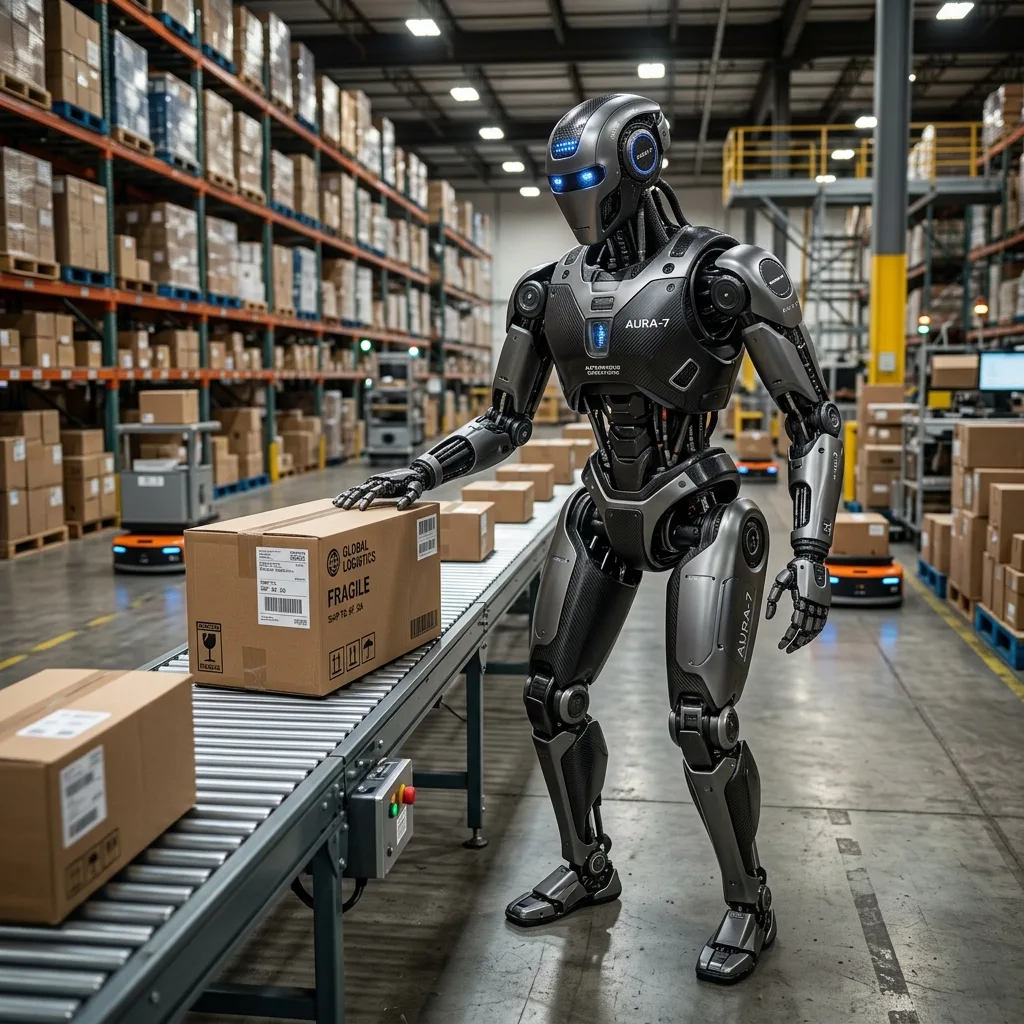
In a live 8-hour broadcast, Figure AI ran a fleet of Figure 03 humanoids through a warehouse package-sorting shift with no human intervention, on the Helix-02 Vision-Language-Action model, at roughly 4 seconds per package against a human baseline near 3. It is a real milestone for embodied AI on one narrow, repetitive task in a controlled setting; general-purpose physical work remains unproven, and demos elsewhere have relied on undisclosed teleoperation.
Open in interactive timeline →Key Numbers
- Helix control rate
- 200 Hz, 35-DoF upper body
- Goldman Sachs 2035 market
- $38B (revised 6x up)
- Musk's robot sale date
- 2027 (Davos forecast)
- Training data for Helix
- ~500 hrs teleoperation
- Status
- Speculative projection, not achieved
Verified Facts
- This entry is a documented projection, not an accomplished fact: as of 2026 no humanoid robot has reached human parity in general dexterity or autonomy. TIME's cover story on Figure's robot noted it could fold clothes and load a dishwasher but still needed human intervention to start cycles and recover from dropped items.
- The 'Helix' in the id refers to a real system: in February 2025 Figure AI unveiled Helix, a Vision-Language-Action (VLA) model it described as the first VLA to output high-rate continuous control of an entire humanoid upper body, coordinating a 35-degree-of-freedom action space (fingers, wrists, torso, head) at 200 Hz.
- Helix uses a dual-system 'System 1 / System 2' architecture borrowed from cognitive psychology: a roughly 7-billion-parameter internet-pretrained vision-language model (S2) runs at 7-9 Hz for scene understanding and reasoning, while an ~80-million-parameter reactive visuomotor policy (S1) converts those latents into motor commands at 200 Hz.
- Figure reported Helix was trained on only about 500 hours of teleoperated demonstrations, augmented by an auto-labeling VLM, yet generalized to pick up thousands of novel household objects by natural-language request without task-specific fine-tuning -- a key data-efficiency claim underpinning parity optimism.
- In January 2026 Figure announced Helix 02, adding a 'System 0' foundation layer running at kilohertz rates for human-like balance and full-body coordination including walking, extending control beyond the upper body covered by the original Helix.
- The single hardest barrier to human parity is Moravec's paradox, named for roboticist Hans Moravec, who observed in 1988 that computers easily reach adult-level performance on reasoning tasks but struggle to match a one-year-old's perception and mobility -- exactly the embodied, dexterous skills humanoids must master.
- Berkeley roboticist Ken Goldberg frames the obstacle as a '100,000-year data gap': language models train on terabytes of text, but no robot has anything close to the lifetime of physical interaction data a human accumulates by age three, making real-world manipulation training scarce and expensive.
- Named predictions for parity vary widely and come mostly from interested parties: Elon Musk forecast at Davos that humanoid robots would go on sale in 2027 and has claimed Optimus could surpass human surgeons by 2030, while Nvidia's Jensen Huang publicly pushed back on the idea of work disappearing, saying instead 'everybody's job will be different.'
- Production reality has lagged the rhetoric: Tesla framed its 2025 Optimus units as primarily for learning rather than productive work, with Musk calling the program 'still very much in the R&D phase,' and Tesla reportedly paused Optimus production in mid-2025 over overheating joint motors, short transmission life, and weak hand performance.
- Market forecasts signal expectation of scale, not achieved parity: Goldman Sachs Research revised its 2035 humanoid-robot market estimate up sixfold to $38 billion (about 1.4 million units), while Morgan Stanley's bull case projects the broader market could reach $5 trillion by 2050 assuming accelerated adoption in the late 2030s.
The World at This Moment
This projected milestone is framed against a concrete 2025-2026 inflection in commercial robotics. On 20 February 2025 Figure AI unveiled Helix, a Vision-Language-Action model pairing a 7-billion-parameter vision-language "System 2" with an 80-million-parameter 200 Hz visuomotor "System 1," controlling 35 upper-body degrees of freedom. Simultaneously, Tesla pushed Optimus toward Fremont-line production (targeting up to one million units/year), Boston Dynamics readied an electric Atlas, and Unitree shipped over 5,500 humanoids in 2025—outpacing all US firms combined—as average unit prices fell from roughly $85,000 (2023) to $25,000 (2025). The moment sits inside the broader generative-AI boom following the 2017 Transformer and the GPT-4 era, with NVIDIA's Isaac/GR00T platforms supplying "physical AI" infrastructure. Geopolitically, US-China competition framed humanoids as strategic industrial technology. "Human parity"—a robot matching an average adult across open-ended physical tasks—remains, as of mid-2026, unachieved and undated; Goldman Sachs projected only ~76,000 shipments by 2027, far below bullish forecasts.
The Paradigm Shift
Were genuine human parity attained, it would resolve Moravec's paradox—Hans Moravec's 1988 observation (Mind Children) that sensorimotor skills trivial for a one-year-old are hardest for machines—inverting a forty-year intuition that perception and dexterity, not abstract reasoning, are AI's true frontier. The proximate shift already underway is architectural: systems like Helix replaced hand-engineered control (Figure reported ~109,000 lines of C++ balance code supplanted by learned policies) with internet-pretrained VLA models, importing the scaling paradigm of large language models into embodied control. This reframes robotics from bespoke automation toward general-purpose embodiment, where one model transfers zero-shot to thousands of unseen objects via natural-language prompting. Conceptually, parity would collapse the long-assumed boundary between "cognitive" and "physical" labor, extending automation's reach into manipulation-heavy work historically immune to digitization. It would also vindicate the embodied-cognition thesis—descended from Rodney Brooks's 1980s "sensing and action" Nouvelle AI—that intelligence is grounded in bodily interaction rather than disembodied symbol manipulation.
In Their Own Words
"It is comparatively easy to make computers exhibit adult level performance on intelligence tests or playing checkers, and difficult or impossible to give them the skills of a one-year-old when it comes to perception and mobility." — Hans Moravec, Mind Children: The Future of Robot and Human Intelligence (Harvard University Press, 1988) — the canonical statement of "Moravec's paradox"
In Depth
The Last Mile of Intelligence: When Mind Met Body
For most of the history of artificial intelligence, the mind raced ahead of the hand. Machines conquered the abstract long before they could manage the concrete. The watershed came in 1997 when Deep Blue (sv-deep-blue) defeated Garry Kasparov at chess — a triumph of pure symbol-manipulation — yet that same machine could not have picked up a single chess piece. This is the heart of Moravec's paradox, named for roboticist Hans Moravec in the 1980s: the things humans find effortless, like walking, grasping, and recognizing a face, are the hardest to reverse-engineer, because they are the product of hundreds of millions of years of evolutionary refinement. The sensorimotor competence of a one-year-old encodes a longer apprenticeship than any theorem.
The Deep Preconditions
That apprenticeship reaches back through the entire arc of this timeline. The dexterity a humanoid robot must imitate was forged when life first crawled onto land in the body of Tiktaalik (sv-tiktaalik), refined into the grasping, depth-perceiving hand of the first primates (sv-first-primates), and finally became the tool-using intelligence that branched off at the human-chimpanzee split (sv-human-chimp-split). To build a machine that moves like a person is, in effect, to compress that whole lineage into silicon and actuators. The intellectual half of the problem had its own long preconditions: the Transformer architecture (sv-transformer-paper) of 2017 and the scaling insights of GPT-3 (sv-gpt3) gave machines internet-scale world-knowledge. The remaining challenge was to graft that disembodied reasoning onto a body operating in real time.
The Synthesis
Figure AI's Helix, unveiled in February 2025, was a documented attempt at exactly this graft. Its dual-system design pairs a roughly 7-billion-parameter vision-language model (System 2) that reasons about a scene at 7–9 Hz with a small, fast visuomotor policy (System 1) that issues motor commands at 200 Hz — slow deliberation married to fast reflex. Its 2026 successor, Helix 02, added a foundation layer (System 0) trained on over a thousand hours of human motion and sim-to-real reinforcement learning across two hundred thousand parallel virtual environments — a learned prior for how a body keeps its balance. Figure reported Helix 02 robots completing eight-hour autonomous logistics shifts. "Human parity" remains, honestly, a projection rather than an accomplished fact: prototypes are tested in factories, and bold timelines (cost parity with manual labor, robots priced under $20,000, near-total automation of manual work by 2030) come from interested company founders, not settled reality. It belongs in the same speculative register as the broader dawn of AGI (sv-ai-dawn) and Ray Kurzweil's projection of AGI by 2029 (sv-kurzweil-agi-2029).
The Ripple Forward
If the projection holds, its consequences rhyme with the deepest disruptions in this timeline. The Agricultural Revolution (sv-agriculture) and the Industrial Revolution (sv-industrial-revolution) each redefined human labor by mechanizing first muscle and then power; a general-purpose humanoid threatens to mechanize the last reserve — the embodied dexterity that survived every prior wave of automation precisely because of Moravec's paradox. Where Kurzweil's Law of Accelerating Returns (sv-kurzweil-law) treated intelligence as the engine of history, embodiment is what lets that intelligence reach out and touch the physical world directly, closing the loop between thought and matter.
That closure is the event's true historical weight. A disembodied superintelligence remains a counselor; an embodied one becomes an actor. The humanoid is the bridge by which abstract cognition acquires hands — and with hands, the capacity to remake its own substrate, to build the factories and the successors that a hard takeoff would require. Seen this way, human-parity robotics is less an endpoint than a hinge: the moment the long evolutionary monopoly on skilled physical agency, unbroken since the origin of life (sv-origin-of-life), finally finds a rival of human design.
Causes & Consequences
What led to it
- The shift from hydraulic to all-electric humanoid hardware—exemplified by Boston Dynamics unveiling an electric Atlas in April 2024 and Tesla building Optimus around in-house electric actuators and EV-derived batteries—gave robots the quiet, energy-efficient, mass-manufacturable bodies that a parity milestone would require.
- Vision-language-action (VLA) models such as Figure's Helix, announced in February 2025, unified perception, natural-language understanding, and high-rate continuous control of the full humanoid upper body under a single set of neural-network weights, letting robots manipulate never-before-seen objects from spoken prompts.
- Large-scale teleoperation and imitation-learning datasets—pioneered by Google's RT-1 and the Open X-Embodiment effort that pooled real-world demonstrations across many robots and tasks—established that web-scale data could be transferred into physical robotic control.
- Empirical demonstration of data scaling laws in robotic imitation learning (Lin et al., 2024, with over 40,000 demonstrations and 15,000+ real-world rollouts) showed that policy generalization improves predictably with more environments, objects, and demonstrations, importing the scaling-law logic of NLP into manipulation.
- GPU-accelerated physics simulators like NVIDIA Isaac Gym and Isaac Lab, together with frameworks such as Humanoid-Gym, made it possible to train locomotion and whole-body skills across thousands of parallel simulated environments and achieve zero-shot sim-to-real transfer onto real humanoids.
- Comprehensive whole-body benchmarks—HumanoidBench's 31 simulated locomotion and manipulation tasks on a Unitree H1 with Shadow Hands, and real-robot suites with hundreds of teleoperated tasks—created the standardized yardsticks against which any claim of 'human parity' could be measured.
What it set in motion
- If humanoids reach human parity, analysts project sweeping labor-market effects: Goldman Sachs has estimated humanoid robots could help fill roughly 4% of U.S. manufacturing labor shortages by 2030, addressing the 600,000-plus unfilled manufacturing jobs the National Association of Manufacturers reported in 2025.
- Investment banks frame the milestone as a multi-hundred-billion-dollar market, with Morgan Stanley projecting a roughly $357 billion humanoid robot market by 2040 and Barclays arguing the technology would fundamentally reshape the real economy.
- Widespread deployment is projected to deliver large per-worker cost savings—on the order of $500,000 to $1 million per substituted human worker over a 20-year horizon—accelerating capital substitution for labor in structured warehouse, logistics, and assembly settings.
- Economists warn the same milestone could widen inequality, with Oxford Economics projecting that intensified robot adoption could widen the wage gap between the top 10% and bottom 50% of earners by roughly 5-12% over a decade absent policy intervention.
- Human-parity manipulation would close the data-collection loop: fleets of capable humanoids generate their own real-world interaction data at scale, feeding the next generation of foundation models and turning embodied AI into a self-reinforcing flywheel rather than a teleoperation-bottlenecked field.
- Parity in the physical world is widely treated as a key waypoint toward embodied AGI, since grounding language models in dexterous bodies that act reliably in unstructured human environments is argued to supply the sensorimotor common sense that text-only systems lack.
The Live Academic Debate
The central, live debate is whether scaling current VLA approaches suffices for human-level dexterity, or whether a qualitative breakthrough is missing. Scaling optimists—exemplified by Figure's research framing ("eager to see what happens when we scale Helix by 1,000x")—argue that more data, parameters, and compute will close the gap, transposing the LLM scaling story to embodiment. Skeptics ground their case in Moravec's paradox and embodied-cognition lineage: Rodney Brooks has long argued (and continues to publicly argue on his blog) that humanoid timelines are systematically overhyped and that sensorimotor competence resists brute scaling. Ken Goldberg's "data gap" position holds that the binding constraint is not architecture but the absence of manipulation data at internet scale. A third, economics-focused camp (reflected in Goldman Sachs's conservative shipment forecasts versus market bulls) debates whether near-term deployments justify valuations. Underlying these is an older philosophical dispute—dating to Hubert Dreyfus's What Computers Can't Do—over whether embodied skill is formalizable at all, or involves tacit, non-representational know-how machines cannot acquire by learning from demonstrations.
How This Event Connects
This event covers a contemporary or forecast topic. The analysis below interprets a fast-moving subject; treat forward-looking claims as forecast, not settled history.
The 2025 release of the Figure Helix foundation model represents a seismic shift in the history of artificial intelligence, breaking the digital containment of prior models to establish the era of Embodied AI. Where autonomous agents like Claude Mythos demonstrated agency in strictly digital, cybersecurity environments, Figure Helix translated advanced semantic reasoning into physical, real-world actuation. By utilizing an end-to-end Vision-Language-Action (VLA) architecture, Helix successfully shattered Moravec’s Paradox, proving that neural networks can master high-frequency sensorimotor control as effectively as language processing.
Historiographically, the deployment of Helix-powered humanoids parallels the macroeconomic disruption of the Industrial Revolution. However, instead of merely mechanizing physical power, Helix mechanizes autonomous cognitive labor within unstructured physical environments. This capability fundamentally threatens the foundations of blue-collar labor, shifting the AI risk discourse from white-collar intellectual displacement to an unprecedented structural shift in global manufacturing and logistics.
Ultimately, Figure Helix serves as a profound empirical validator for the 'A.I. Dawn' and the approaching Turing Threshold of 2029. The system's 'Hive-Mind' data strategy—where physical skills learned by one unit instantaneously update the fleet—demonstrates a form of rapid, networked learning that far outpaces biological evolution, signaling a critical milestone on the trajectory toward recursively self-improving Artificial General Intelligence.
The Counterfactual
The honest counterfactual is that parity may simply not arrive on the timelines its proponents imply. UC Berkeley's Ken Goldberg warns of a "100,000-year data gap": unlike text, dexterous-manipulation data is scarce, expensive to collect (Helix trained on only ~500 teleoperation hours), and resists the internet-scale corpora that powered LLMs. Should manipulation prove a hard wall, the late-2020s "humanoid bubble" could deflate much as 1980s robotics hype did after Moravec and Brooks, leaving capable but narrow factory robots rather than general androids. Conversely, had the VLA breakthrough not occurred—had robotics stayed wedded to hand-coded control—progress would likely have remained incremental and task-specific, as it largely was from the 2000s DARPA challenges through the 2010s. The economic stakes differ sharply across branches: parity reaching domestic and care labor would reshape demographics and immigration economics in aging societies, whereas confinement to structured warehouse and logistics settings (Helix's actual early deployment) reproduces existing automation trajectories without the civilizational rupture singularitarians anticipate.
Myth vs. Reality
Myth: When a humanoid robot is reported to have reached 'human parity,' it has matched human ability in general.
Reality: Reported parity claims describe a single, narrow, highly controlled task, not general capability. Figure's widely cited parity claim, for example, was specifically about small-package sorting speed (roughly three seconds per package), where the robot detects a barcode, picks the package, and reorients it onto a conveyor. Robotics researchers stress the gap between narrow and general intelligence: machines can now beat people at Go yet still cannot reliably unload a dishwasher, chop vegetables, or tie a shoelace. As with AI benchmarks like GLUE, hitting human parity on one task is routinely followed by harder benchmarks that expose how far general competence still lies.
Myth: Viral demos of humanoid robots performing fluid tasks prove they are operating autonomously.
Reality: Many headline demonstrations have involved significant teleoperation or human guidance that was not always disclosed. Outlets including The Verge, TechCrunch, Bloomberg, and Electrek separately flagged that robots at Tesla's 2024 'We, Robot' event were heavily teleoperated, and a later Optimus stumble showed hand movements consistent with a remote operator removing a VR headset. The honest current picture is a blend of scripted behavior, tele-assist, and AI-driven planning rather than full, unsupervised autonomy, so a polished video is not evidence of independent operation.
Myth: Humanoids have basically mastered movement, so dexterous manipulation is just the next easy step.
Reality: This inverts the actual difficulty. Moravec's paradox, formulated by roboticist Hans Moravec and colleagues in the 1980s, observes that abstract reasoning is comparatively easy for machines while the sensorimotor skills of a toddler are extremely hard. Locomotion, balance, and even backflips have largely yielded to modern methods because they can be solved in simulation with well-understood physics. In-hand manipulation of messy, real-world objects resists simulation because contact physics and object dynamics are hard to model, which is why a robot that can do a backflip may still need millions of attempts to learn a lift a person masters in one try.
Myth: Today's humanoids are ready to clock in for ordinary 8-hour human shifts.
Reality: Battery physics is a hard near-term constraint. Most current humanoids run roughly 2 to 4 hours per charge on batteries generally under 2 kWh, because unlike wheeled robots they must continuously fight gravity and draw high peak currents to balance and manipulate. Vendors bridge this not with longer endurance but with workarounds like hot-swappable batteries (Agility's Digit, Apptronik's Apollo) for near-continuous operation. Analysts tie a true single-charge 8-hour shift to future solid-state batteries roughly doubling energy density, which is a projection rather than a shipped capability.
Myth: Robotics experts broadly agree humanoids will replace most human workers within a few years.
Reality: The field itself is markedly skeptical of imminent mass replacement. In a Science Robotics debate on the motion 'Humanoids will soon replace most human workers,' about 80 percent of roughly 3,000 attendees concluded robots would not replace human workers soon. The aggressive timelines, such as Figure CEO Brett Adcock's projection of billions of humanoids in the workforce by 2040, are documented founder predictions tied to manufacturing and cost assumptions, not established forecasts. The realistic near-term path is narrow task performers augmenting human labor, with general-purpose home and workplace robots still farther off.
Frequently Asked Questions
What is Figure's Helix and why is it significant for humanoid robots?
Helix is a Vision-Language-Action (VLA) model that Figure AI unveiled in February 2025 to control its humanoid robots. It uses a dual-system, brain-inspired architecture: a ~7-billion-parameter vision-language model (System 2) handles scene understanding and language at roughly 7-9 Hz, while a faster ~80-million-parameter visuomotor policy (System 1) outputs continuous whole-upper-body control at 200 Hz, including wrists, torso, head, and individual fingers. Figure describes it as the first VLA to output high-rate continuous control of the full humanoid upper body using a single neural network, without task-specific fine-tuning. It is a real, documented system rather than a hypothetical one, though general-purpose human parity remains a future goal, not an achieved fact.
Have humanoid robots actually achieved human parity?
No. As of mid-2026, no humanoid robot has reached general human-level parity in everyday physical tasks. Companies have shown narrow advances, such as Figure reporting Helix-powered robots running extended autonomous logistics shifts, but broad, reliable performance across messy real-world chores has not been demonstrated. Critics note that many 'general-purpose' demos are highly staged, run under controlled lighting with simple objects, and that some home systems still rely on human teleoperation for complex tasks. 'Human parity' for humanoids is best understood as a documented aspiration and projection, not a current reality.
When do experts predict humanoid robots will reach human-level capability?
Predictions vary widely and are uncertain. Elon Musk has made aggressive forecasts, suggesting Tesla's Optimus could go on sale around late 2027 and even claiming humanoid robots could outnumber humans by 2040, though analysts have called the most extreme versions unrealistic. More conservative industry forecasts, such as Bank of America's, project on the order of millions of humanoid shipments by 2030 rather than human parity. Many researchers expect autonomous home chore capability to remain at least several years out, with consumer adoption often estimated around 2028-2030. These are documented predictions, not settled timelines.
Why is physical dexterity so much harder for robots than reasoning or chess?
This is Moravec's paradox, named for roboticist Hans Moravec and colleagues in the 1980s: tasks humans find hard, like math and chess, are relatively easy for computers, while the sensorimotor skills of a toddler, such as walking, grasping, and recognizing objects, are extremely difficult. High-level reasoning requires comparatively little computation, but real-time perception and manipulation demand massive computation, tactile sensitivity, and a rich predictive world model, for example to anticipate how cloth will fold or drape. The paradox has not been solved so much as shifted, with the frontier now at dexterous, embodied common sense.
What is the '100,000-year data gap' holding humanoid robots back?
Berkeley roboticist Ken Goldberg uses the phrase 'data gap' to describe how language models can be trained on a few terabytes of internet text and read like an adult, but no robot has anywhere near the lifetime of physical interaction data a human accumulates by early childhood. Because real-world manipulation experience is scarce compared to abundant internet text, reliably picking up varied objects, folding fabrics, or plugging in connectors under uncertainty remains very hard. To address this, companies like Figure are training on large-scale egocentric human video; Figure's Project Go-Big reported transferring navigation behavior to robots using egocentric human video without any robot demonstrations. Closing this gap is widely seen as central to reaching human-level dexterity.
How do humanoid robots learn tasks from watching humans?
A leading approach is training on egocentric (first-person) human video, where the model learns how people accomplish goals at large scale and diversity. Figure reported that, after training on egocentric human video collected in real homes, its robots could navigate cluttered spaces from natural-language commands like 'go to the fridge,' which it said required no robot demonstrations. Academic projects such as EgoVLA, EgoMimic, and Apple's EgoDex similarly explore learning dexterous manipulation from large egocentric video datasets. Figure also opened a dedicated 'Helix Lab' to collect extensive egocentric human video and interaction data to improve general-purpose skills for its next-generation robots.
Sources & Further Reading
- Humanoid robot — Wikipedia
- Hans Moravec, Mind Children: The Future of Robot and Human Intelligence (Harvard University Press, 1988)
- Rodney A. Brooks, 'Intelligence Without Representation,' Artificial Intelligence 47 (1991), and Flesh and Machines (2002)
- Ray Kurzweil, The Singularity Is Nearer: When We Merge with AI (Viking, 2024)
- Figure AI, 'Helix: A Vision-Language-Action Model for Generalist Humanoid Control' (figure.ai/news/helix, 20 February 2025)
- Hubert L. Dreyfus, What Computers Still Can't Do: A Critique of Artificial Reason (MIT Press, 1992)
- Figure AI
- Brett Adcock (X)
Cite This Page
AskHistoryAI. “Humanoid Robots Work an 8-Hour Shift Unassisted.” AskHistoryAI — Interactive Timeline of Everything. Updated 2026-09-11. https://askhistoryai.com/event/sv-figure-helix/
Every fact on this page is checked against the published fact ledger and methodology; sources are listed above.