AlphaGo Defeats Lee Sedol
The moment AI conquered the game that was supposed to be impossible.
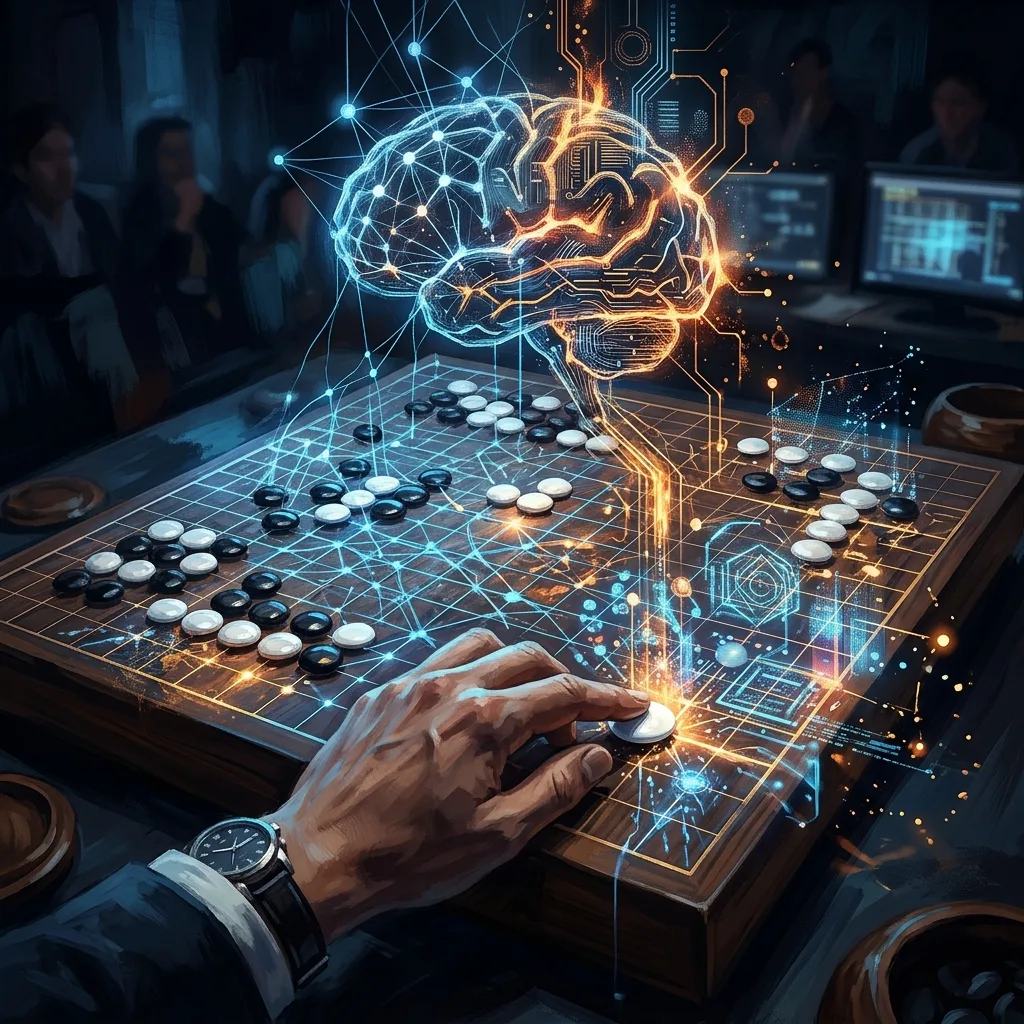
Google DeepMind's AlphaGo defeats 18-time world champion Lee Sedol 4–1 in the ancient board game Go, a feat that experts predicted was at least a decade away. Unlike chess, Go has more possible board positions than atoms in the observable universe, making brute-force calculation impossible. AlphaGo had to develop something resembling intuition.
Open in interactive timeline →Key Numbers
- Final score
- AlphaGo 4 - Lee Sedol 1
- Dates / venue
- March 9-15, 2016, Seoul
- Prize money
- $1M (to charity)
- Global viewers
- 200+ million
- Lee Sedol rank
- 9-dan, 18 world titles
Verified Facts
- The DeepMind Challenge Match was a best-of-five Go series played March 9-15, 2016, at the Four Seasons Hotel in Seoul, which AlphaGo won 4-1, with every one of the five games decided by resignation rather than counting.
- Lee Sedol, a 9-dan professional and one of the strongest players of his generation (18 international titles), had publicly predicted before the match that he would win 5-0 or 4-1; instead he lost the first three games and salvaged only Game 4.
- The match was watched by an estimated 200+ million people worldwide and is widely regarded as a landmark moment that brought modern AI to mainstream public attention.
- AlphaGo's 'Move 37' in Game 2 - a shoulder hit on the fifth line that human convention disfavored - was so unconventional commentators initially thought it a mistake; DeepMind later reported the program estimated only about a 1-in-10,000 chance a human professional would have played it, yet it proved pivotal to the win.
- In Game 4, Lee Sedol's 'Move 78', a wedge later nicknamed the 'God's Touch' or 'divine move', destabilized AlphaGo; the program responded poorly at Move 79 and its win-probability collapsed, handing Lee the only human victory in the series after roughly 180 moves.
- The $1 million prize for an AlphaGo win was pledged by Google DeepMind to charities including UNICEF and Go organizations; Lee Sedol received $170,000 - $150,000 for participating plus a $20,000 bonus for winning one game.
- AlphaGo combined deep neural networks - a policy network to suggest moves and a value network to evaluate positions - with Monte Carlo tree search, and was trained on millions of human games plus extensive self-play, as described in the team's Nature paper.
- Months earlier, in October 2015, an earlier version ('AlphaGo Fan') had beaten European champion Fan Hui 5-0 - the first time a program defeated a Go professional on a full 19x19 board without a handicap - though that result was kept secret until the Nature paper 'Mastering the game of Go with deep neural networks and tree search' was published on 28 January 2016.
- Go had long been considered AI's grand challenge because its branching factor and roughly 10^170 possible board positions made the brute-force search that cracked chess infeasible, so Go was expected to resist computers for another decade or more.
- In November 2019, Lee Sedol retired from professional Go, telling reporters that even as the world's best human 'there is an entity that cannot be defeated,' citing the rise of AI as a central reason for stepping away from the game.
The World at This Moment
The five-game match in Seoul (9-15 March 2016) unfolded amid a surge of deep-learning breakthroughs following the 2012 AlexNet result and the 2014 founding spirit of DeepMind, which Google acquired in 2014. Weeks earlier, on 28 January 2016, Nature had published Silver, Huang, Hassabis et al.'s "Mastering the game of Go with deep neural networks and tree search," reporting AlphaGo's 5-0 defeat of European champion Fan Hui. The match coincided with intensifying public debate over automation and AI risk: Nick Bostrom's Superintelligence (2014) was widely read, and figures like Elon Musk and Stephen Hawking were voicing warnings. In South Korea, the event was a national spectacle watched by an estimated 280 million people, accelerating government and corporate AI investment. Geopolitically, the spectacle is often credited with galvanizing China's AI ambitions, foreshadowing the State Council's 2017 "New Generation Artificial Intelligence Development Plan." Contemporaneously, ImageNet-driven computer vision and early sequence models were maturing, a year before the 2017 "Attention Is All You Need" transformer paper reshaped the field.
The Paradigm Shift
Go's astronomical branching factor (roughly 250 legal moves per position over ~150 moves) had long made it the "holy grail" of game AI, widely judged a decade or more from human-champion play. AlphaGo's victory collapsed that timeline. Crucially, it validated a methodological shift: combining deep convolutional policy and value networks with Monte Carlo Tree Search, trained by supervised learning on human games and then reinforcement learning through self-play. This demonstrated that learned intuition-like evaluation, not handcrafted heuristics or brute-force search alone, could conquer domains of vast complexity. Move 37 in Game 2, which AlphaGo's own policy network rated as a one-in-ten-thousand human choice, became emblematic of machine "creativity," expanding rather than merely imitating human knowledge. The lineage that followed - AlphaGo Zero (2017), learning tabula rasa, then AlphaZero and MuZero - generalized the approach, and DeepMind's Demis Hassabis later applied related thinking toward AlphaFold's 2024 Nobel-recognized protein-structure breakthrough. The match reframed reinforcement learning and self-play as central paradigms in the modern AI research agenda.
In Their Own Words
"It's not a human move. I've never seen a human play this move. So beautiful. So beautiful." — Fan Hui (European Go champion, advising the DeepMind team), reacting to AlphaGo's Move 37 in Game 2, as recorded in Greg Kohs's documentary AlphaGo (2017) and contemporaneous reporting (Wired, 2016)
In Depth
The Move That No Human Would Play
In March 2016, in a Seoul hotel, a machine placed a stone on a Go board that no human professional would have considered, and in doing so it announced that intuition itself had become computable. Over five games, Google DeepMind's AlphaGo defeated Lee Sedol, one of the greatest players of his generation, by a score of 4-1, before an audience of more than 200 million viewers. The match is a hinge in the long arc from matter to mind — the moment the machine crossed from calculation into something that looked, unsettlingly, like judgment.
Why Go, and Why It Mattered
To grasp the magnitude, you have to see what came before. When IBM's machine beat Garry Kasparov at chess in 1997 (sv-deep-blue), it did so largely by brute-force search — counting further ahead than any person could. Go defied that approach. Its board permits more legal positions than there are atoms in the observable universe forged since the first stars (sv-first-stars), so no amount of raw enumeration suffices. Mastery demanded feel. AlphaGo's breakthrough was to fuse deep neural networks — the same architecture unleashed four years earlier when image recognition cracked open (sv-alexnet-convnets) — with reinforcement learning and Monte Carlo tree search. It learned partly by playing millions of games against itself, distilling a kind of trained instinct rather than a lookup table.
The deep precondition is the neuron itself, an inheritance billions of years old. The artificial networks in AlphaGo are crude abstractions of biological brains, which trace back through the first primates (sv-first-primates), the first mammals (sv-first-mammals), and ultimately the nervous tissue that emerged in the riot of body plans during the Cambrian explosion (sv-cambrian-explosion). Humanity spent the Agricultural Revolution (sv-agriculture) onward externalizing thought — into cuneiform (sv-cuneiform), the printing press (sv-printing-press), the World Wide Web (sv-www) — and AlphaGo was the moment the externalized substrate began to think back.
Move 37 and the Texture of Machine Creativity
The match's emblematic instant was Move 37 of Game Two, a shoulder-hit on the fifth line that commentators initially read as a mistake. It was no mistake; it reshaped the whole board, and Lee Sedol left the room to compose himself. Here was a machine producing what observers could only call beauty — alien, but undeniable. The human reply came in Game Four: Lee's Move 78, the "God's Touch," a wedge so precise that AlphaGo had estimated its probability at one in ten thousand. He won that game. It remains, poignantly, one of the last clear human victories over a top engine, a flicker of the creative spark that runs from Homer's improvising bards (sv-homer) through every artist since.
The Ripples
AlphaGo did not stay in Seoul. It convinced a generation of researchers that scaling learned systems, rather than hand-coding rules, was the road forward — a conviction that bore fruit a year later in the Transformer architecture (sv-transformer-paper) and the language models that followed. It lent sudden credibility to the timelines Ray Kurzweil had sketched (sv-singularity-near), in which accelerating returns drive toward machine intelligence by 2029 (sv-kurzweil-agi-2029). Lee Sedol retired from professional Go in 2019, stating plainly that an entity that could not be defeated had appeared. That sentence is the human meaning of the event: not triumph, not catastrophe, but the vertigo of sharing the cognitive frontier. From the Big Bang (sv-big-bang) to a board game in Seoul, the universe had taken a strange step toward building minds that exceed the ones that built them.
Sources: AlphaGo versus Lee Sedol (Wikipedia), Google DeepMind — AlphaGo, Google Blog — AlphaGo's ultimate challenge
Causes & Consequences
What led to it
- Rémi Coulom introduced Monte Carlo tree search for computer Go in his 2006 paper, and the UCT variant proposed by Kocsis and Szepesvári that same year gave AlphaGo the search algorithm it used to navigate Go's enormous game tree.
- The deep learning revolution of the early 2010s, accelerated by GPU-trained convolutional neural networks after AlexNet's 2012 ImageNet win, supplied the policy and value network architectures that let AlphaGo evaluate board positions and candidate moves.
- DeepMind's 2013 deep Q-network work, led by Volodymyr Mnih, was the first system to learn control policies directly from raw pixels by combining deep neural networks with reinforcement learning, establishing the deep RL foundation AlphaGo built upon.
- AlphaGo's training pipeline began by supervised learning on a database of over 100,000 (roughly 30 million positions) games played by strong human players, giving its policy network a grounding in expert Go before self-play refinement.
- DeepMind then improved the networks through reinforcement learning by having versions of AlphaGo play millions of games against themselves, producing a value network that could evaluate positions far beyond human-tuned heuristics.
- In October 2015 AlphaGo defeated European champion Fan Hui 5-0 in London, the first time a program beat a professional on a full board without handicap, and the resulting Nature paper 'Mastering the game of Go with deep neural networks and tree search' (Jan 2016) validated the method just before the Lee Sedol match.
What it set in motion
- AlphaGo's Move 37 in Game 2, a fifth-line shoulder hit that human experts estimated had roughly a 1-in-10,000 chance of being played, overturned centuries of established Go orthodoxy and is widely cited as evidence that AI can generate genuinely novel, creative strategy.
- DeepMind generalized the approach into AlphaGo Zero (2017), which learned Go from scratch through self-play with no human game data, then AlphaZero, which mastered chess and shogi as well, and MuZero, which learned to play without even being told the rules.
- The same self-play and search techniques fed directly into AlphaFold, whose protein-structure predictions earned Demis Hassabis and John Jumper a share of the 2024 Nobel Prize in Chemistry and have been used by more than two million researchers across 190 countries.
- The 4-1 defeat, watched by over 200 million viewers worldwide, became a landmark public moment that helped trigger a surge of corporate and national investment in artificial intelligence, particularly in China after its policymakers took note of the match.
- Spin-off AlphaZero-derived systems went on to discover faster sorting and matrix-multiplication algorithms (AlphaDev, AlphaTensor) now run trillions of times daily, while MuZero was applied to more efficiently compress YouTube video traffic.
- The match accelerated a broader research push toward artificial general intelligence; Ray Kurzweil, in 'The Singularity Is Nearer' (2024), reaffirmed his documented projections of human-level AI around 2029 and a human-AI merger 'singularity' around 2045, predictions that should be read as forecasts rather than established fact.
The Live Academic Debate
A central interpretive debate concerns what the victory actually demonstrated about intelligence. Enthusiasts, echoing DeepMind's framing, read AlphaGo as evidence of genuine machine creativity and intuition, citing Move 37 and the system's novel josekis later adopted by professionals. Skeptics, including Gary Marcus and critics of "narrow AI," counter that AlphaGo remained a domain-specific system reliant on a perfect-information, fully-observable game with a clear reward signal, and warn against extrapolating to general intelligence; the match's limits, they argue, are exposed by Lee Sedol's winning Game 4 "Hand of God" (Move 78), which triggered an MCTS-related failure. A second debate concerns historical significance: was this a discontinuous breakthrough or an incremental, predictable step atop AlexNet-era deep learning? Hubert Dreyfus-influenced critics of symbolic AI saw vindication of connectionism, while others (e.g., commentators noting Monte Carlo Go's prior progress since 2006) emphasize continuity. A third strand, advanced in policy scholarship (Kai-Fu Lee), debates the match's geopolitical causal weight versus its symbolic role.
The Counterfactual
Had AlphaGo lost, or had DeepMind not staged the match, the deep reinforcement-learning paradigm would likely still have advanced, but its public legitimation and funding momentum would have been blunted and delayed. The Seoul match functioned as a "Sputnik moment," especially in China: observers including Kai-Fu Lee (AI Superpowers, 2018) argue it crystallized Chinese policymakers' urgency, feeding into the 2017 national AI plan and a subsequent investment wave. Absent that catalytic spectacle, the perceptual gap between "AI is decades away" and "AI is here now" might have closed more gradually, dampening the surge of talent and capital into deep learning circa 2016-2018. Internally, a defeat could have slowed DeepMind's self-play research trajectory toward AlphaGo Zero and AlphaZero, though the underlying Nature methodology was already published and reproducible. One should be cautious: the broader deep-learning boom rested on AlexNet, GPUs, and large datasets, so the field's direction was overdetermined. The counterfactual chiefly concerns timing, public salience, and geopolitical framing rather than the existence of the techniques themselves.
Myth vs. Reality
Myth: AlphaGo swept Lee Sedol, winning all the games with flawless, unbeatable play.
Reality: AlphaGo won the five-game match 4-1, not 5-0. Lee Sedol won Game 4 (played in Seoul, 9-15 March 2016) by resignation after his celebrated Move 78, a center wedge that AlphaGo's own analysis later put at roughly a 1-in-10,000 chance of being played. AlphaGo responded with a weak Move 79 and did not recognize its error for several moves, eventually resigning. That game remains the only loss this version of AlphaGo ever recorded against a human.
Myth: AlphaGo beat Go the way IBM's Deep Blue beat chess: by brute-force searching far more positions than a human could.
Reality: Go's branching factor (roughly 10^170 possible board states) makes Deep Blue-style exhaustive search infeasible, which is why earlier programs failed at the game. Per DeepMind's 2016 Nature paper, AlphaGo combined deep neural networks (a policy network to suggest moves and a value network to evaluate positions) with Monte Carlo Tree Search, letting it evaluate far fewer positions than Deep Blue did while playing more accurately. Deep Blue actually searched many orders of magnitude more positions per move than AlphaGo.
Myth: The AlphaGo that beat Lee Sedol taught itself Go entirely from scratch, with no human input.
Reality: That describes AlphaGo Zero, a later 2017 system, not the version that played Lee Sedol. The 2016 AlphaGo was bootstrapped with supervised learning on roughly 30 million board positions sampled from about 160,000 games by strong human players on the KGS Go Server, and only then improved through reinforcement learning via self-play. The 'no human knowledge' milestone came over a year later with AlphaGo Zero, described in a separate 2017 Nature paper.
Myth: Lee Sedol was the world's number-one ranked Go player and reigning world champion when he faced AlphaGo.
Reality: Lee Sedol was one of the greatest players of his era, with 18 international titles, but he was not the top-ranked player at the time. Under Rémi Coulom's widely cited rating system, China's Ke Jie held the world number-one position (held since late 2014). DeepMind chose Lee for his legendary status; Ke Jie, the actual top-ranked player, did not play AlphaGo until May 2017, losing 3-0 to the later 'AlphaGo Master.'
Myth: Lee Sedol retired from Go immediately because of the AlphaGo defeat.
Reality: Lee continued playing professionally for over three years and retired in November 2019, not in 2016. He cited the broader rise of AI rather than that single match, saying that even as the number-one human player, 'there is an entity that cannot be defeated.' In a later 2024 interview he reflected that losing to AI felt like his world collapsing and that he could no longer enjoy the game, but the retirement was a years-later decision, not an on-the-spot reaction.
Frequently Asked Questions
Who won the AlphaGo vs. Lee Sedol match and what was the final score?
AlphaGo, the Go-playing program developed by Google DeepMind, defeated South Korean grandmaster Lee Sedol 4-1 in a five-game match played in Seoul from March 9 to 15, 2016. AlphaGo won games one, two, three, and five; Lee Sedol won only game four. The match was watched by an estimated 200 million people worldwide and is widely regarded as a landmark moment in artificial intelligence.
Why was beating a human at Go such a big deal compared to chess?
Go is played on a 19x19 board with roughly 250 legal moves per position, versus about 35 in chess, giving it a game tree far larger than the number of atoms in the observable universe. This astronomical branching factor makes the brute-force search used by chess engines like IBM's Deep Blue impractical, and evaluating a Go position requires deep intuition rather than simple material counting. Many experts had predicted that an AI capable of beating a top professional was still a decade or more away, so AlphaGo's 2016 victory arrived dramatically ahead of schedule.
What was Move 37 and why is it so famous?
Move 37 was a stone AlphaGo played on the fifth line in game two, a shoulder-hit so unconventional that commentators initially thought it was a mistake. DeepMind later noted the program estimated a human would have played it with a probability of about 1 in 10,000. The move proved strategically brilliant and helped AlphaGo win game two, becoming a symbol of AI's ability to discover genuinely novel ideas beyond established human knowledge.
Did Lee Sedol win any games against AlphaGo?
Yes. Lee Sedol won game four with a brilliant wedge known as Move 78, which top Go professional Gu Li called the 'God's touch' or 'hand of God.' The move was so unlikely that AlphaGo had effectively not accounted for it, and the program then played a series of weak moves before resigning. This remains the only officially recorded competitive game that the AlphaGo program ever lost to a human.
What happened to the $1 million prize money?
Google DeepMind put up a $1 million prize for the match, and because AlphaGo won, the company donated the full amount to charity. The recipients included UNICEF, science and technology (STEM) education charities, and Go organizations. Lee Sedol still received appearance fees and a per-win bonus for the one game he won.
Did Lee Sedol retire because of AI, and what did he say about it?
Yes. Lee Sedol announced his retirement from professional Go in November 2019, citing the rise of dominant AI as the deciding factor. In an interview in Seoul he said that even if he became the number one human player, 'there is an entity that cannot be defeated.' He remains, to date, the only human ever to have beaten the AlphaGo program in a competitive game.
Sources & Further Reading
- AlphaGo versus Lee Sedol — Wikipedia
- David Silver, Aja Huang, Demis Hassabis et al., "Mastering the game of Go with deep neural networks and tree search," Nature 529 (28 January 2016): 484-489
- David Silver et al., "Mastering the game of Go without human knowledge," Nature 550 (2017): 354-359 (AlphaGo Zero)
- Greg Kohs (dir.), AlphaGo (documentary, 2017)
- Kai-Fu Lee, AI Superpowers: China, Silicon Valley, and the New World Order (Houghton Mifflin Harcourt, 2018)
- Cade Metz, Genius Makers: The Mavericks Who Brought AI to Google, Facebook, and the World (Dutton, 2021)
- DeepMind: AlphaGo
Cite This Page
AskHistoryAI. “AlphaGo Defeats Lee Sedol.” AskHistoryAI — Interactive Timeline of Everything. Updated 2026-09-11. https://askhistoryai.com/event/sv-alphago/
Every fact on this page is checked against the published fact ledger and methodology; sources are listed above.