AlexNet & The Deep Learning Revolution
The moment machines learned to see.
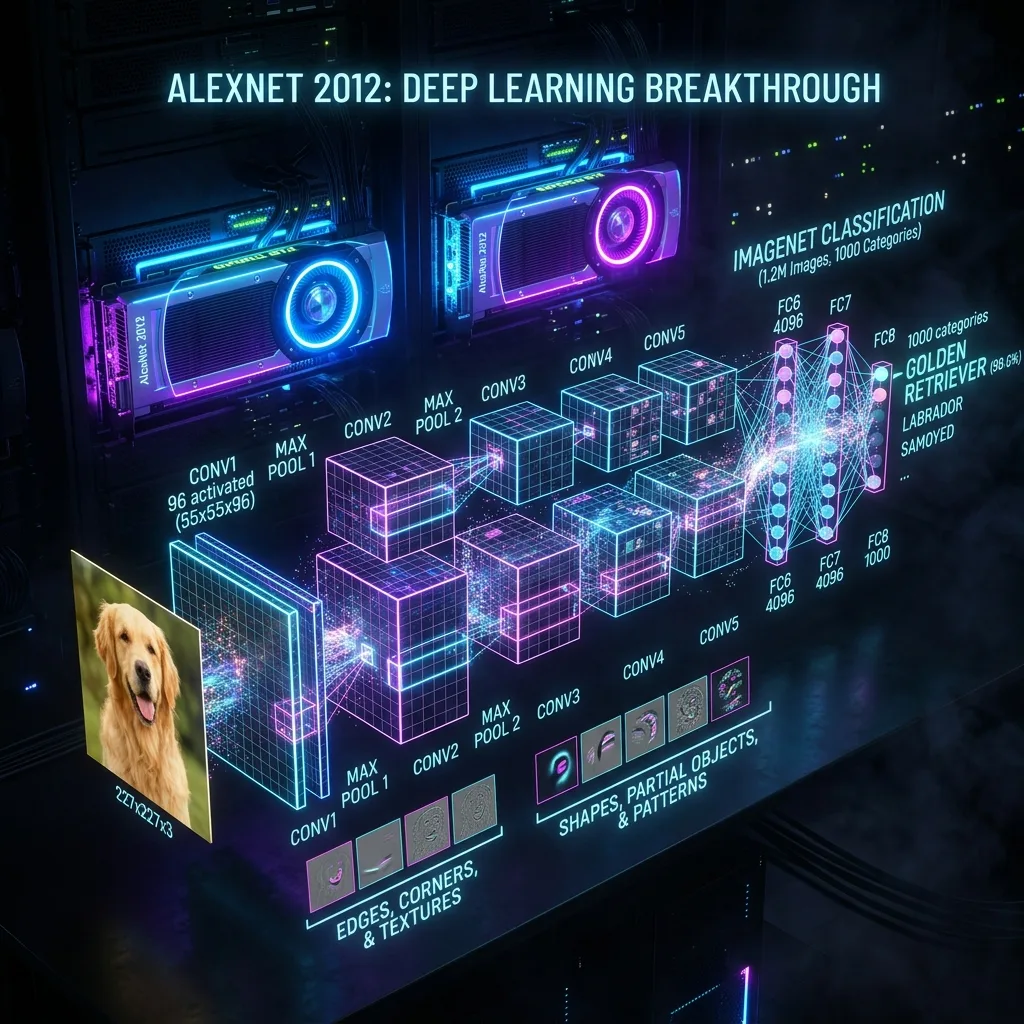
Alex Krizhevsky, Ilya Sutskever, and Geoffrey Hinton enter a deep convolutional neural network (AlexNet) into the ImageNet competition and obliterate the competition, reducing the error rate by nearly half. This single event reignites the entire field of neural networks and launches the modern deep learning revolution.
Open in interactive timeline →Key Numbers
- Top-5 error (ILSVRC 2012)
- 15.3% vs 26.2% runner-up
- Parameters
- ~60 million
- Training hardware
- 2 × NVIDIA GTX 580 (3GB)
- Training time
- ~5-6 days, 90 epochs
- Paper citations
- 172,000+ (Google Scholar)
Verified Facts
- AlexNet won the 2012 ImageNet Large Scale Visual Recognition Challenge (ILSVRC) with a top-5 error rate of 15.3%, crushing the second-place entry at 26.2% — a roughly 11-percentage-point margin that was unprecedented and signaled that deep convolutional networks had decisively overtaken hand-engineered computer-vision pipelines.
- The network was built by Alex Krizhevsky, Ilya Sutskever, and Geoffrey Hinton at the University of Toronto; their paper 'ImageNet Classification with Deep Convolutional Neural Networks' (NeurIPS 2012) is now one of the most-cited papers in all of science, with over 172,000 citations on Google Scholar.
- AlexNet had eight learned layers — five convolutional and three fully connected — about 60 million parameters and 650,000 neurons, and was trained on roughly 1.2 million labeled images across 1,000 categories from the ImageNet dataset.
- Because a single GPU lacked enough memory, Krizhevsky split the network across two NVIDIA GTX 580 cards (3GB each), with the GPUs communicating only at certain layers; training ran about 90 epochs over five to six days, and the implementation was roughly 6,000 lines of hand-written CUDA/C++ code.
- The model leaned on ReLU activations, which trained several times faster than the then-standard tanh/sigmoid units, and on dropout (developed in Hinton's lab) applied to the first two fully connected layers to combat overfitting — techniques that became near-universal in subsequent deep learning.
- AlexNet was only possible because of Fei-Fei Li's ImageNet, a dataset of millions of hand-labeled images organized by the WordNet hierarchy and completed around 2009; it was orders of magnitude larger than prior vision datasets and supplied the scale that deep networks needed to shine.
- Months after the win, Hinton ran a sealed-bid auction for his startup DNNresearch during the December 2012 NeurIPS conference; Baidu, Google, Microsoft, and DeepMind bid, and Hinton accepted Google's offer of $44 million, sending all three researchers to Google in early 2013.
- AlexNet is widely credited as the spark of the modern deep learning and GPU-compute boom — it validated NVIDIA's bet on GPUs for AI, and its co-author Ilya Sutskever went on to co-found OpenAI while Hinton later shared the 2024 Nobel Prize in Physics for foundational neural-network work.
- In March 2025, the Computer History Museum, in partnership with Google, publicly released the original annotated AlexNet source code after a five-year effort led by Google's David Bieber, preserving the historic 2012 codebase for the public.
- For honest framing of speculative timeline entries: Ray Kurzweil's 2029 human-level AI and 2045 singularity dates, AGI arrival estimates, the 'Claude Mythos,' and humanoid-robot parity claims are documented predictions and projections — not established facts — and should be presented as forecasts that may not come to pass.
The World at This Moment
When AlexNet's entry was submitted on 30 September 2012, machine vision was dominated by hand-engineered features (SIFT, HOG) fed to support vector machines; the prevailing wisdom, voiced by skeptics of neural nets since the 1990s "AI winter," held that deep networks were untrainable curiosities. Yet the preconditions had quietly assembled. Fei-Fei Li's ImageNet, begun in 2007 and crowdsourced via Amazon Mechanical Turk, had grown to over 14 million labeled images. NVIDIA's CUDA (2007) had made consumer GPUs programmable for general computation. Geoffrey Hinton's Toronto group had already shown deep nets cracking speech recognition (2009-2011). Beyond AI, 2012 was the year of the Higgs boson discovery at CERN, the Curiosity rover's Mars landing, and the rise of mobile computing and social platforms generating unprecedented training data. The same big-data, cheap-compute conjuncture that powered AlexNet was reshaping science and commerce broadly, making this less an isolated breakthrough than the moment a long-gestating substrate ignited.
The Paradigm Shift
AlexNet's 15.3% top-5 error rate, versus 26.2% for the runner-up, was an unprecedented margin that collapsed the credibility of hand-crafted feature pipelines almost overnight. The shift was methodological rather than purely architectural: the network resembled Yann LeCun's 1998 LeNet-5, but Krizhevsky trained an eight-layer model on 1.2 million images using ReLU activations, dropout regularization, and two NVIDIA GTX 580 GPUs via his cuda-convnet code. It demonstrated that representations could be learned end-to-end from data at scale rather than designed by hand. Within two years, nearly every ILSVRC entrant used deep convolutional networks; the technique swept speech, translation, and eventually language modeling, seeding the lineage that runs through VGG, ResNet, and ultimately the Transformer era. It also realigned the field's economy around GPUs, catalyzing NVIDIA's pivot to AI and the industrial arms race for compute. Yann LeCun called it "an unequivocal turning point in the history of computer vision."
In Their Own Words
"We trained a large, deep convolutional neural network to classify the 1.2 million high-resolution images in the ImageNet LSVRC-2010 contest into the 1000 different classes... we entered a variant of this model in the ILSVRC-2012 competition and achieved a winning top-5 test error rate of 15.3%, compared to 26.2% achieved by the second-best entry." — Alex Krizhevsky, Ilya Sutskever, and Geoffrey E. Hinton, "ImageNet Classification with Deep Convolutional Neural Networks," Advances in Neural Information Processing Systems 25 (NeurIPS, 2012), abstract.
In Depth
The Spark That Lit the Connectionist Fire
In September 2012, three researchers from the University of Toronto—Alex Krizhevsky, Ilya Sutskever, and Geoffrey Hinton—entered a deep convolutional neural network in the ImageNet Large Scale Visual Recognition Challenge. Their model, soon nicknamed AlexNet, achieved a top-5 error rate of 15.3 percent, crushing the runner-up's 26.2 percent by nearly eleven points. In a field where progress had crept forward in fractions of a percent, this was not an increment but a rupture. Almost overnight, the academic consensus that hand-engineered features and support-vector machines were the future of computer vision collapsed. The deep learning revolution had begun.
The Deep Preconditions
AlexNet was less a sudden invention than a long-delayed detonation. Its three essential ingredients had each been maturing for decades. The first was the algorithm: backpropagation through multi-layer networks, championed by Hinton and others in the 1980s, a connectionist tradition that had spent the intervening years in the academic wilderness, dismissed as impractical. The second was data—the ImageNet dataset, released in 2009 by Stanford's Fei-Fei Li, comprising roughly fourteen million labeled images. The third was raw compute, supplied by an unlikely source: two consumer Nvidia GTX 580 graphics cards, gaming hardware repurposed to run the matrix multiplications that neural networks devour. This last ingredient places AlexNet squarely in the lineage of the harnessing of electricity itself, from Michael Faraday (sv-michael-faraday) and James Clerk Maxwell (sv-james-maxwell) to the electric infrastructure pioneered by Thomas Edison (sv-thomas-edison) and Nikola Tesla (sv-nikola-tesla). Without cheap, parallel silicon, the algorithm and the data would have remained inert. AlexNet is what happens when all three converge.
A Different Kind of Machine Victory
The symbolic shadow over AlexNet was Deep Blue Defeats Kasparov (sv-deep-blue), IBM's 1997 chess triumph. But the two victories represented opposed philosophies. Deep Blue won by brute-force search over hand-coded rules—a monument to symbolic AI. AlexNet won by learning its own features from raw pixels, with no human telling it what an edge or a whisker looked like. ReLU activations and dropout regularization let the network train in days rather than weeks while resisting overfitting. This was the connectionist answer to the symbolic dream, and it vindicated a wager Hinton had nursed for thirty years. The contrast echoes an older split in how we model the world, from the rationalist deductions of René Descartes (sv-descartes) to the empirical, bottom-up tradition of observation.
The Ripples Forward
Within a single year, every serious ImageNet entrant used convolutional networks; the old methods were extinct. The architecture's three co-authors scattered into the institutions that would define the next decade—Sutskever a co-founder of OpenAI. The same scaling logic that powered AlexNet led directly to AlphaGo Defeats Lee Sedol (sv-alphago) in 2016, then to the architecture unveiled in Attention Is All You Need (sv-transformer-paper), which generalized deep learning from images to language. From there the lineage runs straight through GPT-3: Scale is All You Need (sv-gpt3) and Claude 3.5 Sonnet (sv-claude-sonnet). The lesson AlexNet taught—that scale of data and compute, not clever hand-crafted rules, was the royal road to intelligence—became the governing creed of an era.
That creed was, in a sense, prophesied. Ray Kurzweil had argued in The Singularity Is Near (sv-singularity-near) that exponential hardware gains would eventually make machine intelligence inevitable, a thesis formalized as his Law of Accelerating Returns (sv-kurzweil-law). AlexNet was the empirical proof-of-concept that the curve was real. If one traces the arc of accelerating intelligence from the first replicating molecules at the Origin of Life (sv-origin-of-life) through the Cambrian Explosion (sv-cambrian-explosion) of nervous systems, AlexNet marks the moment intelligence began bootstrapping itself in silicon—a small network of artificial neurons that quietly rewrote the trajectory of its makers.
Causes & Consequences
What led to it
- Yann LeCun and colleagues at Bell Labs published the first convolutional neural network trained end-to-end with backpropagation in 1989, and the 1998 LeNet-5 model established the convolution-plus-pooling architecture that AlexNet later scaled up.
- Fei-Fei Li's team built ImageNet, introduced at CVPR 2009 with roughly 12 million labeled images across more than 20,000 WordNet-derived categories, using Amazon Mechanical Turk crowdsourcing to verify labels at a scale no prior vision dataset had reached.
- NVIDIA released the CUDA general-purpose GPU programming platform in 2006, making it practical to run massively parallel neural-network computations on consumer graphics cards rather than CPUs.
- Two NVIDIA GTX 580 GPUs with only 3 GB of memory each forced Krizhevsky to split the network across both cards in a two-tower design, which made training a network of this size feasible in about five to six days.
- The rectified linear unit (ReLU), repopularized by Nair and Hinton in 2010 and analyzed by Glorot, Bordes, and Bengio in 2011, gave AlexNet a fast, non-saturating activation that sped training and eased the vanishing-gradient problem.
- Dropout regularization, developed in Hinton's lab, let AlexNet train a very large network on ImageNet without catastrophic overfitting to the training images.
What it set in motion
- AlexNet cut the ILSVRC top-5 error rate from 26.2 percent to 15.3 percent in 2012, a margin so large it convinced the computer-vision community to abandon hand-engineered feature pipelines in favor of deep learning almost overnight.
- Its success turned GPUs into the default substrate for AI, helping drive NVIDIA's pivot from a gaming company to an AI-infrastructure giant whose data-center segment now accounts for roughly nine-tenths of its revenue.
- The techniques AlexNet popularized (ReLU, dropout, data augmentation, and end-to-end learning on GPUs) became standard practice and seeded later breakthroughs including AlphaGo's 2016 defeat of Lee Sedol and the transformer architecture behind modern language models.
- Ilya Sutskever and Geoffrey Hinton, two of AlexNet's three authors, went on to shape the founding of OpenAI and the broader generative-AI wave, with Sutskever becoming OpenAI's chief scientist.
- The deep-learning trajectory AlexNet launched leads (per documented projections, not established fact) to Ray Kurzweil's repeatedly stated prediction of human-level AGI by 2029 and a technological Singularity around 2045.
- That same trajectory underlies present-day frontier systems such as Anthropic's Claude Opus and Mythos-class models and the still-unfinished push toward humanoid robots like Tesla Optimus and Figure's Helix-driven units reaching human dexterity, which as of 2026 remain works in progress rather than achieved parity.
The Live Academic Debate
A live debate concerns why AlexNet succeeded and what it teaches. The "compute-and-data" reading, exemplified by Richard Sutton's "The Bitter Lesson" (2019), holds that AlexNet vindicates general, scalable methods leveraging massive computation over human-engineered knowledge—the architecture was old; data and GPUs were new. Critics such as Max Welling counter that inductive biases and structured priors remain essential where data or compute are scarce, cautioning against over-generalizing from data-rich vision. Sara Hooker's "The Hardware Lottery" (2020) reframes the question entirely: AlexNet won partly because convolutional nets happened to fit available GPU hardware, implying the "best" idea is conflated with the best hardware-matched idea. Historians of science also dispute the "revolution" framing, noting deep continuity with LeCun's 1980s-90s convolutional work and Cireşan's 2011 GPU victories—suggesting AlexNet was a tipping point in a gradual accumulation rather than a sudden rupture. The disagreement bears directly on present strategy: scale maximalism versus architectural innovation.
The Counterfactual
Had AlexNet not won in 2012, the deep learning turn would almost certainly still have occurred, but plausibly slower and more diffuse. The enabling ingredients—ImageNet, CUDA-capable GPUs, backpropagation, dropout, ReLU—were converging independently; Hinton's group had already cracked speech recognition, and Dan Cireşan's GPU-trained nets had won vision contests in 2011. The likeliest counterfactual is not "no deep learning" but a less concentrated ignition: a clear demonstration arriving perhaps a year or two later, possibly from a different lab (Schmidhuber's Swiss group, or Google Brain after its 2012 "cat neuron" work). The discontinuity mattered for sociology as much as science: AlexNet's lopsided margin produced a legible, public shock that redirected funding, talent, and corporate strategy overnight—Google's acquisition of Hinton's DNNresearch in 2013 followed directly. Sara Hooker's "hardware lottery" thesis implies that without the GPU-friendly framing, an equally valid but hardware-mismatched approach might have stalled, delaying the watershed and reshaping which ideas won.
Myth vs. Reality
Myth: AlexNet was the first convolutional neural network, or the first CNN trained on GPUs.
Reality: Neither is true. Convolutional networks date to Kunihiko Fukushima's Neocognitron (1980) and Yann LeCun's LeNet (developed through the late 1980s and 1990s for handwritten-digit recognition). GPU-trained deep CNNs also predate AlexNet: Dan Cireșan's 'DanNet,' built in Jürgen Schmidhuber's IDSIA lab, used CUDA on NVIDIA GPUs and won four computer-vision contests between 2011 and 2012 (including the IJCNN 2011 traffic-sign task, where it reached superhuman accuracy) before AlexNet appeared in December 2012. AlexNet's real significance was scale and impact: it won the much larger ImageNet challenge and triggered the field's wholesale shift to deep learning.
Myth: AlexNet invented the key techniques it used, such as ReLU activations and dropout.
Reality: AlexNet popularized these methods but did not invent them. The rectified linear unit was used by Fukushima as early as the 1970s and was argued for as a replacement for sigmoid/tanh by Vinod Nair and Geoffrey Hinton in 2010, two years before AlexNet. Dropout likewise came out of Hinton's group as a separate regularization idea (the dedicated dropout paper followed in 2014). AlexNet's contribution was assembling ReLU, dropout, GPU training, and data augmentation into one system that worked convincingly at large scale.
Myth: AlexNet succeeded mainly because of a clever new network architecture.
Reality: The architecture mattered, but the breakthrough is inseparable from the dataset that made it possible. Fei-Fei Li's ImageNet, conceived from 2006 and released in 2009, was orders of magnitude larger than prior image datasets (roughly 14 million labeled images across ~22,000 categories), built by crowdsourcing labels through Amazon Mechanical Turk. Without a dataset that large and diverse, a high-capacity deep network would simply have overfit. Scholars consistently frame AlexNet's win as the convergence of three forces: a big labeled dataset (ImageNet), cheap parallel compute (GPUs), and accumulated algorithmic know-how, not architecture alone.
Myth: Deep learning came out of nowhere in 2012, ending an 'AI winter' overnight.
Reality: The 2012 result was a tipping point, not a virgin birth. The core ideas had been maturing for decades: backpropagation was popularized for multilayer networks in 1986 (Rumelhart, Hinton, and Williams), and convolutional and recurrent architectures were developed through the 1980s and 1990s. Progress had been bottlenecked by limited compute and the scarcity of large labeled datasets rather than by missing theory. AlexNet is best understood as the moment those long-standing methods finally met sufficient data and GPU horsepower, which is why it is described as the start of *modern* deep learning rather than its invention.
Myth: AlexNet was Geoffrey Hinton's network, or simply 'Krizhevsky's CNN.'
Reality: The 2012 paper, 'ImageNet Classification with Deep Convolutional Neural Networks,' has three authors: Alex Krizhevsky, Ilya Sutskever, and Geoffrey E. Hinton, with Krizhevsky doing much of the hands-on implementation and GPU engineering as Hinton's graduate student. The name 'AlexNet' itself reflects Krizhevsky's central role. The model won ILSVRC-2012 with a top-5 error rate of 15.3 percent, far ahead of the runner-up's 26.2 percent, a margin large enough to convince the computer-vision community to pivot to deep learning.
Frequently Asked Questions
What was AlexNet and why was it a breakthrough?
AlexNet was a deep convolutional neural network created by Alex Krizhevsky, Ilya Sutskever, and Geoffrey Hinton at the University of Toronto. In 2012 it won the ImageNet Large Scale Visual Recognition Challenge (ILSVRC) with a top-5 error rate of 15.3%, dramatically beating the runner-up's 26.2% and nearly halving the previous state of the art. This result is widely regarded as the spark that ignited the modern deep learning revolution, demonstrating that large neural networks trained on big datasets could outperform the hand-engineered computer-vision methods that had dominated the field.
How accurate was AlexNet on ImageNet in 2012?
AlexNet achieved a top-5 error rate of 15.3% in the 2012 ILSVRC competition, compared with 26.2% for the second-place entry. It also reported a top-1 error rate of about 37%, meaning its single best guess was correct roughly 63% of the time across 1,000 categories. These numbers represented a decisive margin over competing approaches and proved that deep neural networks could win at scale.
What hardware and techniques made AlexNet possible?
AlexNet was trained on two NVIDIA GTX 580 GPUs (each with only 3 GB of memory), which forced the authors to split the network across both cards; training took roughly six days over about 90 epochs. The model used ReLU activations to speed convergence and reduce the vanishing-gradient problem, plus dropout regularization to limit overfitting. NVIDIA's CUDA platform, which exposed GPUs to general-purpose parallel computing, was essential to making this training computationally feasible.
How big was the AlexNet network?
AlexNet had eight learned layers: five convolutional layers followed by three fully connected layers, with roughly 650,000 neurons. It contained about 60 million trainable parameters and was trained on the ImageNet dataset of roughly 1.2 million labeled images spanning 1,000 classes. Its scale was a major part of why it succeeded where earlier, smaller networks had plateaued.
Did AlexNet invent convolutional neural networks?
No. Convolutional neural networks were pioneered by Yann LeCun, whose 1998 LeNet-5 network for handwritten-digit recognition used a similar layered convolutional design with about 60,000 parameters. There were relatively few architectural differences between AlexNet and LeCun's 1990s networks; AlexNet was simply far larger and trained on far more data using GPUs. LeCun himself called AlexNet 'an unequivocal turning point in the history of computer vision,' and its success is often described as a vindication of the neural-network research he and Hinton had long championed.
What happened to AlexNet's creators and its source code?
After their 2012 win, Krizhevsky, Sutskever, and Hinton formed a company, DNNresearch, that Google acquired in 2013, helping seed Google's deep learning efforts; Sutskever later co-founded OpenAI and Hinton received the 2024 Nobel Prize in Physics for foundational neural-network work. In March 2025, the Computer History Museum, in partnership with Google, publicly released the original AlexNet source code on GitHub after a multi-year effort to preserve it. The underlying paper, 'ImageNet Classification with Deep Convolutional Neural Networks,' is one of the most cited papers in modern science.
Sources & Further Reading
- AlexNet — Wikipedia
- Alex Krizhevsky, Ilya Sutskever, Geoffrey E. Hinton, 'ImageNet Classification with Deep Convolutional Neural Networks,' NeurIPS 25 (2012); republished in Communications of the ACM 60, no. 6 (2017)
- Jia Deng, Wei Dong, Richard Socher, Li-Jia Li, Kai Li, Fei-Fei Li, 'ImageNet: A Large-Scale Hierarchical Image Database,' CVPR (2009)
- Richard S. Sutton, 'The Bitter Lesson' (2019)
- Sara Hooker, 'The Hardware Lottery,' Communications of the ACM 64, no. 12 (2021)
- Olga Russakovsky et al., 'ImageNet Large Scale Visual Recognition Challenge,' International Journal of Computer Vision 115 (2015)
- Wikipedia: Convolutional neural network
Cite This Page
AskHistoryAI. “AlexNet & The Deep Learning Revolution.” AskHistoryAI — Interactive Timeline of Everything. Updated 2026-09-11. https://askhistoryai.com/event/sv-alexnet-convnets/
Every fact on this page is checked against the published fact ledger and methodology; sources are listed above.