The American Civil War
The bloody resolution of America's founding paradox.
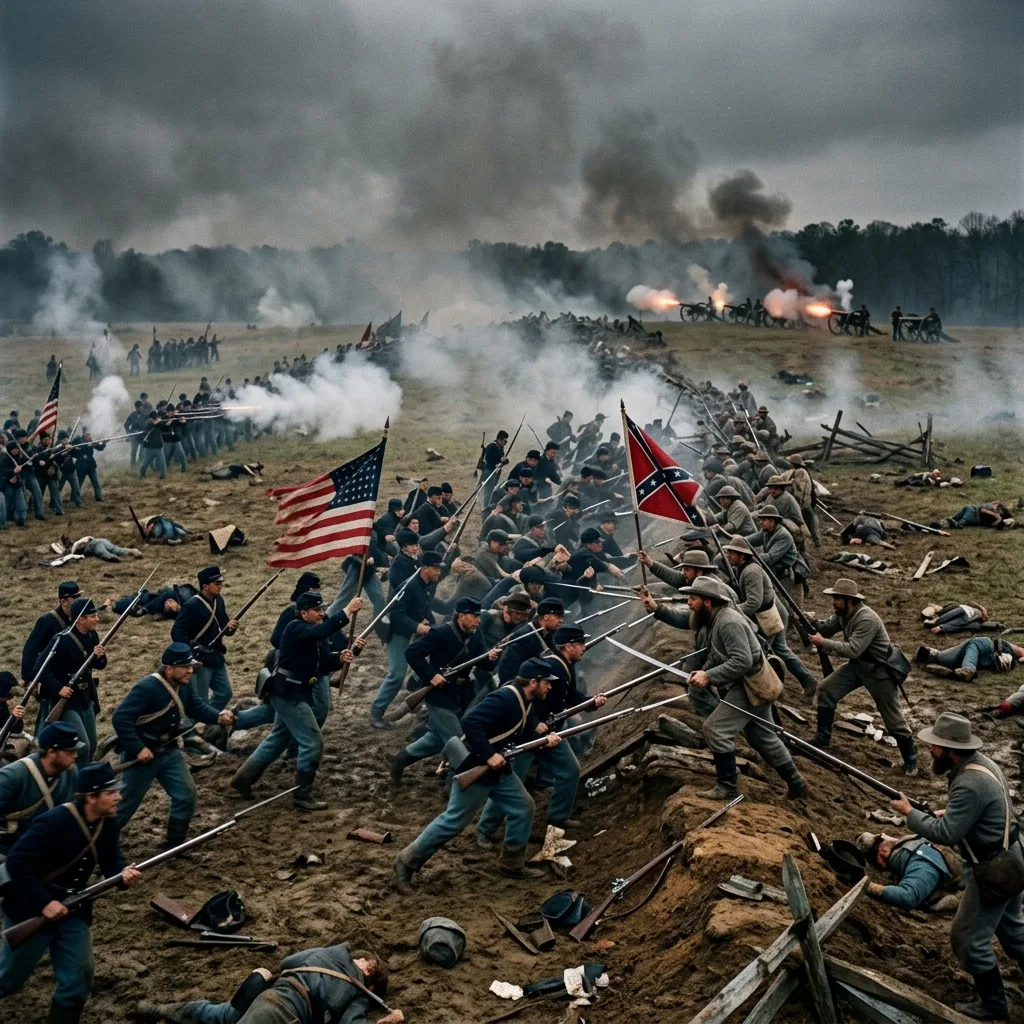
The United States fractures over the institution of chattel slavery. It is the first modern, industrialized war, resulting in over 600,000 deaths and the ultimate abolition of slavery in the US.
Open in interactive timeline →Key Numbers
- Duration
- Apr 1861 - Apr 1865 (4 years)
- Total dead
- ~620,000-750,000
- States seceded
- 11 (Confederacy)
- Enslaved freed
- ~4 million
- Bloodiest single day
- ~22,700 casualties (Antietam)
Verified Facts
- The war began on April 12, 1861, when Confederate artillery bombarded the federal garrison at Fort Sumter in Charleston Harbor, South Carolina, and effectively ended on April 9, 1865, when Confederate General Robert E. Lee surrendered the Army of Northern Virginia to Union General Ulysses S. Grant at Appomattox Court House, Virginia.
- The traditional death toll of about 620,000 was revised upward in 2011 by demographic historian J. David Hacker, who used digitized 1850-1870 census data to estimate roughly 750,000 deaths (with a plausible range of 650,000 to 850,000); the journal Civil War History called his paper among the most consequential it had ever published.
- Roughly two-thirds of Civil War military deaths came not from combat but from disease, with intestinal illnesses such as dysentery and chronic diarrhea, plus typhoid, pneumonia, and measles contracted in crowded camps, killing far more soldiers than bullets did.
- The Battle of Antietam on September 17, 1862, remains the bloodiest single day in American military history, producing about 22,700 combined casualties (killed, wounded, and missing) and giving Lincoln the qualified Union victory he needed to issue the Emancipation Proclamation.
- Lincoln issued the preliminary Emancipation Proclamation on September 22, 1862, and the final one on January 1, 1863; it freed enslaved people only in territory still in rebellion, leaving slavery legally intact in the loyal border states and Union-occupied areas, and its promise of freedom depended on Union military victory.
- The Emancipation Proclamation opened the Union Army and Navy to Black men, and by the war's end roughly 179,000 Black soldiers (about one-tenth of the Union Army, organized largely into United States Colored Troops regiments after General Order 143 of May 22, 1863) and about 19,000 Black sailors had served; nearly 37,000 of them died.
- The combined victories at Gettysburg (July 1-3, 1863), the largest battle ever fought in North America with roughly 51,000 casualties, and the fall of Vicksburg on July 4, 1863, which gave the Union control of the Mississippi River, are most often identified as the war's decisive turning point.
- Slavery was permanently abolished nationwide when the Thirteenth Amendment was ratified in December 1865 (Georgia provided the decisive 27th state on December 6), legally freeing roughly four million enslaved people; eleven states had seceded to form the Confederacy.
The World at This Moment
The Civil War unfolded amid a global wave of state consolidation and unfree-labor reform that historians increasingly read as a transatlantic "age of emancipation." The Kingdom of Italy was proclaimed in March 1861 under Victor Emmanuel II; Tsar Alexander II's Emancipation Manifesto freed over 23 million serfs that same year; and the Taiping Rebellion, the deadliest civil war of the century, ground toward Qing reconquest (Nanjing fell in 1864). Bismarck became Prussian minister-president in 1862, launching German unification. The Union blockade of Confederate ports triggered the "cotton famine" in Lancashire and Normandy, while Napoleon III exploited American distraction to install Maximilian in Mexico. British and French elites debated recognizing the Confederacy; abolitionist workers and Marx's First International (founded 1864) pressed against it. Scholars such as Don Doyle (The Cause of All Nations) situate the war within contests over whether republics and free labor could survive against aristocratic and slaveholding orders worldwide.
The Paradigm Shift
The war destroyed American slavery and recast the United States from a plural "Union" into a singular nation-state. The Thirteenth, Fourteenth, and Fifteenth Amendments abolished slavery, established birthright citizenship and equal protection, and (formally) enfranchised Black men, constitutionalizing a "new birth of freedom" and shifting the locus of rights from states to federal guarantee. As scholars from James McPherson to Eric Foner argue, this was a "second American Revolution": four million people passed from property to personhood, and free-labor ideology displaced the slaveholding republic. The conflict also accelerated industrial-state capacity—national banking, income tax, the transcontinental railroad, and the Homestead Act—while pioneering modern total war (railroads, telegraph, ironclads, mass mobilization). Internationally, the Union's survival vindicated democratic self-government at a moment when monarchist Europe doubted republics could endure, reverberating through later emancipation and franchise movements.
In Their Own Words
"Our new government is founded upon exactly the opposite idea; its foundations are laid, its corner-stone rests, upon the great truth that the negro is not equal to the white man; that slavery—subordination to the superior race—is his natural and normal condition." — Alexander H. Stephens, Vice President of the Confederate States, "Cornerstone Speech," Savannah, Georgia, March 21, 1861
Our new government is founded upon exactly the opposite idea; its foundations are laid, its corner-stone rests, upon the great truth that the negro is not equal to the white man; that slavery, subordination to the superior race, is his natural and normal condition.
Alexander H. Stephens, Vice President of the Confederate States of America, "Cornerstone Speech," Savannah, Georgia, March 21, 1861. This was an extemporaneous speech recorded by newspaper reporters; the standard transcription derives from Henry Cleveland's 1866 collection of Stephens's writings, so punctuation varies slightly across reputable reprints (the American Battlefield Trust prints it without the commas around "subordination to the superior race"), but the wording "its corner-stone rests... the negro is not equal to the white man... his natural and normal condition" is consistent across all sources. — source
that this nation, under God, shall have a new birth of freedom -- and that government of the people, by the people, for the people, shall not perish from the earth.
Abraham Lincoln, closing of the Gettysburg Address, delivered November 19, 1863. Text from the "Bliss copy" (written by Lincoln in 1864), the only manuscript he signed and dated and the version inscribed on the Lincoln Memorial. The phrase "under God" appears only in the final three of the five manuscript copies. — source
Our position is thoroughly identified with the institution of slavery-- the greatest material interest of the world.
Opening line of the body of "A Declaration of the Immediate Causes which Induce and Justify the Secession of the State of Mississippi from the Federal Union," adopted January 1861. Text from Yale Law School's Avalon Project. Mississippi's official statement of why it seceded. — source
In Depth
The Fire That Forged a Nation
The American Civil War (1861–1865) was the violent settling of a contradiction baked into the United States from its founding. The republic born of the American Revolution (sv-american-revolution) and codified by the Constitution defended in the Federalist Papers (sv-federalist-papers) had declared all men created equal while sanctioning the bondage of millions. For four generations that contradiction was deferred through compromise; in 1861 it was paid in blood. Between 618,000 and 750,000 Americans died — the most authoritative recent census-based estimates cluster near 698,000 to 750,000 — making it by a wide margin the deadliest war in the nation's history.
Deep Preconditions
The war's roots reach back to the 13 Colonies (sv-13-colonies), where the plantation system took hold, and to the European Arrival in the Americas (sv-new-world), which inaugurated the transatlantic slave trade. But the proximate engine was economic divergence driven by technology. The Industrial Revolution (sv-industrial-revolution) split the country in two: by 1860 roughly 90 percent of the nation's manufacturing output came from the North, with its factories, railroads, and wage labor, while the South — producing two-thirds of the world's cotton — bound its fortune to enslaved agriculture and held barely a tenth of the country's banks. The cotton gin had made slavery more profitable, not less, so the moral and the material arguments fused. The sectional balance finally shattered with Abraham Lincoln's 1860 election, which triggered the secession of seven states and the formation of the Confederacy.
A New Kind of War
The conflict became, in the judgment of many historians, the first modern "total war." The same forces that powered Northern factories powered the battlefield: railroads moved armies, the telegraph carried orders, ironclads and breech-loading rifles multiplied the killing. Sherman's march to the sea deliberately targeted railroads, factories, and farms — war waged against an economy, not merely an army. This industrialized slaughter foreshadowed the machine warfare that would culminate, eighty years later, at Hiroshima & Nagasaki (sv-hiroshima-nagasaki). The intellectual climate that surrounded the war was equally charged: the Origin of Species had appeared in 1859 (sv-charles-darwin), and the era's debates over human nature and equality ran beneath a manifesto of class conflict published the same decade by Karl Marx (sv-marx).
What It Reshaped
The war's deepest consequence was emancipation. The Emancipation Proclamation of January 1, 1863, declared the enslaved in rebel territory "thenceforward, and forever free," and the Thirteenth Amendment, ratified December 6, 1865, abolished slavery outright; the Fourteenth and Fifteenth Amendments soon attempted to guarantee citizenship and the vote. Nearly 186,000 Black soldiers served the Union, some 38,000 of them dying for their own liberation. Beyond emancipation, the war resolved whether the United States was a league of sovereign states or a single nation — and the answer it gave, at appalling cost, was nation.
That consolidated, industrial, continental power was the platform on which the American century was built. The unleashed industrial machine accelerated into the age of Thomas Edison & Menlo Park (sv-thomas-edison) and Nikola Tesla's alternating current (sv-nikola-tesla), and the mass-production logic that fed armies matured into Henry Ford's Model T (sv-henry-ford). The financial and manufacturing might forged in the 1860s would one day underwrite the laboratories that produced relativity, the moon landing, and eventually the computing revolution. The Civil War was thus a hinge: it destroyed the old order of human bondage and, in the same fire, hardened the industrial nation that would dominate the modern world — a reminder that history's greatest moral reckonings and its greatest accelerations of power are often the same event.
Causes & Consequences
What led to it
- Eli Whitney's 1793 cotton gin made short-staple cotton hugely profitable, entrenching and expanding slavery so that the enslaved population grew from about 700,000 in 1790 to over three million by 1850, and cotton became roughly half of U.S. exports.
- The Missouri Compromise of 1820 admitted Missouri as a slave state and Maine as a free state while barring slavery north of the 36 degrees 30 minutes line, exposing how deeply the slavery question divided the nation and hardening sectional identities.
- The Compromise of 1850, including a far harsher Fugitive Slave Act requiring Northern citizens to help capture escapees, inflamed antislavery sentiment and inspired Harriet Beecher Stowe's 1852 bestseller Uncle Tom's Cabin, which sold hundreds of thousands of copies and galvanized abolitionist feeling.
- The Kansas-Nebraska Act of 1854 repealed the Missouri Compromise line and let settlers vote on slavery through popular sovereignty, triggering the guerrilla violence of 'Bleeding Kansas' and helping give rise to the new antislavery Republican Party.
- The Supreme Court's 1857 Dred Scott v. Sandford decision ruled that Black Americans could not be citizens and that Congress had no power to ban slavery in the territories, radicalizing Northern opinion and deepening the constitutional crisis over slavery's expansion.
- John Brown's failed October 1859 raid on the federal arsenal at Harpers Ferry, intended to spark a slave uprising, convinced many white Southerners that abolitionists would use violence against them, accelerating calls for secession after Abraham Lincoln's election in November 1860.
What it set in motion
- The war ended legal slavery in the United States: the Emancipation Proclamation of 1863 reframed the conflict around freedom, and the Thirteenth Amendment, ratified in December 1865, formally abolished slavery and freed roughly four million enslaved people.
- The Fourteenth Amendment (1868) established birthright citizenship and guaranteed due process and equal protection, and the Fifteenth Amendment (1870) barred denying the vote based on race, creating a constitutional framework later used to challenge segregation in the twentieth-century civil rights movement.
- Reconstruction briefly produced multiracial democracy in the South and the first Black officeholders in American history, before being overturned after the disputed 1876 election by white-supremacist 'Redemption' governments that imposed Jim Crow segregation, voter suppression, and racial terror.
- The war's roughly 620,000 to 750,000 deaths, by recent estimates, made it the deadliest conflict in American history and spurred the creation of the national cemetery system and one of the nation's first large-scale federal pension programs for veterans and survivors.
- The Union victory decisively shifted power toward the federal government and a Northern industrial economy, forging close ties between Washington and business that accelerated railroads, manufacturing, and Western expansion in the Gilded Age.
- The pro-Confederate 'Lost Cause' interpretation, which downplayed slavery as the war's cause, became the ideological foundation for monuments, segregation, and racial violence, leaving contested memory of the war central to American political and cultural conflict into the present.
The Live Academic Debate
The central historiographical battle concerns causation. The early-twentieth-century "revisionists" (Charles Ramsdell, J.G. Randall, Avery Craven) blamed a "blundering generation" and inflated agitation, downplaying slavery—a view bound up with the Dunningite and "Lost Cause" traditions emphasizing states' rights and tariffs. A "fundamentalist" consensus, advanced by James McPherson, Eric Foner, and Charles Dew (Apostles of Disunion), now dominates: secession documents and Alexander Stephens's Cornerstone Speech show slavery was the war's cause. The live debate has shifted to Northern motives: Foner's free-labor thesis versus scholars who stress that mainstream Republicans, including Lincoln, prioritized Union and free-soil for white labor over emancipation. Other contested questions include emancipation's agency—did slaves "free themselves" (the self-emancipation thesis of Ira Berlin and the Freedmen and Southern Society Project) or did Lincoln and the army? And Gary Gallagher counters by insisting the Union cause itself was paramount to most Northerners.
Against the 'Lost Cause' myth: slavery was the cause
The post-war 'Lost Cause' tradition recast the conflict as a noble fight over states' rights and tariffs rather than slavery. Historian James M. McPherson rejects this, writing in The New York Review of Books (2001) that 'Since the 1950s most professional historians have come to agree with Lincoln's assertion that slavery "was, somehow, the cause of the war."' The Confederacy's own founding documents corroborate this: Alexander Stephens's Cornerstone Speech and Mississippi's Declaration of Causes both name the preservation of slavery and white supremacy as the explicit foundation of secession, directly contradicting the later mythology. (The embedded phrase 'was, somehow, the cause of the war' is Lincoln's own, from his Second Inaugural Address, 1865.)
The Counterfactual
Had Lincoln permitted "peaceable secession" or had Britain and France recognized the Confederacy after Antietam, the consequences are debated but consequential. A surviving Confederacy would likely have preserved and possibly expanded slavery into Cuba, Mexico, and the Caribbean—the antebellum filibustering ambition documented by Robert May—deferring abolition by decades. Historians caution against assuming slavery was economically doomed: Roger Ransom and others note it remained highly profitable in 1860. A fractured continent of rival North American republics would have lacked the consolidated power the United States projected by 1900, plausibly altering both world wars. Some counterfactualists (e.g., contributions in Robert Cowley's volumes) stress how near Confederate diplomatic recognition came in 1862. Conversely, had emancipation not become a Union war aim after the 1862 Proclamation, even a Northern victory might have restored the Union with slavery intact, as Lincoln initially offered. The war's transformative outcome was contingent, not foreordained.
Myth vs. Reality
Myth: The Civil War was fought primarily over 'states' rights,' not slavery.
Reality: The Confederate states themselves named slavery as the central cause in their own secession documents. Mississippi's 1861 declaration stated, 'Our position is thoroughly identified with the institution of slavery,' and the Confederate Constitution explicitly barred member states from interfering with slaveholding. The 'states' rights' framing emerged largely after the war as part of the Lost Cause mythology; the modern scholarly consensus, reflected in the secession conventions and declarations, holds that protecting slavery was the principal aim of the eleven seceding states.
Myth: The Emancipation Proclamation immediately freed all enslaved people in the United States.
Reality: Issued January 1, 1863 as a wartime measure, the Proclamation applied only to areas in rebellion and explicitly exempted the loyal border states (Delaware, Maryland, Kentucky, Missouri) and Union-occupied regions, leaving roughly hundreds of thousands of enslaved people legally unfreed by it. It did, however, immediately free people in Confederate areas reached by the advancing Union Army, and full legal abolition required the Thirteenth Amendment, passed by Congress in January 1865 and ratified that December.
Myth: Large numbers of Black soldiers (sometimes claimed in the tens of thousands) fought as armed soldiers for the Confederacy.
Reality: Historian Kevin M. Levin, in 'Searching for Black Confederates: The Civil War's Most Persistent Myth' (UNC Press, 2019), shows there is no documentary evidence of Black men serving as enlisted Confederate soldiers during the war; the claim would have astonished those who actually served. African Americans present with Confederate armies were overwhelmingly enslaved body servants and impressed laborers, not soldiers. Levin traces the belief to the 1970s and 1980s as a response to shifting Civil War memory, not to wartime records.
Myth: The Civil War killed about 620,000 people, the long-standing 'official' figure.
Reality: The traditional count of roughly 618,000 to 620,000 deaths, used for over a century, is now regarded as an undercount. In 2011 demographer J. David Hacker used a census-based method to estimate roughly 750,000 deaths (within a range of about 650,000 to 850,000). A 2024 study using full-count census records refined the figure to approximately 698,000, still well above the traditional number.
Myth: Lincoln went to war in 1861 to abolish slavery.
Reality: Lincoln's stated objective at the war's outset was preserving the Union, not immediate abolition. In his August 22, 1862 public letter to Horace Greeley he wrote, 'My paramount object in this struggle is to save the Union, and is not either to save or to destroy slavery.' Lincoln personally opposed slavery and had, by that point, already privately decided to issue the Emancipation Proclamation, but historians note he framed the war around Union to hold together a Northern public not yet united behind abolition.
Frequently Asked Questions
When did the American Civil War start and end?
The American Civil War began on April 12, 1861, when Confederate forces opened fire on the U.S. Army garrison at Fort Sumter in Charleston Harbor, South Carolina. Major Robert Anderson surrendered the fort after about a day and a half of bombardment. The war's principal fighting effectively ended on April 9, 1865, when Confederate General Robert E. Lee surrendered to Union General Ulysses S. Grant at Appomattox Court House, Virginia, though smaller Confederate forces continued surrendering over the following weeks.
What caused the American Civil War?
The central cause was the dispute over slavery, particularly its expansion into the western territories. Tensions escalated after Abraham Lincoln's election in 1860, prompting seven Southern states to secede and form the Confederate States of America, with four more joining after fighting began. Today historians broadly agree that preserving slavery was the principal aim of the seceding states—the Declarations of Causes issued by states such as South Carolina, Mississippi, Georgia, and Texas explicitly cited the protection of slavery as their motivation.
Was the Civil War about slavery or states' rights?
Modern scholarly consensus holds that slavery was the primary cause of secession and the war. The "states' rights" framing largely emerged later through the post-war "Lost Cause" narrative; in practice, the Confederacy demanded states' rights specifically to protect slavery while opposing Northern states' rights to resist enforcement of fugitive-slave laws. Public opinion has lagged behind the scholarship—a 2011 Pew Research Center poll found 48% of Americans said the war was mainly about states' rights versus 38% who said slavery—but the Confederate secession documents themselves center on slavery.
How many people died in the Civil War?
The traditional and long-cited figure is roughly 618,000 Union and Confederate soldier deaths. More recent demographic research has pushed estimates higher: historian J. David Hacker's analysis suggested a range of about 650,000 to 850,000, and a 2024 study using full-census records estimated around 698,000 deaths. By any of these measures, it remains the deadliest war in American history, with disease killing roughly twice as many soldiers as combat.
Did the Emancipation Proclamation free all the slaves?
No. Lincoln issued a preliminary proclamation on September 22, 1862, and the final Emancipation Proclamation took effect January 1, 1863, but it declared free only enslaved people in the Confederate states then in rebellion—areas outside Union control—and exempted border states and Union-held regions. It was a war measure with limited immediate practical reach, though it reframed the war's purpose and allowed Black men to enlist in the Union Army. Slavery was not fully and legally abolished nationwide until the 13th Amendment was ratified on December 6, 1865.
Who won the Civil War and what happened afterward?
The Union (the North) won, preserving the United States and ending slavery. The 13th Amendment, ratified December 6, 1865, abolished slavery nationwide; it was followed by the 14th and 15th Amendments during the Reconstruction era. However, many Southern states quickly enacted "Black Codes" to restrict the freedom of formerly enslaved people, and the gains of Reconstruction were largely rolled back in subsequent decades. President Lincoln did not live to oversee Reconstruction—he was assassinated by John Wilkes Booth on April 14, 1865, dying the next morning, just days after Lee's surrender.
Sources & Further Reading
- American Civil War — Wikipedia
- James M. McPherson, Battle Cry of Freedom: The Civil War Era (1988)
- Eric Foner, The Fiery Trial: Abraham Lincoln and American Slavery (2010)
- Charles B. Dew, Apostles of Disunion: Southern Secession Commissioners and the Causes of the Civil War (2001)
- Don H. Doyle, The Cause of All Nations: An International History of the American Civil War (2015)
- Gary W. Gallagher, The Union War (2011)
- Wikipedia: Thirteenth Amendment
Cite This Page
AskHistoryAI. “The American Civil War.” AskHistoryAI — Interactive Timeline of Everything. Updated 2026-09-11. https://askhistoryai.com/event/sv-american-civil-war/
Every fact on this page is checked against the published fact ledger and methodology; sources are listed above.