James Clerk Maxwell's Equations
The grand unification of electricity, magnetism, and light.
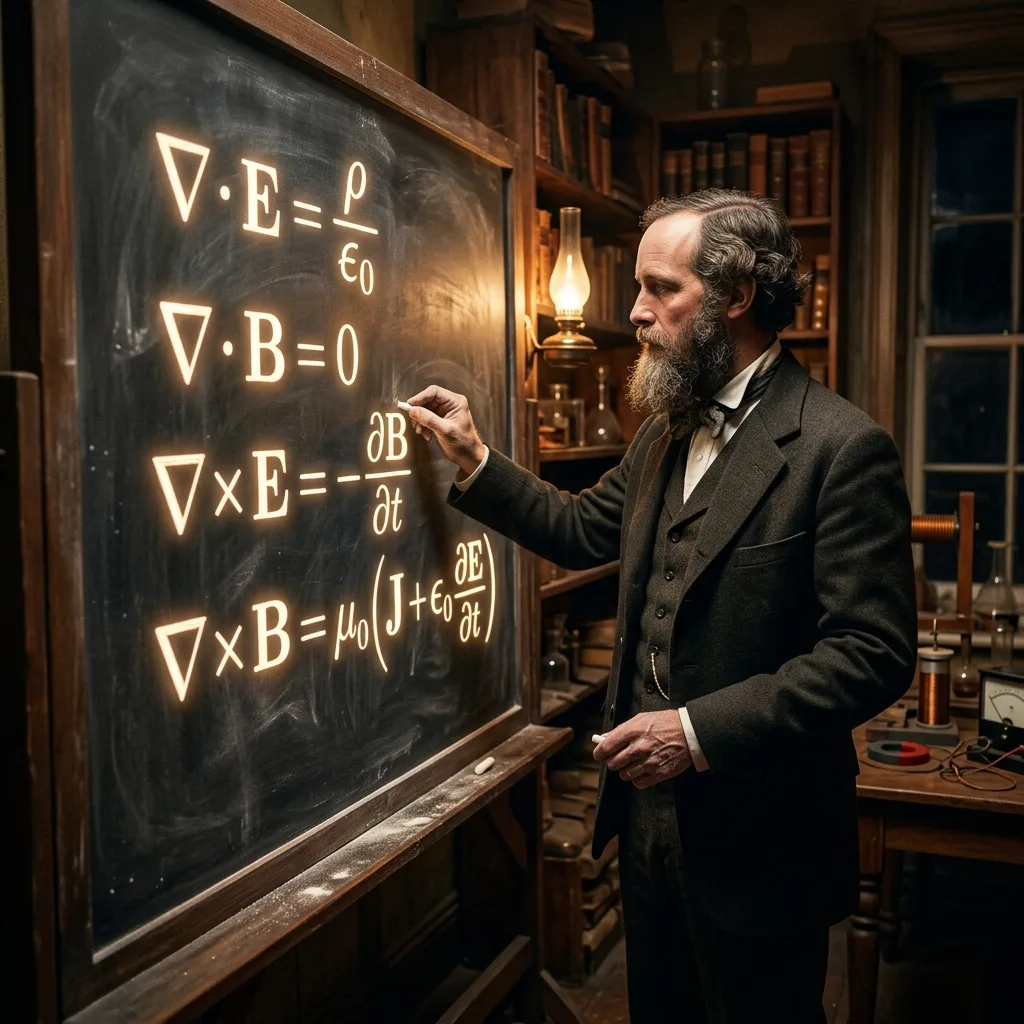
Scottish physicist James Clerk Maxwell publishes a set of differential equations that mathematically prove electricity and magnetism are the exact same phenomenon, and that light itself is simply an electromagnetic wave.
Open in interactive timeline →Key Numbers
- Computed wave speed
- ~310,740 km/s
- Original field equations
- 20 (in 20 variables)
- Reduced by Heaviside to
- 4 equations
- Theory to experimental proof
- ~23 years (1865 to 1888)
- Maxwell's lifespan
- 1831-1879 (age 48)
Verified Facts
- James Clerk Maxwell published 'A Dynamical Theory of the Electromagnetic Field' in 1865 (read to the Royal Society on 8 December 1864, approved for publication 15 June 1865), the paper in which his foundational equations of electromagnetism first appeared and from which he derived a wave equation showing that light is an electromagnetic disturbance.
- In his 1861-62 paper 'On Physical Lines of Force,' Maxwell introduced the 'displacement current' and, using Weber and Kohlrausch's 1856 electromagnetic-to-electrostatic ratio measurement, calculated a wave speed of roughly 310,740 km/s that fell strikingly between Fizeau's 1849 light-speed value (~315,000 km/s) and Foucault's later determination (~298,000 km/s).
- Maxwell wrote that 'we can scarcely avoid the conclusion that light consists in the transverse undulations of the same medium which is the cause of electric and magnetic phenomena' — a single sentence unifying optics with electricity and magnetism for the first time.
- Maxwell's original system comprised about 20 equations in 20 variables (as set out in his 1873 'Treatise on Electricity and Magnetism'); in 1884-85 Oliver Heaviside, working in parallel with Josiah Willard Gibbs and Heinrich Hertz, used vector notation to compress them into the four equations now universally taught as 'Maxwell's equations.'
- Heinrich Hertz experimentally confirmed Maxwell's prediction between 1886 and 1888 at Karlsruhe, using a spark-gap dipole transmitter and a loop-antenna spark-gap detector to generate and detect electromagnetic waves in free space — the work that physically demonstrated radio waves about a decade after Maxwell's death.
- Physicist Freeman Dyson called the publication of Maxwell's 1865 electromagnetic-field paper 'the most important event of the nineteenth century in the history of the physical sciences.'
- In 1861 Maxwell created the first durable color photograph by the three-color method — an image of a tartan ribbon shot three times by photographer Thomas Sutton through red, green, and blue-violet filters — a technique he had proposed in 1855 that still underlies essentially all color photography, analog and digital.
- Albert Einstein, in a 1931 essay for the Cambridge volume marking the centenary of Maxwell's birth, judged that the shift to conceiving physical reality as continuous fields after Maxwell was 'the most profound and the most fruitful that physics has experienced since the time of Newton.'
- Maxwell was born in Edinburgh on 13 June 1831 and died of abdominal cancer in Cambridge on 5 November 1879 at age 48 — the same age and the same disease that had killed his mother; he served as the first director of the Cavendish Laboratory at Cambridge.
- Maxwell's electromagnetic theory implied that the speed of light is the same for all observers regardless of source motion, a tension with Newtonian mechanics that directly motivated Einstein's 1905 special theory of relativity.
The World at This Moment
Maxwell's electromagnetic synthesis matured during the 1860s, a decade of intense upheaval. As he drafted "On Physical Lines of Force" (1861–62) and "A Dynamical Theory of the Electromagnetic Field" (1865), the American Civil War raged and Britain's cotton industry reeled. Charles Darwin's On the Origin of Species (1859) had recently destabilized natural theology, and the telegraph—including the first transatlantic cable attempts (1858, 1866)—made electrical phenomena commercially urgent, drawing physicists like William Thomson (Kelvin) into cable work. Maxwell himself worked amid the British Association's project to standardize electrical units. On the Continent, Wilhelm Weber and Rudolf Kohlrausch had measured the ratio of electromagnetic to electrostatic units, yielding a velocity suspiciously close to light's speed—data Maxwell exploited. Hermann von Helmholtz was systematizing energy conservation. The same years saw German and Italian unification, the founding of the Cavendish Laboratory (1874, which Maxwell would direct), and Mendeleev's periodic table (1869). Field theory thus emerged inside a broadly unifying, industrializing, post-Darwinian intellectual moment.
The Paradigm Shift
Maxwell redirected physics from Newtonian action-at-a-distance toward the field as the fundamental seat of physical reality. Translating Faraday's intuitive lines of force into rigorous partial differential equations, he unified electricity, magnetism, and optics: his equations yielded a wave propagating at the measured speed of light, forcing the conclusion that light is an electromagnetic disturbance. This was the second great unification after Newton's celestial-terrestrial synthesis, and it predicted an entire invisible spectrum—confirmed when Hertz generated radio waves in 1887–88. Conceptually, the field's autonomy (energy stored and transported in space itself) dissolved the mechanical-aether program Maxwell had used as scaffolding and seeded twentieth-century physics: Lorentz's electron theory, and Einstein's 1905 special relativity, whose opening sentence concerns "Maxwell's electrodynamics." The field concept also propagated into gauge theory and quantum field theory. Practically, Maxwell's prediction underwrote radio, radar, and global telecommunications. Few single bodies of work so thoroughly reset both the ontology and the technological trajectory of the modern world.
In Their Own Words
"We can scarcely avoid the inference that light consists in the transverse undulations of the same medium which is the cause of electric and magnetic phenomena." — James Clerk Maxwell, "On Physical Lines of Force," Philosophical Magazine (1862), Part III.
In Depth
The Equations That Caught the Light
In 1865, a quiet Scottish physicist named James Clerk Maxwell published A Dynamical Theory of the Electromagnetic Field and, almost in passing, solved one of the oldest mysteries in nature: what is light? His equations described electric and magnetic fields rippling through space as self-sustaining waves, and when he calculated their speed, it matched the measured speed of light. Light, he concluded, was simply electromagnetism in motion. It was one of the great unifications in the history of science, and it set the stage for nearly everything technological that followed.
The Long Approach March
Maxwell did not begin from nothing. His work was the theoretical capstone on a century of experiment. Benjamin Franklin (sv-benjamin-franklin) had shown that electricity was a single fluid that could be tamed and stored; Michael Faraday (sv-michael-faraday) had discovered electromagnetic induction and, crucially, imagined the invisible "lines of force" filling the space around magnets. Faraday was a brilliant experimentalist but no mathematician. Maxwell's genius was to take Faraday's intuitive field picture and clothe it in rigorous mathematics, adding his own decisive innovation—the displacement current—which let a changing electric field act like a current and so allowed waves to propagate through empty space.
Behind all of this lay the deeper engine of the era: the Industrial Revolution (sv-industrial-revolution), which had created both the instruments and the cultural appetite for harnessing nature's forces. And behind that, in the longest view, lay the scientific method itself, inherited from Isaac Newton (sv-newton), whose Principia had taught Europe that the cosmos obeyed equations that human beings could actually write down.
The Ripple That Became a Flood
Maxwell died in 1879, at only forty-eight, before his prediction could be confirmed. The confirmation came in 1888, when Heinrich Hertz generated and detected the invisible electromagnetic waves Maxwell had foretold—what we now call radio. From Hertz's spark gap flowed the entire electronic age. Nikola Tesla (sv-nikola-tesla) and Thomas Edison (sv-thomas-edison) built the power and lighting systems that put Maxwell's fields to work in every home; later, the same waves carried radio, television, radar, and eventually the signals that knit together the World Wide Web (sv-www).
The deeper consequence was conceptual. Maxwell's equations contained a quiet contradiction with everyday mechanics: the speed of light came out the same regardless of how the observer moved. It was this puzzle, not any experiment, that a young patent clerk seized upon. Albert Einstein (sv-einstein) built special relativity in 1905 precisely by taking Maxwell's equations as inviolable and bending space and time to accommodate them. In a real sense, modern physics begins where Maxwell's chalk left off.
A Thread Toward the Machines
The arc runs further still. Maxwell's mathematics described the electromagnetic field; understanding that field made possible the vacuum tube, then the transistor, then the silicon chip—the physical substrate of all computation. Every neural network now training toward artificial intelligence, from the convolutional breakthrough of AlexNet (sv-alexnet-convnets) to the transformer architectures behind today's large models, runs on electrons shepherded by principles Maxwell first wrote out by hand. The signals racing through a data center are, at bottom, his waves.
It is a striking lineage: a devout, soft-spoken man working out the behavior of invisible fields became, without knowing it, a founding architect of relativity, of global communication, and of the hardware on which intelligence itself is now being rebuilt. Few single insights have rippled so far. When Maxwell caught light in four equations, he handed the future its medium.
Causes & Consequences
What led to it
- Hans Christian Oersted's 1820 discovery that an electric current deflects a compass needle, together with Andre-Marie Ampere's 1820s force laws showing currents act on each other and that magnetism arises from microscopic current loops, established that electricity and magnetism were physically linked phenomena.
- Michael Faraday's discovery of electromagnetic induction in 1831 and his introduction of 'lines of force' (field lines) gave Maxwell the central physical picture of a continuous field filling space, which Maxwell set out to render in rigorous mathematical form.
- William Thomson (Lord Kelvin) demonstrated a mathematical analogy between heat flow and electrostatics, inspiring Maxwell's analogical method in his first paper, 'On Faraday's Lines of Force' (1855-1856), which modeled lines of force on fluid flow.
- Carl Friedrich Gauss's and Charles-Augustin de Coulomb's earlier formulations of the laws governing electric and magnetic flux supplied the established quantitative relations that Maxwell would later unify into his set of field equations.
- Wilhelm Weber and Rudolf Kohlrausch's 1855-1856 measurement of the ratio between electrostatic and electromagnetic units of charge yielded a value strikingly close to the measured speed of light, the numerical clue that let Maxwell identify light with electromagnetic disturbance.
- Hippolyte Fizeau's and other terrestrial measurements of the speed of light in the 1840s-1850s gave Maxwell an independent value to compare against his theoretically derived wave speed, confirming the match around 1861-1862.
What it set in motion
- Maxwell's addition of the 'displacement current' to Ampere's law let him derive the electromagnetic wave equation in his 1865 paper 'A Dynamical Theory of the Electromagnetic Field,' showing that light itself is an electromagnetic wave traveling at a calculable speed.
- Heinrich Hertz's experiments beginning in 1887 generated and detected the radio-frequency electromagnetic waves Maxwell had predicted, confirming the theory and opening the path that Guglielmo Marconi turned into wireless telegraphy and radio.
- The constancy of the speed of light embedded in Maxwell's equations, which did not transform simply under Galilean relativity, became a central postulate of Albert Einstein's 1905 special theory of relativity and motivated the Lorentz transformations.
- Maxwell's unification of electricity, magnetism, and light established the field concept as the template for later physics, directly shaping the development of quantum electrodynamics, of which Maxwell's equations are now understood to be the classical limit.
- The recognition that Maxwell's electrodynamics is invariant under U(1) gauge transformations made it the prototype for modern gauge theories, the framework underlying the Standard Model of particle physics, as Hermann Weyl and later physicists developed.
- Maxwell's prediction of a continuous spectrum of electromagnetic radiation beyond visible light underpinned the discovery and technological exploitation of radio, microwaves, X-rays, and the entire electromagnetic spectrum that powers modern communications and imaging.
- Looking far downstream, futurists such as Ray Kurzweil project that the electromagnetic and computational technologies descended from Maxwell's work will compound toward a predicted technological 'Singularity' around 2045 and toward humanoid-AI parity with humans; these remain documented forecasts and projections, not established outcomes.
The Live Academic Debate
A central historiographical debate concerns authorship of "Maxwell's equations" themselves. Bruce J. Hunt (The Maxwellians, 1991) and Daniel Siegel argue that the four compact vector equations textbooks attribute to Maxwell were actually distilled in the 1880s by Oliver Heaviside and Heinrich Hertz, who discarded Maxwell's cumbersome potentials and his mechanical-aether models—Heaviside's "I never made any progress until I threw all the potentials overboard." This raises the question of how much of "Maxwell" is Maxwellian. A related dispute, advanced by Siegel against older Whiggish readings, concerns the status of Maxwell's notorious spinning-vortex-and-idle-wheel model: was it a literal physical hypothesis, a heuristic "illustration," or—as Maxwell variously claimed—a deliberately "contrived analogy"? Scholars including Peter Harman (editor of Maxwell's Scientific Letters and Papers) stress the methodological role of analogy and the influence of Scottish natural philosophy and Faraday. Thus historians contest both who completed the theory and what Maxwell himself thought he was doing.
The Counterfactual
Had Maxwell (who died in 1879, aged 48) not produced his synthesis, electromagnetic field theory would likely still have emerged, but later and along a different route. Continental physicists—Weber, Riemann, Carl Neumann, and especially Helmholtz—pursued action-at-a-distance and potential-based electrodynamics that already encoded the light-speed constant; Helmholtz's student Hertz set out to test these rival theories. Plausibly a Continental field theory would have crystallized in the 1880s–90s, perhaps less geometrically elegant and more wedded to the aether. The deeper counterfactual concerns timing: Hertz's 1887 detection of electromagnetic waves was explicitly framed as confirming Maxwell, and the "Maxwellians"—Heaviside, FitzGerald, Lodge—built the wireless conceptual toolkit. Absent Maxwell, radio engineering and the relativistic reconception of space and time might have been delayed a decade or more, and Einstein's 1905 starting point would have differed. Bruce Hunt's work suggests the form of the theory was historically contingent even if its content was, in some sense, latent in the period's data.
Myth vs. Reality
Myth: Maxwell wrote down the four elegant vector equations we now call 'Maxwell's equations.'
Reality: Maxwell never published the familiar set of four. In his 1865 'A Dynamical Theory of the Electromagnetic Field' and his 1873 Treatise he laid out a much larger system (commonly counted as 20 equations in 20 variables, using scalar components and quaternion notation). The compact four-equation vector-calculus form taught today was developed in the 1880s by Oliver Heaviside (with Willard Gibbs's vector notation), who reduced and reformulated Maxwell's system around the electric and magnetic fields. Heaviside himself called them 'Maxwell's equations,' but the modern shape is largely his.
Myth: Maxwell discovered the four laws from scratch, replacing the work of Faraday, Ampere, and Gauss.
Reality: Three of the four relations predate him: Gauss's law, Faraday's law of induction (1831), and Ampere's circuital law (1820s) were established by others. Maxwell's own original contribution was the 'displacement current' term he added to Ampere's law, which made the equations self-consistent and allowed electromagnetic waves. His larger achievement was synthesis: translating Faraday's physical 'lines of force' into a unified mathematical field theory, not inventing every individual law.
Myth: Maxwell measured the speed of light himself and thereby proved light is an electromagnetic wave.
Reality: Maxwell did not measure light's speed. He used the ratio of electromagnetic to electrostatic units obtained from the 1856 Weber-Kohlrausch experiment, and compared it to optical speed-of-light values from Fizeau and Foucault. Finding the figures agreed to within about one percent, he inferred (in 'On Physical Lines of Force,' 1861-62) that light 'consists in the transverse undulations of the same medium which is the cause of electric and magnetic phenomena.' It was a theoretical inference from others' measurements, not his own experiment.
Myth: Maxwell derived his theory from abstract field equations, having abandoned mechanical pictures of the ether.
Reality: Maxwell reached his key results through an elaborate mechanical model of the ether: spinning 'molecular vortices' (the magnetic field) separated by small rolling 'idle wheels' (electric particles). This honeycomb-like apparatus, set out in 'On Physical Lines of Force' (1861-62), is exactly where the displacement current and the light-speed result emerged. He later (1865) presented a more abstract 'dynamical' version, but he never treated the field as purely mathematical; belief in a mechanical, light-bearing ether was central to his thinking and to nineteenth-century physics generally.
Myth: Maxwell's electromagnetic theory was recognized as a triumph immediately upon publication.
Reality: His theory was neglected or resisted for roughly two decades. Many physicists found the equations and the underlying model obscure, and Continental 'action-at-a-distance' approaches (e.g., Weber's) remained influential. Maxwell died in 1879 without seeing his theory vindicated. Broad acceptance came in the late 1880s, after Heaviside and Hertz reformulated and clarified it, and especially after Heinrich Hertz experimentally generated and detected electromagnetic waves in 1886-1888.
Frequently Asked Questions
What did James Clerk Maxwell discover about electromagnetism?
Maxwell unified the previously separate phenomena of electricity, magnetism, and light into a single theory of the electromagnetic field. Building on the experimental work of Michael Faraday, he translated those findings into mathematics and showed that oscillating electric and magnetic fields propagate through space as waves. Crucially, he calculated the speed of these waves and found it matched the measured speed of light, leading him to conclude that light itself is an electromagnetic wave.
What are Maxwell's equations?
Maxwell's equations are the set of fundamental laws describing how electric and magnetic fields are generated and how they relate to each other and to electric charges and currents. Maxwell's key theoretical contribution was adding the concept of 'displacement current' to Ampère's law, which made the equations self-consistent and predicted electromagnetic waves. Together they comprehensively describe classical electromagnetism and underpin modern technologies including radio, radar, microwaves, and telecommunications.
When did Maxwell publish his theory of the electromagnetic field?
Maxwell developed his theory across the 1860s. His landmark paper 'A Dynamical Theory of the Electromagnetic Field,' in which he wrote down the equations of the field and derived the electromagnetic wave equation, was sent to the printers on 16 June 1865 and published in the Philosophical Transactions of the Royal Society. He treated the subject more completely in his two-volume 'A Treatise on Electricity and Magnetism,' published in 1873.
Did Maxwell originally write four equations?
No. Maxwell's original formulation was far more cumbersome, consisting of roughly 20 equations written out in separate x, y, and z components and involving both fields and potentials. The compact set of four vector equations taught today was produced later, around 1884, when Oliver Heaviside (with Willard Gibbs) reformulated Maxwell's system using vector calculus, rewriting them in terms of electric and magnetic fields alone.
How were Maxwell's predictions about electromagnetic waves confirmed?
Maxwell predicted electromagnetic waves traveling at the speed of light in 1865, but he died in 1879 before experimental proof existed. The German physicist Heinrich Hertz confirmed the prediction in a series of experiments beginning around 1887, generating and detecting electromagnetic waves in the laboratory. Hertz measured their wavelength and frequency, verified that they travel at the speed of light, and demonstrated that they reflect, refract, and interfere like light, confirming Maxwell's theory.
Why is Maxwell considered as important as Newton and Einstein?
Maxwell is widely regarded as the greatest theoretical physicist of the 19th century, bridging the era of Newton and that of Einstein. His electromagnetic theory directly influenced Einstein's special theory of relativity, and Einstein himself praised Maxwell's work, in 1931 calling the resulting change in our conception of reality 'the most profound and the most fruitful that physics has experienced since the time of Newton.' His unification of electricity, magnetism, and optics set the direction of 20th-century physics.
Sources & Further Reading
- Maxwell's equations — Wikipedia
- Bruce J. Hunt, The Maxwellians (Cornell University Press, 1991)
- Daniel M. Siegel, Innovation in Maxwell's Electromagnetic Theory: Molecular Vortices, Displacement Current, and Light (Cambridge University Press, 1991)
- P. M. Harman, The Natural Philosophy of James Clerk Maxwell (Cambridge University Press, 1998)
- James Clerk Maxwell, 'A Dynamical Theory of the Electromagnetic Field,' Philosophical Transactions of the Royal Society of London 155 (1865)
- Olivier Darrigol, Electrodynamics from Ampère to Einstein (Oxford University Press, 2000)
- Wikipedia: James Clerk Maxwell
- Wikipedia: Maxwell's equations
Cite This Page
AskHistoryAI. “James Clerk Maxwell's Equations.” AskHistoryAI — Interactive Timeline of Everything. Updated 2026-09-11. https://askhistoryai.com/event/sv-james-maxwell/
Every fact on this page is checked against the published fact ledger and methodology; sources are listed above.