The American Revolution
The Enlightenment put into practice.
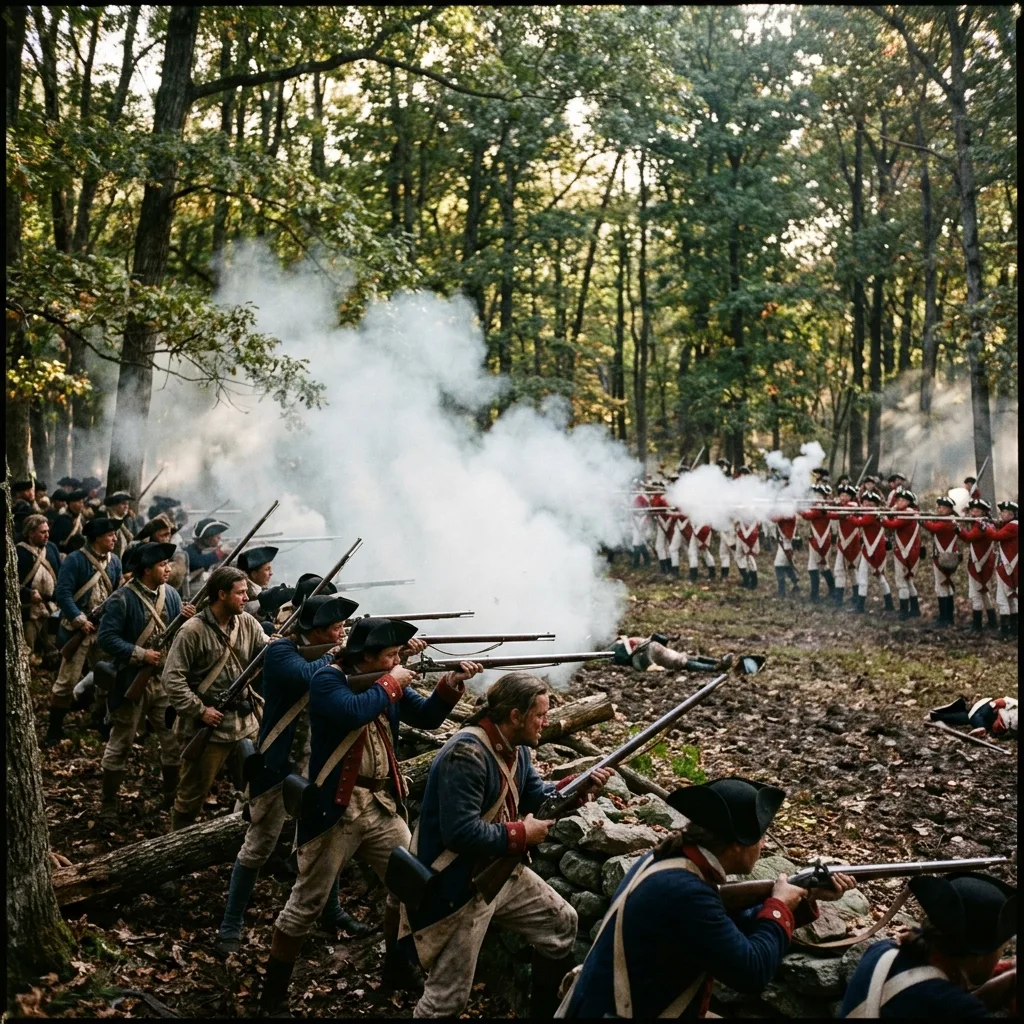
The thirteen American colonies rebel against the British Empire, explicitly founding a new nation not on bloodlines or kings, but on philosophical principles of liberty and self-governance.
Open in interactive timeline →Key Numbers
- Duration
- 1775-1783 (8 years)
- Colonies declaring independence
- 13
- Total served in Continental Army
- ~231,000
- American war deaths
- ~25,000+
- Declaration signers
- 56
Verified Facts
- The war's opening shots came on April 19, 1775, at Lexington and Concord, Massachusetts, where colonial militia confronted British regulars; the clash was later immortalized as the 'shot heard round the world,' a phrase coined by Ralph Waldo Emerson in his 1837 'Concord Hymn.'
- The Declaration of Independence was adopted by the Second Continental Congress on July 4, 1776; twelve colonies voted in favor (New York abstained initially, then ratified days later), and most of its 56 signers actually signed the engrossed copy on August 2, 1776, not on July 4.
- The Battles of Saratoga in autumn 1777 are widely regarded as the war's turning point: British General John Burgoyne surrendered his entire army on October 17, 1777, the first time a full British army capitulated to the Americans.
- News of Saratoga persuaded France to formally ally with the United States in early 1778, sending naval fleets, ground troops, and supplies that decisively shifted the strategic balance against Britain.
- About 231,000 men served in the Continental Army over the course of the war, but Washington never commanded more than roughly 48,000 at any one time, and never more than about 13,000 in a single place.
- The decisive Siege of Yorktown (September 28 to October 19, 1781) was a joint Franco-American operation in which the comte de Grasse's fleet blockaded the sea while Lafayette's and Washington's troops sealed the land, forcing Lord Cornwallis to surrender about 8,000 men and 240 guns on October 19, 1781.
- Disease, not combat, was the war's deadliest killer for Americans: roughly 6,800 died in battle, while thousands more perished from disease in camp and an estimated 8,500 to 12,000 died as prisoners, many aboard the squalid British prison ships in New York Harbor.
- Roughly 20 percent of the colonists remained Loyalists faithful to King George III, making the Revolution as much a bitter civil war among Americans as a war against Britain.
- Cornwallis's defeat at Yorktown triggered the collapse of Lord North's government in Britain and led to peace negotiations; the war formally ended with the Treaty of Paris, signed September 3, 1783, in which Britain recognized American independence.
- The colonial population at the time was roughly 2.5 million, including about 2 million people of European descent and around 400,000 enslaved Africans, underscoring how a comparatively small society took on the world's leading military power.
The World at This Moment
The Revolution unfolded inside a wider eighteenth-century world of competing empires and Enlightenment ferment. The same year as the Declaration, 1776, saw Adam Smith publish The Wealth of Nations, while James Watt's improved steam engine (1776) was inaugurating Britain's nascent industrialization. Qing China under the Qianlong Emperor (r. 1735–1796) was at its territorial zenith—having absorbed Xinjiang, Tibet, and Taiwan—yet largely indifferent to European developments. Mughal India was fracturing, with the East India Company filling the vacuum after Plassey (1757) and Buxar (1764). Continental Europe was governed by "enlightened" absolutists like Frederick II and Catherine the Great. Crucially, the war was a global imperial conflict: France (1778), Spain (1779), and the Dutch Republic (1780) entered against Britain, fighting from the Caribbean to Gibraltar to the Indian Ocean. The struggle was thus less an isolated colonial uprising than the opening act of what R.R. Palmer called the "Age of the Democratic Revolution" spanning the Atlantic world.
The Paradigm Shift
The Revolution's deepest consequence was institutional and ideological: it produced the first large, durable republic founded on written constitutions, popular sovereignty, and the radical proposition that legitimate government derives from the consent of the governed. Gordon Wood argues in The Radicalism of the American Revolution (1992) that it dissolved monarchical and hierarchical assumptions, unleashing an egalitarian, commercial, democratic society more transformative than its leaders intended. The Declaration's claim that "all men are created equal" furnished a portable rhetorical standard later invoked by abolitionists, suffragists, and anticolonial movements worldwide. Concretely, the Revolution generated the constitutional machinery—federalism, separation of powers, a bill of rights—that became a global template. Internationally, it detonated the Atlantic chain: the French Revolution (1789), whose Declaration of the Rights of Man echoed American precedents, the Haitian Revolution (1791), and Latin American independence struggles. It reframed sovereignty itself, shifting the locus of legitimate authority from crown and bloodline to "the people," a reorientation whose ramifications still structure modern political thought.
In Their Own Words
"We have it in our power to begin the world over again. A situation, similar to the present, hath not happened since the days of Noah until now. The birthday of a new world is at hand." — Thomas Paine, Common Sense, Appendix (first published January 10, 1776)
We hold these truths to be self-evident, that all men are created equal, that they are endowed by their Creator with certain unalienable Rights, that among these are Life, Liberty and the pursuit of Happiness.
Thomas Jefferson and the Continental Congress, Declaration of Independence, 1776 — source
How is it that we hear the loudest yelps for liberty among the drivers of negroes?
Samuel Johnson, the British Tory pamphlet "Taxation No Tyranny," 1775 — a Loyalist attack on the hypocrisy of slaveholding Patriots — source
The Mohocks, our particular Nation, have on all occasions shewn their zeal and loyalty to the Great King.
Joseph Brant (Thayendanegea), Mohawk war leader, addressing Lord Germain in London, 1776 — source
In Depth
The Republic as Argument: When an Idea Became a Government
The American Revolution was not the first rebellion against a king, but it was among the first to claim that the very purpose of government could be reasoned out from first principles and then built. Between the Declaration of Independence in 1776 and the British surrender at Yorktown in 1781, a cluster of Atlantic colonies turned a tax dispute into a wager that legitimacy flows upward from the consent of the governed rather than downward from a crown. That wager would echo for centuries.
Deep Preconditions
The Revolution sat atop a long sediment of inheritance. Its colonies were themselves a recent project, the Establishment of the 13 Colonies (sv-13-colonies) seeded by European expansion after the European Arrival in the Americas (sv-new-world). Its intellectual oxygen came from the scientific confidence of the era — a culture that had absorbed Isaac Newton & the Principia (sv-newton) and learned to trust that orderly laws governed both planets and politics. Thomas Jefferson's drafting drew heavily on John Locke's natural-rights philosophy, while the broader colonial mind had been shaped by Enlightenment circulation that flowed in part from René Descartes & the Discourse on Method (sv-descartes) and the print culture unleashed by The Gutenberg Press (sv-printing-press). Even the colonists' self-image as a reasoning, self-governing people owed something to figures like Benjamin Franklin & Electricity (sv-benjamin-franklin), the printer-scientist-diplomat who embodied the practical Enlightenment and helped secure the French alliance that made victory possible. The grievance was concrete — "no taxation without representation" — but the justification was abstract and portable.
How It Reshaped What Came After
The Revolution's most radical act came after the war: turning rebellion into a durable constitutional machine, defended in The Federalist Papers (sv-federalist-papers), which argued that separation of powers and checks and balances could restrain power without a monarch. This was republicanism not as theory but as a working system.
The shockwave crossed the Atlantic almost immediately. French intervention had been decisive — France spent roughly 1.3 billion livres, with the single year of Yorktown consuming about 225 million — and that debt helped detonate the fiscal crisis behind the French Revolution of 1789. Veterans like Lafayette carried republican ideals home, and France's National Assembly modeled the Declaration of the Rights of Man partly on the American example. A successful revolt against a great power proved that "lasting change was possible," igniting independence movements across the Atlantic world.
The new republic also carried a contradiction it could not resolve. A document proclaiming that "all men are created equal" coexisted with chattel slavery, a tension that would eventually tear the country apart in The American Civil War (sv-american-civil-war). Meanwhile the freed energies of a commercial republic dovetailed with The Industrial Revolution (sv-industrial-revolution) already gathering force in Britain, accelerating a century of material transformation.
Threads Forward
The Revolution's deepest legacy is a template: that a polity can be founded on a written argument about human rights and consent, then continuously amended. That template runs forward through the political ferment that produced Karl Marx & the Communist Manifesto (sv-marx) — a rival theory of how the governed should hold power — and ultimately shapes the liberal-democratic order under which later technological revolutions unfolded, from Thomas Edison & Menlo Park (sv-thomas-edison) to the institutions now debating how to govern artificial intelligence.
Seen against the full arc of this timeline, the American Revolution marks a hinge: the moment when the Enlightenment's confidence that the world is intelligible was applied not to stars or atoms but to sovereignty itself. It asserted that government, like nature, could be understood, designed, and improved — a faith in engineered order that still animates every project, political or computational, that dares to redesign the systems humans live inside.
Causes & Consequences
What led to it
- Britain's victory in the Seven Years' War (1756-1763) nearly doubled the national debt, prompting Parliament to seek revenue from the colonies through measures such as the Sugar Act and the Stamp Act of 1765.
- Decades of 'salutary neglect,' during which Britain loosely enforced trade laws, allowed each of the thirteen colonies to develop self-governing assemblies (beginning with Virginia's House of Burgesses) that controlled local finances and grew accustomed to governing themselves.
- Enlightenment political theory, especially John Locke's arguments for natural rights to life, liberty, and property, government by consent of the governed, and a right to overthrow tyranny, gave colonial leaders the intellectual framework for resistance.
- The Stamp Act of 1765 ignited the principle of 'no taxation without representation,' triggering mob action against stamp collectors and the Stamp Act Congress, the first coordinated colonial political response to Parliament.
- The Boston Tea Party of December 1773, in which colonists destroyed East India Company tea to protest the Tea Act, provoked direct confrontation with imperial authority.
- Parliament's punitive Coercive (Intolerable) Acts of 1774, which closed Boston's port and revoked Massachusetts's charter rights, united the colonies and led delegates from twelve colonies to convene the First Continental Congress in Philadelphia in September 1774.
What it set in motion
- The Revolution produced the United States Constitution of 1787 and the Bill of Rights, the first written national constitution to establish separated powers, checks and balances, and popular sovereignty as a working blueprint for government.
- The success of the American colonists demonstrated that a revolt against a major European power could succeed, helping catalyze the French Revolution of 1789.
- The Declaration of the Rights of Man and of the Citizen (1789) was modeled in part on American precedents, with Lafayette drafting it alongside Thomas Jefferson and drawing on George Mason's 1776 Virginia Declaration of Rights.
- The American example inspired the Latin American wars of independence of the early nineteenth century, with creole leaders such as Simon Bolivar invoking American republicanism and modeling Gran Colombia partly on the United States.
- The Revolution's rhetoric of liberty spurred the first organized antislavery efforts, leading northern states to abolish slavery outright or adopt gradual emancipation, so that slavery was largely ended north of Maryland by 1820.
- The U.S. Constitution became a globally influential template, referenced in successive waves by constitution-makers in Europe, Latin America, and Asia throughout the nineteenth and twentieth centuries.
The Live Academic Debate
The central historiographical fault line concerns causation and character. The "ideological" or neo-Whig school, led by Bernard Bailyn (The Ideological Origins of the American Revolution, 1967) and his student Gordon Wood, locates the Revolution's driver in inherited "radical Whig" republican fears of conspiracy and corrupt power, treating it as principally a constitutional and intellectual movement. Against this, neo-Progressive and social historians—Gary Nash (The Urban Crucible), Woody Holton (Forced Founders), and Edward Countryman—stress class conflict, the agency of artisans, enslaved people, women, and frontier farmers, arguing the Revolution was also a contest over "who should rule at home," in Carl Becker's older phrase. A parallel debate pits ideology against economic interest, with economic historians measuring imperial costs; Bailyn countered that the conflict was not driven by "rational" interest-maximizing actors. More recently, Atlantic and imperial historians (e.g., Maya Jasanoff on Loyalists, Gerald Horne on slavery) have decentered the patriot narrative entirely, reframing 1776 within global and racial dynamics.
How This Event Connects
The American Revolution cannot be properly understood outside the context of the Establishment of the 13 Colonies and the broader socio-economic structures they inherited. The revolution was not merely a spontaneous eruption of Enlightenment ideals; rather, it was the explosive culmination of a century of colonial development, marked by massive demographic shifts, localized frontier violence, and the deeply entrenched institution of slavery. The very political autonomy that the colonists fought to preserve had been fostered during decades of "salutary neglect." When the British Empire attempted to centralize its administration and extract revenue to pay for global imperial conflicts, it shattered the delicate equilibrium that had allowed the 13 Colonies to thrive, triggering a reactionary defense of local power structures masquerading as universal liberty.
Ideologically and politically, the Revolution is inextricably linked to Benjamin Franklin and the subsequent drafting of the Federalist Papers. Franklin's diplomatic maneuvering in France secured the vital military alliance that won the war, transforming a localized rebellion into a global imperial conflict. In the war's aftermath, the Federalist Papers represented the intellectual effort to consolidate the fragmented, chaotic energies of the Revolution into a functional nation-state. If the Revolution was the violent dismantling of British authority, the Federalist Papers provided the theoretical blueprint for a new, centralized "fiscal-military state," attempting to prevent the newly independent states from tearing themselves apart or falling victim to European empires.
Furthermore, the American Revolution served as a crucial precursor to the Industrial Revolution in the United States. The political independence achieved through the war necessitated economic independence. The severance from the British mercantilist system forced the new republic to develop its own manufacturing capabilities. Alexander Hamilton's subsequent push for a strong central government and federal support for industry—echoed in his contributions to the Federalist Papers—laid the structural foundations for American industrialization. By protecting domestic markets and encouraging technological innovation, the post-revolutionary state created the conditions necessary for the eventual emergence of an industrial powerhouse.
The Haudenosaunee (Iroquois Confederacy) view
For the Six Nations, the Revolution was less a fight for liberty than a catastrophe that shattered their centuries-old Confederacy. As historian Colin G. Calloway documents in The American Revolution in Indian Country, most nations, led by figures such as Joseph Brant, allied with Britain in hopes the Crown would curb colonial expansion onto their lands, while the Oneida and Tuscarora sided with the Americans. In 1779 George Washington ordered the Sullivan Expedition, which destroyed some forty Haudenosaunee towns and their crops and drove thousands of refugees toward British Fort Niagara; the Seneca thereafter remembered him as "Town Destroyer." The 1783 Treaty of Paris ended the war without once mentioning Britain's Indigenous allies.
The Counterfactual
Had the rebellion failed or never occurred, the immediate Atlantic trajectory would have differed sharply. Britain's fiscal crisis after the Seven Years' War was the proximate spark for colonial taxation; absent the costly American war, France's catastrophic debt—a principal trigger of 1789, as William Doyle and Simon Schama emphasize—might have been less acute, plausibly delaying or altering the French Revolution. Without an independent republic demonstrating that a large nation could govern itself without monarchy, the model that Palmer and Jonathan Israel see radiating across the Atlantic would have lacked its proof of concept. Counterfactuals must stay disciplined: a defeated revolution might still have yielded eventual reform along Canadian "dominion" lines, gradual self-government rather than rupture. Yet slavery's trajectory is genuinely uncertain—some scholars (e.g., Gerald Horne) controversially argue independence partly protected slavery from British abolitionist pressure, implying earlier emancipation under continued imperial rule. The claim is contested and speculative, but it underscores that the Revolution's emancipatory reputation is itself a debated, contingent outcome rather than an inevitability.
Myth vs. Reality
Myth: A clear majority of American colonists supported independence from Britain.
Reality: Colonial society was deeply divided. Historians estimate that roughly 15-20 percent of the white population (about 500,000 people) were active Loyalists, while a comparable or somewhat larger share were committed Patriots, and a large bloc remained neutral or apathetic. The familiar 'one-third for, one-third against, one-third indifferent' formula is unreliable: it derives from a remark by John Adams in 1815 that historians have concluded actually described American attitudes toward the French Revolution, not the American one.
Myth: The Revolution was primarily a revolt against crushing, oppressive British taxes.
Reality: Colonists paid strikingly low taxes by the standards of the day, far lighter than Britons at home. Contemporary comparisons cited by historians put the burden at roughly 26 shillings a year for a resident of Britain versus about 1 shilling a year in New England, and colonial taxes were too low even to cover the costs of colonial administration. The core grievance was not the size of the tax bill but the principle of being taxed by a Parliament in which the colonists had no representation.
Myth: Paul Revere rode alone to Concord shouting 'The British are coming!'
Reality: This image comes mainly from Henry Wadsworth Longfellow's 1860 poem, which deliberately altered the facts for poetic and patriotic effect on the eve of the Civil War. Revere was one of multiple riders; he was detained by a British patrol and never reached Concord, and it was Samuel Prescott (with William Dawes also riding) who carried the warning the rest of the way. The mission was meant to be discreet, so a rider bellowing about 'the British' would have been counterproductive, and many colonists still considered themselves British in any case.
Myth: Plucky American minutemen and citizen-militia won the war on their own.
Reality: Militia and minutemen mattered most in the opening clashes at Lexington and Concord and in local defense, but historians emphasize that independence was ultimately secured by the professionally trained Continental Army under Washington, not by part-time farmers. The militia were valuable for harassment and local control but generally could not stand against British regulars in pitched battle, which is why building and sustaining a regular army was central to American strategy.
Myth: Americans defeated Britain essentially by themselves at Yorktown.
Reality: The decisive 1781 victory at Yorktown was a Franco-American operation in which French forces were indispensable and, on land, actually outnumbered the Americans present: roughly 9,500 French troops alongside about 8,800 Americans. Crucially, Admiral de Grasse's French fleet won naval control of the Chesapeake and blockaded the bay, cutting off Cornwallis's escape and resupply by sea, the single factor that made the British surrender of more than 8,000 men possible.
Frequently Asked Questions
When did the American Revolution start and end?
The Revolutionary War began on April 19, 1775, with the first shots fired at the Battles of Lexington and Concord in Massachusetts. Active fighting effectively ended after the British surrender at Yorktown in October 1781. The war was formally concluded by the Treaty of Paris, signed on September 3, 1783, in which Britain recognized the independence of the United States and ceded most territory east of the Mississippi River.
What were the main causes of the American Revolution?
The core grievance was "no taxation without representation": after the Seven Years' War left Britain deeply in debt, Parliament imposed a series of revenue measures on the colonies, including the Sugar Act (1764), Stamp Act (1765), Townshend Acts (1767), and Tea Act (1773). Colonists, who had no elected representatives in Parliament, argued these taxes violated their rights as Englishmen. Notably, it was largely a dispute over the principle and power to tax rather than the tax burden itself, since Britons at home generally paid higher taxes than colonists.
Who wrote the Declaration of Independence and when was it signed?
Thomas Jefferson was the principal author, drafting the document on behalf of the Committee of Five, which also included Benjamin Franklin, John Adams, Roger Sherman, and Robert Livingston. The Continental Congress adopted the Declaration on July 4, 1776. Most of the 56 delegates did not actually sign until August 2, 1776, with a few adding their signatures even later; John Hancock, as president of Congress, signed first and most prominently.
Why was the Battle of Saratoga a turning point?
The American victory at Saratoga in October 1777 convinced the French government that the Americans could defeat disciplined British regulars and were worth backing. On February 6, 1778, France signed treaties of alliance and commerce with the United States in Paris, formally recognizing American independence and pledging military and financial support. French money, troops, and especially naval power proved decisive to the eventual American victory.
How important was France to the American victory?
France's intervention was crucial to winning the war. After allying with the United States in 1778, France supplied financial credit, weapons, trained engineers, soldiers, and a navy that the Continental Army could not have matched on its own. This support culminated in the 1781 siege of Yorktown, where a combined Franco-American land force and the French fleet trapped a major British army under Cornwallis on a Virginia peninsula and forced its surrender, effectively ending the war.
How did the Revolution treat slavery and enslaved people?
The Revolution exposed a sharp contradiction between the rhetoric of liberty and the reality of slavery. In November 1775, Virginia's royal governor Lord Dunmore issued a proclamation promising freedom to enslaved people and indentured servants who left Patriot owners to fight for the British. Although his regiment remained small, the offer and similar British promises inspired tens of thousands of enslaved people to flee toward British lines over the course of the war, while slavery itself persisted in the new nation.
How many people died in the American Revolution?
Estimates indicate roughly 6,800 American soldiers were killed in battle, with total American deaths in service around 25,000 once disease and the notoriously deadly British prison ships are counted. Disease was the leading killer on both sides during the eight-year conflict. British and allied losses are estimated near 24,000, with thousands of Hessian and British troops dying of illness, and at least 1,000 to 2,000 Native Americans were also killed in combat.
Sources & Further Reading
- American Revolution — Wikipedia
- Bernard Bailyn, The Ideological Origins of the American Revolution (Harvard University Press, 1967; enlarged ed. 1992)
- Gordon S. Wood, The Radicalism of the American Revolution (Alfred A. Knopf, 1992)
- Gary B. Nash, The Urban Crucible: Social Change, Political Consciousness, and the Origins of the American Revolution (Harvard University Press, 1979)
- Woody Holton, Forced Founders: Indians, Debtors, Slaves, and the Making of the American Revolution in Virginia (University of North Carolina Press, 1999)
- R. R. Palmer, The Age of the Democratic Revolution: A Political History of Europe and America, 1760–1800 (Princeton University Press, 1959–1964)
- Wikipedia: Age of Enlightenment
Cite This Page
AskHistoryAI. “The American Revolution.” AskHistoryAI — Interactive Timeline of Everything. Updated 2026-09-11. https://askhistoryai.com/event/sv-american-revolution/
Every fact on this page is checked against the published fact ledger and methodology; sources are listed above.