The Industrial Revolution
The machine age upends agrarian humanity.
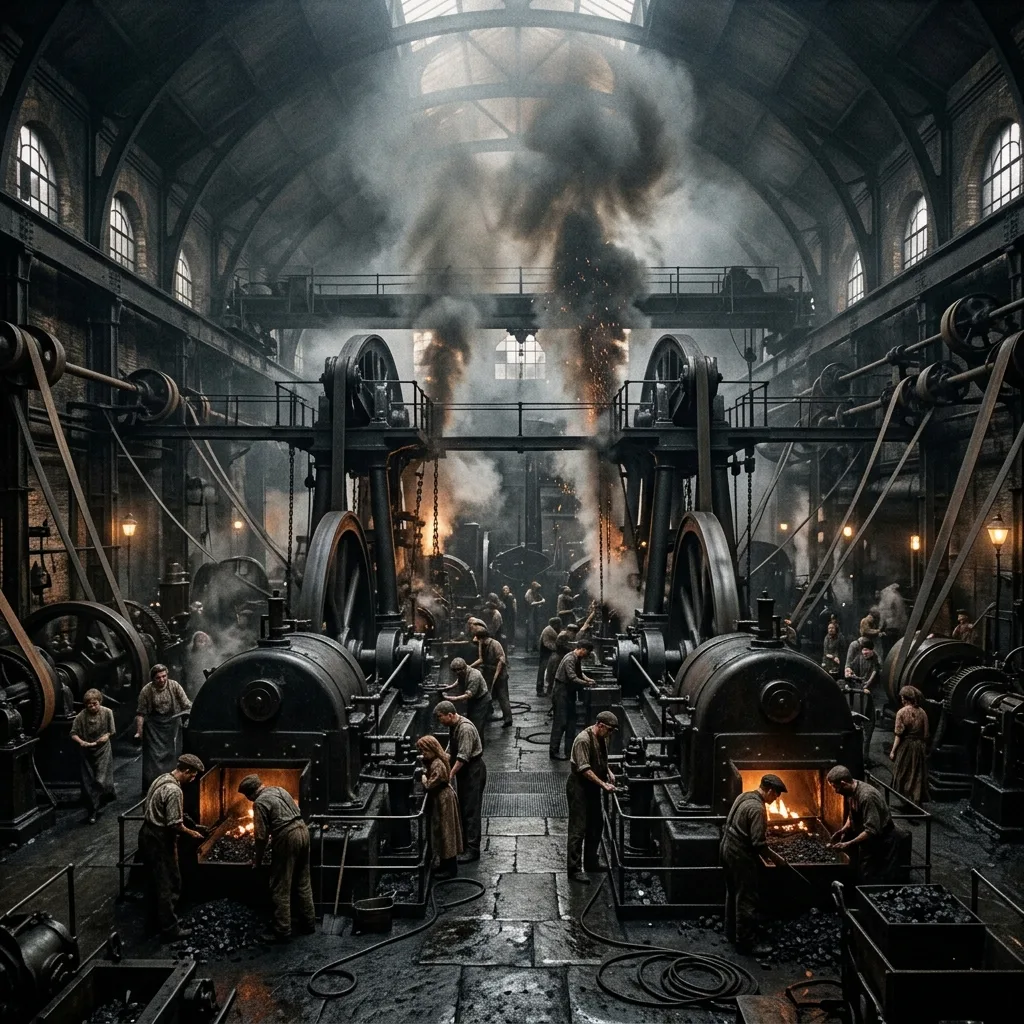
Originating in Great Britain, the transition from hand production methods to machines, new chemical manufacturing, and iron production processes revolutionized the world. It fundamentally shifted human society from agrarian and rural to industrial and urban.
Open in interactive timeline →Key Numbers
- Raw cotton imports
- 2.5M lbs (1760) to 366M lbs (1837)
- British pig iron output
- ~20,000 tons (1720) to over 250,000 tons (1800)
- England's urban share
- ~30% (1801) to over 50% (1851)
- Yarn-spinning cost collapse
- 1 week's wage (1784) to under 3 hrs' wage (1832) per lb
- Cotton share of British exports
- Over 50% by 1850
Verified Facts
- Historians conventionally date the First Industrial Revolution to roughly 1760-1840, centered first and most intensively in Britain, though the precise start is debated and variously given as 1760, 1770, or 1780; the term itself was popularized by historian Arnold Toynbee in the 19th century.
- James Watt's separate condenser, patented on 5 January 1769 under the title 'A new method of lessening the consumption of steam and fuel in fire-engines,' was the single greatest improvement ever made to the steam engine, letting engines burn about two-thirds less coal than the earlier Newcomen design and freeing them from being tied to coal mines.
- Watt's breakthrough became commercially transformative only after he partnered with Birmingham manufacturer Matthew Boulton; in 1776 the Boulton & Watt firm installed its first two working separate-condenser engines.
- Britain's raw cotton imports exploded from about 2.5 million pounds in 1760 to 22 million pounds in 1787 and roughly 366 million pounds by 1837, as cotton textiles grew from near 0% of GNP in 1760 to about 8% by 1812.
- Mechanization slashed the cost of spinning cotton yarn so dramatically that producing one pound of yarn, which cost a full week's wage for an unskilled laborer in 1784, required less than three hours' wages by 1832; by 1850 the Manchester area alone produced roughly 40% of world cotton textile output.
- Henry Cort's puddling process (patented 1784) and grooved rolling mill (1783) let British ironmakers convert pig iron to wrought iron using coal instead of charcoal, helping pig iron output rise from around 20,000 tons in 1720 to over 250,000 tons by 1800, with Britain making over half the world's iron by 1840.
- Robert Stephenson's locomotive Rocket won the Rainhill Trials held 6-14 October 1829, the only one of five entrants to finish, hauling a 13-ton load at an average of about 14 mph and reaching roughly 30 mph, securing the contract to supply the Liverpool & Manchester Railway.
- The Liverpool & Manchester Railway opened on 15 September 1830 as the world's first inter-city passenger railway; on opening day Rocket struck and killed MP William Huskisson at Parkside, making him one of the first widely reported railway fatalities.
- England's population roughly doubled between 1740 and 1821, from about 5.7 to 11.5 million, while the urban share rose from around 30% at the 1801 census to over half by 1851 as people crowded into cities like Manchester, Birmingham, and Liverpool.
- The Factory Act of 1833 barred children under nine from textile mills, capped 9-to-13-year-olds at eight hours a day, and created a four-man national inspectorate answerable to the Home Office with power to enter mills and impose penalties, making it Britain's first factory law with real enforcement teeth.
The World at This Moment
As Britain's first mechanized cotton mills spun up in the 1770s–1780s, the wider world was in upheaval. The American Revolution (1776) and French Revolution (1789) recast political legitimacy; the Napoleonic Wars (1803–1815) convulsed Europe. Qing China under the Qianlong Emperor remained the world's largest economy, and Pomeranz argues the Yangtze Delta's living standards rivaled Britain's as late as 1800. Mughal India's once-dominant cotton textile industry was being eclipsed and colonized by the East India Company, whose 1757 victory at Plassey funneled wealth toward Britain. The Atlantic slave economy supplied raw cotton from the Americas; Eric Williams (1944) controversially tied this to industrial capital. Meanwhile the Enlightenment had matured into applied "useful knowledge," and the 1769 patents of Watt's separate-condenser steam engine and Arkwright's water frame mark the technological inflection. The first phase thus unfolded amid global war, revolution, and an Atlantic system of coerced labor that historians still debate as cause versus context.
The Paradigm Shift
The Industrial Revolution broke the Malthusian ceiling that had bounded human living standards for millennia: for the first time, sustained per-capita growth outpaced population. Mechanized production—Hargreaves's jenny, Arkwright's frame, Crompton's mule, and above all the Watt steam engine—decoupled energy from muscle, wind, and water, drawing on coal's deep stock of stored solar energy. The factory replaced the artisan workshop, imposing time-discipline (E. P. Thompson's "Time, Work-Discipline, and Industrial Capitalism," 1967) and creating an industrial proletariat. Output, urbanization, and trade compounded; Britain became the "workshop of the world." Joel Mokyr frames this as the moment "useful knowledge" began to feed continuous technological change, inaugurating modern economic growth. The shift was civilizational, not merely economic: it produced the Great Divergence between West and East, the wage-labor society Marx and Engels theorized, fossil-fuel dependence whose climatic consequences now define the Anthropocene, and the expectation—novel in human history—that material conditions improve generation upon generation.
In Their Own Words
"The principle of the factory system then is, to substitute mechanical science for hand skill, and the partition of a process into its essential constituents, for the division or graduation of labour among artisans." — Andrew Ure, The Philosophy of Manufactures; or, An Exposition of the Scientific, Moral, and Commercial Economy of the Factory System of Great Britain (London, 1835)
And was Jerusalem builded here, / Among these dark Satanic Mills?
William Blake, from the lyric beginning "And did those feet in ancient time," in the Preface to his prophetic book Milton: A Poem (engraved c. 1804–1808; the lines later set to music as the hymn "Jerusalem" in 1916). Note: Blake wrote "these dark Satanic Mills"; Hubert Parry's famous 1916 setting changed it to "those." — source
Suppose you flagged a little, or were too late, what would they do?—Strap us.
Testimony of Elizabeth Bentley (a former child flax-mill worker in Leeds), examined before the Parliamentary Select Committee on Factory Children's Labour chaired by Michael Sadler, 1832 (the "Sadler Report"). This is a verbatim question-and-answer exchange from the committee transcript, not Bentley's narrative; a following exchange confirms "Have you ever been strapped?—Yes. Severely?—Yes." — source
any Person found out, in so doing or attempting to give any information, will be Punish'd with death... (by order of King Lud)
"Ned Lud's Proclamation," an anonymous Luddite threatening notice dated 23 December 1811, held by The (UK) National Archives, catalogue reference HO 42/118. Spelling/punctuation are as in the original manuscript; "Ned Ludd"/"King Lud" was a collective pseudonym used by frame-breaking textile workers, not a single real author. — source
In Depth
The Hinge of the Modern World
For roughly ten thousand years after the Agricultural Revolution (sv-agriculture), human societies were trapped in the same iron logic: every gain in productivity was eventually consumed by a larger population, leaving the average person no richer than their distant ancestors. Economists call this the Malthusian trap. The Industrial Revolution — beginning in Britain in the 1760s and accelerating through 1840 — was the moment humanity finally broke out of it, securing for the first time a systematic excess of output growth over population growth. It is, arguably, the single sharpest discontinuity in human history since farming began.
Why Britain, Why Then
The Revolution had deep preconditions, and none of them appeared in isolation. Eighteenth-century agricultural improvements — crop rotation, enclosure, better yields — freed labor and food, while a rising population supplied both workers and demand. Britain sat atop enormous coal reserves, producing some 80% of Europe's coal by 1700. The decisive bottleneck was water flooding the deeper mine shafts, and the solution to that problem became the engine of an age: in 1769 James Watt patented his separate-condenser steam engine, the first truly efficient one, turning stored chemical energy in coal into reliable mechanical work. This was the long downstream payoff of the scientific culture seeded by the Italian Renaissance (sv-renaissance) and crystallized in Isaac Newton's mechanics (sv-newton) — a worldview that treated nature as a lawful machine that could be measured, predicted, and harnessed.
A New Relationship With Energy
What made industrialization unprecedented was its energy basis. Every prior civilization — from the pyramid-builders (sv-pyramids) to the Roman Republic (sv-roman-republic) — ran on muscle, wood, wind, and water, all bounded by the daily flux of sunlight. Coal, and later oil, let humanity draw down hundreds of millions of years of buried solar energy. Per-capita energy use exploded, and with it productivity, urbanization, and city growth. People drained from the countryside into smoke-choked factory towns, inverting a settlement pattern that had held since Göbekli Tepe (sv-gobekli-tepe). This is the double edge of the event: it lifted billions out of subsistence poverty while inaugurating the fossil-carbon economy whose climate consequences now define the twenty-first century.
The Ripples Forward
The Industrial Revolution reshaped nearly everything that followed. Its grinding factory conditions provoked Karl Marx (sv-marx) to write the Communist Manifesto, framing history as class struggle and shaping a century of politics. Its appetite for understanding nature dovetailed with Charles Darwin (sv-charles-darwin), whose theory of natural selection mirrored the era's vision of relentless competitive change. Mechanized production reached its apotheosis in Henry Ford's moving assembly line (sv-henry-ford), which made the automobile a mass object and the factory the template for modern life. And the harnessing of steam was only the first energy revolution; the second, electricity, followed directly from Michael Faraday's induction (sv-michael-faraday) and Thomas Edison's incandescent grid (sv-thomas-edison).
The First Knee of the Curve
Seen from the vantage of a Big Bang–to–AGI timeline, the Industrial Revolution is the moment the curve of human capability visibly bent upward. Ray Kurzweil's Law of Accelerating Returns (sv-kurzweil-law) reads it as one paradigm in a deeper exponential: mechanization amplified the returns that made electrification possible, which made electronics possible, which made the World Wide Web (sv-www) and ultimately deep learning possible. Each stage built faster tools for building the next. The steam engine and the transformer model are distant cousins on the same accelerating arc — the first taught machines to do our physical labor, the second now reaches for our cognitive labor. Understood this way, the smoke of 1769 Manchester is continuous with the data centers of today: the same long story of humanity offloading work onto ever more capable engines.
Causes & Consequences
What led to it
- The British Agricultural Revolution of the 17th and 18th centuries, driven by enclosure, crop rotation, and selective breeding, raised farm productivity so that fewer laborers could feed a growing population, freeing surplus workers to move into manufacturing.
- Britain possessed abundant, easily transported coal that was far cheaper than wood or charcoal across most of Europe, supplying the cheap energy that made steam power economically attractive.
- Profits from colonial trade, the Atlantic slave economy, and the British Empire's captive markets generated capital and demand that wealthy landowners and merchants reinvested in new technologies, factories, and infrastructure.
- Economic historian Robert Allen's high-wage economy theory holds that Britain's unusually high wages relative to cheap coal and capital gave inventors a strong incentive to build labor-saving, coal-burning machines like the spinning jenny and steam engine.
- The Scientific Revolution and Enlightenment culture of experimentation, alongside an environment historians like Margaret Jacob and David Landes describe as receptive to mechanical improvement, fostered the practical knowledge applied to industrial machinery.
- British institutions protecting private property, a relatively stable government, and patent law that let inventors profit from their work created conditions that rewarded innovation and commercial enterprise.
What it set in motion
- James Watt's separate-condenser steam engine, patented in 1769, roughly doubled fuel efficiency and freed factories from dependence on water power, enabling mechanized production in mines, mills, and later railways and steamships.
- Sustained growth in per capita income began for the first time in human history, ending millennia in which living standards were roughly constant and launching the modern era of continuous economic expansion.
- Rapid urbanization drew rural populations into cities, producing crowded tenements, poor sanitation, child labor, and public-health crises such as cholera epidemics in early industrial towns.
- Harsh factory conditions spurred trade unions, Chartism, and labor movements, leading to reforms like the Factory Acts and the 1871 Trade Union Act, and inspiring socialist and communist ideologies associated with Karl Marx.
- The Great Divergence opened a widening gap between an industrialized Western core and a poorer periphery, with regions such as India undergoing deindustrialization as they were reshaped into suppliers of raw materials and markets for British goods.
- Large-scale fossil-fuel combustion began the steady rise in atmospheric carbon dioxide that historians and climate scientists identify as the origin of human-caused climate change.
The Live Academic Debate
Three live debates dominate. First, timing and pace: the "gradualist" macroeconomic revisionism of N. F. R. Crafts and C. Knick Harley (Harley 1982; Crafts 1985) used reconstructed output indices to show growth far slower than Deane and Cole had claimed, prompting some to question whether "revolution" fits—against Maxine Berg and Pat Hudson, who stress regional, qualitative, and gendered transformation the aggregates miss. Second, causation: Robert Allen's high-wage/cheap-coal factor-price thesis competes with Joel Mokyr's emphasis on Enlightenment "useful knowledge" and the Republic of Letters; many treat them as complementary rather than rival. Third, the Great Divergence: Kenneth Pomeranz and the "California School" argue Europe and China were broadly comparable until coal and colonies tilted the balance around 1800, whereas Eurocentric accounts and critics like Peer Vries and Prasannan Parthasarathi dispute the dating and the comparability of "core" regions. Eric Williams's claim linking slavery profits to industrial capital likewise remains fiercely contested empirically.
How This Event Connects
The Industrial Revolution represents a profound inflection point in human history, fundamentally reshaping the economic and material conditions of the globe. Its intellectual origins can be traced back to the scientific paradigm established by Isaac Newton. Newton's Principia provided the mathematical language and deterministic worldview necessary to treat the physical world as a predictable, manipulable machine. This mechanization of nature was a prerequisite for the engineering breakthroughs of the 18th century. The steam engine and early textile machinery did not emerge in a vacuum; they were the practical applications of a scientific culture that viewed the universe through the lens of calculable forces and mechanical efficiency, a culture entirely downstream of Newtonian physics.
However, the consequences of this mechanization extended far beyond mere engineering, sparking profound sociological and political crises that were most acutely diagnosed by Karl Marx. Marx analyzed the Industrial Revolution not as a triumph of human ingenuity, but as a brutal process of alienation and class exploitation. He identified how the transition to factory discipline stripped artisans of their autonomy, reducing human labor to a mere appendage of the machine. Furthermore, the advent of "Fossil Capitalism"—the shift to coal-fired steam power—allowed capitalists to consolidate production in dense urban centers, maximizing their control over an increasingly desperate proletariat. Marx's entire philosophical framework was a direct response to the massive inequalities generated by early industrialization.
The biological and ecological implications of this era were equally monumental, profoundly influencing the theories of Charles Darwin. Darwin's concept of natural selection was heavily indebted to the grim, hyper-competitive economic realities of the Industrial Revolution, specifically Thomas Malthus's theories on population and resource scarcity. Darwin essentially projected the laissez-faire capitalism of Victorian Britain onto the natural world, defining evolution as an endless, violent "struggle for existence." Furthermore, the massive environmental degradation caused by industrialization—the smog, the urbanization, the "metabolic rift"—provided the polluted backdrop against which these new, secular theories of life and evolution were debated and understood.
The workers' history from below (vs. the GDP/progress narrative)
Marxist social historian E. P. Thompson, in The Making of the English Working Class (1963), reframed industrialization from the vantage point of those it ground down rather than the entrepreneurs and output figures it enriched. He wrote that he sought "to rescue the poor stockinger, the Luddite cropper, the 'obsolete' hand-loom weaver, the 'Utopian' artisan, and even the deluded follower of Joanna Southcott, from the enormous condescension of posterity." Against the triumphalist story of rising production, Thompson argued the Luddites and displaced artisans were not backward fools resisting inevitable progress but people whose grievances and aspirations "were valid in terms of their own experience."
The Counterfactual
Robert Allen's factor-price model implies the strongest counterfactual: absent Britain's singular combination of high wages and uniquely cheap coal, the spinning jenny, steam engine, and coke smelting would not have been profitable to invent and adopt where they arose. In France or the Yangtze Delta, where labor was cheap and fuel dear, the same machines made no economic sense—so mechanization might have been delayed for generations or taken a different, less energy-intensive path. Had Britain lacked accessible Newcastle coal, Pomeranz argues, it would have hit the same ecological land-constraint that checked China, and no New World "ghost acreage" could have substituted indefinitely. Counterfactually, sustained modern growth might have emerged later and elsewhere, or industrialization could have remained a localized curiosity rather than a self-reinforcing global transformation. Mokyr counters that Britain's Enlightenment culture of useful knowledge was the deeper precondition, suggesting innovation might still have ignited—though more slowly. All such claims remain contested thought-experiments, not settled history.
Myth vs. Reality
Myth: The Industrial Revolution immediately raised living standards for ordinary working people.
Reality: This is one of the most contested questions in economic history, and the early decades were not a clear win for workers. In the classic "standard of living debate," pessimists (following scholars like Eric Hobsbawm) argued that real wages stagnated or fell for the laboring poor during roughly 1790-1840, while optimists argued they rose. Most economic historians agree income inequality widened in this period, and biological evidence is grim: data show average heights of British men actually declined for cohorts born in the early-to-mid 19th century, and life expectancy in industrial cities was far lower than in the countryside. Sustained, broad-based real-wage gains are generally dated to after about 1840-1850, not to the Revolution's onset.
Myth: James Watt invented the steam engine, which then powered the Industrial Revolution.
Reality: Watt did not invent the steam engine. Working atmospheric steam engines already existed and were used to pump water from mines, most notably Thomas Newcomen's engine of 1712 (itself building on Thomas Savery's earlier work). Watt's contribution, patented in 1769, was the separate condenser, which made the engine far more fuel-efficient, and later improvements (such as rotary motion) that suited it to driving factory machinery. He transformed and popularized the technology rather than originating it, which is why he is so closely but somewhat misleadingly associated with its invention.
Myth: The Industrial Revolution created child labor.
Reality: Child labor long predated industrialization. For centuries children had worked alongside their families in agriculture, domestic workshops, and cottage industry, where their labor and income were treated as essential. What changed with industrialization was the form and visibility of the work, not its existence: children moved into factories, textile mills, and coal mines under harsher discipline, longer fixed hours, and more dangerous conditions, which prompted the documentation and reform campaigns (such as the Factory Acts) that make industrial child labor so memorable today.
Myth: The Industrial Revolution was a sudden, overnight transformation of the economy.
Reality: Quantitative work by economic historians, especially the revised national-output estimates of Nicholas Crafts and C. Knick Harley in the 1980s, shows that aggregate growth and industrial expansion during roughly 1760-1830 were far more gradual than older accounts (like Deane and Cole) had implied, with overall economic growth rates that were modest by modern standards. Because the change was so incremental and rooted in centuries of prior development, some scholars argue the term "revolution" is a misnomer and prefer "industrial evolution." That said, Crafts and Harley themselves stressed that Britain's transformation was still historically unique, and historians like Maxine Berg and Pat Hudson pushed back on overly deflationary readings.
Myth: The Industrial Revolution happened because a few British inventive geniuses sparked it more or less single-handedly.
Reality: Modern scholarship attributes the breakthrough to a convergence of many factors rather than lone inventors or innate national genius. Robert Allen emphasizes Britain's distinctive combination of high wages and cheap coal, which made labor-saving machines profitable there first. Joel Mokyr stresses institutions, the open circulation of "useful knowledge," and the culture of the Enlightenment over individual heroics, while E.A. Wrigley highlights the shift to a coal-based energy economy. Many historians also note an element of contingency, that Britain's lead drew on a series of fortunate circumstances rather than any one decisive cause.
Frequently Asked Questions
When did the Industrial Revolution start and end?
Historians conventionally date the First Industrial Revolution from roughly 1760 to 1840, beginning in Britain. There is no single agreed end point, with sources placing it anywhere between about 1820 and 1840. Many scholars further distinguish a Second Industrial Revolution, driven by electricity, steel, and mass production, lasting from the mid-19th century into the early 20th century. The exact timeline remains a subject of scholarly debate.
Why did the Industrial Revolution begin in Britain?
Britain combined several advantages no other country had all at once: abundant and accessible coal and iron, relatively high wages alongside cheap energy (which made labor-saving machines profitable), and gains in farm productivity from the earlier Agricultural Revolution that freed up workers. Political stability, a strong banking and capital system, and a vast colonial empire that supplied raw materials and captive export markets also played major roles. New canals and roads built from the 1760s onward helped move goods and resources efficiently.
What were the most important inventions of the Industrial Revolution?
Two of the most transformative were the spinning jenny, invented by James Hargreaves in 1764, which let a single worker spin many threads at once, and the improved steam engine. Thomas Newcomen had built an early steam engine in the early 1700s to pump water out of mines, but James Watt's separate-condenser improvement in the 1760s, later developed with Matthew Boulton into a rotary engine, made steam power efficient enough to drive factories across many industries. Coke-fueled iron furnaces were another foundational breakthrough, dramatically increasing production capacity.
How did the Industrial Revolution affect society and workers?
It produced harsh early factory conditions, with workdays often lasting 12 to 16 hours, six or seven days a week, in dangerous, poorly lit settings with little safety protection. Child labor was widespread, with children sometimes as young as four or five working in factories and mines because owners saw them as cheaper and more manageable. Rapid urbanization followed: by 1850 Britain became the first country where more people lived in cities than in the countryside, often outpacing infrastructure and causing pollution, overcrowding, and disease. Reforms such as Britain's Factory Act of 1833 began restricting child labor in response.
What is the difference between the First, Second, Third, and Fourth Industrial Revolutions?
The First Industrial Revolution (roughly 1760-1840) was driven by steam power, mechanized textiles, and the rise of factories. The Second (mid-1800s to early 1900s) was powered by electricity, steel, and assembly-line mass production. The Third, in the late 20th century, brought computers, digital electronics, and automation. The Fourth, the current era, is characterized by artificial intelligence, the Internet of Things, and cyber-physical systems that blend digital, physical, and biological technologies.
What was the long-term economic impact of the Industrial Revolution?
It marked a sharp break from millennia of near-stagnant living standards; for centuries before about 1750, real GDP per capita had barely grown. Afterward, growth per person rose to roughly 1.5% annually, with per-capita GDP doubling by 1900 and rising many times over through the 20th century. Economic historians regard this as one of the most consequential shifts in human history, exceeding even the rise of agriculture in its effect on incomes. The benefits were uneven, however, and most economic historians agree income inequality widened in Britain between about 1790 and 1840.
Sources & Further Reading
- Industrial Revolution — Wikipedia
- Robert C. Allen, The British Industrial Revolution in Global Perspective (Cambridge University Press, 2009)
- Kenneth Pomeranz, The Great Divergence: China, Europe, and the Making of the Modern World Economy (Princeton University Press, 2000)
- Joel Mokyr, The Enlightened Economy: An Economic History of Britain 1700–1850 (Yale University Press, 2009)
- N. F. R. Crafts, British Economic Growth during the Industrial Revolution (Oxford University Press, 1985); C. Knick Harley, 'British Industrialization Before 1841,' Journal of Economic History (1982)
- E. P. Thompson, 'Time, Work-Discipline, and Industrial Capitalism,' Past & Present (1967)
- Britannica: Industrial Revolution
Cite This Page
AskHistoryAI. “The Industrial Revolution.” AskHistoryAI — Interactive Timeline of Everything. Updated 2026-09-11. https://askhistoryai.com/event/sv-industrial-revolution/
Every fact on this page is checked against the published fact ledger and methodology; sources are listed above.