Armenia: The First Christian State
A small kingdom beats the Roman Empire to Christianity by over a decade.
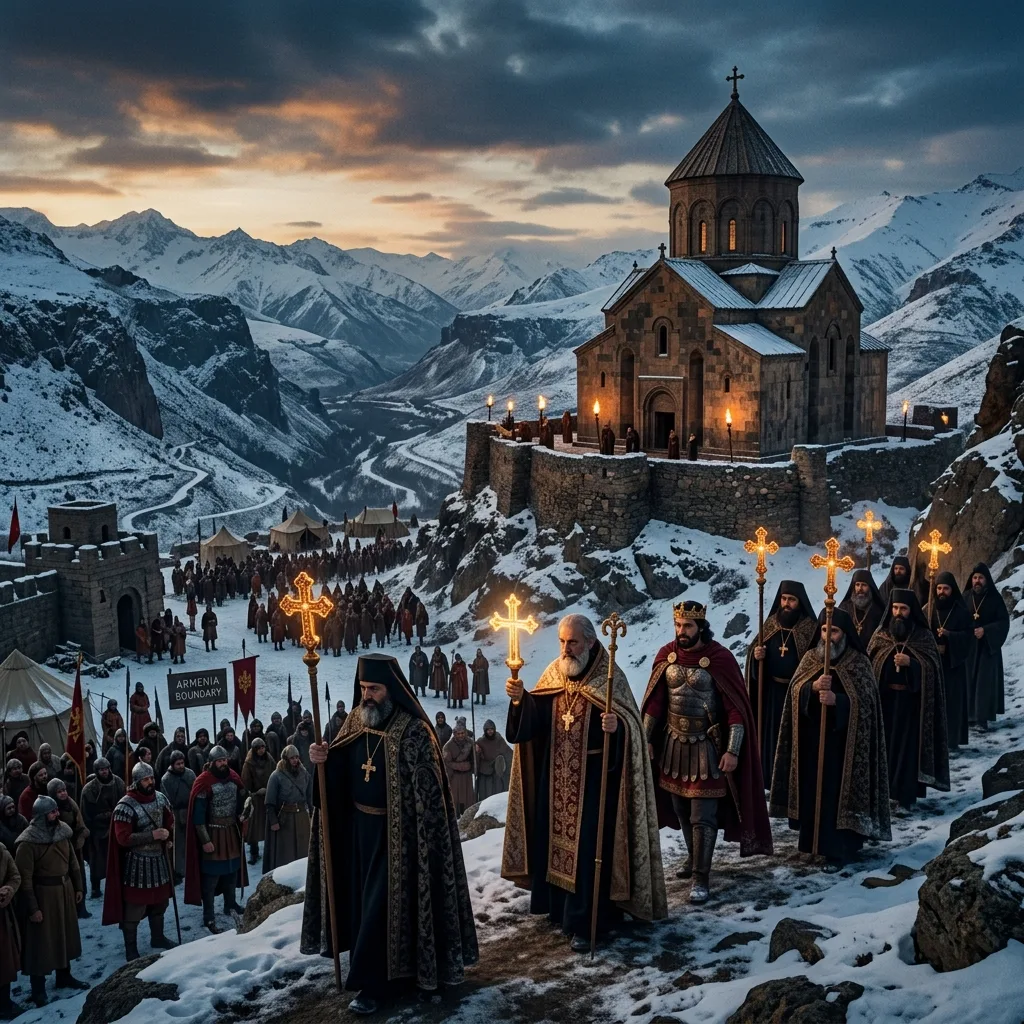
King Tiridates III of Armenia officially adopts Christianity as the state religion, making Armenia the first country in the world to do so—a full 12 years before the Roman Emperor Constantine even legalized it.
Open in interactive timeline →Key Numbers
- Traditional date
- AD 301
- Years before Rome's Edict of Milan
- ~12 years
- Gregory imprisoned at Khor Virap
- 13-15 years
- Scholarly date range proposed
- 284-325
- Oldest cathedral in the world
- Etchmiadzin, c. 301-303
Verified Facts
- Armenia is traditionally credited as the first state to adopt Christianity as its official religion, dated to AD 301 under the Arsacid king Tiridates III (Trdat), roughly a decade before Constantine's Edict of Milan (313) legalized Christianity in the Roman Empire.
- The conversion was driven by Gregory the Illuminator (Grigor Lusavorich, c. 239-c. 330), a Christian noble who, according to tradition, was imprisoned by Tiridates for thirteen to fifteen years in the pit at Khor Virap near the old capital Artashat for refusing to sacrifice to the pagan goddess Anahit.
- The primary source for the conversion narrative is Agathangelos's 'History of the Armenians,' composed in the mid-5th century (c. 460)-more than a century after the events-which functions largely as hagiography glorifying Gregory and legitimizing the Armenian Church, blending miracles with a historical core.
- Many modern scholars favor a date of around 314 rather than 301, tied to Gregory's consecration as bishop at Caesarea in Cappadocia; the traditional 301 is suspected of being retrospectively pushed earlier to claim primacy over Rome's official tolerance of Christianity.
- The traditional account holds that Tiridates persecuted the Roman virgin martyrs Hripsime, her abbess Gayane, and roughly 35 companions who had fled Diocletian's persecution to Vagharshapat; the king's subsequent madness (legend says he was transformed into a boar) was cured only when Gregory was released from the pit.
- Etchmiadzin Cathedral at Vagharshapat, traditionally built c. 301-303 after Gregory had a vision of Christ striking the ground with a golden hammer, is widely regarded as the oldest cathedral in the world and remains the spiritual center and seat of the Catholicos of All Armenians.
- The name 'Etchmiadzin' means 'the descent of the Only-Begotten' (from echnel, to descend, and miatsin, only-begotten), referring to Gregory's vision of Christ descending to mark the site.
- The conversion realigned Armenia culturally away from its centuries-long ties to the Zoroastrian Iranian (Sasanian) world and toward the Christian Roman-Hellenistic sphere, helping forge a durable national identity that outlasted the loss of political independence.
- Christianization was a gradual process rather than an overnight event; it was greatly accelerated after c. 405 when Mesrop Mashtots invented the Armenian alphabet, enabling scripture and liturgy to be rendered in the vernacular for ordinary Armenians.
- The Temple of Garni, a 1st-century Greco-Roman colonnaded temple dedicated to the sun god Mihr, uniquely survived the destruction of pagan shrines that followed conversion; it stood until an earthquake in 1679 and was reconstructed in 1969-75, making it the only free-standing Greco-Roman structure in Armenia today.
The World at This Moment
The Armenian conversion belongs to the turbulent decades around 300 CE, when the late Roman world convulsed. Diocletian's Tetrarchy (established 293) had stabilized the empire even as it launched the Great Persecution (303–311), the bloodiest official assault on Christians in Roman history, with Galerius and Maximinus Daza most savage in the East. Armenia sat squarely on the Roman–Sasanian frontier: the Peace of Nisibis (298) had just handed Rome the advantage after Galerius crushed the Persian Narseh, leaving Tiridates a Roman-backed client king. Constantine had not yet risen; his Edict of Milan (313) and the Council of Nicaea (325) lay in the future. Elsewhere, the Sasanian Empire under Narseh and later Shapur II championed Zoroastrianism; Mani's dualist church was spreading; and in India the Gupta dynasty had not yet emerged. Thus Armenia embraced a faith still illegal and persecuted within the neighboring Roman superpower — a striking act of confessional independence on a contested borderland between two empires.
The Paradigm Shift
Armenia's conversion made it, by tradition, the first polity to adopt Christianity as its state religion — a generation before Constantine and the Roman establishment. This bound Armenian national identity to the Church so tightly that the two became inseparable, a fusion with no clear precedent. Its deepest downstream consequence was cultural: to translate scripture and liturgy, Mesrop Mashtots devised the Armenian alphabet (c. 405), inaugurating a national literary language and a "golden age" of letters that preserved Armenian distinctness for centuries. The Church also charted a doctrinally independent course, ultimately rejecting the Council of Chalcedon (451) and aligning with Oriental Orthodoxy. When Sasanian Persia tried to impose Zoroastrianism, Armenians resisted at Avarayr (451) under Vardan Mamikonian, securing religious freedom in the Nvarsak treaty (484). Christianity thereby became the load-bearing structure of Armenian survival as a stateless people across later Arab, Byzantine, Seljuk, and Ottoman dominations — a template for how a small nation could make a confessional identity the vessel of its continuity.
In Depth
The Kingdom That Crossed First
Around the year 301 — or, as many modern historians now prefer, closer to 314 — the Arsacid king Tiridates III declared Christianity the official religion of the Kingdom of Armenia. By tradition this made Armenia the first state in history to bind its political identity to the new faith, a full generation before Rome's emperor would do the same. The traditional story is vivid: the king persecuted and imprisoned Gregory the Illuminator, fell into a wasting madness, and was healed only when Gregory was released — whereupon Tiridates converted, tore down the pagan temples, and consecrated Gregory as the first head of the Armenian Church. Historians treat the dramatic single-event version cautiously, favoring a more organic conversion spread across years; the later date of 314 is appealing precisely because it follows Constantine's legalization of Christianity (sv-constantine-legal), making a king's baptism politically thinkable.
The preconditions of a small state's gamble
Armenia's decision did not emerge from nowhere. Christianity had been a persecuted minority cult for three centuries, hardened by martyrdom from the era of the apologists like Justin Martyr (sv-justin-martyr) and Origen (sv-origen). What changed by 301 was that the faith had matured into something a monarch could adopt as an instrument of unity. Armenia sat on a geopolitical fault line — wedged between the Roman Empire to the west and the Zoroastrian Sasanian Persia to the east. Adopting Christianity was, among other things, a declaration of cultural independence: a way to be neither Roman nor Persian, but distinctly Armenian. In this it inverted the older logic of states like the Seleucid (sv-seleucid) and Ptolemaic (sv-ptolemaic) kingdoms, where Hellenistic ruler-cults had bound subjects to a king's divinity. Armenia chose instead a god above all kings.
The ripple: faith as national identity
The most consequential thread runs forward into how Christianity could fuse with nationhood. To root the faith in ordinary lives, the monk Mesrop Mashtots invented the Armenian alphabet around 405, enabling Scripture to be read in the vernacular for the first time. Letters and liturgy together forged an identity that resisted assimilation — a model the printing press (sv-printing-press) would later universalize, and that Luther's vernacular Reformation (sv-martin-luther) would echo more than a millennium on. That identity was tested in blood at the Battle of Avarayr in 451, when Vartan Mamikonian led Armenians against Yazdegerd II's decree to force them back to Zoroastrianism. Militarily a defeat, Avarayr secured — via the later Nvarsak Treaty of 484 — the Armenians' right to their faith, establishing the enduring template of a small Christian people defending belief against an empire.
Armenia and the Roman pivot
Armenia's precedence reframes the more famous Roman story. When Constantine convened Nicaea and tilted the Empire toward Christianity, and when Theodosius later outlawed paganism outright (sv-theodosius), they were following a road a minor kingdom had already opened. Yet because Rome was vast and Armenia small, it is Constantine whom popular memory credits. There is irony here that runs back to the faith's birth pangs — the same religion crushed when the Second Temple fell (sv-second-temple) and whose adherents were blamed for the Great Fire of Rome (sv-great-fire) had, within two and a half centuries, captured a throne.
Armenia's conversion thus marks a hinge: the moment a counter-imperial cult became a tool of statecraft, and the first proof that a nation could define itself by creed rather than conquest or descent. The Armenian Church, autocephalous and unbroken, remains the oldest national church on Earth — a living artifact of the day a king crossed first.
Causes & Consequences
What led to it
- Armenian tradition held that the apostles Thaddeus and Bartholomew evangelized Armenia in the first century, giving the later church an 'apostolic' self-understanding and a founding narrative for native Christianity.
- Christianity spread into Armenia across the second and third centuries from two neighboring centers: Syriac-speaking Edessa in Mesopotamia and Greek-speaking Cappadocia, seeding communities long before any state act.
- An organized Christian community existed in Armenia well before Constantine, attested by the Armenian bishop Meruzanes corresponding with Dionysius of Alexandria around 250 CE.
- Armenia's precarious position as a buffer kingdom contested between Rome and Sasanian Persia gave its rulers strong incentive to adopt a religion that distinguished the realm from Persian-dominated Zoroastrianism.
- According to the fifth-century hagiographer Agathangelos, King Tiridates III persecuted and imprisoned Gregory the Illuminator, then was cured of a debilitating affliction by him, a conversion story that supplied the religious legitimation for the royal change of faith.
- The collapse of stable Roman control in the eastern provinces after Diocletian gave Tiridates III an opening to act independently and impose a new state cult on his nakharar nobility.
What it set in motion
- Armenia is traditionally credited as the first state to adopt Christianity as its official religion, around 301 CE, roughly a decade before Constantine's Edict of Milan legalized the faith across the Roman Empire (scholars debate the exact date, with proposals ranging from c. 299 to 314).
- Gregory the Illuminator became the first head (katholikos) of the Armenian Church around 314 CE, establishing a hereditary ecclesiastical leadership and the institutional foundation of the Armenian Apostolic Church.
- The drive to make scripture and liturgy accessible led Mesrop Mashtots to create the 36-letter Armenian alphabet around 405 CE, whose first use was translating the Bible and which became the bedrock of Armenian literature and identity.
- Armenian Christianity became so central to national identity that nobles under Vardan Mamikonian fought the Sasanians at the Battle of Avarayr in 451 CE to resist forced conversion to Zoroastrianism, leading to the Nvarsak Treaty of 484 that secured the right to practice Christianity.
- The Armenian Church rejected the Christological formula of the Council of Chalcedon (451), formalizing its break at the councils of Dvin in the sixth century and becoming one of the miaphysite Oriental Orthodox churches, distinct from both Rome and Constantinople.
- The Armenian Apostolic Church became the enduring structure preserving Armenian ethnic and cultural identity across centuries of foreign rule and the absence of political independence.
The Live Academic Debate
The central debate concerns dating and historicity. Armenian tradition and the Church fix the conversion at 301 CE (commemorated in the 2001 jubilee), but many modern historians — following arguments revisited by scholars such as Nina Garsoïan and the chronological reassessment associated with Paul Ananian — favor c. 314, after the Edict of Milan (313) made Roman toleration plausible and a Roman-backed Tiridates's baptism more secure. A second debate, sharpened by Robert W. Thomson's translation and study of Agathangelos, targets the source itself: the History of the Armenians attributed to "Agathangelos" purports to be eyewitness testimony but was compiled in the mid-fifth century, cast in heavily biblical and hagiographic molds (Tiridates's madness, his transformation into a boar), making the factual nucleus hard to recover. Garsoïan further identified an "Iranian substratum" beneath the Christianizing narrative. A third strand resists the very notion of a single "conversion event," preferring a protracted, uneven Christianization across regions and decades rather than a royal decree — questioning whether 301 or 314 marks anything more than a symbolic, retrospectively constructed founding moment.
How This Event Connects
The conversion of Armenia to Christianity around 301 CE marks a profound paradigm shift in Late Antiquity, demonstrating how theology became inextricably intertwined with ethno-national survival. Pre-dating the imperial conversion of Constantine & Nicaea by decades, the Armenian experience provides a crucial counter-narrative to the Roman-centric model of Christianization. For Armenia, caught as a vulnerable buffer state, adopting Christianity was an aggressive geopolitical maneuver designed to forge a distinct identity and resist assimilation by the Sasanian Persian Empire and its Zoroastrian infrastructure.
This synthesis of religion and national identity foreshadowed the complex geopolitical realignments that would characterize the later Early Muslim Conquests. Just as Armenia weaponized theology to maintain independence between rival superpowers, the nascent Islamic state would similarly leverage a strict monotheistic identity to unify disparate tribal factions and conquer the exhausted remnants of the Byzantine and Sasanian empires.
Moreover, the Armenian Church's subsequent rejection of the Council of Chalcedon in 451 CE—opting for Miaphysitism—established a powerful precedent for religious schism driven by ethnic and political necessity. This localized theological fracture structurally anticipated the far more devastating Great Schism, illustrating how theological disputes over Christology often served as proxies for deeper administrative, linguistic, and geopolitical alienations.
The Counterfactual
Had Armenia not adopted Christianity early, the likeliest alternative was deeper assimilation into the Iranian, Zoroastrian world to which it was long tied dynastically (the Arsacids were of Parthian stock) and culturally. Without a confessional boundary distinguishing it from Sasanian Persia, Armenia might have followed the trajectory of other Iranian borderlands, gradually losing political and cultural distinctness. Crucially, the specific impetus for Mashtots's alphabet — rendering Christian scripture into Armenian — would have been absent or weaker, and a national literary language might never have crystallized, leaving Armenian more vulnerable to Syriac, Greek, or Persian cultural absorption. The fierce resistance at Avarayr (451), framed entirely as defense of the faith, presupposes the conversion; without it, no comparable rallying ideology existed. One should be cautious: Christianity spread organically in the region regardless, so some Armenian Christianity was probable. But the early state adoption, and the church-nation fusion it produced, were contingent — and that fusion, scholars like Nina Garsoïan stress, is precisely what enabled Armenian survival as a people without a durable state.
Myth vs. Reality
Myth: Armenia adopted Christianity as its state religion in a firmly established year, 301 AD.
Reality: The 301 date is the traditional date held by the Armenian Apostolic Church, not a securely documented one. The earliest narrative source, Agathangelos, wrote his 'History' around 460 AD, more than 150 years after the events, and his account is heavily hagiographical. Modern historians have proposed a range of dates from roughly 284 to no later than 325, with many preferring a date closer to 314. The conversion's primacy does not depend on the exact year: even at 314, Armenia precedes Rome's adoption of Christianity by decades.
Myth: King Trdat (Tiridates III) and Gregory the Illuminator introduced Christianity to a Armenia that had never encountered the faith.
Reality: Christianity had been present in Armenia for well over a century before Trdat's conversion, spreading from the Syriac Christian centers of Mesopotamia, especially Edessa, from the second and third centuries on. Eusebius of Caesarea refers to a bishop of Armenia named Meruzanes in the mid-third century, and tradition credits the apostles Thaddeus and Bartholomew with first preaching there. Gregory's achievement was making Christianity the official state religion, not bringing it for the first time.
Myth: Armenia's conversion was an instantaneous, peaceful, nationwide transformation once the king converted.
Reality: Christianization was a gradual and at times violent process. Sources describe armed resistance from families of pagan priests and the dismantling of pagan temples and shrines. Conversion at the level of the royal court and aristocracy outpaced that of the wider population, and missionaries used a strategy of denouncing or adapting pagan practices, so pre-Christian elements persisted in blended form. The survival of the Hellenistic temple at Garni is one well-known sign that the transformation was uneven.
Myth: Armenia is the undisputed first Christian kingdom, with no rival claims.
Reality: The kingdom of Edessa (Osroene) and its King Abgar are sometimes cited as an earlier Christian state. However, the story of Abgar V as a first-century convert rests on letters most scholars regard as a third-century fabrication, and some identify the converted king as the later Abgar VIII (Abgar IX) of the late second century. Because Edessa's claim depends on legendary material and contested dating, Armenia is generally regarded as the first state to formally adopt Christianity, though scholars note the question is genuinely debated rather than settled.
Myth: Agathangelos was a contemporary eyewitness who recorded the conversion as it happened.
Reality: Agathangelos presents himself as a Roman scribe present at the events, but scholars date the surviving 'History' to around 460 AD, and his claim to eyewitness status is widely doubted. Portions of his narrative of Gregory's mission closely parallel Koriun's earlier 'Life of Mashtots,' suggesting literary borrowing rather than firsthand reporting. That said, Gregory was a real historical figure: his son and successor Aristakes is recorded among the signatories of the Council of Nicaea in 325.
Frequently Asked Questions
When did Armenia become the first Christian state, and is the date of 301 AD accurate?
Tradition holds that King Tiridates III (Trdat) proclaimed Christianity the state religion of Armenia in 301 AD, which would make it the first nation to do so officially. However, the exact date is disputed among scholars, who have proposed anything from 284 to as late as 325; many modern historians favor a more secure date of around 314 AD, closer to when Gregory the Illuminator was consecrated as the church's first head. Regardless of which date is correct, Armenia's adoption preceded the Roman Empire's, since Constantine's Edict of Milan only legalized Christianity in 313 and it did not become Rome's state religion until near the end of the 4th century.
Who converted Armenia to Christianity?
Saint Gregory the Illuminator is traditionally credited with converting King Tiridates III and Christianizing Armenia. According to tradition, Tiridates had been a pagan who persecuted Christians and imprisoned Gregory for years, but after the king fell gravely ill, Gregory healed him, leading to the king's conversion. Gregory then became the first head (Catholicos) of the Armenian Church, around 314 AD, and the Armenian Church is called "Apostolic" because it also traces its origins to the apostles Bartholomew and Thaddeus.
Was Armenia really the first Christian nation, or was it Ethiopia or Edessa?
The answer depends on how "first Christian nation" is defined. The small Syriac kingdom of Edessa (Osroene) is sometimes cited as adopting Christianity even earlier, but it was a minor state that did not endure. Ethiopia's King Ezana converted in the 4th century with coins bearing the cross as evidence, but this is generally dated somewhat after Armenia's conversion. Armenia is widely regarded as the first state to make a sustained, institutionalized commitment to Christianity as its official religion at the national level.
How did the Armenian alphabet relate to Christianity?
The Armenian alphabet was created around 405 AD by the monk and scholar Mesrop Mashtots specifically to translate Christian scripture into Armenian. His 36-letter script (later expanded) allowed ordinary Armenians to read the Bible in their own language for the first time, helping entrench Christianity in the country. Working with Catholicos Isaac (Sahak), Mashtots's circle translated the Bible, drawing on Syriac and Greek texts including the Septuagint, in a project that also launched a golden age of Armenian literature.
What was the Battle of Avarayr and why does it matter for Armenian Christianity?
The Battle of Avarayr was fought on 26 May 451 AD between a Christian Armenian army led by Vardan Mamikonian and the Zoroastrian Sassanid Persian Empire, which had tried to force Armenians to abandon Christianity. Although the Persians won the battle and Vardan was killed, the Armenian resistance continued, and the conflict ultimately led to the Treaty of Nvarsak (484 AD), which guaranteed Armenians the right to practice Christianity freely. Vardan Mamikonian is venerated as a martyr and saint, and Avarayr is remembered as one of the first battles fought in defense of the Christian faith.
Why is the Armenian Apostolic Church considered separate from Catholic and Eastern Orthodox churches?
The Armenian Apostolic Church is one of the Oriental Orthodox churches, which split from the rest of Christendom after rejecting the Council of Chalcedon (451 AD); Armenia formally rejected Chalcedon at the Council of Dvin in 506. The dispute centered on Christology: the Armenian Church holds to miaphysitism, the belief that Christ's divinity and humanity exist together in one united nature, rather than the Chalcedonian formula of two natures in one person. Its spiritual center is the Mother See of Holy Etchmiadzin near Yerevan, led by the Catholicos of All Armenians.
Sources & Further Reading
- Christianization of Armenia — Wikipedia
- Agathangelos, History of the Armenians, trans. and commentary by Robert W. Thomson (Albany: SUNY Press, 1976)
- Nina G. Garsoïan, 'The Iranian Substratum of the Agatʿangełos Cycle,' in East of Byzantium: Syria and Armenia in the Formative Period (Dumbarton Oaks, 1982)
- Robert W. Thomson, 'Mission, Conversion, and Christianization: The Armenian Example,' Harvard Ukrainian Studies (1988/89)
- Nina G. Garsoïan, 'Armenia in the Fourth Century: An Attempt to Redefine the Concepts Armenia and Loyalty,' Revue des Études Arméniennes 8 (1971)
- Mark Cartwright, 'The Early Christianization of Armenia,' World History Encyclopedia (2018)
- Wikipedia: Armenian Apostolic Church
Cite This Page
AskHistoryAI. “Armenia: The First Christian State.” AskHistoryAI — Interactive Timeline of Everything. Updated 2026-09-11. https://askhistoryai.com/event/sv-armenia-christian/
Every fact on this page is checked against the published fact ledger and methodology; sources are listed above.