Constantine & Nicaea
Christianity transitions from a persecuted cult to state power.
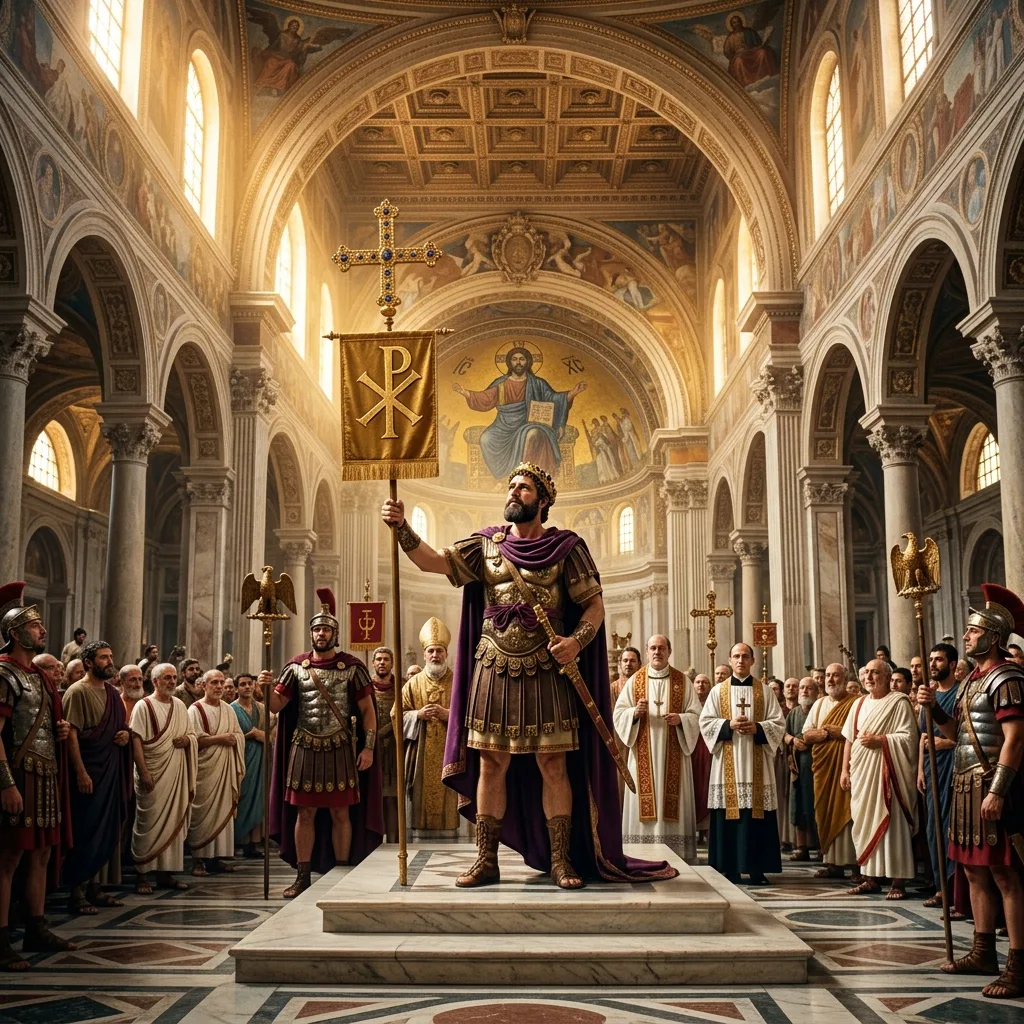
Emperor Constantine issues the Edict of Milan (313 CE) legalizing Christianity, and later convenes the Council of Nicaea (325 CE) to standardize Christian doctrine.
Open in interactive timeline →Key Numbers
- Council convened
- May 20, AD 325, Nicaea
- Bishops present
- ~250-318 (tradition: 318)
- Refused to sign creed
- 2 bishops + Arius, exiled
- Disciplinary canons issued
- 20
- Christianity legalized
- AD 313, Edict of Milan
Verified Facts
- The Edict of Milan, agreed in February 313 between the co-emperors Constantine I (West) and Licinius (East), did not make Christianity the state religion but granted universal freedom of worship and ordered the prompt return of property confiscated from Christians during the prior persecutions.
- Constantine summoned and personally presided over the First Council of Nicaea, which opened on May 20, 325, in Bithynia (modern Iznik, Turkey) - the first 'ecumenical' (empire-wide) council and the first time a Roman emperor convened and enforced a church gathering.
- Ancient sources disagree on attendance: estimates range from about 220 to 300 bishops, but church tradition fixed the symbolic figure at 318, the number of Abraham's servants in Genesis 14:14.
- The central dispute was triggered by Arius, a presbyter of Alexandria, who taught that the Son was a created being subordinate to the Father - summarized in the slogan 'there was a time when he was not' - which the council condemned as heresy.
- The council's resolution hinged on the Greek term 'homoousios' ('of one substance/being'), which Constantine himself is reported to have pressed for inclusion, defining the Son as of the same essence as the Father against the Arian position.
- Of the bishops present, only Arius and two Libyan bishops, Theonas of Marmarica and Secundus of Ptolemais, ultimately refused to sign the creed and were exiled along with Arius to Illyricum; several others signed only under threat of banishment.
- Beyond the creed, the council issued 20 disciplinary canons and standardized the calculation of Easter so it would be observed uniformly and independently of the Jewish calendar - the root of the modern Easter dating system.
- Despite championing Nicene orthodoxy, Constantine delayed baptism until his deathbed and was baptized on May 22, 337, by Eusebius of Nicomedia - an Arian-leaning bishop - underscoring that the Arian controversy was far from settled by the council.
- The Nicene Creed produced in 325 was not the final text recited today; it was expanded at the First Council of Constantinople in 381, and the doctrinal struggle over Arianism continued for roughly six decades after Nicaea.
- Forward-looking comparison entries on this timeline - such as Kurzweil's 2045 singularity prediction, projected AGI arrival, the Claude Mythos, and humanoid-robot human-parity - are documented predictions and projections, not established historical facts, and should be read as forecasts rather than events.
The World at This Moment
When Constantine summoned the bishops to Nicaea in 325, he had only the previous year defeated Licinius (324) to become sole Augustus, ending the Tetrarchic civil wars and refounding Byzantium as Constantinople. The Roman world was emerging from the Great Persecution under Diocletian and Galerius (303-311). Eastward, the Sasanian Persian empire under Shapur II was the chief geopolitical rival, with its own Zoroastrian establishment and a Christian minority soon caught between empires. In India, the Gupta dynasty's consolidation lay slightly ahead (Chandragupta I, c. 320); China was fractured among the Sixteen Kingdoms after the fall of Western Jin. Christianity itself was a minority faith—often estimated near 10 percent of perhaps 60 million imperial subjects (per Rodney Stark's modeling)—but unevenly concentrated in the Greek-speaking East. The Mediterranean intellectual scene still ran on Neoplatonism (Porphyry had died c. 305) and traditional civic cult. Nicaea was thus convened by a still-pagan-tinged monarchy presiding over a religion it had legalized barely a dozen years earlier through the 313 Edict of Milan.
The Paradigm Shift
Nicaea inaugurated a new political theology: for the first time a Roman emperor convened, funded, and effectively chaired a doctrinal assembly of the whole Church, binding orthodoxy to imperial authority. The council's creed, deploying the non-scriptural term homoousios ("of one substance") to affirm the Son's full divinity against Arius, established the principle that universal ("ecumenical") councils could define dogma and that the state would enforce it—exiling dissenters and burning proscribed books. This fused civil and ecclesiastical power into what later observers called "Caesaropapism," shaping Byzantium for a millennium and supplying the template medieval Western Christendom adapted. Theologically, Nicaea set the trajectory toward the developed doctrine of the Trinity, ratified at Constantinople in 381. More broadly, the Constantinian turn converted a persecuted sect into the empire's favored, then (under Theodosius, 380-392) official religion, redirecting late-antique culture, law, art, and philanthropy. As H. A. Drake argues, it recast religious identity as a matter of public, enforceable consensus rather than private cult—an arrangement whose consequences for church-state relations endure.
In Their Own Words
"I was on the point of restoring all to a state of concord, when I find that... on the ground of some trifling and foolish verbal difference between yourselves, brethren should assume towards each other the attitude of enemies." — Constantine I, letter to Bishop Alexander of Alexandria and the presbyter Arius, preserved in Eusebius of Caesarea, Life of Constantine (Vita Constantini), Book 2, ch. 71 (trans. NPNF / E. C. Richardson)
In Depth
The Emperor Who Defined God: How Nicaea Fused Faith and State
When the emperor Constantine summoned roughly 250 to 300 bishops to the Bithynian town of Nicaea in 325 AD, he did something no Roman had done before: he made the Roman state the arbiter of theological truth. The Council of Nicaea, and the chain of imperial decisions surrounding it, marks the hinge on which the ancient world swung from a polytheistic empire into the seedbed of Christendom. To understand its weight is to trace a single thread running back through the persecuted underground church and forward into the medieval West.
The Deep Preconditions
Nicaea was unthinkable without three centuries of accumulated pressure. Christianity had grown out of the world of the Second Temple's fall (sv-second-temple) and the diaspora it scattered, carried along the very roads built by Augustus (sv-augustus). It had been theorized by apologists like Justin Martyr (sv-justin-martyr) and the formidable Origen (sv-origen), who had already wrestled with how the Son related to the Father. The faith had survived the great fire of Rome (sv-great-fire) and waves of imperial hostility. By Constantine's day it had spread far enough that Armenia (sv-armenia-christian) had already become the first state to adopt it. The decisive turn came at the Milvian Bridge in 312, where Constantine — having reportedly seen a cross-sign and the words in hoc signo vinces — defeated Maxentius. The following year, the Edict of Milan he issued with Licinius ended persecution and granted Christians legal toleration. A once-criminal sect now had an imperial patron.
Defining the Indefinable
Toleration created a new problem: a legal church could afford to fight openly over doctrine. The presbyter Arius of Alexandria taught that the Son was a created being, subordinate to the Father — a view that threatened to split the church Constantine wanted as a unifying glue for his reunited empire. His solution was Roman to the core: convene a council and impose order. Nicaea produced the Nicene Creed, anchored by the Greek term homoousios ("of one substance"), declaring the Son fully equal to the Father. It condemned Arianism as heresy, fixed a common computation for Easter independent of the Jewish calendar, and issued twenty canons of church law. Crucially, Constantine decreed exile for any bishop who refused to sign. The principle was now established that the emperor could enforce orthodoxy with the machinery of the state.
The Ripples Forward
Nicaea's settlement was neither clean nor final — Constantine himself later softened toward Arius, and the controversy raged for decades. The pagan reaction under Julian the Apostate (sv-julian) showed how contested the new order remained. But the trajectory held. In 380 the Edict of Thessalonica under Theodosius (sv-theodosius) made Nicene Christianity the official religion of the empire and outlawed paganism outright. The court bishop Eusebius of Caesarea (sv-eusebius) supplied the theology of a Christian empire, and Augustine of Hippo (sv-augustine) would later give that empire's collapse a theological meaning in The City of God. The creedal machinery Nicaea invented — ecumenical councils defining binding doctrine — became permanent, and the fracture lines it could not fully heal eventually widened into the Great Schism of 1054 (sv-great-schism) and, much later, the Reformation (sv-martin-luther). Every subsequent argument in the West about what the state owes to truth, and what authority may define belief, descends in part from a council an emperor called to keep his empire whole. Constantine did not merely tolerate a religion; he handed the church the tools of imperial power, and in doing so set the terms of European civilization for the next thousand years.
Causes & Consequences
What led to it
- The Diocletianic (Great) Persecution launched in 303 had inflicted the empire's most severe state campaign against Christians, creating both the martyr-memory and the urgent demand for relief that toleration would answer.
- Constantine's victory over Maxentius at the Battle of the Milvian Bridge on 28 October 312, which Eusebius and Lactantius linked to a vision of a Christian sign, secured his control of the West and inclined him toward favoring Christianity.
- The Edict of Milan, the toleration agreement reached between Constantine and Licinius in 313, ended persecution, restored confiscated church property, and granted Christians legal freedom to worship, making an emperor-convened church council politically conceivable.
- Constantine's defeat of Licinius in 324 reunified the entire Roman Empire under a single Christian-favoring emperor, giving him the sole authority to summon bishops from across both East and West.
- The Arian controversy, sparked by the Alexandrian presbyter Arius teaching that the Son was a created being not co-eternal or of the same essence as the Father, had divided the Eastern churches and threatened the unity Constantine needed.
- The existing network of bishops, regional synods, and an increasingly organized episcopal hierarchy provided the institutional machinery that could be assembled into an empire-wide ecumenical gathering.
What it set in motion
- The Council of Nicaea in 325 produced the original Nicene Creed, affirming that the Son is homoousios (of one substance) with the Father and condemning Arianism, establishing a doctrinal standard of Christian orthodoxy.
- The council set the precedent of the ecumenical council as the church's mechanism for defining doctrine, a model followed by later councils such as Constantinople (381), Ephesus (431), and Chalcedon (451).
- The Edict of Thessalonica issued by Theodosius I in 380 made Nicene Christianity the official state religion of the Roman Empire, building directly on the Nicene definition to enforce orthodoxy by imperial law.
- The fusion of imperial and ecclesiastical authority modeled at Nicaea, where a Roman emperor convened and oversaw a church council, shaped the church-state relationship of late antiquity and the later Byzantine and medieval Christendom.
- Nicaea also issued twenty canons on church governance and worked toward a common method for dating Easter, advancing the standardization of ecclesiastical discipline and the liturgical calendar.
- By branding Arianism a heresy, the council framed the centuries-long Trinitarian disputes that persisted among Germanic kingdoms and continued to be litigated until the later councils more fully resolved them.
The Live Academic Debate
The central debate concerns Constantine's motives and the council's character. Jacob Burckhardt (1853) famously dismissed his conversion as cynical political calculation, reading Eusebius as propaganda; Norman Baynes (1929/1972) replied that Constantine was a sincere if idiosyncratic Christian, insisting he be judged within his own era. Timothy Barnes (Constantine and Eusebius, 1981) defended a genuinely committed Christian emperor, while H. A. Drake (Constantine and the Bishops, 2000) reframed the question entirely: rather than sincerity, the issue is policy—Constantine pursued a broad religious "consensus" of toleration that hardline bishops, not the emperor, pushed toward coercion. A parallel debate, advanced by scholars like Lewis Ayres and Khaled Anatolios, stresses that "the Arian controversy" was less a clash of two fixed parties than a messy, decades-long clarification; Nicaea settled little immediately, with reversals until 381. Averil Cameron and others further scrutinize Eusebius's Life of Constantine as a tendentious, partly hagiographic source whose authenticity and reliability remain contested.
How This Event Connects
The reign of Constantine the Great and the subsequent Council of Nicaea fundamentally transformed Christianity from a persecuted, decentralized faith into a highly structured apparatus of Roman imperial statecraft. Unlike the earlier grassroots conversion of Armenia: The First Christian State, Constantine's integration of the Church involved a deliberate, decades-long process of religious syncretism. By weaponizing theological consensus as a tool for imperial unity, Constantine permanently altered the relationship between Church and State, establishing the Emperor as the ultimate arbiter of ecclesiastical disputes.
This massive geopolitical realignment immediately triggered a reactionary ideological backlash, culminating in the brief but intense reign of Julian "the Apostate". Julian’s frantic, state-sponsored attempt to dismantle Constantinian Christianity and resurrect a highly centralized, Neoplatonic "Pagan Church" was a direct historiographical response to the new institutional reality established by Nicaea. Julian recognized that the only way to combat the organizational dominance of the Constantinian Church was to mirror its administrative power.
Ultimately, the complex legacy of Constantine's imperial Church required profound theoretical justification, a task largely fulfilled by Augustine of Hippo. Faced with the messy reality of a Christianized Roman Empire struggling with schisms (such as the Donatist controversy) and external collapse, Augustine developed pragmatic theological frameworks—including the "Just War" theory—to reconcile the violent, coercive nature of the Roman state with the normative pacifism of early Christianity.
The Counterfactual
Had Constantine lost at the Milvian Bridge (312) or to Licinius (324), or had he treated Christianity as one tolerated cult among many rather than the object of active imperial patronage, the consolidation of catholic orthodoxy would likely have been slower and more fragmented. Without an emperor to convene and enforce a single creed, the Arian dispute might have hardened into durable regional churches—plausible given that Arianizing "homoian" Christianity dominated under Constantius II and was carried to the Goths via Ulfilas, persisting among Germanic kingdoms into the sixth century. Yet scholars caution against overstating Constantine's decisiveness: Christianity was already growing steadily (Stark), and Drake and Averil Cameron note the church, not the emperor, drove much theological definition. A non-Constantinian Christianity might have remained a vigorous minority, as in Sasanian Persia, without becoming the empire's establishment. The likeliest divergence is not Christianity's disappearance but the absence of the council-plus-coercion mechanism—weaker doctrinal uniformity, no Caesaropapist Byzantine model, and a Europe of competing Christianities rather than a single enforced orthodoxy.
Myth vs. Reality
Myth: The Council of Nicaea decided which books belong in the Bible (the New Testament canon).
Reality: There is no record from the council, nor from eyewitness attendees such as Eusebius of Caesarea or Athanasius, of any debate or vote on the biblical canon. Nicaea's documented business was the Arian controversy, the Nicene Creed, the dating of Easter, and about twenty disciplinary canons. The canon developed gradually through usage and lists spanning roughly the 2nd to 4th centuries; the Nicaea-canon claim traces to a late, legendary source (the 9th-century Synodicon Vetus) and was popularized by Voltaire and, more recently, Dan Brown's The Da Vinci Code.
Myth: Nicaea invented or first declared the divinity of Jesus, which Christians had not previously believed.
Reality: Belief in Christ's divinity long predated 325 and was shared by virtually all parties at the council, including Arius. The dispute was over how the Son was divine: whether he was eternally of the same being as the Father (homoousios) or a created, subordinate being who 'was not' before he was begotten. As Bart Ehrman notes, the question was the nature of Jesus' divine sonship, not whether he was divine at all.
Myth: Jesus' divinity passed by a razor-thin vote that Constantine engineered.
Reality: The outcome was lopsided, not close. Of the roughly 250 to 318 bishops present (318 is the traditional figure), only a small handful resisted; after Arius was condemned, just two bishops, Theonas of Marmarica and Secundus of Ptolemais, finally refused to sign and were exiled with him. Constantine convened the council seeking unity but did not dictate the theology, and the idea of a near-tie 'vote' on Jesus' divinity has no basis in the sources.
Myth: Constantine converted to Christianity at Nicaea and used Roman power to enforce its creed for the rest of his life.
Reality: Constantine was not baptized until shortly before his death in May 337, about twelve years after Nicaea, and notably by Eusebius of Nicomedia, an Arian sympathizer. He retained the pagan title Pontifex Maximus, and in the years after Nicaea imperial policy often swung the other way: Constantine recalled exiled Arians and pressured the church toward compromise, so the post-Nicene state did not consistently enforce the creed the council had adopted.
Myth: Saint Nicholas (Santa Claus) punched the heretic Arius in the face at the council.
Reality: This is late hagiographical legend, not history. It is doubtful Nicholas attended at all, as he does not appear in the surviving attendance lists. The slapping story first surfaces over a thousand years later, with the earliest known version in Petrus de Natalibus, a late-14th-century bishop, who wrote only that Nicholas struck 'a certain Arian' (not Arius himself); the detail naming Arius is a still-later embellishment.
Frequently Asked Questions
What happened at the Council of Nicaea in 325 AD?
The First Council of Nicaea was the first ecumenical council of the Christian Church, convened in 325 AD by Emperor Constantine in the city of Nicaea (in modern-day Turkey). Roughly 300 bishops (tradition says 318) gathered chiefly to resolve the Arian controversy over whether Jesus the Son was equal to God the Father or a created being. The council condemned Arius's teaching, produced the original Nicene Creed affirming the Son was 'of the same substance' (homoousios) as the Father, set a unified rule for dating Easter, and issued 20 canons on church governance.
Did Constantine make Christianity the official religion of the Roman Empire?
No. Constantine, together with Licinius, issued the Edict of Milan in 313 AD, which legalized Christianity and granted religious freedom to all faiths, ending state persecution and ordering the return of confiscated Christian property. It did not make Christianity the official state religion. Christianity only became the Roman Empire's official religion later, under Emperor Theodosius I with the Edict of Thessalonica in 380 AD.
Did the Council of Nicaea decide which books are in the Bible?
No, this is a popular myth with no basis in the historical record. The idea was spread by Dan Brown's 2003 novel The Da Vinci Code, but the canon of Scripture was not on the council's agenda. Eyewitness attendees such as Eusebius and Athanasius left accounts of Nicaea, and none of them mention any vote or deliberation about which books belonged in the Bible. The council dealt with the Arian controversy, the Nicene Creed, the date of Easter, and church discipline.
What was the Arian controversy and how did Nicaea resolve it?
Arius, a presbyter from Alexandria, taught that the Son of God was a created being, exalted but not co-eternal or equal with the Father. The council rejected this, affirming in the Nicene Creed that the Son was 'begotten, not made' and homoousios ('of the same substance') with the Father, a key term Constantine himself pressed for. The vote was overwhelmingly in favor; only Arius and two allies, Theonas and Secundus, refused to sign and were exiled. The dispute was not fully settled, however, as Constantine later recalled Arius from exile and Arian-leaning factions persisted for decades.
Was Constantine actually a Christian, and when was he baptized?
Constantine favored and promoted Christianity for most of his reign after his reported vision before the Battle of the Milvian Bridge in 312 AD, but his personal conversion was gradual. He was not baptized until shortly before his death in 337 AD, reportedly by Eusebius of Nicomedia, a bishop of Arian sympathies. Delaying baptism until late in life was common in the 4th century, since baptism was believed to wash away all prior sins. He is generally regarded as the first Roman emperor to embrace Christianity.
Why did the Council of Nicaea standardize the date of Easter?
Christians had been observing the resurrection on differing dates: some, called Quartodecimans, tied it to the Jewish Passover on 14 Nisan, while others always celebrated on a Sunday. To create unity, the council ruled that Easter should fall on the first Sunday after the first full moon following the spring equinox, calculated independently of the Hebrew calendar. The Bishop of Alexandria was tasked with announcing the date each year to the other churches. This decision gradually brought the various local practices into alignment.
Sources & Further Reading
- First Council of Nicaea — Wikipedia
- H. A. Drake, Constantine and the Bishops: The Politics of Intolerance (Johns Hopkins University Press, 2000)
- Timothy D. Barnes, Constantine and Eusebius (Harvard University Press, 1981)
- Norman H. Baynes, Constantine the Great and the Christian Church (British Academy, 1929; 2nd ed. 1972)
- Lewis Ayres, Nicaea and Its Legacy: An Approach to Fourth-Century Trinitarian Theology (Oxford University Press, 2004)
- Eusebius of Caesarea, Life of Constantine, trans. Averil Cameron and Stuart G. Hall (Oxford University Press, 1999)
- Wikipedia: Constantine the Great
Cite This Page
AskHistoryAI. “Constantine & Nicaea.” AskHistoryAI — Interactive Timeline of Everything. Updated 2026-09-11. https://askhistoryai.com/event/sv-constantine-legal/
Every fact on this page is checked against the published fact ledger and methodology; sources are listed above.