Benjamin Franklin & Electricity
The taming of lightning and the birth of American science.
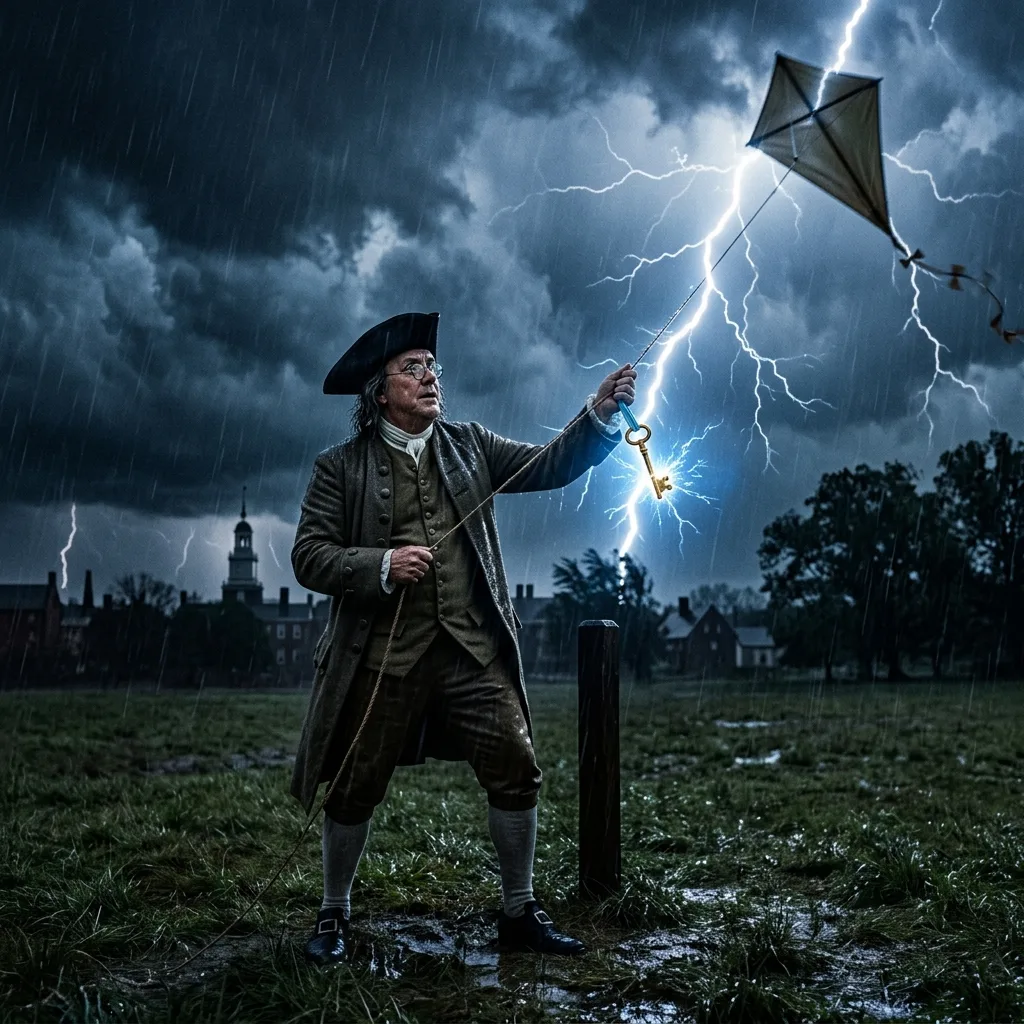
Benjamin Franklin famously proves that lightning is electricity (through his legendary kite experiment) and invents the lightning rod, fundamentally transforming a terrifying "act of God" into a manageable physical phenomenon.
Open in interactive timeline →Key Numbers
- Kite experiment
- June 1752, Philadelphia
- Rod height at Marly
- ~40 ft (13 m) iron rod
- Copley Medal
- Awarded Nov 30, 1753
- Patents filed
- Zero (by principle)
- Terms still in use
- Battery, charge, conductor, +/-
Verified Facts
- Franklin's interest in electricity ignited in 1746 in Boston, where he watched a traveling lecturer, Dr. Archibald Spencer, perform electrical demonstrations; soon after, the Royal Society's Peter Collinson sent a glass friction tube to Franklin's Library Company in Philadelphia, equipping his amateur experiments.
- Franklin was the first to apply the words 'positive' and 'negative' (plus and minus) to electrical charge, in a 1747-48 letter to Collinson, and he coined or popularized a vocabulary still used today including battery, charge, conductor, condenser, and electrician.
- Franklin advanced a 'single-fluid' theory of electricity: a body with an excess of the electrical fluid was 'positive' and one with a deficit was 'negative' a conservation-of-charge insight that remains essentially correct, even though his arbitrary sign convention left conventional current flowing opposite to the actual electron motion.
- Crucially, Franklin's own kite experiment did NOT involve the kite being struck by lightning a direct strike would likely have killed him. Instead the wet hemp string drew ambient charge from the storm clouds, and sparks jumped from a key to his knuckle, proving clouds carry electricity.
- Franklin's theory was first confirmed not by him but in France: on May 10, 1752, following his published 'sentry-box' proposal, Thomas-Francois Dalibard's assistant drew sparks from a ~40-foot insulated iron rod at Marly-la-Ville, weeks before Franklin's own kite test in June 1752.
- Franklin described the kite experiment in his own words in the Pennsylvania Gazette of October 19, 1752, with his 21-year-old son William assisting and contrary to legend, the experiment's purpose was not to 'discover electricity' (already known) but to prove that lightning was the same electrical phenomenon studied in laboratories.
- Franklin's 1751 collection 'Experiments and Observations on Electricity,' communicated through Collinson, made his reputation across Europe; it earned him the Royal Society's Copley Medal on November 30, 1753, and Immanuel Kant later hailed him as 'the Prometheus of modern times.'
- The lightning rod was Franklin's practical payoff: he equipped his own Philadelphia house with one in September 1752 and published instructions in the 1753 Poor Richard's Almanack, describing a pointed iron rod connected by wire to a ground stake to safely channel strikes away from buildings.
- On principle, Franklin patented none of his inventions including the lightning rod writing in his autobiography that since 'we enjoy great advantages from the inventions of others, we should be glad of an opportunity to serve others by any invention of ours; and this we should do freely and generously.'
- The danger was real: on August 6, 1753, physicist Georg Wilhelm Richmann was killed in St. Petersburg while conducting a related lightning experiment, struck in the head by what witnesses described as ball lightning a death Franklin himself later reported in the Pennsylvania Gazette in 1754.
The World at This Moment
Franklin's electrical letters to Peter Collinson (1747-1750), printed in London in 1751 as Experiments and Observations on Electricity, emerged from a transatlantic Enlightenment in full ferment. In Paris, Diderot and d'Alembert were launching the Encyclopedie (first volume 1751); the abbe Nollet dominated French electrical science with his rival "two-effluvia" theory. In Sweden, Linnaeus had recently fixed binomial nomenclature; in Scotland, David Hume and the nascent moral philosophy circle were active. Leyden jars, invented around 1745-1746 at Leiden and Pomerania, had made spectacular electrical shocks a fashionable parlor and lecture-hall sensation across Europe. Politically, Britain's North American colonies were prosperous but restive; the Seven Years' War (1756) loomed. Franklin himself was a Philadelphia printer, postmaster, and civic organizer, not a university natural philosopher. His work reached Europe through Collinson, the Royal Society, and the Comte de Buffon's French translation, situating colonial America, for the first time, as a contributor to, rather than a consumer of, metropolitan science.
The Paradigm Shift
Franklin reframed electricity from a catalogue of curiosities into a quantitative, conserved phenomenon. His single-fluid theory held that electrical "fire" is neither created nor destroyed but redistributed; a body with excess he called "positive" (plus), a body in deficit "negative" (minus)—coinages, with "charge," "conductor," "condenser," and "battery," that remain standard. This implied conservation of charge, a genuine physical law preceding wider conservation principles. By proposing (1750) and confirming (via Dalibard at Marly, May 1752, then his own kite, June 1752) that lightning is an electrical discharge, he collapsed the boundary between terrestrial laboratory sparks and a feared celestial portent, secularizing a phenomenon long read theologically. The lightning rod was the Enlightenment's emblematic case of useful, predictive natural knowledge: theory yielding a device that demonstrably protected churches, magazines, and ships. As J.L. Heilbron argues, Franklin's system gave electrical science its first coherent conceptual framework, shaping the field until Coulomb, Volta, and the quantification of the later eighteenth century.
In Their Own Words
"As soon as any of the Thunder Clouds come over the Kite, the pointed Wire will draw the Electric Fire from them... And when the Rain has wet the Kite and Twine, so that it can conduct the Electric Fire freely, you will find it stream out plentifully from the Key on the Approach of your Knuckle." — Benjamin Franklin, letter to Peter Collinson, October 1752, published in the Pennsylvania Gazette (19 October 1752) and read before the Royal Society; reprinted in later editions of Experiments and Observations on Electricity.
In Depth
Drawing Fire From the Sky: How a Printer Tamed the Lightning
When Benjamin Franklin began drawing sparks from glass tubes in the late 1740s, electricity was a parlor amusement — a way to make a girl's hair stand on end or to shock a circle of monks holding hands. By the time he published Experiments and Observations on Electricity, Made at Philadelphia in America (1751), he had converted that amusement into a science with a coherent theory and a deadly serious application. His was the first great original contribution to natural philosophy to come from the European colonies in the Americas (sv-new-world), and it announced that the western edge of the Enlightenment could now generate knowledge, not merely import it.
The Preconditions
Franklin's work was unthinkable without the apparatus and the worldview that the Scientific Revolution had assembled. Isaac Newton (sv-newton) had shown that nature obeyed mathematical, mechanical laws, and the telescope-driven empiricism of Galileo (sv-galileo) and the method of Descartes (sv-descartes) had made systematic experiment respectable. More concretely, Franklin depended on hardware: the friction-generating electrostatic machine and, crucially, the Leyden jar — the first device that could store a meaningful electric charge. Franklin, a self-educated printer who had helped found Harvard's intellectual rival institutions and corresponded across the Atlantic, took these tools and asked what electricity actually was.
What Franklin Changed
His answer was the single-fluid theory: electricity is one "fire" that flows; rubbing does not create it but merely moves it, so that what one body gains another loses. From this he derived the conservation of charge and coined the vocabulary we still use — positive and negative, charge, conductor, battery (named for an analogy to a battery of cannon). That a printer's terminology survives in every physics classroom three centuries later is a measure of how cleanly his framework cut.
Then came the famous gamble. Franklin proposed that lightning was simply electrical discharge on a giant scale, and that a pointed iron rod could draw its "fire" harmlessly to ground. In May 1752, before Franklin flew his own kite, Thomas-François Dalibard performed Franklin's "sentry-box" experiment at Marly-la-Ville and drew sparks from a storm. The lightning rod that followed was arguably the Enlightenment's first piece of genuine science-based technology — a device that demystified a phenomenon humanity had read as divine wrath since the days of Göbekli Tepe (sv-gobekli-tepe) and Hesiod's thunder-hurling Zeus (sv-hesiod). Franklin had, in Turgot's phrase, snatched the lightning from heaven.
The Threads Forward
Franklin's celebrity as the man who tamed the sky gave him diplomatic weight that proved decisive in the American Revolution (sv-american-revolution); the philosopher-scientist who charmed Paris helped secure the French alliance that won it. Scientifically, his conceptual groundwork lay dormant until the nineteenth century, when Michael Faraday (sv-michael-faraday) turned electricity from curiosity into force with electromagnetic induction, and James Clerk Maxwell (sv-james-maxwell) unified it with magnetism and light in a set of equations. That lineage runs straight into the incandescent world of Thomas Edison (sv-thomas-edison) and the alternating-current grid of Nikola Tesla (sv-nikola-tesla) — and onward into every transistor and data center now training artificial minds. The electric "fire" Franklin named is the same current that lights the deep-learning revolution (sv-alexnet-convnets). A Philadelphia printer flying a kite stands, improbably, at the headwaters of the machine age and the information age alike.
Causes & Consequences
What led to it
- Stephen Gray's experiments around 1729 demonstrated that electricity could be conducted along threads and wires over distances and distinguished conductors from non-conductors, giving Franklin the categories he would later refine.
- Charles Francois du Fay's 1733 discovery that electricity came in two kinds he called 'vitreous' and 'resinous' set up the puzzle that Franklin reframed as a single fluid present in excess (positive) or deficiency (negative).
- The invention of the Leyden jar around 1745 by Pieter van Musschenbroek (and independently Ewald von Kleist) gave experimenters the first device that could store a substantial electric charge, which became the central apparatus of Franklin's investigations.
- A 1746 demonstration of electrical experiments Franklin saw in Boston (attributed to a Dr. Spencer/Spence) first sparked his fascination with electricity and drew him into systematic study.
- Peter Collinson of the Royal Society sent Franklin's Library Company of Philadelphia a glass tube and instructions for electrical experiments, supplying both the equipment and the correspondence channel through which Franklin's results reached Europe.
- Collinson arranged the 1751 London publication of Franklin's letters as 'Experiments and Observations on Electricity,' broadcasting the Philadelphia work to the wider European scientific community.
What it set in motion
- Franklin's single-fluid theory established the principle of conservation of charge, the idea that electric charge is never created or destroyed but only transferred between bodies, which remains foundational to electrical science.
- Franklin coined a vocabulary still in everyday use, including 'positive' and 'negative,' 'charge,' 'conductor,' 'condenser,' and 'battery,' standardizing how electricity is described.
- His 1752 demonstration that lightning is an electrical phenomenon, pursued via the kite-and-key and grounded-rod experiments, settled a long-standing question about the nature of lightning.
- The lightning rod that grew out of this work became the first widely practical electrical technology, protecting buildings and ships from lightning damage and saving countless lives and structures.
- The 1751 book and the electrical experiments won Franklin the Royal Society's Copley Medal in 1753 and an international scientific reputation, helping legitimize American natural philosophy on the European stage.
- Franklin's idea that different materials hold different amounts of the electrical fluid helped inspire Alessandro Volta's work ranking and stacking metals, a line of inquiry that led toward the voltaic pile and the study of current electricity.
The Live Academic Debate
The sharpest debate concerns whether Franklin actually performed the kite experiment, and when. Carl Van Doren (1939) noted the episode is "dim and mystifying in fact." Tom Tucker's Bolt of Fate (2003) argued provocatively that Franklin never flew the kite and may have perpetrated a hoax, a thesis most historians reject as overstated but which sharpened scrutiny of the thin contemporary evidence: Franklin's own October 1752 account is curiously impersonal, and Joseph Priestley's fuller 1767 narrative came fifteen years later. Priority is a second axis: Dalibard's Marly sentry-box trial (May 1752) preceded any documented kite flight, so the experimentum crucis confirming lightning's electrical nature was arguably French, executing Franklin's published design. A third strand, advanced by J.L. Heilbron and I. Bernard Cohen, weighs how genuinely original Franklin's theory was versus how much it crystallized ideas circulating among Watson, the Leyden-jar investigators, and others—Cohen emphasizing Franklin's conceptual coherence, while situating him firmly within a collaborative European research community rather than as a lone genius.
How This Event Connects
Benjamin Franklin's profound historical resonance lies in his unique intersection of material culture, Enlightenment science, and democratic statecraft. Historiographically, Franklin's trajectory is deeply indebted to the transformative power of the Gutenberg Press. As a printer, he maximized the potential of print capitalism, practically inventing the first mass-media market in the American colonies through publications like Poor Richard's Almanack. This shared print culture created a cognitive and cultural baseline that unified the disparate colonies, rendering the ideological mobilization of the American Revolution possible. By managing the physical infrastructure of the postal system, Franklin manifested the "Republic of Letters" into a tangible network, proving that communication technology is a prerequisite for political cohesion.
Franklin's role as a Founding Father deeply connects him to both the American Revolution and the drafting of the Federalist Papers. Although not an author of the Federalist essays, Franklin's pragmatic, compromising statecraft at the Constitutional Convention created the deeply flawed but durable document that Hamilton and Madison subsequently defended. His earlier demographic theories—arguing for aggressive territorial expansion to prevent urban poverty—also foreshadowed the expansive, continental ambitions justified by the Federalist defense of the "extended republic." Franklin’s late-life shift towards abolitionism further underscores the profound contradictions inherent in the founding era, highlighting the unresolved tensions between liberty and slavery that the Federalist Papers often sought to obfuscate.
Finally, Franklin's pioneering work in electricity laid the conceptual groundwork for the technological titans of the 19th century, notably Thomas Edison. Franklin's demystification of lightning and his invention of the lightning rod initiated the long process of harnessing electrical power for human utility. While Edison operated within the hyper-capitalist context of the late Industrial Revolution—a far cry from Franklin's gentlemanly, philosophical approach to science—both men embodied the archetypal American "Self-Made Man," blending practical invention with shrewd self-promotion and commercial acumen. Franklin established the paradigm of the pragmatic American inventor, a lineage that Edison would aggressively monetize and expand.
The Counterfactual
Franklin's specific results were not irreplaceable—electrical science was a crowded field—but his synthesis and timing mattered. Absent his single-fluid theory, Nollet's rival "two-effluvia" account, or William Watson's parallel English work, might have framed mid-century electricity, plausibly leaving us a different and perhaps clumsier vocabulary; "positive/negative" and "conservation of charge" gave the field unusual conceptual economy. The lightning-rod proposal, however, was the consequential intervention. Had Franklin not published his "sentry-box" sketch in the 1751 Experiments and Observations, Dalibard would have had nothing to execute at Marly in May 1752, and the dramatic confirmation that made Franklin world-famous—and the protective device—would likely have been delayed by years, costing lives and structures (the 1769 Brescia magazine disaster shows the stakes). Heilbron cautions against treating any single experiment as decisive; the kite itself, whose details Carl Van Doren called "dim and mystifying," may be partly legendary. The deeper counterfactual is reputational and political: without this fame, Franklin's later diplomatic stature in France—crucial to the 1778 alliance—would have rested on weaker foundations.
Myth vs. Reality
Myth: Benjamin Franklin discovered electricity.
Reality: Electricity was studied for centuries before Franklin. Static electricity was known to the ancient Greeks (Thales of Miletus described amber attracting objects when rubbed), and 18th-century experimenters like Stephen Gray, Charles Du Fay, and the inventors of the Leyden jar were already working with it. Franklin's actual contributions were theoretical and terminological: he advanced the single-fluid theory of electricity and coined enduring terms such as positive, negative, charge, and battery. His 1752 work demonstrated that lightning is electrical, not that electricity itself existed.
Myth: Lightning struck Franklin's kite (or the key), and that's the whole point of the experiment.
Reality: Franklin's kite was almost certainly never struck by lightning. A direct strike would likely have killed him, as it did Georg Wilhelm Richmann in St. Petersburg in 1753 while replicating such experiments. According to Joseph Priestley's 1767 account (the main source, written 15 years later and reviewed by Franklin), the wet kite string drew ambient electrical charge from the storm-charged air, which Franklin detected as sparks from the key. The experiment was designed to show that storm clouds carry the same electricity producible in a lab, not to attract a lightning bolt.
Myth: Franklin was the first to prove lightning is electricity with his kite.
Reality: Franklin proposed the test, but the first successful demonstration was carried out in France. On 10 May 1752, following Franklin's published 'sentry-box' proposal, Thomas-Francois Dalibard had an assistant draw sparks from a tall insulated iron rod during a storm at Marly-la-Ville, weeks before Franklin's own kite trial (generally placed in June 1752). Franklin actually devised the kite because he thought a ground rod could not be made tall enough.
Myth: The kite experiment is a well-documented, firmly dated historical event.
Reality: Franklin never published a first-person narrative of flying the kite, and the exact date and location were never recorded. Nearly everything known comes from Priestley's secondhand 1767 account. This thin documentation has led some historians to question the details, and author Tom Tucker, in his 2003 book Bolt of Fate, argued the dramatic kite story may have been exaggerated or even a hoax. Most scholars accept that Franklin did some version of the experiment, but the storybook image is not on solid documentary footing.
Myth: Franklin invented the lightning rod only after the kite experiment proved his idea.
Reality: Franklin had proposed protective pointed lightning rods in his electrical writings before either the French sentry-box trial or his own kite experiment. His sketches and proposals to use grounded metal rods to draw off electrical charge from buildings date to around 1750. The 1752 experiments confirmed the underlying principle that lightning is electrical, but the practical lightning rod grew out of his earlier theoretical work on pointed conductors, not as an afterthought to the kite.
Frequently Asked Questions
Did Benjamin Franklin discover electricity?
No. Electricity and static charge were studied long before Franklin, and devices like the Leyden jar (invented around 1745 in the Netherlands) already let researchers store and discharge it. Franklin's contribution was to propose, and help prove, that lightning is the same electrical phenomenon, and to advance a unifying theory of how electricity behaves. He is best understood as a pioneering theorist and experimenter of electricity, not its discoverer.
What actually happened in Franklin's 1752 kite experiment?
By the traditional account, in June 1752 Franklin flew a kite during a thunderstorm, with his son William assisting, to test whether storm clouds were electrified. A metal key was tied to the wet hemp kite string, while Franklin held a dry silk ribbon as an insulator and stood under a doorway to keep it dry. When he brought his knuckle near the key, a spark jumped, indicating the string had drawn electric charge from the atmosphere. Importantly, the kite was not struck by a lightning bolt; a direct strike would likely have been fatal.
Was Franklin really the first to prove lightning is electricity?
No. Acting on Franklin's published proposal, the French naturalist Thomas-Francois Dalibard had the experiment performed at Marly-la-Ville on 10 May 1752, where an insulated iron rod drew sparks from a storm cloud about a month before Franklin's own kite trial. This 'sentry-box' experiment is generally credited as the first demonstration that thunderclouds are electrified. Franklin originated the idea and experimental design, but French experimenters were the first to carry it out.
Did Franklin invent the lightning rod, and how does it work?
Yes. Franklin proposed pointed, grounded iron rods after observing that a sharp metal point could quietly draw off the charge from an electrified object. Mounted above a building and connected to the earth, a lightning rod offers a safe, low-resistance path that conducts a strike's current into the ground, protecting the structure. His pointed design became the worldwide standard, though it drew controversy, including from some religious figures who objected to 'controlling' lightning.
Which electrical terms did Benjamin Franklin coin?
Franklin introduced much of the vocabulary still used today. From his single-fluid theory he applied the terms 'positive' and 'negative' (plus and minus) to electric charge, and he is credited with popularizing words such as 'battery,' 'conductor,' 'charge,' and 'electrician.' He used 'battery' for a set of linked Leyden jars, by analogy to a battery of cannon. These terms reflected his idea that electricity is a single fluid that is transferred rather than created or destroyed.
Was anyone killed trying to repeat Franklin's lightning experiments?
Yes. Georg Wilhelm Richmann, a physicist working in St. Petersburg, was killed on 6 August 1753 while using an insulated rod to study a storm's electrical effects, reportedly by what was described as ball lightning. He is often cited as the first person to die conducting electrical experiments. Franklin himself later published an account of the accident in the Pennsylvania Gazette in 1754, underscoring how dangerous the work was.
Sources & Further Reading
- Kite experiment — Wikipedia
- J. L. Heilbron, Electricity in the 17th and 18th Centuries: A Study of Early Modern Physics (University of California Press, 1979)
- I. Bernard Cohen, Benjamin Franklin's Science (Harvard University Press, 1990)
- Carl Van Doren, Benjamin Franklin (Viking Press, 1938)
- Tom Tucker, Bolt of Fate: Benjamin Franklin and His Electric Kite Hoax (PublicAffairs, 2003)
- Benjamin Franklin, Experiments and Observations on Electricity, Made at Philadelphia in America (London: E. Cave, 1751-1754)
- Wikipedia: Benjamin Franklin
- Franklin Institute: Kite Experiment
Cite This Page
AskHistoryAI. “Benjamin Franklin & Electricity.” AskHistoryAI — Interactive Timeline of Everything. Updated 2026-09-11. https://askhistoryai.com/event/sv-benjamin-franklin/
Every fact on this page is checked against the published fact ledger and methodology; sources are listed above.