Harrison's Sea Watch
A clock solves the longitude problem.
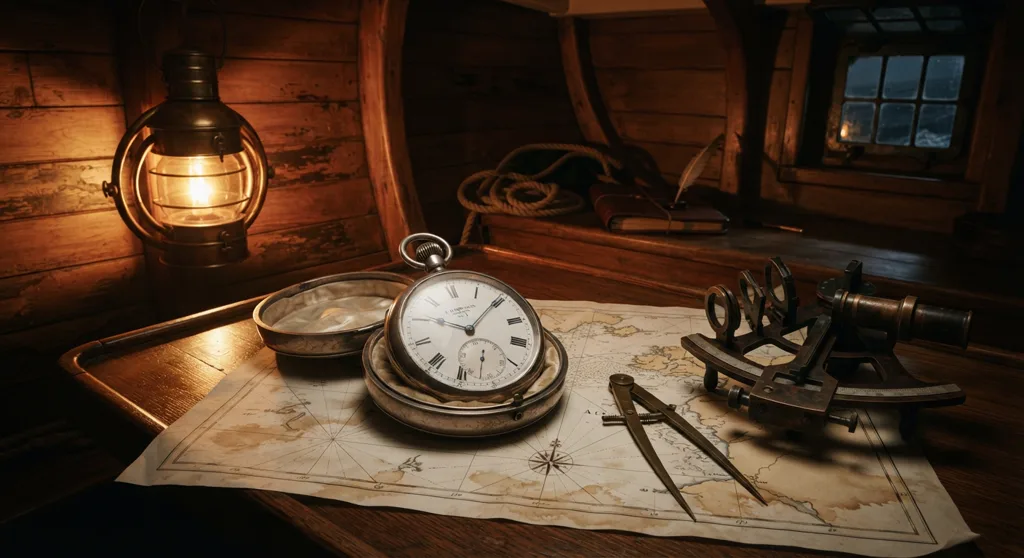
John Harrison builds a watch that keeps time accurately enough at sea to fix a ship's longitude, turning navigation from estimation into arithmetic and making a portable clock the most valuable instrument aboard.
Open in interactive timeline →Key Numbers
- Longitude Act Prize
- Up to £20,000 (1714)
- H4 Completed
- 1759, after six years
- Jamaica Voyage
- 81 days 5 hours, from 18 Nov 1761
- Error on Arrival
- 5 seconds slow (~1 nautical mile)
- Total Harrison Received
- £23,065
Verified Facts
- The 1714 Longitude Act offered up to £20,000 — about £3.83 million in 2025 terms — for a practical method of finding longitude at sea.
- Harrison’s H4 took six years to build and was completed in 1759, engraved with his signature and marked Number 1.
- H4 is not a boxed chronometer but a large watch.
- HMS Deptford sailed from Portsmouth on 18 November 1761 and reached Jamaica after 81 days and 5 hours.
- Corrected for its known rate, H4 was 5 seconds slow on arrival — an error of about 1.25 minutes of longitude, roughly one nautical mile.
- Harrison received £4,315 in increments from the Board of Longitude, £10,000 as an interim payment in 1765, and £8,750 from Parliament in 1773.
- His payments totalled £23,065 — more than the £20,000 headline prize, though he never won the prize itself.
Myth vs. Reality
Myth:
Reality: He never won the prize as such, but he was not left empty-handed. He received £4,315 from the Board of Longitude, £10,000 in 1765 and £8,750 from Parliament in 1773 — £23,065 in total, more than the headline prize.
Myth:
Reality: It was a clock problem. Latitude can be read from the sun’s height, but longitude requires knowing the time at a reference place at the moment of observation — and no clock could hold time on a rolling, damp, temperature-swinging ship.
Myth:
Reality: H4 is a large watch, not the boxed gimballed instrument the phrase "marine chronometer" usually calls to mind.
Frequently Asked Questions
Why was finding longitude at sea so hard?
Because it is a timekeeping problem rather than an observational one. Latitude can be taken from the height of the sun, but longitude requires comparing local time with the time at a known reference place. That demanded a clock that could keep accurate time through months of motion, damp and temperature change — something no clock could do before Harrison.
How accurate was H4 on its sea trial?
On the Jamaica voyage, HMS Deptford sailed from Portsmouth on 18 November 1761 and arrived after 81 days and 5 hours. Corrected for its known rate, H4 was 5 seconds slow — an error of roughly 1.25 minutes of longitude, or about one nautical mile.
Did John Harrison ever get the £20,000 prize?
Not as an award. He did, however, receive £4,315 in increments from the Board of Longitude, £10,000 as an interim payment for H4 in 1765, and £8,750 from Parliament in 1773 — £23,065 in all, which is more than the headline prize figure.
What does "chronometer" mean today?
On a modern watch it denotes a movement certified to meet a defined accuracy standard, which is a narrower and more bureaucratic meaning than Harrison’s sea-going instrument. It does not mean a stopwatch — that is a chronograph.
Sources & Further Reading
Cite This Page
AskHistoryAI. “Harrison's Sea Watch.” AskHistoryAI — Interactive Timeline of Everything. Updated 2026-10-20. https://askhistoryai.com/event/sv-marine-chronometer/
Every fact on this page is checked against the published fact ledger and methodology; sources are listed above.
More from this project
- Chronometer vs chronograph — what the words actually mean — The Horologist — Harrison’s word survives on watch dials, where it means a certified accuracy standard — not a stopwatch.
- What 200m water resistance really means — The Horologist — The other half of the sea-going instrument problem Harrison never had to solve.
The Horologist is another reference site by the same author.