René Descartes & "I Think, Therefore I Am"
The radical birth of modern Western philosophy.
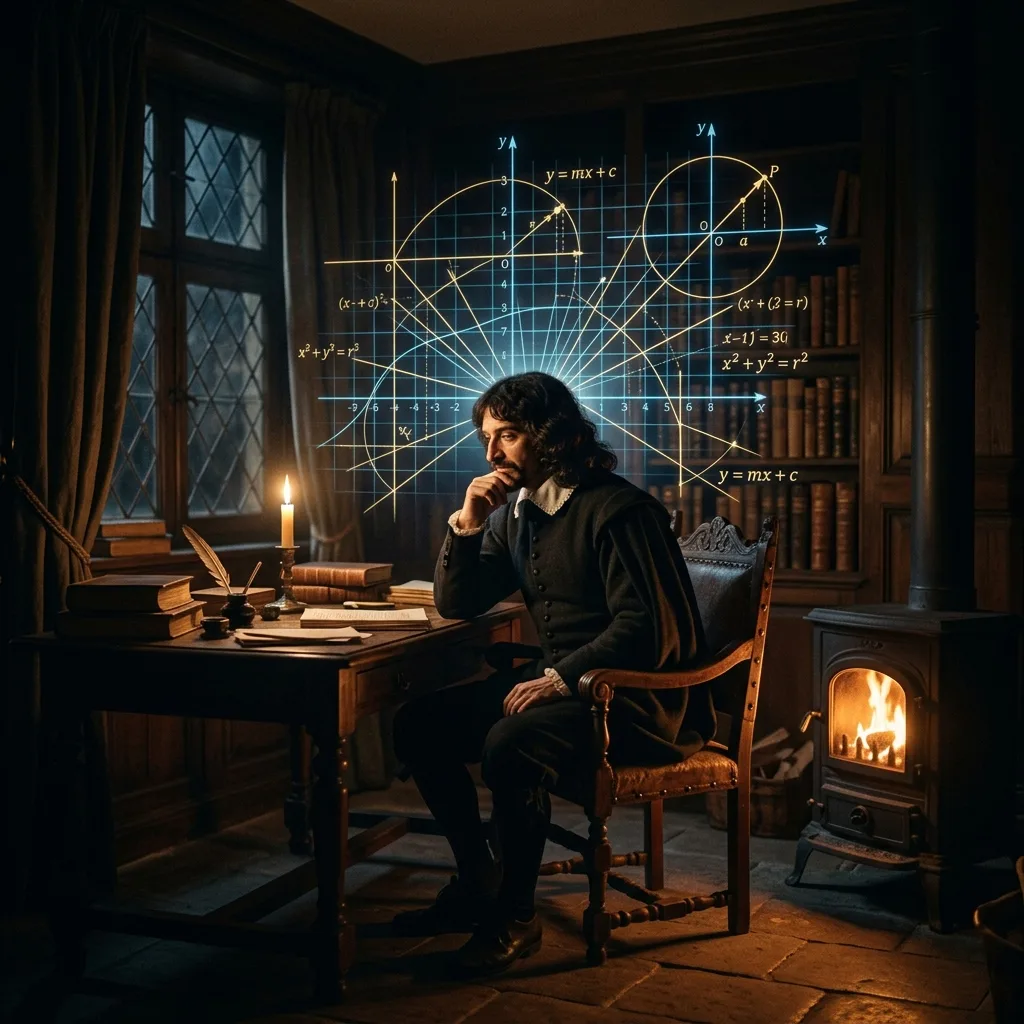
In his "Discourse on the Method", Descartes decides to doubt everything he has ever been taught—including his own senses—to see if any absolute truth remains. He hits bedrock with "Cogito, ergo sum" (I think, therefore I am).
Open in interactive timeline →Key Numbers
- Published
- 1637, Leiden (anonymously)
- Original language
- French, not Latin
- Parts in the Discourse
- 6
- Rules of the method
- 4
- Accompanying essays
- 3 (Optics, Meteorology, Geometry)
Verified Facts
- The full title is 'Discourse on the Method of Rightly Conducting One's Reason and of Seeking Truth in the Sciences' (Discours de la methode), published anonymously in Leiden in the Netherlands in mid-1637.
- Descartes wrote it in French rather than the scholarly Latin of the age deliberately, so that even the unlearned, women, and those guided only by their natural reason might read it, rather than only university scholars.
- The Discourse was actually a preface to three scientific essays meant to demonstrate his method in practice: 'La Dioptrique' (Optics), 'Les Meteores' (Meteorology), and 'La Geometrie' (Geometry).
- The appended 'La Geometrie' founded analytic geometry by uniting algebra and geometry, and gave rise to the Cartesian coordinate system, in which each point on a plane is fixed by two numbers.
- The most famous formulation, 'Je pense, donc je suis' ('I think, therefore I am'), appears in Part IV of the Discourse; the celebrated Latin 'Cogito, ergo sum' came later, with its earliest written form in the 1644 Principles of Philosophy.
- It opens with one of philosophy's most quoted lines: 'Good sense is, of all things among men, the most equally distributed,' arguing that reason is by nature equal in everyone and only our methods differ.
- Part II lays out four rules of method: accept nothing as true that is not evidently so; divide each difficulty into as many parts as possible; proceed from the simplest objects to the most complex; and make enumerations so complete and reviews so general as to be certain nothing was omitted.
- Descartes had earlier written a treatise, 'Le Monde' (The World), endorsing the heliocentric Copernican system, but suppressed it after learning of the Roman Inquisition's 1633 condemnation of Galileo; he wrote to Mersenne that if the Earth's motion were false, 'so too are the entire foundations of my philosophy.' Le Monde appeared only posthumously, in 1664.
- Born in 1596 in La Haye en Touraine, France (the town was later renamed Descartes in his honor), he died on 11 February 1650 in Stockholm of pneumonia at age 53, after Queen Christina of Sweden required pre-dawn philosophy lessons that strained his health.
- Despite his professed Catholic faith, Descartes's works were placed on the Catholic Church's Index of Prohibited Books in the 1660s, and France banned the teaching of Cartesianism in its schools in the 1670s.
The World at This Moment
The Discours de la méthode appeared at Leiden in June 1637, amid the Thirty Years' War that was devastating Central Europe and four years after the Roman Inquisition's 1633 condemnation of Galileo for defending Copernican heliocentrism. Descartes, a French Catholic, had settled in the more tolerant Dutch Republic, then in its commercial and intellectual golden age. Across the Channel, Charles I ruled England on the eve of civil war; the colony of Massachusetts Bay was barely seven years old. In science, William Harvey had published his account of blood circulation in 1628, Kepler had died in 1630 having issued his laws of planetary motion, and Galileo's telescopic discoveries had upended Aristotelian cosmology. Mersenne's Parisian circle of correspondents stitched this fragmented learned world together by letter. Bacon's Novum Organum (1620) had already called for a new inductive method. Descartes wrote in vernacular French rather than scholarly Latin, signaling an address to educated lay readers and a deliberate break from the Latin Schools then dominated by a revived Aristotelian Scholasticism.
The Paradigm Shift
The Discourse, prefacing three scientific essays (La Dioptrique, Les Météores, La Géométrie), made systematic methodical doubt the foundation of knowledge and located certainty in the thinking subject rather than in tradition, authority, or sense experience. Its formula "je pense, donc je suis" furnished an indubitable first principle from which Descartes rebuilt knowledge, inaugurating the epistemological turn that would define modern philosophy from Locke and Hume to Kant. By sharply distinguishing thinking substance from extended matter, it gave dualism its canonical form and licensed a mechanistic physics in which nature became res extensa, mathematically describable and free of occult qualities. La Géométrie wedded algebra to geometry, creating the analytic geometry whose coordinate methods underpinned Newtonian and Leibnizian calculus. Writing in French, Descartes helped pry natural philosophy loose from Latin Scholasticism and address a lay public. The work thus stands as a charter text of the Scientific Revolution and of rationalism, shifting authority from the inherited cosmos toward the autonomous reasoning individual.
In Their Own Words
"…remarquant que cette vérité: je pense, donc je suis, était si ferme et si assurée, que toutes les plus extravagantes suppositions des sceptiques n'étaient pas capables de l'ébranler, je jugeai que je pouvais la recevoir sans scrupule pour le premier principe de la philosophie que je cherchais." — René Descartes, Discours de la méthode (1637), Part IV
In Depth
The Method That Doubted Everything
In 1637, in the relative freedom of the Dutch Republic, a French expatriate named René Descartes published a slim, anonymous book in plain French rather than scholarly Latin: the Discourse on the Method of Rightly Conducting One's Reason and Seeking Truth in the Sciences. Printed in Leiden by the house of Elzevier, it carried three technical appendices — on optics, meteorology, and geometry. The book is remembered for four words, je pense, donc je suis — "I think, therefore I am" — but its deeper significance is that it proposed a procedure for reaching certainty by first doubting everything that could be doubted. Western thought has not fully climbed out of that act of demolition since.
The Preconditions of Doubt
Descartes did not invent skepticism from nothing. He inherited a civilization newly destabilized. The Italian Renaissance (sv-renaissance) had recovered ancient texts and revived the confidence that reason could rival the ancients; the Gutenberg press (sv-printing-press) had shattered the Church's monopoly on knowledge and let a 3,000-copy print run travel across borders. Martin Luther's Reformation (sv-martin-luther) had already taught Europe that an individual conscience could stand against received authority. And just years before the Discourse, the Church had condemned Galileo (sv-galileo) for following telescopic evidence over scripture — a trauma that made Descartes withhold his own physics treatise and seek refuge in cautious, methodical argument. His debt to antiquity ran deeper still: the rationalism of Plato (sv-plato), the mechanistic atomism of Democritus (sv-democritus), and the deductive architecture of Euclid (sv-euclid) all fed his conviction that truth should be built like geometry, from indubitable first principles outward.
Rebuilding the World as Mathematics
Descartes' second move was constructive. In La Géométrie, the appendix that most mathematicians actually remember, he fused algebra and geometry into analytic geometry — the coordinate system that still bears his name. A curve became an equation; space became number. This was not a side hobby but the heart of his vision: a universe legible as mathematics, matter as extension governed by deterministic law rather than Aristotelian purpose. That mechanistic picture handed the Scientific Revolution its operating assumption. Half a century later, Isaac Newton (sv-newton) would write the Principia using exactly the analytic and mechanical framework Descartes had laid down — even while rejecting Descartes' specific vortex physics. The Cartesian plane remains the silent grid beneath Faraday's fields (sv-michael-faraday), Maxwell's equations (sv-james-maxwell), and Einstein's spacetime (sv-einstein).
The Long Echo of the Cogito
The Discourse split the human being into thinking mind and mechanical body — the "Cartesian dualism" that organized centuries of debate about consciousness. That fault line runs straight into the present. When Darwin (sv-charles-darwin) folded humans back into the animal continuum, he attacked the special status of the Cartesian soul. When Nietzsche (sv-nietzsche) declared the death of God, he was demolishing the divine guarantor Descartes had smuggled back in to rescue knowledge from doubt. And the question Descartes raised — what is the relationship between thinking and being? — becomes literal once machines begin to think. The line from "I think, therefore I am" reaches Deep Blue (sv-deep-blue), the Transformer (sv-transformer-paper), and every modern system, like Claude Opus 4.5 (sv-claude-opus-45), that manipulates symbols well enough to make us ask whether something is "thinking" inside. Kurzweil's projected AGI (sv-kurzweil-agi-2029) is, in one sense, the Cartesian cogito turned into an engineering target.
Descartes' method — doubt the inherited, rebuild from clear foundations, express the world in mathematics — is the intellectual operating system of modernity. Its certainties were overstated, its dualism arguably a dead end. But the gesture of clearing the ground and demanding reasons remains the posture of every science, and of every machine we now build to reason in our place.
Causes & Consequences
What led to it
- Descartes was educated from around age ten at the Jesuit college of La Fleche, where his rigorous training in Scholastic Aristotelian philosophy and especially mathematics gave him both the tools and the dissatisfaction that drove his later search for a more certain method.
- The Renaissance revival of ancient skepticism, transmitted in part through Michel de Montaigne's Essais and its doubts about the reliability of the senses and human judgment, gave Descartes a model of systematic doubt that he transformed into a deliberate philosophical method.
- His own pioneering work in mathematics, including the analytic geometry he set out in La Geometrie (one of the 1637 essays appended to the Discourse), convinced him that the certainty of mathematical reasoning could serve as a template for all reliable knowledge.
- The Roman Inquisition's 1633 condemnation of Galileo for defending Copernican heliocentrism alarmed Descartes so deeply that he suppressed his own heliocentric treatise Le Monde and instead introduced his ideas cautiously through the Discourse, which he published anonymously in 1637.
- He chose to write the Discourse in vernacular French rather than scholarly Latin, deliberately reaching educated readers, including women, beyond the Latin-trained university establishment.
- The early-seventeenth-century crisis of authority, in which the fragmentation of Christendom after the Reformation and the perceived failure of Scholasticism left competing claims to truth, created the demand for a new, self-grounded foundation for knowledge that Descartes set out to supply.
What it set in motion
- The Discourse's method of systematic doubt, culminating in the cogito ('I think, therefore I am'), established the thinking, self-certain subject as the foundation of knowledge and is widely credited with inaugurating modern Western philosophy.
- Descartes' sharp separation of thinking mind from extended matter formulated the first influential modern version of mind-body dualism, which set the agenda for centuries of debate and remains a live reference point in today's philosophy of mind and consciousness studies.
- His rationalist program directly shaped the great seventeenth-century systems of Spinoza, who replaced Cartesian dualism with substance monism, and Leibniz, who answered it with his idealist monadology and pre-established harmony.
- The analytic geometry introduced alongside the Discourse united algebra and geometry through what became the Cartesian coordinate system, providing the mathematical language later essential to Newton, Leibniz, and the development of calculus and modern physics.
- His insistence on doubting received authority and accepting only clear and distinct ideas helped orient European thought away from Scholastic appeals to tradition and toward the autonomous reason prized by Enlightenment thinkers such as Voltaire and Kant.
- By framing the body, and later animals, as a kind of machine governed by mechanical laws, Descartes helped entrench the mechanistic conception of nature that underwrote modern science and, much later, informed mechanistic and computational metaphors for the human mind.
The Live Academic Debate
A central scholarly debate concerns the status of the "method" itself. Stephen Gaukroger and Geneviève Rodis-Lewis read the Discourse less as a finished epistemological treatise than as a preface salvaged from the abandoned physics of Le Monde, arguing Descartes's real commitments were to a comprehensive mechanistic science, with the famous four rules being relatively thin. Others, following Daniel Garber, emphasize the genuine continuity between method, metaphysics, and physics, treating the metaphysical foundations as load-bearing rather than ornamental. A further dispute, advanced by John Schuster and others, holds that Descartes's actual scientific practice (in optics and the rainbow) did not follow the announced method, which functioned more as rhetoric and self-fashioning than as procedure. Feminist and contextualist scholars (e.g., Susan Bordo) debate whether Cartesian dualism instituted a gendered, disembodied conception of reason. There is also ongoing argument over whether the cogito is an inference or an intuition—a problem Descartes himself addressed in replies to Mersenne and Gassendi—and over how autobiography functions in the text's persuasive strategy.
How This Event Connects
René Descartes & "I Think, Therefore I Am" marks a profound epistemological rupture in Western philosophy, fundamentally shifting the basis of knowledge from external scholastic authority to internal, rational deduction. This radical re-centering of the thinking subject paralleled and provided the philosophical framework for the empirical and mathematical challenges to Aristotelian physics championed by Galileo Galilei.
Descartes' insistence on a mechanistic universe, governed by geometric laws rather than mystical forces, laid the crucial philosophical and mathematical groundwork for Isaac Newton & the Principia. While Newton would later discard Descartes' specific physical theories (like vortices), the Cartesian coordinate system and the broader mechanistic paradigm were essential for Newton's formulation of universal gravitation and classical mechanics.
Historiographically, Descartes' radical doubt and quest for undeniable foundational truths represent a return to, and a modern reimagining of, the epistemological debates initiated by Plato & The Academy. By discarding sensory illusion in favor of pure rational intellect, Descartes echoed Platonic idealism, but reoriented it to serve as the rigorous, mathematical foundation for the modern Scientific Revolution.
The Counterfactual
Had Descartes published his suppressed Le Monde (withheld after Galileo's 1633 condemnation), the methodological and metaphysical framing of the Discourse might never have crystallized; the Discourse was in part a strategic substitute, presenting method and selected results while shelving the openly Copernican cosmology. Yet the broader Cartesian rupture was overdetermined: Bacon, Galileo, Mersenne, and Hobbes were already advancing mechanism and method, so some version of the mathematized, anti-Scholastic program would likely have emerged regardless. What might have been lost is the specific dualist architecture and the cogito's framing of certainty in subjectivity—the inward, foundationalist turn that shaped Spinoza, Malebranche, Leibniz, and ultimately Kant's critical project. Counterfactually, philosophy might have developed along more empiricist or materialist lines, as Hobbes pressed, with the mind-body problem posed differently or less acutely. Without La Géométrie's coordinate methods, analytic geometry would presumably still have arisen (Fermat developed comparable techniques independently), but the canonical notation and pedagogy might differ.
Myth vs. Reality
Myth: Descartes wrote "Cogito, ergo sum" ("I think, therefore I am") in Latin in his Meditations.
Reality: The famous formulation actually first appeared in French as "Je pense, donc je suis" in the Discourse on the Method (1637). The Latin "Cogito, ergo sum" comes from his later Principles of Philosophy (1644). In the Meditations on First Philosophy (1641), Descartes deliberately avoided that wording, using instead "Ego sum, ego existo" ("I am, I exist")—reportedly because the "ergo" wrongly implied a formal logical inference rather than the immediate, self-evident intuition he intended.
Myth: Descartes published the Discourse on Method as a standalone philosophical treatise under his own name.
Reality: The 1637 work was published anonymously and served as the preface to three accompanying scientific essays: the Optics (Dioptrique), the Meteorology (Meteores), and the Geometry (Geometrie). Descartes withheld his name hoping to reach an open-minded lay audience and to gauge reception of his ideas. Its full title is Discourse on the Method of Rightly Conducting One's Reason and of Seeking Truth in the Sciences.
Myth: The Discourse on Method is a dry, systematic philosophical argument.
Reality: It is largely autobiographical and written in an accessible, personal style. Descartes narrates his own intellectual development—his disillusionment with formal schooling, his travels, and the famous day of solitary reflection "in a stove-heated room"—to explain how he arrived at his method. Notably, it was written in French rather than the scholarly Latin of the era, deliberately aimed at ordinary readers who possessed "good sense" (le bon sens), which the opening line calls the most evenly distributed thing in the world.
Myth: Descartes was a skeptic who doubted everything and concluded we cannot know anything for certain.
Reality: Descartes used doubt only as a methodological tool, not as a destination. He explicitly distinguished himself from "the sceptics, who doubt only for the sake of doubting," stating his aim was "to reach certainty—to cast aside the loose earth and sand so as to come upon rock or clay." His hypothetical, systematic doubt was a strategy to clear away unreliable beliefs and find an indubitable foundation for knowledge—the opposite of embracing skepticism as a permanent stance.
Myth: Descartes single-handedly invented the modern Cartesian coordinate system—the familiar grid of perpendicular x- and y-axes.
Reality: The Geometrie (1637) introduced the union of algebra and geometry, but it contains no modern coordinate grid: Descartes used line segments rather than a pair of fixed perpendicular axes, did not measure perpendicularly, and did not conceive of points as ordered number pairs. The grid we now call "Cartesian" was developed by later mathematicians. Moreover, Pierre de Fermat independently developed an essentially equivalent analytic geometry in his manuscript Ad Locos Planos et Solidos Isagoge (composed by 1636, circulated before Descartes published), making him a co-founder of the field.
Frequently Asked Questions
What is Descartes' Discourse on Method, and when was it published?
The Discourse on Method is a 1637 philosophical and autobiographical work by the French thinker René Descartes (1596–1650), whose full title was Discourse on the Method of Rightly Conducting One's Reason and Seeking Truth in the Sciences (Discours de la méthode). It was published anonymously in Leiden, in the Dutch Republic, as a preface to three accompanying scientific essays. Written in everyday French rather than scholarly Latin, it aimed to reach an open-minded lay readership and is regarded as a foundational text of modern Western philosophy and science.
Does the phrase 'I think, therefore I am' come from the Discourse on Method?
Yes. Descartes first published the idea in French as 'Je pense, donc je suis' in the Discourse on Method (1637), in Part Four. The famous Latin form 'Cogito, ergo sum' appeared later, in his Principles of Philosophy (1644). The statement marks the one truth Descartes felt he could not doubt: even if he doubts everything, the very act of thinking proves that he, the thinker, exists.
What are Descartes' four rules of method?
In Part Two of the Discourse, Descartes lays out four rules for guiding reason. First, accept nothing as true unless it is clearly and distinctly known to be so, avoiding hasty judgment. Second, divide each difficulty into as many parts as possible. Third, proceed in order from the simplest objects to the more complex. Fourth, make enumerations and reviews so complete that nothing is omitted. These rules distilled the rigor he admired in mathematics into a general method for seeking truth.
Why did Descartes write the Discourse in French instead of Latin?
Latin was the standard language of scholarship in 17th-century Europe, but Descartes deliberately chose vernacular French to reach educated general readers rather than only university-trained academics. He wanted his method judged by natural reason — by 'good sense,' which the Discourse famously opens by calling the most evenly distributed thing in the world — rather than by appeal to traditional authority. This choice helped make the Discourse one of the first major philosophical works composed in French and broadened its influence.
What were the three essays published with the Discourse on Method?
The Discourse was originally issued as an introduction to three scientific treatises meant to demonstrate his method in practice: the Optics (Dioptrique), the Meteorology (Météores), and the Geometry (Géométrie). The Geometry was especially important, introducing ideas that helped found analytic geometry by linking algebra with geometric curves. Together the essays were intended to show that the method could yield concrete results across the sciences.
How did Galileo's condemnation affect the Discourse on Method?
In 1633 Descartes learned that the Inquisition in Rome had condemned Galileo for defending the view that the Earth moves around the Sun. Alarmed, Descartes withheld his own cosmological treatise, The World (Le Monde), which contained heliocentric and mechanistic ideas. The Discourse on Method, published a few years later in 1637, presented his philosophical and methodological ideas while prudently avoiding the openly controversial physics that had endangered Galileo.
Why is Descartes called the 'father of modern philosophy'?
Descartes earned the title largely by breaking with the prevailing Scholastic and Aristotelian tradition and grounding knowledge in systematic doubt and individual reason rather than inherited authority. His method of radical doubt, his cogito, and his mind-body dualism reframed core questions in epistemology and the philosophy of mind. These ideas helped launch the rationalist tradition and influenced later thinkers such as Spinoza, Leibniz, and Kant, shaping the course of modern Western thought.
Sources & Further Reading
- Discourse on the Method — Wikipedia
- Stephen Gaukroger, Descartes: An Intellectual Biography (Oxford: Clarendon Press, 1995)
- Geneviève Rodis-Lewis, Descartes: His Life and Thought, trans. Jane Marie Todd (Cornell University Press, 1998)
- Daniel Garber, Descartes' Metaphysical Physics (University of Chicago Press, 1992)
- Desmond M. Clarke, Descartes: A Biography (Cambridge University Press, 2006)
- Gary Hatfield, 'René Descartes', Stanford Encyclopedia of Philosophy
- Wikipedia: René Descartes
Cite This Page
AskHistoryAI. “René Descartes & "I Think, Therefore I Am".” AskHistoryAI — Interactive Timeline of Everything. Updated 2026-09-11. https://askhistoryai.com/event/sv-descartes/
Every fact on this page is checked against the published fact ledger and methodology; sources are listed above.