Galileo Galilei & The Telescope
The birth of observational astronomy and the wrath of the Inquisition.
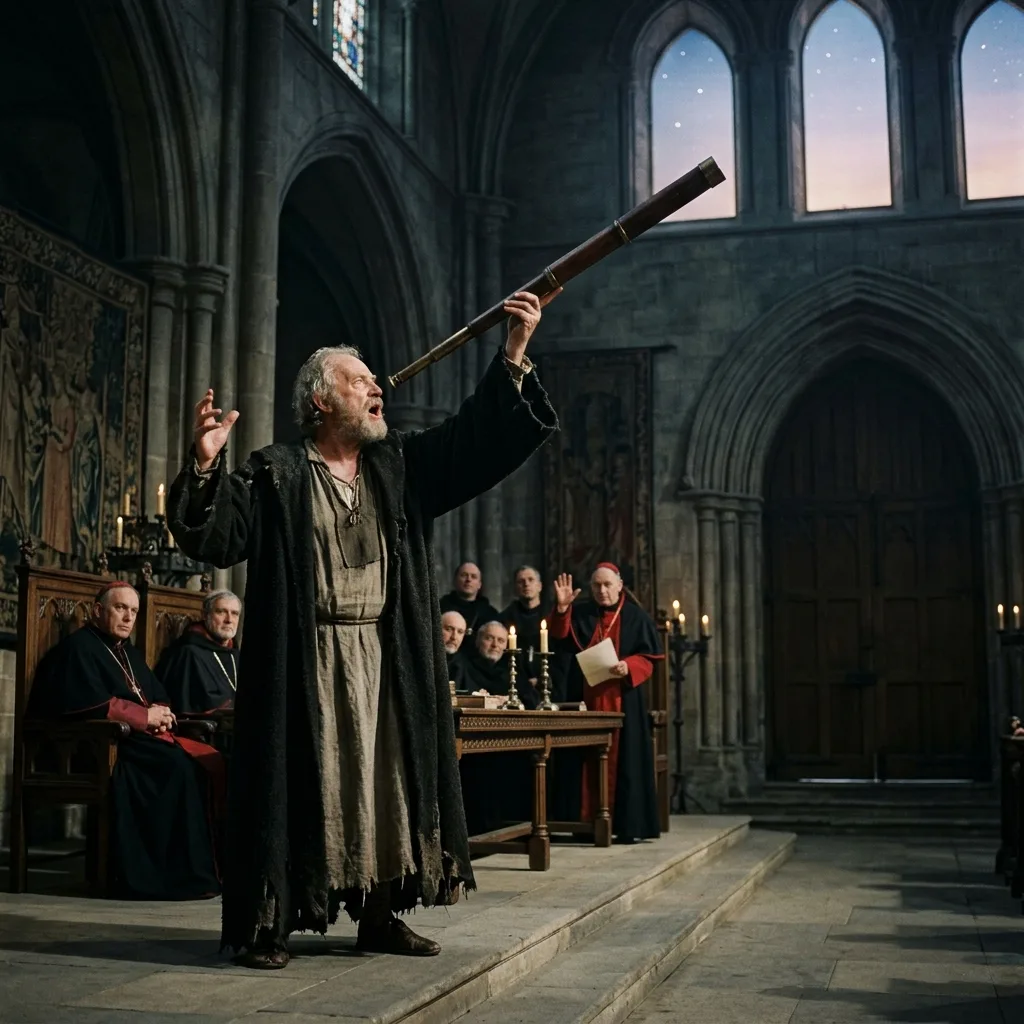
Italian astronomer Galileo Galilei dramatically improves the telescope, observing the moons of Jupiter and the phases of Venus. This definitively proves the Earth orbits the Sun, leading to his legendary trial and house arrest by the Catholic Inquisition.
Open in interactive timeline →Key Numbers
- Telescope magnification
- ~3x to 30x
- Jupiter's moons found
- 4 (Jan 1610)
- Sidereus Nuncius published
- March 1610
- Heresy conviction
- June 22, 1633
- Church rehabilitation
- 1992 (359 yrs later)
Verified Facts
- Galileo did not invent the telescope: the Dutch spectacle-maker Hans Lipperhey applied for a patent on a 'looking glass' in October 1608. Hearing of the device in 1609, Galileo built his own and crucially turned it toward the night sky, becoming the first to systematically publish astronomical observations made through one.
- Galileo's telescopes were primitive by modern standards. His first instruments magnified only about 3x; he refined them to roughly 20x for his key 1609-1610 observations and eventually reached about 30x, though with a very narrow field of view.
- Beginning around November 30, 1609, Galileo sketched the Moon and argued from the shifting pattern of light and shadow near the terminator that it had mountains and craters, shattering the ancient belief in a perfectly smooth, perfect celestial sphere.
- On the night of January 7, 1610, Galileo observed three (and within days a fourth) 'stars' near Jupiter that moved with the planet; he correctly concluded they were moons orbiting Jupiter, proving Earth was not the unique center around which all bodies revolve.
- Galileo published these findings in March 1610 in 'Sidereus Nuncius' (The Starry Messenger), the first scientific work based on telescopic observation. He named Jupiter's moons the 'Medicean Stars' to flatter Cosimo II de' Medici, Grand Duke of Tuscany, a bid that helped win him a court appointment in Florence.
- The four moons are known today as Io, Europa, Ganymede, and Callisto, names proposed by rival astronomer Simon Marius (Simon Mayr), not by Galileo himself.
- In late 1610 Galileo observed that Venus showed a full cycle of phases like the Moon, including a 'full' gibbous phase, which was impossible under the strict Ptolemaic geocentric model and provided strong observational support for a Sun-centered (or at least Tychonic) arrangement.
- Galileo's heliocentric advocacy led to his 1633 trial by the Roman Inquisition over his 'Dialogue Concerning the Two Chief World Systems.' On June 22, 1633 he was found 'vehemently suspect of heresy,' forced to formally abjure, and sentenced to indefinite house arrest, which he served at his villa in Arcetri near Florence until his death.
- The famous defiant phrase 'E pur si muove' ('And yet it moves'), supposedly muttered after his recantation, is almost certainly apocryphal; it appears in no trial record and surfaces only in biographies more than a century later (by the 1750s-1760s).
- Galileo (1564-1642) spent his final years under house arrest and went blind around 1638. In 1992, after a study commission Pope John Paul II had convened in 1979, the Vatican formally acknowledged the errors of the judges who condemned him, effectively rehabilitating Galileo 359 years after his conviction.
The World at This Moment
When Galileo turned his improved spyglass skyward in late 1609, Europe was politically tense and intellectually restless. The Twelve Years' Truce (1609) had just paused the Dutch-Spanish war; it was in that Dutch milieu that Hans Lipperhey filed his 1608 spyglass patent. In May 1610, weeks after Sidereus Nuncius appeared, Henry IV of France was assassinated by Ravaillac, destabilizing northern Europe ahead of the Thirty Years' War (1618). In Prague, Johannes Kepler—imperial mathematician to Rudolf II—had just published Astronomia Nova (1609) with its first two laws of planetary motion, and quickly endorsed Galileo in his Dissertatio cum Nuncio Sidereo. Beyond Europe, Jahangir ruled the Mughal Empire, the Ming under the Wanli Emperor were drifting toward crisis, the Ottomans under Ahmed I were suppressing the Celali revolts in Anatolia, and Tokugawa Ieyasu was consolidating Japan. Counter-Reformation Rome, fresh from burning Giordano Bruno (1600), policed cosmological speculation. Galileo's discoveries thus landed in a Europe primed for both Copernican controversy and confessional anxiety.
The Paradigm Shift
Galileo did not invent the telescope, but he transformed it from a Dutch novelty into an instrument of natural philosophy, and in doing so collapsed the Aristotelian boundary between an incorruptible heavens and a corruptible Earth. The mountainous, cratered Moon, Jupiter's four orbiting satellites (the Medicean Stars, first seen January 1610), the Milky Way resolved into countless stars, and—soon after—the phases of Venus furnished empirical anomalies geocentrism could not absorb. Venus's full phase cycle was decisive: it was incompatible with Ptolemy, though consistent with both the Copernican and Tychonic systems. The deeper rupture was epistemological. Galileo asserted that an instrument-aided eye, not received authority or unaided sense, could adjudicate cosmological truth, inaugurating a culture of instrumented, mathematized observation. Sidereus Nuncius (March 1610) modeled rapid, illustrated publication of fresh data. As Stillman Drake and others argue, Galileo thereby helped shift natural philosophy from textual commentary toward experimental, evidence-driven inquiry—a foundational move toward the methods later codified by Newton and the Royal Society.
In Their Own Words
"The galaxy is, in fact, nothing but a congeries of innumerable stars grouped together in clusters. Upon whatever part of it the telescope is directed, a vast crowd of stars is immediately presented to view." — Galileo Galilei, Sidereus Nuncius (The Starry Messenger), Venice, 1610; Albert Van Helden translation (University of Chicago Press, 1989)
the surface of the Moon is not perfectly smooth, free from inequalities and exactly spherical, as a large school of philosophers considers with regard to the Moon and the other heavenly bodies, but that, on the contrary, it is full of inequalities, uneven, full of hollows and protuberances, just like the surface of the Earth itself, which is varied everywhere by lofty mountains and deep valleys.
Galileo Galilei, Sidereus Nuncius (The Sidereal Messenger), 1610; quoted from the public-domain English translation by Edward Stafford Carlos (1880). These are Galileo's own words from the treatise. — source
On the 7th day of January in the present year, 1610, in the first hour of the following night, when I was viewing the constellations of the heavens through a telescope, the planet Jupiter presented itself to my view, and as I had prepared for myself a very excellent instrument, I noticed a circumstance which I had never been able to notice before, owing to want of power in my other telescope, namely, that three little stars, small but very bright, were near the planet
Galileo Galilei, Sidereus Nuncius, 1610 (Carlos 1880 translation), describing his first sighting of what became the Medicean Stars / four moons of Jupiter. Galileo's own words. — source
With sincere heart and unfeigned faith I abjure, curse, and detest the aforesaid errors and heresies, and generally every other error, heresy, and sect whatsoever contrary to the said Holy Church
Galileo Galilei, Abjuration before the Roman Inquisition, recited at the Convent of Minerva, Rome, 22 June 1633 (standard English translation of the trial document). Galileo's own forced recantation; corroborated across independent transcriptions (Famous Trials / UMKC and Ohio State HTI documentary edition). — source
In Depth
The Night the Heavens Stopped Being Perfect
When Galileo Galilei turned a refined spyglass toward the sky in the winter of 1609 and published the results in Sidereus Nuncius (the Starry Messenger) in March 1610, he did something stranger than discovering new objects. He demolished a metaphysics. For two millennia, the cosmos had been split in two: a corruptible, changeable Earth below, and incorruptible, perfect spheres above — a division systematized by Aristotle (sv-aristotle) and woven so deeply into medieval Christendom that Augustine of Hippo (sv-augustine) and the later Scholastics treated it as nearly synonymous with the order of creation. Galileo's lens showed mountains and craters on the Moon, spots on the Sun, four moons circling Jupiter, and — most damningly — the full set of phases of Venus, which Ptolemaic geocentrism could not produce. The heavens were lumpy, busy, and material. They obeyed the same physics as a thrown stone.
Deep Preconditions
Galileo did not arrive from nowhere. His instrument was a Dutch optical novelty refined by a mind trained in the mathematical tradition that ran from Euclid (sv-euclid) and Archimedes (sv-archimedes) through the recovered learning of the Italian Renaissance (sv-renaissance). His ambition to publish fast and in the vernacular was made possible by the Gutenberg press (sv-printing-press), which turned a private observation into a continent-wide sensation within weeks. And his willingness to trust the senses over inherited authority drew on the same humanist confidence that animated Leonardo da Vinci (sv-leonardo-da-vinci) and, in religion, the defiance of Martin Luther (sv-martin-luther). The Copernican hypothesis he championed was decades old; what Galileo added was evidence you could look at.
The Collision and Its Cost
That evidence collided with power. In 1632 Galileo published the Dialogue Concerning the Two Chief World Systems, putting the geocentric arguments — some of them the Pope's own — in the mouth of a character named Simplicio. In 1633 the Roman Inquisition found him "vehemently suspect of heresy," forced his recantation on his knees, and placed him under house arrest until his death in 1642. The Dialogue stayed on the Index of Forbidden Books until 1835. The Galileo affair became the founding myth of the conflict between empirical inquiry and dogma — a cautionary tale about institutions that try to legislate what the universe is allowed to be.
Ripple Effects
Yet the recantation was a tactical loss inside a strategic victory. Galileo's insistence that nature is "written in the language of mathematics" became the operating premise of modern science. René Descartes (sv-descartes), who shelved his own cosmology in fright at Galileo's sentence, nonetheless built a method on mechanical, quantitative reasoning. Within a lifetime Isaac Newton (sv-newton) united Galileo's terrestrial mechanics with Kepler's celestial orbits into a single law of universal gravitation — finishing the demolition by proving the same force pulls an apple and steers the Moon. From there the line runs straight: through the Industrial Revolution (sv-industrial-revolution) that mechanized Galileo's physics, through Albert Einstein (sv-einstein) — who called him the father of modern science — and ultimately to Apollo 11 (sv-apollo11), when humans stood on the cratered Moon Galileo had first seen as a world.
There is a longer arc still. By insisting the cosmos is intelligible matter rather than divine perfection, Galileo opened the path on which Charles Darwin (sv-charles-darwin) would naturalize life and on which our own age would naturalize mind. The telescope was the first instrument to extend human perception beyond the body's limits; the project it began — building machines that see and reason further than we can — now points toward the dawn of AGI (sv-ai-dawn). Galileo cracked the crystalline spheres, and we have been falling outward through the gap ever since.
Causes & Consequences
What led to it
- The grinding of convex and concave spectacle lenses, a craft that emerged in Italy around the 1280s and matured among the Murano glassmakers of Venice, created the optical components and lens-grinding skills on which any refracting telescope depended.
- In October 1608 the Middelburg spectacle-maker Hans Lipperhey applied to the Dutch States General for a patent on an instrument 'for seeing things far away as if they were nearby,' establishing the basic spyglass design of a convex objective and concave eyepiece that magnified about three times.
- News of the Dutch spyglass spread rapidly across Europe through diplomatic reports in 1608-1609, reaching figures such as Paolo Sarpi in Venice, which is how Galileo learned of the device and was prompted to build and improve his own version reaching roughly 20x magnification by late 1609.
- Nicolaus Copernicus's 'De Revolutionibus Orbium Coelestium' (1543) had already proposed a sun-centered cosmos, giving Galileo a rival theoretical framework whose specific predictions, like the phases of Venus, his telescopic observations could later test.
- Johannes Kepler's work on optics and planetary motion, including his correspondence with Galileo and his analysis of how lenses form images, provided a developing theoretical context for understanding and trusting what the new instrument revealed.
- A culture of wealthy patronage in Italy, embodied by the Medici court in Florence, gave Galileo the financial support and incentive to pursue astronomy, which is why he named Jupiter's moons the 'Medicean Stars.'
What it set in motion
- Galileo's 'Sidereus Nuncius' (March 1610) reported mountains and craters on the Moon, hundreds of previously unseen stars, and four moons orbiting Jupiter, becoming the first scientific work based on telescopic data and demonstrating that the heavens were neither perfect nor centered solely on Earth.
- His subsequent observation that Venus shows a full cycle of phases provided direct observational evidence incompatible with the pure Earth-centered Ptolemaic system, strengthening the empirical case for a sun-centered arrangement.
- The telescope established direct observation and instrument-aided empiricism as central to astronomy, shifting the discipline from chart-making toward discovery and helping to drive the broader Scientific Revolution.
- Galileo's public advocacy for Copernicanism led to his 1632 'Dialogue Concerning the Two Chief World Systems' and his 1633 condemnation by the Roman Inquisition, ending in abjuration and lifelong house arrest, an episode that became a lasting symbol of conflict between scientific inquiry and institutional authority.
- His pioneering use of the telescope opened a continuous tradition of instrument-driven astronomy, leading to ever-larger and more powerful telescopes that would eventually reveal the structure of the galaxy and the wider universe.
- The combination of Galileo's observational mechanics and Kepler's laws of planetary motion provided the empirical foundation that Isaac Newton synthesized in his 'Principia' (1687), unifying celestial and terrestrial physics under universal gravitation.
The Live Academic Debate
A live debate concerns why Galileo built and deployed the telescope, and why he ultimately fell. Richard Westfall's "Science and Patronage: Galileo and the Telescope" (Isis, 1985) argued that securing position at the Tuscan court—not pure astronomy—drove Galileo's instrument strategy, naming Jupiter's moons after the Medici. Mario Biagioli (Galileo, Courtier, 1993) radicalized this, reading all of Galileo's post-1610 science as the self-fashioning of a courtier within absolutist patronage, framing even his 1633 condemnation as the conventional "fall of a favorite." Against such social-constructionist readings, Stillman Drake stressed Galileo's genuine empirical and religious commitments, while Pietro Redondi (Galileo Heretic, 1987) controversially relocated the real charge to Galileo's atomism and its threat to Eucharistic doctrine—an interpretation many historians find underdetermined by the evidence. Critics of Biagioli, including Michael Shank, charge that patronage analysis risks dissolving the cognitive content of Galileo's science into pure sociology. The methodological tension—internalist accomplishment versus externalist context—remains unresolved.
How This Event Connects
Galileo Galilei stands at the epicenter of the Scientific Revolution, challenging the traditional Aristotelian worldview through a complex synthesis of empirical observation and courtly patronage deeply rooted in the Italian Renaissance. His use of the telescope was not merely a passive observation but a highly calculated political act, weaponizing early instrumentation to secure prestige and challenging the epistemological boundaries of what constituted definitive proof.
The intellectual rupture initiated by Galileo's defense of heliocentrism and his insistence on mathematical models of the physical universe laid the indispensable groundwork for Isaac Newton & the Principia. Newton's grand synthesis of classical mechanics would ultimately validate Galileo's intuition, transforming localized, highly contested observations into universal, mathematical laws of nature.
Crucially, the "Galileo Affair" must also be understood in the context of the institutional paranoia generated by Martin Luther & The Reformation. The Inquisition's aggressive response to Galileo was less a pure rejection of science than an embattled Papacy asserting strict absolute authority during the traumatic political and religious crises of the Thirty Years' War, highlighting the profound intersection of scientific epistemology and religious geopolitics.
The Galileo affair as more than 'science vs. religion'
Historian Maurice A. Finocchiaro, the leading documentary scholar of the trial, argues the 1633 condemnation cannot be reduced to a simple clash of science against faith. The real seventeenth-century conflict, he shows, pitted conservative against innovative forces across several domains at once: astronomical observation, the physics of motion, philosophical principles about the nature of knowledge, and theological principles about the authority and interpretation of Scripture. From the Church's side the dispute also turned on who held the right to reinterpret the Bible in light of new and still-contested evidence, not merely on whether the Earth moved. Finocchiaro notes the original controversy spawned a second one, still alive today, over whether the case really proves science and religion are incompatible.
The Counterfactual
Had Galileo never built his telescope, the instrument itself would still have spread: Lipperhey, Janssen, and Metius had already disseminated the Dutch spyglass by 1608, and Thomas Harriot mapped the Moon telescopically in mid-1609, slightly before Galileo. Telescopic discovery of Jupiter's moons and lunar relief was thus, in some form, nearly inevitable within a few years. What was contingent was the constellation of Galileo's polemical genius, vernacular Italian advocacy, and Medici patronage that made Copernicanism a public European cause. Without Galileo's combative campaigning, the heliocentric debate might have remained a quieter, more technical affair among mathematicians like Kepler—whose physics arguably mattered more—delaying the dramatic confrontation with Rome. The 1616 condemnation and 1633 trial, which made Galileo a symbol of science-versus-dogma, might never have crystallized as they did. The scientific results would likely have arrived; their explosive cultural and institutional meaning, and the iconic martyrdom narrative, were far more dependent on Galileo's particular character and choices.
Myth vs. Reality
Myth: Galileo invented the telescope.
Reality: He did not. The telescope emerged in the Netherlands around 1608, with Hans Lippershey filing the first known patent application that year. Galileo, hearing of the device in 1609, built his own improved version and turned it to the sky. His achievement was to construct a superior instrument (eventually reaching about 20x to 30x magnification) and to use it for systematic, published astronomical observation, not to invent it.
Myth: Galileo was the first person ever to point a telescope at the heavens.
Reality: The English astronomer and mathematician Thomas Harriot drew the Moon through a telescope on 26 July 1609, roughly four months before Galileo's own lunar observations, and later produced detailed Moon maps. Galileo's priority comes from publishing his findings in 'Sidereus Nuncius' (1610) and pursuing them aggressively; Harriot never published his drawings, so he is largely forgotten despite observing first.
Myth: Galileo was imprisoned in a dungeon and tortured by the Inquisition.
Reality: He was neither. As historian Maurice Finocchiaro and the 'Galileo Goes to Jail' essay collection document from the trial records, Galileo faced only the formal verbal threat of torture, which the pope ordered stopped short of any physical act, a routine limitation given his age and ill health. After his 1633 condemnation he was placed under comfortable house arrest, not jailed in a cell, spending his final years at his villa in Arcetri. The torture and prison stories spread because the full trial evidence was not public for over a century.
Myth: On leaving his trial Galileo muttered 'And yet it moves' (Eppur si muove) in defiance.
Reality: There is no contemporary evidence he said this. The phrase first appears in print in Giuseppe Baretti's 'The Italian Library' in 1757, more than a century after the 1633 trial and 115 years after Galileo's death. It appears in none of the trial records or Galileo's own writings. Historians treat it as a later legend; saying it aloud before the Inquisition would also have been reckless and is not how the cautious Galileo behaved.
Myth: Galileo's telescope gave him decisive proof that the Earth orbits the Sun.
Reality: It did not, and this is partly why the Church demanded he treat heliocentrism as hypothesis rather than fact. His observations (Jupiter's moons, Venus's phases) refuted the pure Ptolemaic system but were compatible with rival models like Tycho Brahe's. His own favored 'proof,' an argument from the tides, was mistaken (he wrongly assumed one tide per day). Real physical confirmation came much later: stellar aberration (Bradley, 1729), stellar parallax (Bessel, 1838), and the Foucault pendulum (1851).
Frequently Asked Questions
Did Galileo invent the telescope?
No. The telescope is generally credited to the Dutch spectacle-maker Hans Lippershey, who applied to the States General of the Netherlands for a patent on his "instrument for seeing things far away as if they were nearby" in October 1608. In 1609 Galileo learned of the device, built his own improved versions, and became the first person to systematically turn one toward the night sky. So his fame rests not on inventing the telescope but on dramatically improving it and using it for astronomy.
What did Galileo discover with his telescope?
Beginning in late 1609 and through 1610, Galileo observed that the Moon was rough and cratered rather than a perfect sphere, that the Milky Way was made of countless individual stars, and that Jupiter had four moons orbiting it (now called the Galilean moons), which he first spotted in January 1610. He later observed that Venus goes through a full set of phases like the Moon, and he studied sunspots. He published the lunar and Jovian findings in his 1610 book Sidereus Nuncius ("Starry Messenger").
How powerful was Galileo's telescope?
Galileo's earliest telescope in the summer of 1609 magnified only about 3 times. He rapidly improved the design, reaching roughly 8x and then about 20x by the time he made his major discoveries in early 1610, and eventually up to around 30x before optical distortion became too severe. These were narrow-field refracting telescopes with a convex objective lens and a concave eyepiece, far weaker than modern instruments but revolutionary for their day.
How did Galileo's discoveries support Copernicus and heliocentrism?
The four moons orbiting Jupiter proved that not everything in the heavens circles the Earth, undermining a core assumption of the Earth-centered Ptolemaic system. Even more decisively, Galileo's observation that Venus shows a full cycle of phases (from crescent to nearly full) was impossible under the strict Ptolemaic model but consistent with Venus orbiting the Sun. Historians note, however, that the phases of Venus were also compatible with Tycho Brahe's geo-heliocentric model, so they refuted Ptolemy without single-handedly proving Copernicus correct.
Why was Galileo put on trial by the Catholic Church?
In 1616 Church authorities declared the idea of a moving Earth and stationary Sun "formally heretical" as a literal claim, and Galileo was warned not to hold or defend it. After he published his Dialogue Concerning the Two Chief World Systems in 1632, which strongly favored Copernicanism, he was summoned to Rome. The Roman Inquisition tried him in 1633 and, on June 22, found him guilty of "vehement suspicion of heresy," forcing him to kneel and abjure his views. He spent his remaining years, until his death in January 1642, under house arrest at his villa in Arcetri near Florence.
Did the Catholic Church ever apologize for the Galileo trial?
Yes, though long after the fact. In 1979 Pope John Paul II called for a re-examination of the case, and a commission studied it for roughly a decade. On October 31, 1992, the pope formally acknowledged that the Church had erred, describing the affair as a "tragic mutual incomprehension" between faith and science, and noting that Galileo, a sincere believer, had understood scriptural interpretation better than many of his theological opponents.
Sources & Further Reading
- Galileo Galilei — Wikipedia
- Albert Van Helden (trans.), Galileo, Sidereus Nuncius, or The Sidereal Messenger (University of Chicago Press, 1989)
- Richard S. Westfall, 'Science and Patronage: Galileo and the Telescope,' Isis 76 (1985)
- Mario Biagioli, Galileo, Courtier: The Practice of Science in the Culture of Absolutism (University of Chicago Press, 1993)
- Stillman Drake, Galileo at Work: His Scientific Biography (University of Chicago Press, 1978)
- Pietro Redondi, Galileo Heretic (Princeton University Press, 1987)
- Stanford Encyclopedia: Galileo
Cite This Page
AskHistoryAI. “Galileo Galilei & The Telescope.” AskHistoryAI — Interactive Timeline of Everything. Updated 2026-09-11. https://askhistoryai.com/event/sv-galileo/
Every fact on this page is checked against the published fact ledger and methodology; sources are listed above.