The First True Mammals
Our tiny, shrew-like ancestors hiding in the shadows of the dinosaurs.
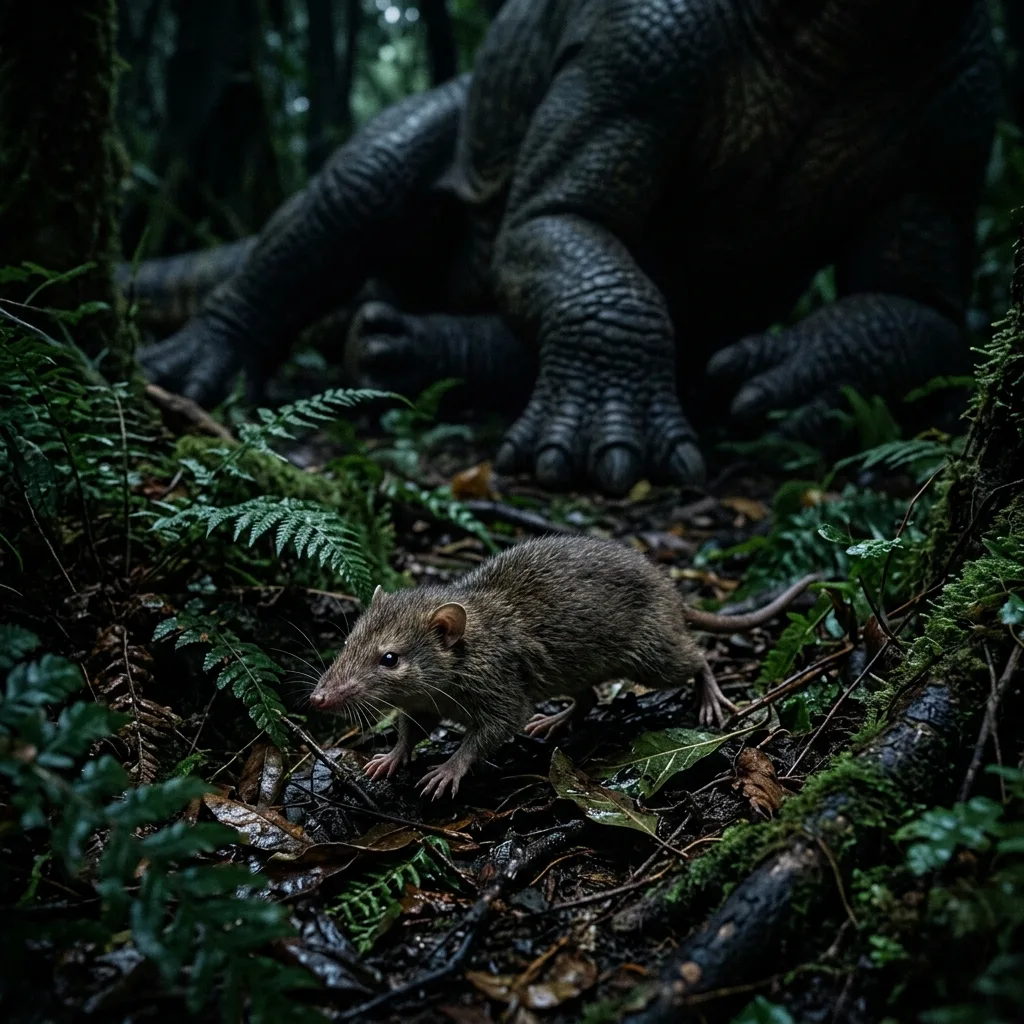
During the Late Triassic period, right as the very first dinosaurs were beginning to dominate the Earth, a group of mammal-like reptiles (cynodonts) evolved into the very first true mammals (like Morganucodon).
Open in interactive timeline →Key Numbers
- Oldest claimed mammal
- ~225 million years (Brasilodon)
- Body size
- shrew-to-mouse, ~20 cm / 27-89 g
- Max lifespan
- up to 14 years
- Middle ear bones gained
- 2 (malleus + incus from jaw)
- Era
- Late Triassic-Early Jurassic
Verified Facts
- Morganucodon, long regarded as one of the first true mammals, was a tiny insectivore roughly the size of a shrew or mouse, weighing only about 27-89 grams with a skull just 2-3 cm long, and is known mainly from Late Triassic-Early Jurassic fossils about 205 million years old.
- The defining anatomical signature of mammals is a new jaw joint between the dentary (single lower-jaw bone) and the squamosal; in earlier synapsids the jaw hinged on the articular and quadrate bones, which in mammals shrank and migrated into the middle ear to become the malleus and incus, joining the pre-existing stapes.
- Morganucodon was named 'Glamorgan tooth' (Morganuc, the Domesday-Book name for South Glamorgan, plus Greek odon, 'tooth') after Walter Georg Kühne identified a single primitive cheek tooth in 1949 from fissure-fill deposits in Carboniferous limestone quarried at Glamorgan, South Wales.
- A 2020 study led by the Universities of Bristol and Southampton (published in Nature Communications) counted annual growth rings in the fossilized tooth roots of Morganucodon and Kuehneotherium using European Synchrotron Radiation Facility scans, finding lifespans up to 14 years for Morganucodon and about 9 years for Kuehneotherium.
- Those 14-year lifespans were a major surprise because similarly sized modern mammals like mice and shrews live only a year or two, implying these earliest mammals retained a slow, reptile-like metabolism rather than the fast, warm-blooded 'live fast, die young' physiology of their modern relatives.
- Kuehneotherium, a contemporary of Morganucodon from the same South Welsh fissures, was even smaller, estimated at just 4-5.5 grams as an adult, and its more triangulated molar cusps point toward the tribosphenic chewing teeth of later true mammals.
- A 2022 study in the Journal of Anatomy, with senior author Martha Richter of London's Natural History Museum, argued that Brasilodon quadrangularis from southern Brazil, dated to about 225 million years ago, is the oldest known mammal, pushing the origin back roughly 20 million years before Morganucodon.
- The Brasilodon claim rests on diphyodonty, the mammalian trait of growing only two successive tooth sets (one replacement) rather than the continuous reptilian replacement; this ~20-cm, shrew-like, probably burrowing animal lived alongside some of the earliest dinosaurs in the Late Triassic.
- The 'first mammal' title is genuinely contested because the answer depends on definition: a strict dentary-squamosal-jaw-joint standard favors forms like Morganucodon, while a dental/diphyodonty standard favors Brasilodon, and critics counter that diphyodonty alone may not reliably define Mammalia and that Brasilodon may be a non-mammalian cynodont.
- Eye-socket structure in Morganucodon indicates it was likely nocturnal, consistent with the influential 'nocturnal bottleneck' hypothesis that early mammals survived in night-time niches beneath the dinosaurs, a constraint thought to have shaped mammalian traits such as enhanced hearing, smell, and (in later lineages) color-vision loss.
The World at This Moment
The first mammaliaforms appeared in the Late Triassic, roughly 225-205 million years ago, when Earth's landmasses were fused into the supercontinent Pangaea. This was a world dominated by other synapsids' reptilian rivals: the earliest dinosaurs were radiating during the Carnian and Norian, alongside crurotarsan archosaurs, rhynchosaurs, and the cynodont lineages from which mammals themselves descended. Morganucodon, Sinoconodon, and Kuehneotherium were shrew-sized insectivores, likely nocturnal, occupying small-bodied niches beneath the larger archosaurs. The end-Triassic mass extinction (c. 201 Ma), now widely linked to massive CO2 release from the Central Atlantic Magmatic Province as Pangaea began to rift, cleared the way for dinosaur dominance through the Jurassic. Mammaliaforms survived this filter as small, generalized animals. The Greenland fossil Morganucodon and the Welsh fissure-fill faunas, together with Sinoconodon and docodonts from China, anchor this radiation. Mammals would remain small and ecologically marginal for some 130 million years, a "nocturnal bottleneck" lasting until the Cretaceous-Paleogene extinction removed the non-avian dinosaurs.
The Paradigm Shift
The mammaliaform transition is paleontology's textbook case of a major evolutionary novelty assembled in fine, traceable gradations. Its defining innovation was the dentary-squamosal jaw joint: in forms like Morganucodon the new joint coexisted alongside the old quadrate-articular hinge, a "double jaw joint" that physically documents the transformation. The former jaw-articulation bones (quadrate and articular) progressively shrank and migrated into the middle ear, becoming the incus and malleus—the homology proposed by Karl Reichert (1837) and developed by Ernst Gaupp (1913), and since corroborated by fossils, developmental biology, and molecular genetics. This reorganization improved both feeding mechanics (precise occlusion, the tribosphenic-precursor molars) and high-frequency hearing. The shift redirected vertebrate evolution by establishing the mammalian Bauplan—single-boned lower jaw, three-ossicle ear, differentiated dentition—whose downstream consequences include the sensory and metabolic platform of all later mammals. For evolutionary theory it became the canonical demonstration that "irreducibly complex" structures arise stepwise, each intermediate functional, making the synapsid-to-mammal record one of the most cited transitional sequences.
In Depth
Small Things in the Shadow: The Long Apprenticeship of the Mammals
When the first true mammals appeared near the Triassic–Jurassic boundary, roughly 205 million years ago, nothing about them announced a future. They were shrew-sized insectivores like Morganucodon, easily overlooked beside the giant archosaurs already rising around them. Yet this modest debut was the payoff of an evolutionary investment hundreds of millions of years deep, and the seed of a lineage that would one day write history about itself.
Deep preconditions
A mammal is impossible without a long prior scaffolding. The atoms in its bones were forged in stars and scattered by the deaths of giant suns (sv-first-supernova), and assembled on a world cooled enough for biochemistry after the Solar System took shape (sv-earth-formation). Its very metabolism depends on free oxygen, the legacy of cyanobacteria poisoning the early air (sv-great-oxygenation), and on the nucleated, mitochondria-bearing cell that made large, energy-hungry animals possible (sv-first-complex-cells). The body plan itself — bilateral, segmented, with paired limbs — was drafted in the burst of animal diversity of the Cambrian (sv-cambrian-explosion) and carried onto dry land by lobe-finned pioneers whose descendants learned to breathe air and walk (sv-tiktaalik).
What made mammals mammalian, though, was a slow remodeling within the synapsid lineage. Synapsids — the so-called "mammal-like reptiles" — diverged from other amniotes back in the Carboniferous–Permian. Their descendants, the therapsids and then the cynodonts (appearing in the Late Permian, around 260 million years ago), survived the catastrophic end-Permian extinction and gradually acquired the traits we recognize: differentiated teeth, a secondary palate, an upright gait, and most strikingly, a reworked jaw. Over tens of millions of years the dentary bone enlarged while the post-dentary bones shrank, until the old reptilian jaw joint detached entirely and migrated into the skull to become the malleus and incus — two of the three tiny bones of the uniquely mammalian middle ear. Few transformations in the fossil record are documented in such exquisite, gradual detail.
What it reshaped
For their first 135 million years, mammals lived small and largely at night. The "nocturnal bottleneck" hypothesis holds that dominance by diurnal dinosaurs confined early mammals to the dark, a pressure that honed acute hearing, smell, whiskers, and fur — and possibly true warm-bloodedness, though recent work on Morganucodon suggests its metabolism was still closer to a reptile's than a modern mammal's. Lactation, live birth in most lineages, and an enlarged brain were all forged in this long shadow.
The constraint became destiny only when the constraint was lifted. The asteroid that ended the Cretaceous (sv-dinosaur-extinction) erased the non-avian dinosaurs and opened the daytime world that mammals had been excluded from. The survivors radiated explosively into the vacated niches, and within ten million years the descendants of those nocturnal insectivores included the first primates (sv-first-primates). From that branch came the great apes (sv-great-apes), the human–chimpanzee split (sv-human-chimp-split), and eventually a species that survived the megafauna die-offs of the last glacial period (sv-last-ice-age) to invent agriculture, writing, and machines.
The longest thread
There is a quiet recursiveness here worth naming. The same lineage that began as a twitching insectivore in the dark would, billions of years after the Big Bang (sv-big-bang), build telescopes to look back at it, and dream of intelligence that outpaces its own. Every distinctly mammalian inheritance — the warm body, the nursing bond, the oversized inquisitive brain — was first an adaptation to smallness and fear. The first true mammals are a lesson the rest of the timeline keeps repeating: that the obscure, marginal, and underestimated thing is often where the next chapter is being quietly assembled.
Causes & Consequences
What led to it
- Synapsids, the lineage including mammals and their ancestors, diverged early among amniotes and gave rise to therapsids, establishing the deep stem from which mammalian features would later evolve.
- Cynodont therapsids, originating in the Late Permian (roughly 260-252 million years ago), evolved differentiated teeth, an enlarged dentary bone, and a bony secondary palate that allowed simultaneous chewing and breathing for faster digestion.
- Cynodonts survived the end-Permian mass extinction around 252 million years ago and diversified extensively across the Triassic, filling carnivore and herbivore niches and refining the mammalian body plan in their braincase, jaw, teeth, and limbs.
- Evidence such as foramina in cynodont snouts interpreted as channels for blood vessels and nerves to whiskers points to early sensory hair, an antecedent of the fur tied to mammalian endothermy.
- Isotopic and physiological evidence indicates that multiple Permo-Triassic therapsid clades, including Triassic cynodonts, evolved elevated thermometabolism (warm-bloodedness), supplying the high-energy physiology mammals would inherit.
- Across cynodont evolution the dentary progressively enlarged while the post-dentary bones shrank and the articular-quadrate jaw joint gradually lost its load-bearing function, setting up the new dentary-squamosal articulation that defines mammaliaforms.
What it set in motion
- Mammaliaforms such as Morganucodon, appearing around the Triassic-Jurassic boundary about 200 million years ago, possessed the dentary-squamosal jaw joint that is the diagnostic synapomorphy distinguishing true mammals and their close kin.
- The post-dentary bones freed from jaw articulation migrated into the middle ear, with the articular and quadrate becoming the malleus and incus to form the three-ossicle chain that gives mammals acute, high-frequency hearing.
- Throughout the Mesozoic mammals remained mostly small, shrew-to-cat-sized, and largely nocturnal, a constrained niche that nonetheless persisted alongside dinosaurs for over 100 million years and seeded later groups.
- Fewer than about ten placental lineages crossed the Cretaceous-Paleogene boundary 66 million years ago, yet from these survivors the more than 6,000 living placental species ultimately descended.
- In the roughly five-million-year window after the K-Pg extinction, mammalian rates of morphological evolution ran about three times background levels as lineages invaded vacated niches, launching the 'Age of Mammals.'
- This radiation produced the full ecological breadth of modern mammals, from bats and whales to primates, ultimately including the human lineage and, far downstream, the species building artificial intelligence today.
The Live Academic Debate
The central, still-live debate is definitional and phylogenetic: where does "Mammalia" begin? Timothy Rowe's influential 1988 paper (Journal of Vertebrate Paleontology 8:241-264) defined Mammalia strictly as the crown group—the clade of the last common ancestor of living monotremes and therians—thereby excluding Morganucodontidae, Kuehneotheriidae, and Haramiyidae as non-mammalian Mammaliaformes. This contrasts with the older apomorphy-based usage, traceable to G. G. Simpson and continued by some workers (e.g., Kenneth Kermack), which counts any animal with the dentary-squamosal joint as a mammal, making Morganucodon a true mammal. Beyond terminology, researchers including Zhe-Xi Luo, Thomas Kemp, and Zofia Kielan-Jaworowska dispute the branching order of Sinoconodon, morganucodonts, docodonts, Hadrocodium, and haramiyids relative to the crown, and whether haramiyids fall inside or outside Mammalia (bearing on whether crown mammals originated in the Triassic or Jurassic). Tip-dating analyses (King et al. 2020) have proposed novel resolutions, while the homoplasy of the jaw joint itself, highlighted by recent Brazilian discoveries, further complicates any single diagnostic criterion.
How This Event Connects
The evolutionary crystallization of the first true mammals cannot be fully decoupled from the foundational tetrapod adaptations first observed in transitional forms like Tiktaalik. The fundamental transition from aquatic to terrestrial locomotion necessitated a reorganization of the appendicular skeleton, establishing the pentadactyl limb and rudimentary girdles. Over geologic time, the mammalian lineage rigorously modified this basal architecture, shifting from the sprawling posture of early synapsids to the erect, parasagittal gait characteristic of true mammals. This deep-time continuity underscores how initial Devonian constraints directly shaped the biomechanical parameters of mammalian endothermy and terrestrial dominance.
The trajectory of these early mammalian lineages was radically and catastrophically redirected by the K-Pg extinction event (The K-Pg Extinction Event). For tens of millions of years during the Mesozoic, the first true mammals were largely constrained to nocturnal, diminutive, insectivorous niches due to the overwhelming ecological hegemony of non-avian dinosaurs. The sudden bolide impact and subsequent environmental collapse eradicated these saurian competitors, fundamentally altering the global ecospace. It was this exogenous cataclysm that provided the ecological release necessary for surviving basal mammalian clades to undergo explosive adaptive radiation into the myriad macro-niches of the Cenozoic.
Following this post-extinction radiation, specific lineages capitalized on the newly available paleofloral environments, leading directly to the emergence of the first primates (The First Primates). The profound mammalian innovations—such as precise dental occlusion, endothermy, and an expanded neocortex—equipped these early arboreal specialists to exploit angiosperm-dominated forest canopies. The transition from the first generalized mammals to the specialized euarchontan ancestors of primates illustrates a critical evolutionary sequence: the survival adaptations honed in the shadows of dinosaurs became the very tools utilized to conquer the complex, three-dimensional arboreal biomes of the Paleocene.
The Counterfactual
Counterfactual reasoning here must distinguish contingency from convergence. The mammalian jaw-and-ear reorganization was not a single fluke: the dentary-squamosal contact appears to have evolved more than once among cynodonts (recent Brazilian fossils such as Brasilodon-related forms suggest homoplasy in the oldest mammalian jaw joint), implying that something like the mammalian condition was strongly favored and might have arisen via another prozostrodont lineage had Morganucodon's specific clade failed. What was genuinely contingent was survival through the end-Triassic and later bottlenecks. Had the small-bodied, possibly nocturnal mammaliaform niche not buffered these animals against the extinctions that culled larger competitors, the lineage carrying advanced occlusion and endothermy might have been lost, leaving the Cenozoic to be filled by surviving reptilian or avian radiations. Conversely, had mammaliaforms grown large during the Jurassic, they would likely have been outcompeted by dinosaurs. The plausible inference, following Kemp and Luo, is that the mammalian body plan was robustly "attractor-like," but its eventual dominance depended on the contingent removal of dinosaurs at 66 Ma rather than on Triassic events alone.
Myth vs. Reality
Myth: Mammals evolved from dinosaurs, or descended from reptiles after the dinosaurs.
Reality: Mammals never evolved from dinosaurs or from reptiles. The mammal lineage (synapsids) split from the reptile-and-bird lineage (sauropsids) from a common amniote ancestor in the Late Carboniferous, roughly 320-315 million years ago, long before the first dinosaurs. Dinosaurs and the first true mammals actually appeared at about the same time in the Late Triassic and coexisted for over 150 million years. Mammals descend from the synapsid line, specifically from cynodonts, not from anything in the reptile branch.
Myth: Early mammal relatives were 'mammal-like reptiles.'
Reality: The old term 'mammal-like reptiles' (and 'pelycosaur') is now considered archaic and misleading in technical literature; researchers use 'stem mammals' or 'non-mammalian synapsids' instead. These animals were never reptiles. Reptiles sit within Sauropsida, the sister group to Synapsida, so early synapsids were a separate lineage that branched in parallel with reptiles rather than descending from them. They were more closely related to living mammals than to any reptile.
Myth: The very first mammals were already warm-blooded with the fast metabolism we associate with mammals today.
Reality: A 2020 study (Newham et al., Nature Communications) used synchrotron imaging of tooth cementum growth rings in Morganucodon and Kuehneotherium and found these Early Jurassic stem-mammals had lifespans up to about 14 years, far longer than the 1-3 years typical of similar-sized modern mammals, plus femoral blood-flow rates intermediate between mammals and reptiles. This suggests they still had a comparatively reptile-like, lower metabolic rate. Full mammalian endothermy appears to have evolved somewhat later, likely in the Jurassic, not at the very origin of mammals.
Myth: There is one clear, agreed-upon 'first mammal.'
Reality: Where to draw the line is genuinely debated because the transition was gradual and 'mammal' is defined by anatomical traits that appear piecemeal in the fossil record. The Late Triassic Morganucodon (around 205 million years ago) is a classic candidate, but a 2020 study argued that Brasilodon quadrangularis, dated to about 225 million years ago and showing two successive sets of teeth (diphyodonty) like modern mammals, may be older. Some specialists classify these as mammaliaforms or stem mammals rather than crown mammals, so the 'first mammal' depends on which definition is used.
Myth: Mesozoic mammals were all tiny, shrew-like creatures that cowered helplessly in the shadow of dinosaurs.
Reality: Most Mesozoic mammals were small, but they were ecologically diverse: forms that swam, glided, climbed, and burrowed are known. The traditional 'suppressed by dinosaurs' narrative is outdated. A striking fossil described in 2023 preserves the badger-sized Repenomamus robustus locked in combat atop a larger Psittacosaurus dinosaur, and earlier specimens preserve baby-dinosaur remains in Repenomamus gut contents, direct evidence that some mammals preyed on dinosaurs rather than merely hiding from them.
Frequently Asked Questions
When did the first true mammals appear?
The first true mammals evolved during the Late Triassic period, roughly 210 to 225 million years ago, emerging alongside some of the earliest dinosaurs. The mammaliaform Morganucodon, known mainly from isolated teeth dating to around 205 million years ago, is the classic textbook example. A 2022 study in the Journal of Anatomy argued that Brasilodon quadrangularis, from about 225 million years ago in Brazil, may be the oldest known animal that qualifies as a mammal, pushing the origin back by roughly 20 million years.
What was the first mammal called?
There is no single undisputed answer, and experts still debate it. Morganucodon, a tiny shrew-like creature from around 200 to 205 million years ago, has long been cited as one of the earliest mammals because it had the dentary-squamosal jaw joint that defines mammals. In 2022, researchers led by the Federal University of Rio Grande do Sul, with King's College London and the Natural History Museum, proposed that Brasilodon quadrangularis (around 225 million years old) is the earliest, based on its mammal-style tooth replacement. Whether Brasilodon counts as a true mammal or an advanced cynodont remains contested among paleontologists.
What made early mammals different from their reptile-like ancestors?
Mammals descended from cynodonts, a lineage of synapsids (often loosely called mammal-like reptiles) that radiated after the Permian extinction. Several defining features set true mammals apart: a jaw joint formed directly between the dentary and squamosal bones, three tiny middle-ear bones (the malleus, incus, and stapes), and diphyodonty, meaning just two sets of teeth (baby and permanent) rather than continuous replacement. The middle-ear bones are evolutionarily linked to the jaw, having migrated from bones that once formed the reptilian jaw joint.
How big were the first mammals?
The earliest mammals were very small, typically only about 10 to 20 centimeters (4 to 8 inches) long. Morganucodon was roughly mouse-sized and weighed an estimated 10 to 25 grams, while Brasilodon has been described as around 20 centimeters long. They were almost certainly insectivores with sharp, multi-cusped teeth, hunting insects and other small prey in the undergrowth, and were considerably smaller than their immediate non-mammalian cynodont ancestors.
Why did early mammals stay small while dinosaurs grew huge?
For over 100 million years of the Mesozoic, mammals remained small, mostly nocturnal insectivores, a pattern often explained by the nocturnal bottleneck hypothesis. Under this idea, early mammals avoided competition and predation from dominant, largely diurnal dinosaurs by being active at night, which favored small bodies and heightened senses of smell and hearing over vision. Mammals only diversified into larger sizes and daytime niches after the asteroid-driven Cretaceous-Paleogene extinction wiped out non-avian dinosaurs about 66 million years ago. Sensory adaptations to night life are still visible in many modern mammals as a legacy of this period.
Were the first mammals warm-blooded and did they lay eggs?
The earliest mammals likely had fur and probably laid eggs, much like their cynodont ancestors and like modern monotremes such as the platypus. Endothermy (warm-bloodedness) is thought to have emerged in the Late Triassic in small mammaliaforms, though it may not have been as fully developed as in living mammals. A 2020 study in Nature Communications, which counted annual growth rings in the tooth roots of Morganucodon and Kuehneotherium, found they lived up to about 14 and 9 years respectively, far longer than similarly sized modern mice or shrews. This suggests early mammals had a slower, more reptile-like pace of life and lower metabolic rates than their later descendants.
Sources & Further Reading
- Mammaliaformes — Wikipedia
- Timothy Rowe, "Definition, Diagnosis, and Origin of Mammalia," Journal of Vertebrate Paleontology 8(3): 241-264 (1988)
- Thomas S. Kemp, The Origin and Evolution of Mammals (Oxford University Press, 2005)
- Zhe-Xi Luo, "Transformation and diversification in early mammal evolution," Nature 450: 1011-1019 (2007)
- Zofia Kielan-Jaworowska, Richard L. Cifelli, and Zhe-Xi Luo, Mammals from the Age of Dinosaurs: Origins, Evolution, and Structure (Columbia University Press, 2004)
- Benjamin King et al., "Tip dating supports novel resolutions of controversial relationships among early mammals," BMC Evolutionary Biology 20:55 (2020)
- Wikipedia: Morganucodon
- PBS Eons: When Mammals Hid From Dinosaurs
Cite This Page
AskHistoryAI. “The First True Mammals.” AskHistoryAI — Interactive Timeline of Everything. Updated 2026-09-11. https://askhistoryai.com/event/sv-first-mammals/
Every fact on this page is checked against the published fact ledger and methodology; sources are listed above.