The First Primates
Tiny, squirrel-like tree-dwellers that emerged from the ashes of the dinosaurs.
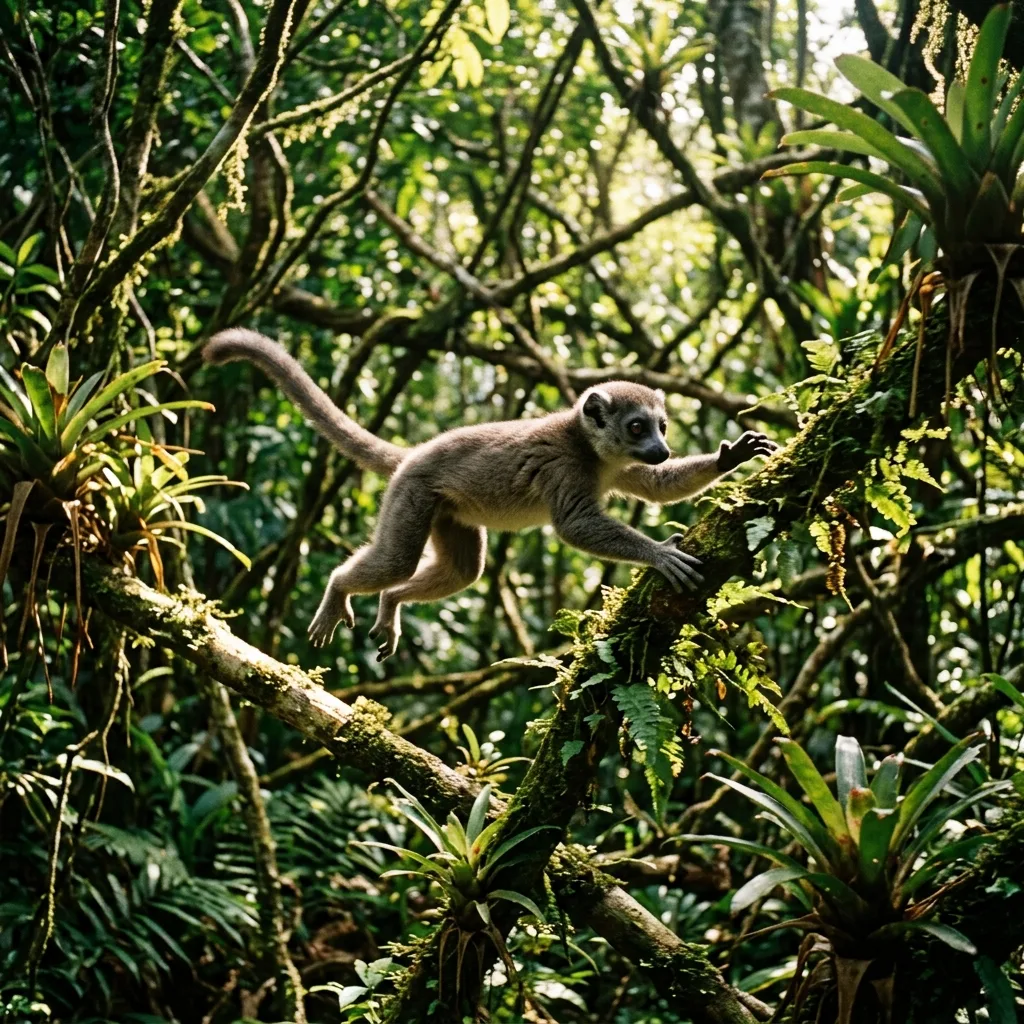
Just 10 million years after the asteroid wiped out the dinosaurs, the first primate-like mammals (like Plesiadapis) appear in the fossil record. These tiny, tree-dwelling creatures take advantage of the now-empty ecological niches left by the reptiles.
Open in interactive timeline →Key Numbers
- Oldest primate fossil
- ~65.9 million years ago
- After dino extinction
- 105,000-139,000 yrs
- Purgatorius body size
- ~15 cm, ~37 grams
- Molecular-clock estimate
- ~80+ Ma (vs ~56 Ma fossils)
- First true primates (euprimates)
- ~56 million years ago
Verified Facts
- The oldest known primate is Purgatorius, a stem primate (plesiadapiform) whose fossil teeth from the Hell Creek region of northeastern Montana date to about 65.9 million years ago — just 105,000 to 139,000 years after the Cretaceous-Paleogene asteroid impact that wiped out the non-avian dinosaurs 66 million years ago.
- The genus Purgatorius was formally named in 1965 by paleontologists Leigh Van Valen and Robert Sloan, taking its name from Purgatory Hill, a fossil locality in Garfield County, Montana, where the type specimens were collected.
- Purgatorius was a tiny, rat-sized arboreal animal — roughly 15 cm long and weighing only about 37 grams — that likely lived in the trees and ate a mixed diet of fruit and insects.
- A landmark 2021 study in Royal Society Open Science, led by Gregory Wilson Mantilla and Stephen Chester, described teeth of two Purgatorius species (P. janisae and the newly named P. mckeeveri) and pushed the documented origin of primates to the earliest Palaeocene, immediately after the mass extinction.
- Ankle bones (tarsals) attributed to Purgatorius, described in a 2015 PNAS paper, reveal a highly mobile, flexible ankle typical of tree-dwelling mammals — the oldest fossil evidence that primates were arboreal, living in trees within a few hundred thousand years of the dinosaurs' demise.
- There is a major discrepancy between fossils and DNA: molecular-clock studies generally place the origin of crown primates in the Late Cretaceous, often around 80 million years ago or more, whereas the oldest unambiguous fossils of true primates are only about 56 million years old — a gap of roughly 45%.
- The first 'primates of modern aspect' (euprimates), with forward-facing eyes, enlarged brains, grasping hands and feet, and nails instead of claws, appear in the fossil record around 56 million years ago during the Paleocene-Eocene Thermal Maximum (PETM), a sudden global warming event.
- Teilhardina is the oldest known genus of euprimate; species spread rapidly across the Northern Hemisphere during the PETM — T. asiatica in China, T. belgica in Europe, and T. brandti in North America — with the terminal finger bones of T. brandti providing the oldest evidence of true nails in primates.
- Within about one million years of arriving in northeastern Montana, plesiadapiforms became numerically dominant, outstripping archaic hoofed mammals and taking over the arboreal omnivore-frugivore niche during the ecological recovery that followed the mass extinction.
The World at This Moment
The first stem primates appear in the immediate aftermath of the Cretaceous-Paleogene (K-Pg) mass extinction of ~66 million years ago, the bolide-and-volcanism catastrophe that erased non-avian dinosaurs and roughly three-quarters of species. Purgatorius fossils from Montana's Hell Creek region are constrained to within ~105,000-139,000 years after the boundary, making purgatoriids among the oldest known placental mammals. This was the great mammalian adaptive radiation: archaic ungulates, multituberculates, and the earliest euarchontans diversified into emptied arboreal and terrestrial niches amid recovering, angiosperm-dominated forests. The world was hot and humid, with no polar ice. The first true euprimates (Teilhardina, Cantius) arrive ~10 million years later at the Paleocene-Eocene Thermal Maximum (~56 Ma), a 100,000-year carbon-release hyperthermal that warmed the planet and opened high-latitude land bridges across which primates dispersed nearly simultaneously through Asia, Europe, and North America. India was drifting toward Eurasia; flowering-plant forests and modern insect lineages were flourishing.
The Paradigm Shift
Primate origins redirected mammalian evolution toward a distinctive arboreal adaptive complex that ultimately produced humanity. The transition from stem plesiadapiforms to euprimates assembled the defining primate package: grasping hands and feet with nails replacing claws, opposable digits, forward-rotated orbits enabling stereoscopic vision, relatively enlarged brains, and reliance on hands and vision over snout and smell. The 56-million-year-old skeleton of Carpolestes simpsoni shows grasping with a nailed hallux evolved before visual convergence and leaping, reordering the assumed sequence of primate trait acquisition. These features, honed for navigating slender terminal branches and exploiting fruit and insects in the canopy, established the morphological and behavioral substrate on which all later primate evolution—anthropoids, apes, and hominins—was built. Without this early Cenozoic experiment in arboreal, visually guided, manually dexterous mammalian life, the eventual emergence of large-brained, tool-using, culture-bearing hominins becomes difficult to imagine. The primate radiation thus constitutes a foundational node in the grand narrative leading to human intelligence.
In Their Own Words
"Rather, primate trends are explicable as consequences of a basic adaptation for predation upon insects and other small prey, an adaptation which involved both the development of grasping hind feet and the optical convergence and reduction of the snout." — Matt Cartmill, "Rethinking Primate Origins," Science 184 (1974), articulating the visual-predation hypothesis (paraphrasing the abstract's core claim)
In Depth
Creatures of the Canopy: How the First Primates Inherited an Emptied World
The first primates were small, secretive animals, but they sit at one of the most consequential hinges in the whole story of life — the moment a particular kind of mammalian eye and hand first turned toward the trees. Their origin is inseparable from a catastrophe. When the asteroid struck at the end of the Cretaceous, the K-Pg Extinction Event (sv-dinosaur-extinction) erased the dinosaurs and roughly three-quarters of all species, and into that ecological vacuum the surviving mammals exploded. The oldest known stem primates, the plesiadapiform Purgatorius, appear in early Paleocene rocks of Montana dated to within roughly 105,000–139,000 years after the boundary — geologically, almost the morning after. Rates of morphological evolution in placental mammals tripled in the five million years that followed, one of the clearest examples in the fossil record of how extinction clears the stage for radiation.
The deep inheritance
Every trait that defines a primate was assembled from older bequests. The First True Mammals (sv-first-mammals) had already evolved warm blood, fur, milk, and the differentiated teeth that let Purgatorius specialize on insects and fruit. Those teeth, in turn, were possible only because the move onto land at events like Tiktaalik (sv-tiktaalik) had carried the vertebrate body plan out of the water hundreds of millions of years earlier. Behind all of it lies an even older debt: the breathable atmosphere produced by the Great Oxygenation Event (sv-great-oxygenation), without which no active, large-brained metabolism could exist. The first primates were, in this sense, a late and intricate echo of the very Origin of Life (sv-origin-of-life) itself, running on the same chemistry first kindled on the young Earth.
Why the trees mattered
What made primates distinctive was not size or speed but a suite of adaptations for life in the canopy: grasping hands and feet, nails replacing claws, forward-facing eyes with overlapping visual fields, and a brain weighted toward vision over smell. Matt Cartmill's visual-predation hypothesis (1970) argues these features evolved for hunting insects on slender terminal branches at night; a rival angiosperm-coevolution model emphasizes reaching for fruits and flowers. The two are not exclusive — and both depend on the explosive diversification of flowering plants and their insect partners, the descendants of the world's first arthropods, the Earliest Insects (sv-earliest-insects). The primate body was, quite literally, shaped by the three-dimensional architecture of trees, the inheritors of the First True Trees (sv-first-trees).
The thread forward
From this modest Paleocene root, the lineage branched relentlessly. The same grasping hand and stereoscopic gaze would, tens of millions of years on, equip the Rise of the Great Apes (sv-great-apes) and ultimately the Human-Chimpanzee Split (sv-human-chimp-split). It is no exaggeration to say that the cognition behind every later human achievement — the cave-shrines of Göbekli Tepe (sv-gobekli-tepe), the first writing in Cuneiform (sv-cuneiform), and the machine intelligences of the present age — traces its hardware to choices made by a shrew-sized creature learning to judge the gap between two branches.
The first primates remind us that history's grandest arcs often begin with the unglamorous and the lucky. A rock from space killed the rulers of the Mesozoic; a forgettable insectivore inherited the canopy; and the particular way it learned to see and grasp set in motion a chain that runs, unbroken, all the way to the species now writing its own timeline.
Causes & Consequences
What led to it
- The Cretaceous-Paleogene mass extinction roughly 66 million years ago wiped out the non-avian dinosaurs, emptying terrestrial and arboreal niches and relaxing predation pressure so that surviving small placental mammals could diversify rapidly.
- The Cretaceous radiation of angiosperms (flowering plants) spread fruit-, flower-, and nectar-bearing trees across the globe, creating the three-dimensional canopy resources that an arboreal omnivore-frugivore could exploit.
- Coevolution between flowering plants and pollinating insects produced an abundant, diversifying insect food supply that could sustain small insectivorous and omnivorous tree-dwelling mammals.
- An ancestral lineage of small, nocturnal, insectivorous placental mammals within Euarchonta already existed by the Late Cretaceous, providing the body plan from which stem primates descended.
- Selection for arboreal locomotion in early therian mammals favored grasping extremities and enhanced limb flexion, supplying the anatomical groundwork later elaborated into primate grasping hands and feet.
- The earliest purgatoriids (Purgatorius) appeared in the earliest Paleocene of Montana within roughly 105,000-139,000 years after the K-Pg boundary, marking the initial radiation of stem primates (plesiadapiforms).
What it set in motion
- Plesiadapiforms radiated explosively through the Paleocene, and within about a million years they outstripped archaic ungulates in abundance and dominated the arboreal omnivore-frugivore niche across North American faunas.
- Primates of modern aspect (euprimates) such as Teilhardina appeared during the Paleocene-Eocene Thermal Maximum about 56 million years ago, evolving the diagnostic primate suite of grasping hands and feet, nails instead of claws, and forward-facing eyes with convergent binocular vision.
- During the warm PETM interval, Teilhardina dispersed across Asia, Europe, and North America in roughly 25,000 years, establishing primates of modern aspect on all three Holarctic continents.
- Anthropoid primates emerged by the late Eocene (around 40 million years ago) in Afro-Arabia and Asia, documented richly in the Fayum Depression of Egypt by forms such as Aegyptopithecus.
- The catarrhine split gave rise to Old World monkeys and apes, with hominoids (apes and humans) diverging from cercopithecoid monkeys roughly 25-30 million years ago and Miocene apes such as Proconsul radiating across Africa.
- This unbroken primate lineage ultimately produced the hominin branch and Homo sapiens, making the origin of primates a foundational precondition for the entire human evolutionary story.
The Live Academic Debate
Two live debates dominate. First, are plesiadapiforms (Purgatorius, Carpolestes) true primates? Earlier workers (Martin 1968; Cartmill 1974) excluded them as merely primate-like, restricting Primates to crown euprimates with the full visual-grasping complex; Bloch, Boyer, Silcox, and Sargis argue from new cranial and postcranial fossils that plesiadapiforms are stem primates and that grasping preceded visual specialization, undermining a strict euprimate definition. Second, what drove primate origins? Cartmill's visual-predation hypothesis holds that orbital convergence and grasping evolved for catching insects by sight; Sussman and Rasmussen counter with an angiosperm-coevolution model emphasizing fruit and flower exploitation; the older arboreal hypothesis (Smith Woodward, Wood Jones, Le Gros Clark) stresses general adaptation to life in trees. A third, persistent controversy concerns timing: molecular-clock estimates place crown-primate origins deep in the Late Cretaceous (~74-80 Ma), while the fossil record yields no unambiguous euprimate before ~56 Ma. Steiper, Seiffert, and others debate whether convergent molecular rate slowdowns or genuine fossil gaps explain this discordance.
How This Event Connects
The emergence of the first primates was fundamentally contingent upon the catastrophic ecological turnover precipitated by the K-Pg Extinction Event. The sudden removal of the non-avian dinosaurs vacated vast ecological niches, prompting a rapid, explosive radiation of surviving mammalian lineages. In the ensuing Paleocene epoch, expanding angiosperm (flowering plant) forests created novel, complex, three-dimensional arboreal biomes. The early primates evolved precisely as a specialized adaptive response to exploit this new canopy ecosystem, developing traits such as grasping hands and forward-facing eyes to navigate branches and forage for fruits and insects.
This crucial adaptation to the arboreal niche set the morphological and neurological foundation for the eventual rise of the Great Apes millions of years later. The fundamental primate toolkit—emphasizing stereoscopic vision over olfaction, increased encephalization, and complex appendicular mobility—was progressively refined throughout the Cenozoic. When global climatic shifts during the Miocene began altering the dense forest landscapes into more fragmented, mosaic environments, these inherited arboreal adaptations allowed the ancestral apes to experiment with novel forms of locomotion, such as suspensory brachiation, prefiguring the morphological shifts required for true hominoid diversity.
Ultimately, the evolutionary trajectory initiated by the first primates culminated in the profound divergence marking the Human-Chimpanzee Split. The deep-seated neurological complexity and intricate social structures first selected for in early Paleocene canopies were continuously compounded over epochs. By the late Miocene, the selective pressures of shifting African ecosystems acting upon this robust primate foundation drove the hominin lineage toward bipedalism and advanced cognition, fundamentally separating them from their panin cousins. Thus, the origins of the human condition are inextricably rooted in the initial arboreal foray of the very first primates.
The Counterfactual
Counterfactual reasoning about deep-time origins is necessarily speculative, but two contingencies stand out. First, the K-Pg impact itself: had the Chicxulub bolide missed, dinosaur-dominated ecosystems might have persisted, suppressing the mammalian radiation that gave euarchontan placentals room to diversify; primates as we know them might never have arisen. The post-extinction vacancy of arboreal niches was a precondition for the primate experiment. Second, the angiosperm-coevolution hypothesis (Sussman, Rasmussen) implies that primate grasping and color-relevant adaptations track the diversification of flowering plants offering fruit, nectar, and the insects they attract; a different botanical world might have selected for a different mammalian form. The near-simultaneous PETM dispersal of Teilhardina across three continents (Smith, Rose, Gingerich 2006) shows how tightly early primate biogeography was coupled to a single transient warming event—absent that hyperthermal and its land connections, primate distribution and subsequent regional diversification would have differed substantially. None of this is determinate, but it underscores how contingent the primate lineage—and ultimately us—appears.
Myth vs. Reality
Myth: Humans (or primates generally) evolved from monkeys, so the first primates were monkey-like.
Reality: Humans did not descend from any living monkey, ape, or lemur; rather, all primates share common ancestors in the deep past. The Smithsonian's Human Origins Program and museum sources stress that monkeys and apes are our evolutionary cousins, not our ancestors. The earliest primates (and stem-primate plesiadapiforms) were small, archaic mammals that looked nothing like modern monkeys, which evolved much later from those shared lineages.
Myth: The first primates appeared only after the dinosaurs went extinct, in a clean sequence.
Reality: The fossil and molecular evidence disagree, and the timing is genuinely contested. The oldest widely cited stem primate, Purgatorius, appears in the early Paleocene of Montana within roughly 105,000-139,000 years after the K/Pg (dinosaur-extinction) boundary. But molecular-clock studies place the last common ancestor of crown primates deeper, in the Cretaceous (~77 million years ago), implying earliest primates or their immediate ancestors may have overlapped with dinosaurs. Researchers continue to work (e.g., Bayesian models of the fossil record) to reconcile this gap.
Myth: The first primates were defined by large, advanced brains.
Reality: Big brains evolved later, not at primate origins. The earliest primates had relatively small brains; the notable early change was a reduction of the olfactory (smell) region and an expansion of visual areas, reflecting a shift toward vision. Scholarship notes there is no single brain-based diagnostic trait of primates at all; one of the more reliable shared features is an ossified auditory bulla formed by the petrosal bone, along with grasping hands with nails and forward-facing eyes.
Myth: Scientists agree that Purgatorius and the other archaic 'first primates' were true primates.
Reality: This classification is actively debated. Phylogenetic and tarsal (ankle) evidence supports primate affinities for Purgatorius and indicates an arboreal, mobile-ankled animal, which is why it is often called the oldest known stem primate. However, many researchers are reluctant to classify plesiadapiforms as true primates, placing them instead in a separate group (Plesiadapiformes) or even questioning their placement among placental mammals. Calling Purgatorius 'the first primate' simplifies an unresolved scientific question.
Myth: The famous fossil 'Ida' (Darwinius masillae) is the 'missing link' showing the first primate ancestor of humans.
Reality: This claim came from a 2009 media campaign, not the scientific consensus. The 47-million-year-old Darwinius is an adapiform, a group most analyses over the past two decades place on the strepsirrhine (lemur-related) side of the primate tree, not the haplorhine line leading to monkeys, apes, and humans. Researchers from UT Austin, Duke, and the University of Chicago specifically rebutted the human-ancestor claim. More broadly, the 'missing link' framing is itself a misconception: evolution is a branching tree, not a single linear chain.
Frequently Asked Questions
When did the first primates appear?
The earliest primate-like mammals, called plesiadapiforms, appear in the fossil record shortly after the dinosaur extinction. The genus Purgatorius, often considered the oldest known proto-primate, dates to roughly 65-66 million years ago, just after the Cretaceous-Paleogene boundary. The first 'true' primates (euprimates), with traits like nails and grasping feet, appear suddenly across the northern continents around 56 million years ago, at the start of the Eocene. Molecular clock estimates, however, often push the group's origin back to the Late Cretaceous, at least 10 million years earlier than the oldest accepted fossils.
What was the very first primate?
There is no single undisputed 'first primate,' but Purgatorius is frequently cited as the earliest known stem primate, with fossils dated to about 65-66 million years ago from Montana. Purgatorius was a small, tree-dwelling mammal that likely ate insects and fruit. It belongs to the plesiadapiforms, an archaic group ancestral to or closely related to true primates rather than a true primate itself. The earliest unambiguous true primates (euprimates) are genera like Teilhardina from the early Eocene.
What features defined the earliest primates?
Early primates evolved a suite of traits suited to life in the trees: grasping hands and feet, nails instead of claws on at least some digits, and an opposable big toe (hallux). True primates (euprimates) added forward-facing eyes for stereoscopic depth perception, a reduced sense of smell, and relatively larger brains. Crucially, the 56-million-year-old fossil Carpolestes simpsoni shows a grasping foot with a nailed, opposable big toe but lacks the forward-facing eyes of later primates, indicating that grasping evolved before visual specializations.
Why did primate traits like grasping hands and forward-facing eyes evolve?
The traditional 'arboreal hypothesis,' credited to anatomist Frederic Wood Jones in the early 1900s, argues these traits arose as adaptations to moving through trees. Grafton Elliot Smith later proposed that forward-facing eyes and acute vision helped primates make accurate leaps through the three-dimensional forest canopy. A competing view, the 'visual predation' and 'terminal branch feeding' hypotheses, suggests that grasping and keen vision evolved to capture insects or to feed on fruits and flowers on the thin terminal branches of trees. Evidence from Carpolestes supports the idea that grasping for terminal-branch feeding came first, before specialized leaping or predatory vision.
Did the first primates live alongside dinosaurs?
The fossil evidence is debated. The oldest known primate fossils, such as Purgatorius, date to just after the Cretaceous-Paleogene mass extinction roughly 65-66 million years ago, so the known fossils slightly postdate the non-avian dinosaurs. However, molecular clock studies and some fossil analyses suggest the ancestor of all primates may have emerged in the Late Cretaceous, which would mean early primate ancestors coexisted with large dinosaurs. The absence of confirmed euprimate fossils before the boundary keeps this an open question in paleontology.
Are humans descended from these first primates?
Yes. Humans are primates, and modern humans, along with monkeys, apes, lemurs, and tarsiers, ultimately trace their ancestry back to these early primate and primate-like mammals. The true primates (euprimates) that appeared around 56 million years ago split into lineages including the omomyoids and adapoids, from which later monkeys, apes, and eventually hominins descended. Fossils like Carpolestes simpsoni help scientists reconstruct the evolutionary pathway, showing how features such as grasping hands and nails that humans still have today first emerged in small, tree-dwelling ancestors.
Sources & Further Reading
- Plesiadapiformes — Wikipedia
- Gregory P. Wilson Mantilla et al., 'Earliest Palaeocene purgatoriids and the initial radiation of stem primates,' Royal Society Open Science 8 (2021)
- Jonathan I. Bloch, Mary T. Silcox, Doug M. Boyer & Eric J. Sargis, 'New Paleocene skeletons and the relationship of plesiadapiforms to crown-clade primates,' PNAS 104 (2007)
- Thierry Smith, Kenneth D. Rose & Philip D. Gingerich, 'Rapid Asia-Europe-North America geographic dispersal of earliest Eocene primate Teilhardina during the Paleocene-Eocene Thermal Maximum,' PNAS 103 (2006)
- Matt Cartmill, 'Rethinking Primate Origins,' Science 184 (1974)
- Robert W. Sussman, 'Primate origins and the evolution of angiosperms,' American Journal of Primatology 23 (1991)
- Wikipedia: Plesiadapis
- Wikipedia: Primate evolution
Cite This Page
AskHistoryAI. “The First Primates.” AskHistoryAI — Interactive Timeline of Everything. Updated 2026-09-11. https://askhistoryai.com/event/sv-first-primates/
Every fact on this page is checked against the published fact ledger and methodology; sources are listed above.