The Rise of the Great Apes
Our tailless, big-brained ancestors diverge from the gibbons (the lesser apes).
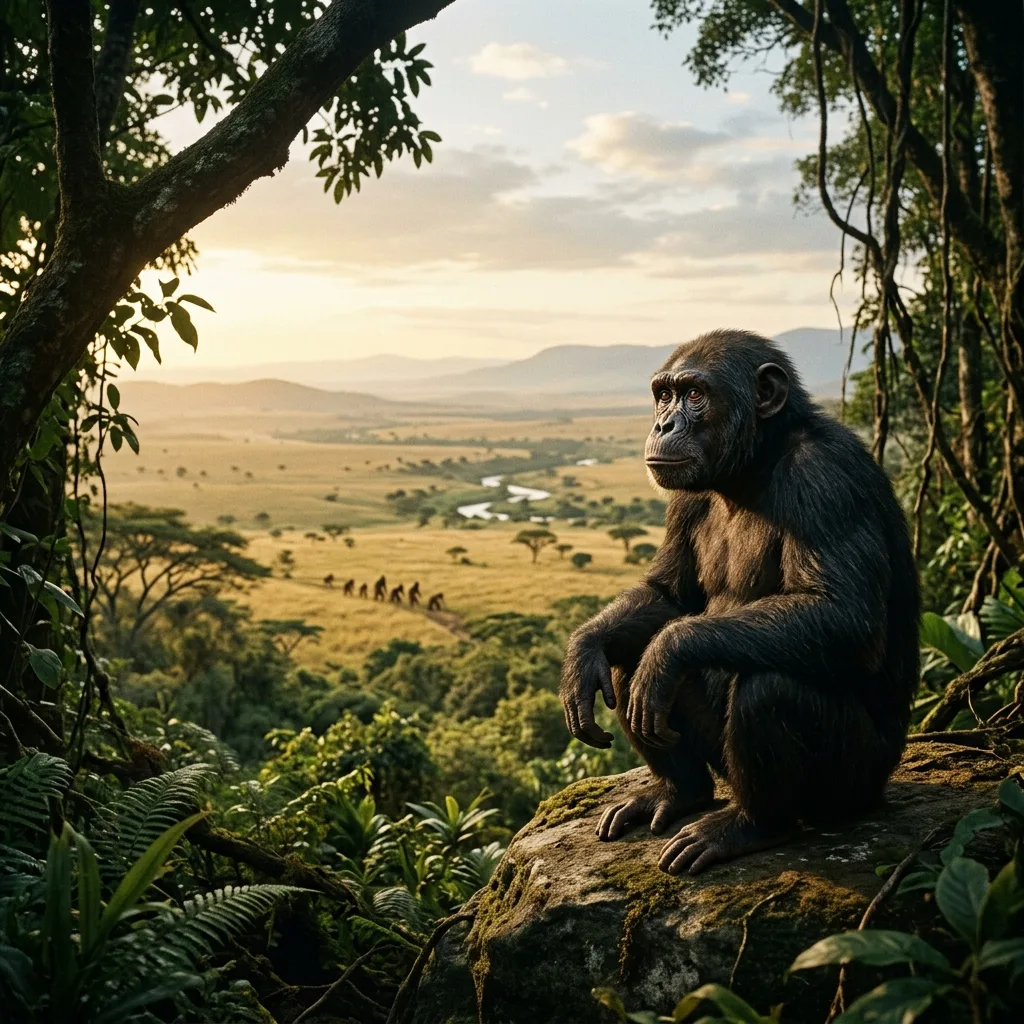
During the Miocene epoch, a group of Old World monkeys in Africa evolve into the first great apes (hominids). These larger, more intelligent primates lose their tails entirely and develop significantly bigger brains.
Open in interactive timeline →Key Numbers
- Miocene ape diversity
- 20+ genera
- First ape diversification
- ~23-5.3 Mya
- Living great ape species
- 8 (4 genera)
- Largest ape ever
- ~3 m, 200-300 kg
- Human-chimp split
- ~7-8 Mya
Verified Facts
- The great apes belong to the family Hominidae, which today contains just four extant genera - Pongo (orangutans), Gorilla, Pan (chimpanzees and bonobos), and Homo (humans) - totaling eight living species, with humans the sole survivor of the genus Homo.
- Apes underwent an explosive adaptive radiation during the Miocene Epoch (about 23 to 5.3 million years ago), when the fossil record documents 20 or more genera spanning a wide range of body sizes and ecological strategies - a diversity far exceeding the handful of ape lineages alive today.
- Proconsul, the first fossil ape recognized in Africa (initially found at Koru, Kenya in the 1920s and described by Hopwood in 1933 as Proconsul africanus), lived roughly 23 to 16 million years ago and is generally regarded as a basal stem hominoid rather than a true great ape.
- Pierolapithecus catalaunicus, described in 2004 by a team led by Salvador Moya-Sola from a skeleton at Barranc de Can Vila 1 near Barcelona and dated to about 12.5-12 million years ago, is a pivotal fossil whose postcranial anatomy marks it as a crown hominoid with a modern ape-like upright (orthograde) body plan.
- Pierolapithecus showed that an upright trunk posture evolved before full suspensory hanging-and-swinging adaptations: it likely clambered using its legs through trees rather than swinging by its arms like living apes, reframing the sequence of great-ape locomotor evolution.
- Sivapithecus, known from the Siwalik Hills of the Indian subcontinent between roughly 12.5 and 8.5 million years ago, is widely interpreted as an early member of the orangutan lineage; David Pilbeam's 1982 description of a large facial fossil revealed orangutan-like features (narrowly set eyes, concave face, enlarged central incisors) that cemented this link.
- Gigantopithecus blacki, known mainly from some 2,000 fossil teeth and four jawbones from caves in southern China, was the largest ape that ever lived - estimated at about 3 meters tall and 200-300 kg - and ancient protein analysis confirms it was a giant relative of modern orangutans.
- Gigantopithecus blacki survived from about 2.3 million years ago until going extinct roughly 295,000 to 215,000 years ago; a 2024 fossil-dating study attributed its demise to an inability to adapt its diet as forests gave way to drier, more open landscapes.
- Molecular-clock estimates place the orangutan lineage's split from the African ape-human stock the earliest (on the order of 11-17 million years ago), followed by gorillas, with the human-chimpanzee divergence most recent - commonly estimated around 7-8 million years ago, though estimates range widely depending on calibration and generation-time assumptions.
- The mid-to-late Miocene closure of the Tethys Sea and global warming around 16 million years ago opened land connections that let African primates emigrate into Eurasia, seeding later great-ape forms such as Dryopithecus in Europe and Sivapithecus in Asia by roughly 13 million years ago.
The World at This Moment
The great-ape radiation unfolded across the Miocene Epoch (23–5.3 Ma), a world warmer and wetter than today. Its pivot was the Middle Miocene Climatic Optimum (c. 17–14.75 Ma), when global mean temperatures peaked roughly 3°C above present and subtropical forests stretched deep into Eurasia. This warmth opened a forested corridor—amplified by the Early-Miocene closure of the Tethys and the c. 19 Ma Gomphotherium land bridge linking Afro-Arabia to Eurasia—across which apes dispersed out of Africa. The same epoch saw proboscideans radiate, bovids and equids diversify on emerging grasslands, and, after the optimum, pronounced cooling with Antarctic ice expansion and the spread of savannas. Old World monkeys (cercopithecoids), initially rarer than apes, were beginning the rise that would later eclipse hominoid diversity. Continents had nearly reached modern positions; the Himalayas and Alps were rising. In this dynamic, forest-rich Miocene world—long before any hominin—apes were the dominant primates, a true "planet of the apes" spanning Spain to China.
The Paradigm Shift
The Miocene radiation assembled the great-ape body plan that every later hominin inherited—including ourselves. Early African forms such as Proconsul (c. 18 Ma) were tailless but largely above-branch arboreal quadrupeds lacking modern suspensory specializations. The decisive innovation was the orthograde (upright-trunked) torso, first comprehensively documented in Pierolapithecus catalaunicus (c. 12 Ma, Spain; Moyà-Solà et al. 2004), whose stiffened lower back, broad shallow thorax, and mobile wrists enabled vertical climbing and clambering. This orthograde scaffold—not knuckle-walking or bipedalism—is the structural prerequisite from which hominin upright posture was later exapted. The radiation also fixed the deep phylogenetic architecture of living hominoids: molecular clocks place the orangutan lineage's divergence in the Middle-to-Late Miocene and the gorilla and chimpanzee splits in the Late Miocene. By generating the crown-hominoid morphotype and seeding the lineages leading to orangutans, gorillas, chimpanzees, and humans, the Miocene ape diversification set the entire trajectory of subsequent primate—and ultimately human—evolution.
In Their Own Words
"It is therefore probable that Africa was formerly inhabited by extinct apes closely allied to the gorilla and chimpanzee; and as these two species are now man's nearest allies, it is somewhat more probable that our early progenitors lived on the African continent than elsewhere." — Charles Darwin, The Descent of Man, and Selection in Relation to Sex (1871), vol. 1, ch. 6
In Depth
Bodies Built for Branches: The Great Ape Experiment
The great apes did not arrive as a triumph. They arrived as one ambitious variation on a body plan that the planet had been refining for hundreds of millions of years, and for most of their history they were a fading lineage rather than an ascendant one. To see them clearly is to see deep time converge: every constraint that shaped them was inherited, and almost everything we are was first sketched in their bones.
The Inheritance
The great apes are unthinkable without the long chain that preceded them. Their warm, large-brained, fast-metabolizing bodies run on oxygen that only became abundant after the Great Oxygenation Event (sv-great-oxygenation) poisoned the early world and remade its chemistry. Their cells are the compartmentalized, mitochondria-powered eukaryotic kind first assembled by the first complex cells (sv-first-complex-cells), and they reproduce through the genetic shuffling pioneered by the invention of sexual reproduction (sv-invention-of-sex)—the engine that lets variation accumulate fast enough for an ape lineage to diversify at all. Their grasping skeleton is a refinement of the four-limbed vertebrate frame that Tiktaalik (sv-tiktaalik) first dragged onto land, and their nursing, parental, warm-blooded biology descends directly from the first true mammals (sv-first-mammals). Most immediately, they are the inheritors of the first primates (sv-first-primates), arboreal mammals whose forward-facing eyes and dexterous hands were honed for life in the canopy.
The Miocene Moment
Apes proper emerged in Africa near the Oligocene-Miocene boundary, with stem forms like Proconsul by roughly eighteen million years ago. The crucial development was an evolutionary radiation: by the Middle Miocene, apes expanded out of Africa into Eurasia, producing twenty or more genera spanning a wide range of sizes. Dryopithecus spread through Europe and Sivapithecus through Asia, the latter widely regarded as a forebear of the orangutan. These animals already grew slowly, had life histories like living apes, and—as Dryopithecus braincases show—carried brains comparable to a chimpanzee's. The molecular clock tracks the splitting that followed: orangutans diverged perhaps twelve to sixteen million years ago, gorillas later still, setting the stage for the human-chimpanzee split (sv-human-chimp-split) within the last several million years.
This was a forest empire, and it did not last. Late Miocene mountain-building in the Alps, Himalayas, and East Africa, shifting ocean currents, and the first polar ice precipitated the Asian monsoon, dried East Africa, and cooled Europe. Most Eurasian great apes went extinct. The lineage that survived did so by adapting to the patchy, drying woodlands left behind—pressure that eventually drove some apes out of the trees entirely.
The Ripple Forward
Everything downstream of the human story is, biologically, a continuation of the great ape experiment. The slow-growing, large-brained body that survived the Miocene collapse became the platform for tool-using, fire-keeping, symbol-making hominins. From there the thread runs unbroken through the Last Ice Age (sv-last-ice-age) that culled the megafauna our ancestors hunted, to the first monumental religion at Göbekli Tepe (sv-gobekli-tepe), to the Agricultural Revolution (sv-agriculture) that settled us in place. The hands that AlphaGo's engineers used to type, the brains that conceived the Transformer (sv-transformer-paper)—all are the slowly-grown great ape body, still running on Miocene wiring. It took Charles Darwin (sv-charles-darwin) to recognize that these dwindling forest creatures and ourselves were one continuous lineage. The great apes were never destined to inherit the Earth. One marginal branch of them, against the odds, simply did not die.
Causes & Consequences
What led to it
- The Catarrhini lineage emerged in Afro-Arabia during the late Eocene and Oligocene, exemplified by stem catarrhines such as Aegyptopithecus zeuxis (roughly 38-29.5 million years ago) from Egypt's Fayum Jebel Qatrani Formation, establishing the ancestral stock from which both Old World monkeys and apes would descend.
- Combined morphological and molecular evidence places the divergence of hominoids (apes) from cercopithecoids (Old World monkeys) at roughly 29.6 million years ago in Afro-Arabia, splitting the ape lineage onto its own evolutionary trajectory.
- Early Miocene Africa functioned as an island continent whose warm, wet, multistoried closed-canopy tropical forests, such as those reconstructed on Kenya's Rusinga Island, provided the arboreal habitat in which a diverse cohort of early apes radiated.
- Loss of the external tail, inferred to have occurred around the time the hominoid lineage diverged from Old World monkeys (about 25 million years ago) and leaving only a few coccygeal vertebrae, removed a balancing organ used in quadrupedal branch-walking and helped reorient the ape lineage toward upright, climbing-based postures.
- Early proconsulid apes such as Proconsul (and related forms now placed in Ekembo, Afropithecus, and Turkanapithecus), known from exceptionally complete fossils in Kenya and Uganda dating from roughly 23 to 14 million years ago, established the tailless, larger-bodied catarrhine bauplan on which later great-ape specializations were built.
- The Mid-Miocene Climatic Optimum, a global warming peak around 17-15 million years ago, expanded forested habitat and is associated with the diversification of Miocene apes into as many as roughly 50 fossil genera across Africa, Europe, and Asia.
What it set in motion
- The orthograde (upright-torsoed) body plan with a broad, flattened thorax evolved in a stepwise, mosaic fashion across Miocene apes, with forms like the Middle Miocene Pierolapithecus catalaunicus and the Late Miocene Hispanopithecus laietanus documenting enhanced vertical climbing and the oldest unambiguous suspensory adaptations that define living great apes.
- After their initial African radiation, apes dispersed into Eurasia by roughly 14 million years ago amid shifting tectonics and climate, diversifying into great-ape genera such as Dryopithecus in Europe and Sivapithecus in Asia.
- Sivapithecus from the Indo-Pakistani region preserves orangutan-like cranial features, supporting hypotheses that the Asian great-ape (Pongo) lineage traces back to Late Miocene Eurasian apes.
- A significant Miocene increase in encephalization marked the emergence of the great-ape-and-human clade (Hominidae), and because mid-to-late Miocene apes already had brains of comparable size to living great apes, capacities such as symbolic cognition, innovation, and cultural transmission may have been potentiated as early as 12-14 million years ago.
- The Middle Miocene climate transition's stepwise cooling and drying, combined with the dietary specializations of Western Eurasian apes, ultimately drove the extinction of the European great apes as forests contracted, leaving the African lineages to carry the clade forward.
- Within the African hominine lineage, gorillas diverged first and then the human (hominin) and chimpanzee (panin) lines split late in the Miocene roughly 6-8 million years ago, a window represented by candidate early hominins such as the approximately 7-million-year-old Sahelanthropus tchadensis (Toumaï) from Chad, though its hominin status remains debated.
The Live Academic Debate
The sharpest live debate concerns the geographic cradle of the great-ape-and-human clade (Hominidae/Homininae). David Begun and colleagues advance a Eurasian-origin, "back to Africa" model: Eurasian dryopithecines (e.g., Dryopithecus, Rudapithecus, Ouranopithecus) include the ancestry of African apes and humans, who re-dispersed into Africa in the latest Miocene. Against this, a Darwinian African-origin school—long defended by Peter Andrews and reinforced by Egyptian finds such as the newly described Masripithecus (2026), which is placed closer to crown hominoids than coeval East African apes—locates the relevant common ancestor in northern Africa or Arabia. A second controversy surrounds Pierolapithecus: Moyà-Solà et al. read it as an early crown great ape documenting orthograde origins, while critics (Begun, Ward) question whether it is a crown hominid at all rather than a stem form, and dispute its locomotor reconstruction. Underlying both is a methodological rift—how far molecular divergence dates should override, or be calibrated by, a fragmentary and homoplasy-riddled fossil record (Alba; Pugh).
How This Event Connects
The evolutionary emergence and diversification of the Great Apes during the Miocene epoch is deeply rooted in the foundational anatomical and neurological architectures established by the first primates (The First Primates). The initial suite of primate adaptations—such as prehensile extremities, an increased reliance on stereoscopic vision, and enhanced encephalization—were originally honed for generalized arboreal life. However, during the "Age of Apes," shifting ecological pressures drove these ancestral lineages to radically modify this inherited toolkit. The development of specialized traits like a broad thorax, dorsally placed scapulae, and the loss of the external tail allowed the Great Apes to master suspensory locomotion, representing a profound evolutionary compounding of basal primate traits.
This period of intense morphological innovation directly set the stage for one of the most critical bifurcations in evolutionary history: the Human-Chimpanzee split (The Human-Chimpanzee Split). The diverse array of Miocene apes, forced to adapt to fluctuating climatic conditions and increasingly fragmented forest-savanna mosaic environments, fostered incredible genetic and behavioral plasticity. The specific evolutionary pressures acting upon a subset of these highly derived apes ultimately triggered the "complex speciation" event. The divergence of hominins toward habitual bipedalism was not an abrupt aberration, but rather an exaptation of the orthograde (upright) postures and versatile body plans already pioneered by their Miocene ape ancestors.
Furthermore, analyzing the evolutionary paradigms of the Great Apes provides a critical framework for understanding Charles Darwin's On the Origin of Species. Darwin's explosive postulation that humans share a common ancestor with African apes was originally met with profound skepticism due to a lack of fossil evidence. The subsequent discovery of the rich Miocene hominoid fossil record has thoroughly vindicated Darwinian evolutionary mechanics, providing the crucial morphological missing links. The rise of the Great Apes stands as a monumental testament to the predictive power of natural selection in explaining the deeply interconnected web of primate phylogeny.
The Counterfactual
Had the Miocene forests not sustained a sprawling ape radiation, the hominin lineage would have had no platform from which to emerge. The counterfactual is constrained by ecology: cercopithecoid monkeys, with their efficient quadrupedalism and ability to digest unripe and toxic foliage (notably colobines), progressively outcompeted apes as Late-Miocene cooling fragmented forests. Andrews and others argue that dietary specialization and habitat loss drove the extinction of European great apes after c. 9 Ma; absent the earlier orthograde innovation, apes might have vanished entirely, leaving monkeys as the Old World's dominant anthropoids and no orthograde scaffold for bipedalism. Conversely, had the Eurasian radiation never occurred, Begun's "back to Africa" model—in which the African ape-human clade descends from a Eurasian dryopithecine that re-entered Africa 6–9 Ma—would be impossible, and the geography of human origins would differ. The radiation was thus a genuine bottleneck-and-opportunity: remove it, and the most plausible outcome is a primate world of monkeys without hominins, a conclusion supported by the documented Late-Miocene ape contraction to equatorial refugia.
Myth vs. Reality
Myth: Humans evolved from chimpanzees (or from any living ape), so the 'rise of the great apes' was a ladder climbing toward us.
Reality: Humans did not descend from chimpanzees; the two lineages split from a common, now-extinct ancestor roughly 6-8 million years ago, and each evolved independently afterward. Molecular comparisons show humans and chimps share around 98-99% of their DNA, with the differences accumulating after the split. Great-ape evolution is a branching bush, not a directional ladder pointed at Homo sapiens, which is why chimpanzees still exist alongside us rather than having 'turned into' humans.
Myth: Great apes are a small, primitive group that has always been marginal compared to monkeys and humans.
Reality: During the Miocene (roughly 23-5 million years ago), apes were spectacularly diverse, with researchers estimating as many as 100 ape species ranging across the Old World, from France to China and from Kenya to Namibia. The living great apes (gibbons, orangutans, gorillas, chimps, bonobos, and humans count as hominoids/apes) are a relict remnant of that vanished radiation. By about 7 million years ago apes had gone extinct in Europe while surviving lineages in Asia and Africa gave rise to the modern forms.
Myth: Ramapithecus was confirmed as the earliest human ancestor, an established fact of the great-ape story.
Reality: From the 1960s into the 1970s, fossils named Ramapithecus (studied by Elwyn Simons and David Pilbeam) were widely promoted as the first hominin on the line to humans, based on jaw and tooth shape. A more complete jaw Pilbeam described in 1976 showed a V-shaped (not human-like parabolic) dental arcade, and molecular-clock evidence pointing to a much later human-ape split contradicted the old timeline. By the early 1980s Ramapithecus was reinterpreted as part of Sivapithecus, an ancestor or close relative of the orangutan, not of humans.
Myth: Human bipedalism evolved straightforwardly from a knuckle-walking great-ape ancestor like a gorilla or chimp.
Reality: This 'knuckle-walking origin' idea is contested. Kivell and Schmitt (2009) argued that knuckle-walking features evolved independently in gorillas and in chimps/bonobos, implying the last common ancestor of humans and African apes was likely not a committed knuckle-walker. Fossils such as Danuvius guggenmosi (about 11.6 million years old, described by Madelaine Bohme and colleagues in 2019) suggest some Miocene apes combined upright walking with arboreal climbing, supporting the view that bipedal tendencies may have arisen in trees rather than from a ground-based knuckle-walking stage.
Myth: The rise of the great apes hinges on finding the single 'missing link' between apes and humans.
Reality: The phrase 'missing link' is a popular-media term, not a scientific one, and it misleads by implying a linear chain with one pivotal gap. Anthropologists prefer 'last common ancestor' because evolution branches like a bush, and most fossil apes are side-branches and evolutionary dead ends rather than direct ancestors. Rather than one elusive link, scientists work with many transitional fossils and independent lines of evidence; the National Center for Science Education and UC Berkeley's evolution resources both stress that no single missing link is expected or needed.
Frequently Asked Questions
What does "The Rise of the Great Apes" refer to?
"Great apes" (the family Hominidae) comprises orangutans, gorillas, chimpanzees, bonobos, and humans. Their evolutionary rise unfolded over millions of years: the lineage leading to humans, chimps, and gorillas split from orangutans roughly 12-16 million years ago, gorillas branched off around 8 million years ago, and the human line diverged from chimpanzees and bonobos roughly 5.5-7 million years ago. In a forward-looking framing, the phrase also serves as a metaphor for an inflection point in cognition itself, linking the biological emergence of large-brained apes to projected milestones in machine and human-AI intelligence.
How smart are great apes, and can they really use language?
Great apes are among the most cognitively sophisticated non-human animals, demonstrating tool use, self-recognition, and rich social reasoning. In language research, the chimpanzee Washoe learned roughly 350 American Sign Language signs, and the gorilla Koko was reported to know over 1,000 signs and to understand around 2,000 spoken English words. The bonobo Kanzi, who died in March 2025 at age 44, was notable because he picked up symbolic communication spontaneously rather than through direct training, mastering hundreds of keyboard lexigrams and even making simple stone tools. These findings are debated among linguists, but they reshaped views on the cognitive continuity between humans and other apes.
What is the technological singularity, and who came up with the idea?
The technological singularity is a hypothesized future point at which AI surpasses human intelligence and becomes capable of recursive self-improvement, driving rapid and hard-to-predict technological change. The underlying notion of an "intelligence explosion" was first articulated by mathematician I. J. Good in 1965. Mathematician and science-fiction author Vernor Vinge popularized the specific framing, using "singularity" in this sense in the early 1980s and developing it in his 1993 essay "The Coming Technological Singularity." It remains a speculative hypothesis, not an established scientific fact.
When did Ray Kurzweil predict AGI and the singularity would arrive?
Inventor and futurist Ray Kurzweil has long predicted that AI will reach human-level intelligence around 2029, including passing a rigorous Turing Test, and that the singularity will arrive by 2045. He envisions humans merging with AI around that point to vastly amplify intelligence. These are Kurzweil's personal projections rather than consensus forecasts, and many researchers consider his timelines optimistic; they should be read as documented predictions, not certainties.
When do experts actually expect AGI, and why do estimates vary so much?
Forecasts differ widely because there is no agreed definition of artificial general intelligence, which is broadly described as an AI that matches or exceeds human cognitive ability across virtually all tasks. A large 2023 survey of AI researchers put the median estimate for "high-level machine intelligence" around 2047, while some prediction markets and compute-based models center on the 2030s. Estimates shift dramatically with the chosen definition, so these figures represent a spread of projections rather than a settled timeline.
Are humanoid robots close to matching humans, and what is the "Claude mythos"?
Humanoid robots from companies like Tesla (Optimus) and Figure are advancing quickly, but human-level manual dexterity remains an unsolved hurdle that no company has matched at scale; many industry projections target the late 2020s and 2030s for broader capability and deployment. Separately, the "Claude mythos" is community and research lore that has grown around Anthropic's Claude models since roughly 2023, including the documented "spiritual bliss attractor" tendency Anthropic reported under specific evaluation conditions. Both topics are best understood as ongoing developments and projections rather than achieved milestones, and Anthropic has explicitly avoided claiming its models are conscious.
Sources & Further Reading
- Hominidae — Wikipedia
- Moyà-Solà, S., Köhler, M., Alba, D. M., Casanovas-Vilar, I., & Galindo, J. (2004). 'Pierolapithecus catalaunicus, a New Middle Miocene Great Ape from Spain.' Science 306: 1339–1344.
- Begun, D. R. (2010). 'Miocene Hominids and the Origins of the African Apes and Humans.' Annual Review of Anthropology 39: 67–84.
- Andrews, P. (2020). 'Last Common Ancestor of Apes and Humans: Morphology and Environment.' Folia Primatologica.
- Charles Darwin (1871). The Descent of Man, and Selection in Relation to Sex. London: John Murray.
- Alba, D. M. (2012). 'Fossil Apes from the Vallès-Penedès Basin.' Evolutionary Anthropology 21: 254–269.
- Wikipedia: Proconsul (primate)
Cite This Page
AskHistoryAI. “The Rise of the Great Apes.” AskHistoryAI — Interactive Timeline of Everything. Updated 2026-09-11. https://askhistoryai.com/event/sv-great-apes/
Every fact on this page is checked against the published fact ledger and methodology; sources are listed above.