The Evolution of Sharks
The apex predators that predate trees, dinosaurs, and the rings of Saturn.
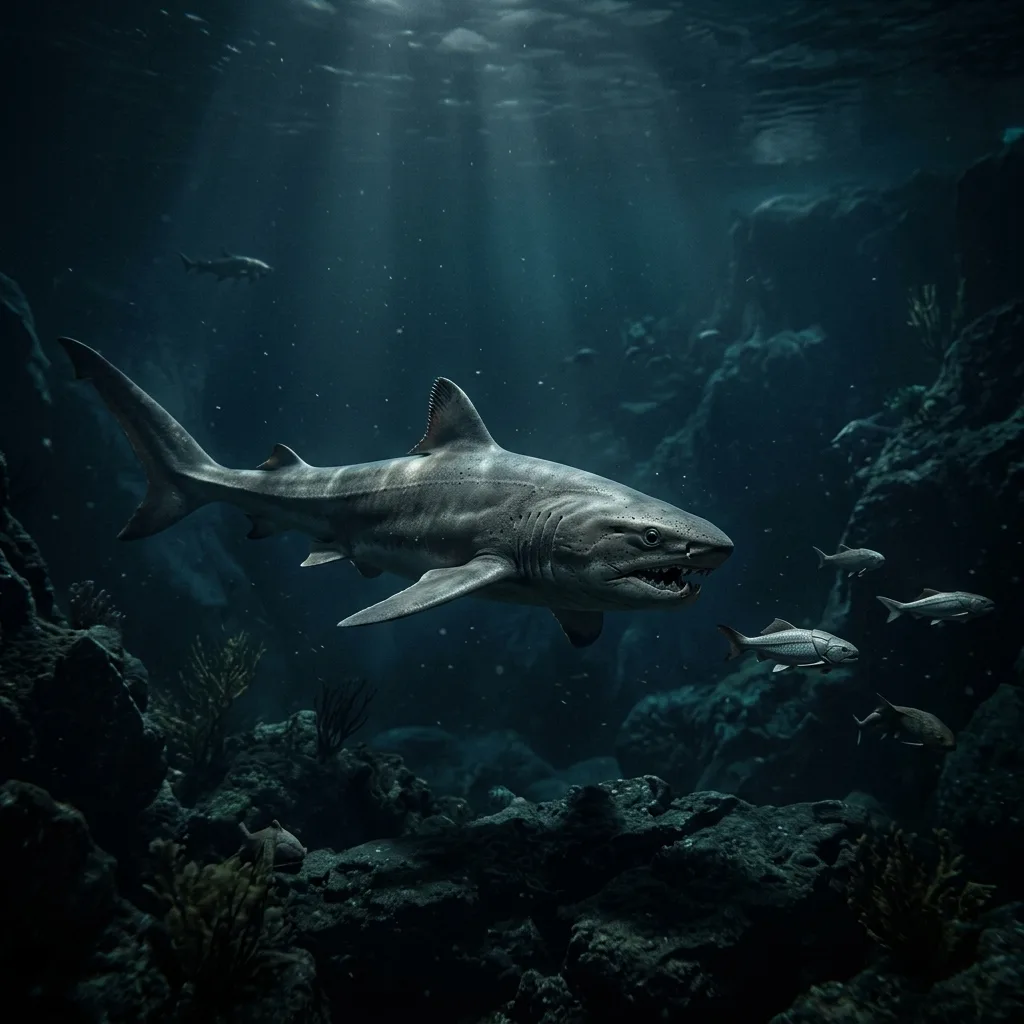
The earliest fossil evidence of sharks (fossilized scales) appears during the Ordovician period. These ancient cartilaginous fish would go on to survive four out of the five mass extinctions in Earth's history, perfectly adapting to the oceans.
Open in interactive timeline →Key Numbers
- First shark-like scales
- ~450 million years ago
- Mass extinctions survived
- 5 (all of them)
- Largest shark ever (megalodon)
- 15-18 m / up to ~60 ft
- Megalodon tooth length
- up to ~19 cm (7.5 in)
- Living shark species today
- 500+ described
Verified Facts
- Sharks predate trees, dinosaurs, and even Saturn's rings in some reckonings: the oldest undisputed shark-like scales, assigned to the genus Elegestolepis, are roughly 420 million years old from early Silurian deposits in Siberia, while contested shark-like scales push the lineage back to about 450 million years ago in the Late Ordovician.
- The earliest near-complete shark fossils are the ~380-million-year-old Cladoselache specimens from the Cleveland Shale of Ohio; remarkably, some preserve mineralized soft tissue including jaw and gill musculature and traces of kidneys, and the animal already had the streamlined body, two dorsal fins, and heterocercal tail blueprint inherited by nearly every later shark.
- Sharks are the only major vertebrate group to have survived all five of Earth's great mass extinctions, including the end-Cretaceous asteroid strike 66 million years ago that wiped out the non-avian dinosaurs.
- The Carboniferous Period (beginning ~359 million years ago) is nicknamed the 'Golden Age of Sharks' because the end-Devonian extinction wiped out roughly 75% of species and cleared the seas, letting sharks radiate into a bizarre diversity of shapes that has never been matched since.
- One Carboniferous-era star, Stethacanthus, was only about 60 cm long but bore an anvil- or ironing-board-shaped dorsal fin studded with tooth-like denticles, thought to have been used in mating display.
- The buzzsaw-toothed Helicoprion carried a spiral whorl of teeth in its lower jaw, but it was not a true shark at all; it belonged to a cartilaginous lineage more closely related to modern ratfishes (chimaeras).
- Otodus megalodon, the largest shark that ever lived, reached an estimated 15-18 meters (roughly 50-60 feet) and left teeth up to about 19 cm (7.5 inches) long; it cruised the Miocene and Pliocene oceans before going extinct around 3.6 million years ago.
- Sharks belong to the class Chondrichthyes and have skeletons made entirely of cartilage with no true bone, which is why their fossil record is dominated by the parts that mineralize easily: their hard scales and their teeth.
- A single shark can shed and replace teeth continuously throughout its life, producing well over ten thousand teeth over a lifetime, which is why fossil shark teeth are among the most abundant vertebrate fossils on Earth.
- Despite a 450-million-year history, sharks have remained strikingly conservative in form: the first confirmed sharks lived alongside the first trees and already looked recognizably shark-like, and today over 500 living species still occupy niches from deep abyssal waters to shallow seas and even rivers.
The World at This Moment
The first sharks emerged into a profoundly alien Earth. During the Late Ordovician and Silurian (roughly 455–420 Ma), most landmasses lay clustered as Gondwana over the southern pole, while Laurentia, Baltica and Avalonia straddled the equator, with the Iapetus Ocean closing toward the eventual Euramerica. Land was nearly barren: only bryophytes—mosses, liverworts, hornworts—and, by the mid-Silurian, the first vascular plant Cooksonia colonized deltaic margins. There were no trees, no forests, no terrestrial animals of consequence. The end-Ordovician mass extinction (~445 Ma), the second-largest in Earth history, driven by glaciation and sea-level collapse, had just reset marine ecosystems. Seas teemed with trilobites, brachiopods, cephalopods, graptolites, eurypterids, and armored jawless ostracoderms. Among jawed vertebrates (gnathostomes), the heavily armored placoderms and the spiny "acanthodians" shared the water with the earliest chondrichthyans. Sharks thus predate the first forests by some 65 million years—a fact emphasized by the Natural History Museum—and emerged in a world whose continents, atmosphere, and biosphere bore little resemblance to the modern planet.
The Paradigm Shift
The advent of chondrichthyans marks one of the foundational divergences of jawed vertebrates—our own clade. Around the Ordovician–Silurian boundary, the gnathostome lineage split into Chondrichthyes (cartilaginous fishes) and Osteichthyes (bony fishes, ancestral to tetrapods including humans). Sharks therefore anchor one half of the deepest branch on the vertebrate tree relevant to understanding our own jaws, teeth, and paired fins. Recent fossils have made this lineage scientifically pivotal: Andreev et al.'s 2022 description of Qianodus duplicis pushed the minimum age of toothed gnathostomes back ~14 million years to ~439 Ma, while its companion, Fanjingshania renovata, documents early fin-spine and dermal-skeleton architecture. Because chondrichthyans retain a largely cartilaginous skeleton and conservative body plan, they became a key "model" for inferring the ancestral gnathostome condition. The reinterpretation of acanthodians as stem-chondrichthyans (Brazeau; Davis et al.; Dearden et al.) further recast sharks not as a peripheral oddity but as the surviving crown of an enormous Paleozoic radiation that frames how anatomists reconstruct the origin of teeth, jaws, and limbs.
In Their Own Words
"We provide the earliest direct evidence for jawed vertebrates by describing Qianodus duplicis, a new genus and species of an early Silurian gnathostome based on isolated tooth whorls from Guizhou province, China." — Plamen S. Andreev, Ivan J. Sansom, Qiang Li, et al., "The oldest gnathostome teeth," Nature 609 (2022): 964–968
In Depth
The Cartilage Survivors: How Sharks Became Deep Time's Great Constant
Few lineages on the timeline can claim what sharks can: to have arisen near the dawn of complex marine animals and to still patrol the same oceans half a billion years later. The evolution of sharks is not a single moment but a slow, stubborn persistence — a story about what it takes to outlast the catastrophes that erase nearly everything else.
Deep Preconditions
The shark could not exist until the sea had been seeded with the right ingredients. The carbon and oxygen in its body trace back through generations of dying stars — the elements forged in the first supernovas (sv-first-supernova) that scattered heavy matter across the cosmos after the universe's beginning (sv-big-bang). Closer to home, the very chemistry of an aerobic predator depended on a breathable ocean, which arrived only when cyanobacteria flooded the atmosphere during the Great Oxygenation Event (sv-great-oxygenation). And a shark is, anatomically, a triumph of body-plan engineering — paired fins, jaws, a streamlined predatory build — none of which would have been possible without the explosion of animal diversity in the Cambrian Explosion (sv-cambrian-explosion), which itself unfolded only after the strange, soft-bodied experiments of the Ediacaran Biota (sv-ediacaran-biota) faded.
The earliest chondrichthyan traces are scattered scales and dermal denticles, possibly from the Late Ordovician roughly 455 million years ago, with the oldest undisputed shark scales (genus Elegestolepis) from the early Silurian around 420 million years ago. The first recognizable shark teeth belong to the enigmatic Leonodus — tiny, two-pronged fossils less than four millimeters long from the early Devonian. The oldest articulated body fossils, like Doliodus problematicus from New Brunswick, are about 409 million years old.
The Age of Fishes and a Golden Age
It was the Devonian, the "Age of Fishes," that gave sharks their proving ground. This same window of vertebrate experimentation produced the lobe-finned fish whose descendants would crawl ashore in the saga of Tiktaalik and the move to land (sv-tiktaalik) — meaning sharks and the entire terrestrial vertebrate line, including our own, are branches of one Devonian radiation. Then catastrophe became opportunity. The end-Devonian extinction wiped out roughly three-quarters of species, clearing the water and ushering in the Carboniferous "golden age of sharks," when some 45 families of cartilaginous fish flourished — among them the bizarre, anvil-finned Stethacanthus. This was also the era when the first true trees (sv-first-trees) built the coal forests onshore, a reminder that the golden age of sharks and the greening of the continents were contemporaries.
The Art of Surviving Catastrophe
What truly distinguishes sharks is endurance. The end-Permian extinction obliterated up to 99% of marine species, yet a few shark lineages slipped through, one giving rise to the neoselachians — the ancestors of all modern sharks, skates, and rays — in the Triassic. When the K-Pg extinction event (sv-dinosaur-extinction) annihilated the marine reptiles and non-avian dinosaurs 66 million years ago, chondrichthyans were comparatively spared; the genus Carcharias survives today as the sand tiger shark. The cartilaginous skeleton that makes early sharks so hard to fossilize may itself encode a survival strategy — light, flexible, efficient.
Across the same deep time that produced the first mammals (sv-first-mammals) and, eventually, the lineage leading to humans, the shark scarcely needed to change. It is the silent witness running beneath the entire human story — a design so well-tuned it predates trees, insects, and dinosaurs, and outlived them all. When humans finally invented writing, science, and now artificial minds, the oldest hunters were already ancient beyond reckoning.
Sources: Natural History Museum: Shark evolution timeline; Nature: oldest articulated chondrichthyan; elasmo-research: Earliest Sharks & Golden Age; fossilguy: Prehistoric Shark Evolution.
Causes & Consequences
What led to it
- The evolution of jawed vertebrates (gnathostomes), which arose by the late Silurian period, gave rise to the cartilaginous-fish lineage from which sharks descended, splitting from the bony-vertebrate (Osteichthyes) line.
- The origin of vertebrate jaws — widely thought to derive from modified anterior pharyngeal (gill) arches, as Karl Gegenbaur first proposed and as modern developmental and molecular studies of shark and skate embryos support — provided the grasping apparatus that let early sharks become mobile predators rather than jawless suspension feeders.
- The development of odontodes and tooth-like dermal denticles, the scale structures that share the same basic build as teeth, established the genetic and developmental toolkit later deployed to grow continuously replaced rows of shark teeth.
- Shark-like dermal scales appear in the fossil record as early as the late Ordovician, roughly 455 million years ago in deposits from what is now Colorado, with undisputed early shark scales (genus Elegestolepis) from the early Silurian of Siberia around 420 million years ago.
- The evolution of a lightweight, flexible cartilaginous endoskeleton — a secondary reduction of bone in chondrichthyan ancestors that had bony skeletons — gave early sharks buoyancy and maneuverability suited to active predation.
- The end-Devonian mass extinction wiped out roughly three-quarters of species, including the dominant armored placoderms, vacating marine ecological niches that surviving shark lineages were positioned to exploit.
What it set in motion
- The clearing of the seas after the Devonian let sharks radiate into the Carboniferous 'golden age of sharks,' during which roughly 45 families — more than exist today — produced a riot of forms including Cladoselache, the ctenacanths, and the bizarrely ornamented symmoriiforms like Stethacanthus and Falcatus.
- Shark lineages endured all five global mass extinctions over more than 450 million years, including the end-Permian event that killed about 96 percent of marine species — survived in part by retreating into deep-water refuges — making sharks one of the most persistent vertebrate groups on Earth.
- Modern shark orders emerged from this long lineage, with the oldest living group, the sixgill sharks (Hexanchiformes), appearing by the Early Jurassic around 195 million years ago, followed by most other modern shark groups through the rest of the Jurassic.
- The lineage produced the giant predatory sharks of the Cenozoic, including Otodus (Carcharocles) megalodon, the largest macropredatory shark known, whose serrated teeth and ecology reshaped Neogene marine food webs.
- The same evolutionary radiation gave rise to the modern great white shark, whose ancestry traces through broad-toothed mako-like forms such as Carcharodon hastalis and the transitional Carcharodon hubbelli rather than directly from megalodon, resolving a long-standing classification debate.
- Sharks diversified into the more than 500 living species occupying nearly every marine habitat — from filter-feeding whale sharks to deep-sea forms — and assumed apex- and meso-predator roles that structure ocean ecosystems today.
The Live Academic Debate
Two intertwined debates dominate. First: what counts as the "first shark"? Late Ordovician scales (~455 Ma, e.g., from Colorado and Siberia) are interpreted by some as chondrichthyan denticles, but critics argue these isolated microfossils cannot be securely diagnosed as true sharks rather than stem-gnathostomes; the oldest undisputed articulated chondrichthyan remains Doliodus problematicus (~400–409 Ma, Early Devonian), described by Miller, Cloutier, and Turner. Second, and more consequential: the status of "acanthodians." Once treated as a distinct class, mounting evidence—Brazeau's (2009) reanalysis of Ptomacanthus, Davis, Finarelli and Coates's (2012) restudy of the Acanthodes braincase, and phylogenetic work by Dearden, Frey, and colleagues—now widely supports acanthodians as a paraphyletic grade of stem-chondrichthyans. If correct, the earliest "sharks" look nothing like modern ones, and spiny acanthodians effectively are early chondrichthyans. Andreev, Sansom, and collaborators' Silurian Qianodus and Fanjingshania (2022) intensified discussion of how early dentitions and dermal skeletons assembled, though some researchers urge caution about phylogenetic placement from fragmentary material.
The Counterfactual
Had cartilaginous fishes never diverged—or vanished early—the consequences would be more interpretive than ecological, since the gnathostome jaw and the osteichthyan lineage (our ancestors) arose independently. Yet sharks' persistence has been scientifically indispensable. Without surviving chondrichthyans, reconstructing the ancestral jawed-vertebrate condition would lose its most informative living comparator; debates over the primitive versus derived nature of cartilage, placoid scales, and tooth whorls (illuminated by Doliodus, Cladoselache, and Qianodus) would rest far more heavily on incomplete fossils. Ecologically, the Carboniferous "golden age of sharks"—with ~45 families exploiting niches vacated by declining placoders—suggests chondrichthyans repeatedly filled top-predator roles; absent them, bony fishes or other lineages would plausibly have radiated into those roles, as teleosts later did. The deeper counterfactual concerns survival itself: sharks weathered all five mass extinctions, including the end-Permian and end-Cretaceous. Their loss at any juncture would have removed a major macropredatory guild for millions of years, with cascading but ultimately recoverable effects on marine trophic structure, as the fossil record of post-extinction recoveries implies.
Myth vs. Reality
Myth: Sharks have remained essentially unchanged for hundreds of millions of years -- they are 'living fossils.'
Reality: This is one of the most persistent myths in popular science, but paleontologists have actively rejected it. The first sharks looked nothing like modern ones, and shark lineages have radiated into wildly diverse forms across their history -- the Carboniferous in particular produced bizarre body plans with no modern equivalent. A 325-million-year-old fossil (Ozarcus mapesae, described in 2014) showed that early sharks had gill structures more like those of bony fishes, leading researchers to conclude that modern sharks are 'evolutionarily quite advanced' rather than primitive holdovers. As the Natural History Museum (London) puts it, sharks have 'evolved many different guises.'
Myth: A shark's cartilage skeleton is a primitive trait, proving sharks are more 'ancient' or less evolved than bony fish.
Reality: Cartilage is a derived, specialized condition, not a primitive one. The common ancestor of sharks and bony vertebrates had a bony skeleton, and the shark lineage secondarily lost most of its bone. A roughly 380-million-year-old Devonian fossil from Western Australia (the placoderm-related work and the 2015 study of an Acanthodes-like fish reported by Imperial College London) helped show sharks descended from bonier ancestors. Lighter cartilage is now interpreted as an adaptation for buoyancy and fast swimming, meaning sharks are not the 'primitive' branch the textbook story implied.
Myth: Megalodon was simply a giant great white shark -- the great white is its direct descendant.
Reality: Modern phylogenetic and dental analyses place megalodon in the genus Otodus, on a separate lineage (the otodontids) from the great white. The two are not in a direct ancestor-descendant relationship; great whites (Carcharodon) are more closely tied to broad-toothed mako sharks, while megalodon's closest living relatives trace toward the mako line. The superficial resemblance comes from convergent tooth shape and serrations -- megalodon's serrations are actually much finer. Some research (e.g., the NSF- and National Geographic-reported work) even suggests early great whites competed with and helped drive out megalodon, making them rivals rather than parent and child.
Myth: Megalodon may still be lurking undiscovered in the deep ocean.
Reality: There is no credible scientific evidence megalodon survives. A 2019 review by Boessenecker and colleagues concluded the species went extinct around 3.6 million years ago, in the early-to-mid Pliocene -- and as a shallow-water coastal predator dependent on warm seas and abundant whales, it could not hide in the cold deep sea. Its disappearance is linked to global cooling, loss of warm coastal nursery grounds, declining prey diversity, and competition, not to an undiscovered refuge. The 'it's still out there' idea comes largely from sensationalized television, not research.
Myth: Sharks are older than trees, so the sharks swimming today are essentially the same Ordovician animals.
Reality: The headline 'sharks are older than trees' is broadly accurate -- shark-like scales appear in the Late Ordovician (around 450 million years ago), tens of millions of years before the first true trees such as Wattieza and Archaeopteris in the Middle-to-Late Devonian (around 385 million years ago). But the framing misleads people into thinking modern sharks are that old. The earliest Ordovician 'sharks' are known only from scales, and some specialists doubt they are true sharks at all. Most modern shark families arose within roughly the last 100-150 million years, and the great white genus Carcharodon is only a few million years old.
Frequently Asked Questions
When did sharks first appear, and are they really older than the dinosaurs?
Sharks or their close relatives first appear in the fossil record around 450 million years ago, during the Late Ordovician Period, based on isolated scales. This means sharks predate the dinosaurs by well over 200 million years (dinosaurs arose roughly 230 million years ago) and have existed for nearly two and a half times as long as the entire age of dinosaurs. Because shark skeletons are made of cartilage rather than bone, they rarely fossilize fully, so the earliest record consists mostly of scales and, later, teeth.
Are sharks older than trees?
Yes. The shark fossil record begins around 450 million years ago, while the first true trees appeared roughly 385 million years ago in the Devonian Period, making sharks about 65 million years older. When the earliest sharks were swimming, the only land plants were low-growing mosses and liverworts. This frequently repeated fact comes from comparing the established fossil timelines of cartilaginous fishes and early land plants.
What is the oldest shark fossil ever found?
The oldest evidence of sharks comes from isolated scales dated to about 450 million years ago in the Late Ordovician. The earliest well-known shark teeth belong to Doliodus problematicus, an Early Devonian fish roughly 410 million years old, which is also among the first sharks known from a relatively complete skeleton. Sharks did not become common and diverse until the Devonian, around 400 million years ago.
How did sharks survive all five mass extinctions?
Sharks are among the few animal groups to survive all five of Earth's major mass extinctions, including the end-Permian event that wiped out roughly 96% of marine species. Research suggests some shark lineages endured catastrophes through habitat contraction, retreating into deep-sea refuges where conditions were more stable. Their resilience is also tied to traits like flexible diets, efficient cartilage skeletons, and electroreception. After the end-Devonian extinction, sharks radiated into many forms during the Carboniferous Period, often called the 'golden age of sharks.'
How big was Megalodon and when did it go extinct?
Otodus megalodon, whose name means 'giant tooth,' was the largest shark that ever lived, with most estimates placing it around 15 to 18 meters (50 to 60 feet) long; a 2025 study proposed it may have reached up to roughly 24 meters. Its teeth can be nearly three times the size of a great white's. Megalodon lived from about 23 million to 3.6 million years ago, according to a 2019 reassessment that pushed its extinction earlier than the previously cited 2.6 million years ago.
Why did Megalodon go extinct?
There is no single confirmed cause, but scientists point to a combination of factors during the cooling oceans of the Pliocene. A decline in Megalodon's large prey, climate-driven changes in ocean circulation, and rising competition likely all contributed. A 2022 Natural History Museum study comparing tooth chemistry suggested that newly evolving great white sharks may have competed with Megalodon for the same prey, helping push the giant toward extinction.
Sources & Further Reading
- Chondrichthyes — Wikipedia
- Andreev, P. S., Sansom, I. J., Li, Q., et al. (2022). 'The oldest gnathostome teeth.' Nature 609: 964–968
- Miller, R. F., Cloutier, R., & Turner, S. (2003). 'The oldest articulated chondrichthyan from the Early Devonian period.' Nature 425: 501–504
- Brazeau, M. D. (2009). 'The braincase and jaws of a Devonian ‘acanthodian’ and modern gnathostome origins.' Nature 457: 305–308
- Davis, S. P., Finarelli, J. A., & Coates, M. I. (2012). 'Acanthodes and shark-like conditions in the last common ancestor of modern gnathostomes.' Nature 486: 247–250
- Dearden, R. P., Stockey, C., & Brazeau, M. D. (2019). 'The pharynx of the stem-chondrichthyan Ptomacanthus and the early evolution of the gnathostome gill skeleton.' Nature Communications 10: 2050
- Wikipedia: Evolution of sharks
- Natural History Museum: Shark Evolution
Cite This Page
AskHistoryAI. “The Evolution of Sharks.” AskHistoryAI — Interactive Timeline of Everything. Updated 2026-09-11. https://askhistoryai.com/event/sv-first-sharks/
Every fact on this page is checked against the published fact ledger and methodology; sources are listed above.