The Cambrian Explosion
Biology's "Big Bang" and the sudden appearance of complex animal life.
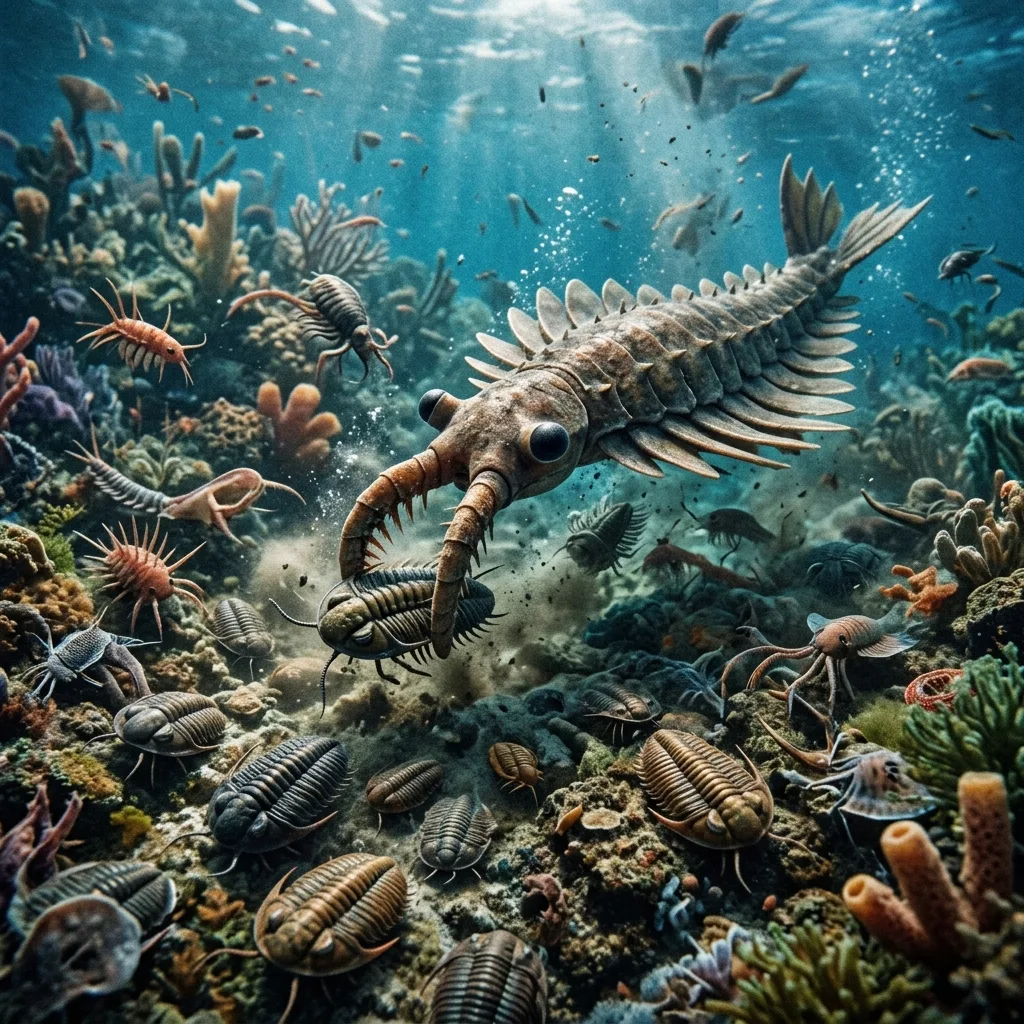
For billions of years, life on Earth was incredibly simple. Then, suddenly, over a period of just a few million years, an unparalleled burst of rapid evolution occurred. Almost all of the major animal body plans we see today abruptly appeared in the fossil record.
Open in interactive timeline →Key Numbers
- Onset
- ~538.8 million years ago
- Main burst duration
- ~13-25 million years
- Animal phyla appearing
- ~20 major phyla
- Burgess Shale specimens (Walcott)
- 65,000+
- Anomalocaris (apex predator)
- ~tens of cm, up to ~1 m est.
Verified Facts
- The Cambrian Explosion marks the geologically sudden appearance of most major animal body plans; roughly 20 of the ~40 living animal phyla, including essentially all the readily fossilizable ones, first show up in the fossil record over just a few tens of millions of years in the early Cambrian.
- High-precision radiometric dating places the Ediacaran-Cambrian boundary between about 538.99 and 538.58 million years ago, and recent work argues the main diversification burst was far shorter than once thought, with the most explosive phase often bracketed between roughly 530 and 520 million years ago.
- On August 30, 1909, American geologist Charles Doolittle Walcott, then Secretary of the Smithsonian Institution, discovered the Burgess Shale in Yoho National Park, British Columbia; across field trips from 1909 to 1924 he collected more than 65,000 specimens.
- The Burgess Shale is a Lagerstatte famous for exceptional soft-tissue preservation, capturing eyes, guts, and other soft parts that normally decay, giving a rare window into organisms beyond just hard shells and exoskeletons.
- The Chengjiang biota of Yunnan, China, dated to about 518 million years ago and named a UNESCO World Heritage Site in 2012, is the earliest exceptionally preserved Cambrian community, documenting at least sixteen phyla and roughly 196 species, including some of the oldest known chordates and vertebrates.
- Anomalocaris was among the largest Cambrian animals and is often called the first true apex predator; while traditionally reconstructed at up to about 1 meter, more recent analyses of body proportions suggest many specimens were closer to a few tens of centimeters, and its compound eyes preserved thousands of lenses for tracking prey.
- Trilobites possessed the oldest well-preserved visual systems known: early Cambrian forms already had complex compound (holochroal) eyes built from transparent calcite crystal lenses, with the trilobite eye record running from about 520 million years ago.
- Leading explanations frame the explosion as a feedback loop rather than a single cause: a rise in atmospheric and oceanic oxygen crossed an ecological threshold that enabled active predators, and the onset of carnivory triggered an evolutionary arms race producing eyes, hard skeletons, burrowing, and complex nervous systems.
- Molecular-clock estimates suggest the genetic divergence of major animal lineages began in the Ediacaran, before the Cambrian, implying the 'explosion' partly reflects a burst in fossilizable hard parts and ecological complexity rather than the sudden origin of all lineages from nothing.
- Stephen Jay Gould popularized the Burgess Shale in his 1989 book Wonderful Life, arguing it showed early animal disparity was extraordinarily wide and that the survivors who shaped later life were partly a matter of contingency, a thesis later debated by paleontologists such as Simon Conway Morris.
The World at This Moment
The Cambrian radiation, conventionally dated to roughly 538.8 Ma at the Ediacaran–Cambrian boundary, was not an isolated burst but the climax of profound late-Neoproterozoic upheaval. It followed the severe "Snowball Earth" glaciations—the Sturtian (c. 717–660 Ma) and Marinoan (c. 650–635 Ma)—and the milder Gaskiers event (c. 580 Ma). Across this interval, atmospheric and oceanic oxygen rose episodically (the Neoproterozoic Oxygenation Event), and the soft-bodied Ediacaran biota flourished then largely vanished in a biotic turnover around 550–539 Ma. Tectonically, the supercontinent Rodinia had fragmented, and Gondwana was assembling; widening shallow seas, intense continental weathering, and a large basal-Cambrian carbon-isotope excursion (BACE) accompanied the transition. Crucially, no humans, plants, or land life existed; the drama was entirely marine. Trace fossils show deepening bioturbation ("agronomic revolution"), and the first mineralized skeletons (the "small shelly fauna") appear in the Fortunian. The famous Lagerstätten—China's Chengjiang biota (c. 518 Ma) and Canada's Burgess Shale (c. 508 Ma)—postdate the explosion's onset, preserving its aftermath.
The Paradigm Shift
The Cambrian Explosion redirected the trajectory of life by assembling, within perhaps 13–25 million years, nearly all the major animal body plans (phyla) that persist today—arthropods, chordates, mollusks, echinoderms, brachiopods—including the first vertebrates such as Chengjiang's Myllokunmingia. Stephen Jay Gould's distinction between "diversity" (species count) and "disparity" (range of body plans) reframed the event: disparity, he argued, reached an early maximum and was subsequently pruned, inverting the intuitive cone-of-increasing-variety. The radiation also marks the base of the Phanerozoic eon and the practical beginning of the rich fossil record. Ecologically, it inaugurated modern food webs—active predation (Anomalocaris), hard skeletons, eyes, burrowing, and an "arms race" that restructured the seafloor. For evolutionary biology it became the paradigm case of macroevolutionary innovation, forcing engagement with developmental genetics (the deep conservation of Hox genes) and with the tempo and mode of evolution. It transformed how scientists conceptualize the relationship between genotype, development, ecology, and morphological novelty.
In Their Own Words
"The case at present must remain inexplicable; and may be truly urged as a valid argument against the views here entertained." — Charles Darwin, On the Origin of Species (1859), Chapter X, "On the sudden appearance of groups of allied species in the lowest known fossiliferous strata," pp. 313–314, discussing what is now called the Cambrian Explosion (then attributed to the "Silurian" system).
In Depth
The Hinge of Animal Life
Around 538 million years ago, in the span of a geological eyeblink, the oceans of Earth filled with creatures bearing eyes, shells, claws, antennae, and articulated limbs. The Cambrian Explosion is the single most consequential burst of biological novelty in the planet's history: nearly every major animal body plan, or phylum, that exists today first appears in the fossil record within a window of roughly 13 to 25 million years. Arthropods, mollusks, echinoderms, annelids, and our own group, the chordates, all trace their architecture to this moment. To stand before a Burgess Shale slab from about 505 million years ago is to read the opening chapter of every animal lineage that followed.
The Long Fuse
No explosion detonates without a fuse, and the Cambrian's was billions of years long. The story begins, as all stories on this site do, with the forging of matter in the Big Bang (sv-big-bang) and the heavy elements cooked inside the first supernovas (sv-first-supernova), which seeded the carbon, oxygen, and iron that biochemistry requires. Once Earth formed (sv-earth-formation) and life took hold (sv-origin-of-life), the planet spent eons assembling preconditions. The Great Oxygenation Event (sv-great-oxygenation) loaded the atmosphere with the oxygen that large, active, energy-hungry bodies would later demand. The arrival of complex cells (sv-first-complex-cells) supplied the mitochondrial power plants for multicellularity, and the invention of sexual reproduction (sv-invention-of-sex) accelerated the genetic shuffling that natural selection feeds on.
Closer still, the brutal global glaciations of Snowball Earth (sv-snowball-earth) appear to have reset ocean chemistry and oxygen levels in the run-up to animal life, and the soft, frondlike organisms of the Ediacaran biota (sv-ediacaran-biota) represent the first true experiments in large multicellular form, a quiet rehearsal before the main act. The Cambrian did not arrive from nowhere; it was the cashing-in of a long deposit.
Why It Detonated
Scientists no longer seek a single trigger. The consensus is a feedback loop. Rising oceanic oxygen permitted larger, more metabolically demanding bodies. The duplication and divergence of Hox and other homeobox developmental genes gave evolution a richer toolkit for sculpting segmented, patterned anatomy. And crucially, the invention of predation lit an evolutionary arms race: the first eyes, the first armored shells, the first burrowing escape behaviors all coevolved as hunters and hunted drove one another's complexity upward. Ecology became a furnace.
The Ripples Forward
Everything muscular, eyed, and skeletal that came after is downstream of this event. The chordate body plan that debuted here led to the first jawed predators like the early sharks (sv-first-sharks), then to the lobe-finned pioneers of Tiktaalik (sv-tiktaalik) who hauled vertebrate life onto land, where it would meet the first true trees (sv-first-trees) and the earliest insects (sv-earliest-insects). From that vertebrate thread came the first mammals (sv-first-mammals), survivors of the K-Pg catastrophe (sv-dinosaur-extinction), and eventually the primates whose branch produced us. Every reader of this timeline carries a notochord first drafted in Cambrian seas.
There is a humbling lesson here. The Cambrian shows that complexity arrives not gradually but in punctuated leaps, when accumulated preconditions cross a threshold and feedback loops ignite. It is a pattern worth holding in mind as one reads forward to the agricultural, industrial, and digital explosions of the human story, and to the speculative intelligence explosion that this site's later entries anticipate. Life's body plans were written once, in a geological instant, and never fundamentally rewritten since. We are still living inside the Cambrian's answer.
Causes & Consequences
What led to it
- The Marinoan 'Snowball Earth' glaciation (ending roughly 635 million years ago) was followed by intense deglacial weathering and nutrient delivery to the oceans, setting up the environmental conditions in which complex life later flourished.
- A rise in atmospheric and shallow-ocean oxygen across the late Ediacaran and into the early Cambrian crossed thresholds needed to sustain larger, more active, metabolically demanding animals; recent work argues even a modest oxygen increase was enough to enable the radiation.
- The soft-bodied Ediacaran biota (about 635-541 million years ago) represented the first widespread multicellular animal communities, providing an evolutionary precursor whose disappearance opened ecological space for Cambrian forms.
- The assembly of the bilaterian developmental genetic toolkit, including expansion of Hox and ParaHox genes in the last common ancestor of bilaterians (Urbilateria, with at least seven Hox genes), gave animals the regulatory machinery to build complex, regionalized body plans.
- Changes in seawater chemistry, including elevated calcium and carbonate ion concentrations linked to enhanced continental weathering and the erosion recorded by the Great Unconformity, made biomineralization of shells and skeletons chemically feasible.
- The onset of mobile bilaterian burrowing in the late Ediacaran (the early agronomic revolution, recorded by penetrative trace fossils) began disturbing microbial matground substrates, reshaping the seafloor before the main Cambrian radiation.
What it set in motion
- Most of the major animal phyla seen today, including arthropods, mollusks, chordates, echinoderms, and annelids, first appear during the Cambrian, so essentially every major animal group alive now traces its origin to this interval (beginning roughly 538.8 million years ago).
- No fundamentally new animal phyla have evolved since the Cambrian, meaning the basic architecture and body plans of animal life were effectively fixed for the following 500-plus million years.
- The widespread evolution of biomineralized shells, spines, and skeletons created a durable fossil record and equipped animals with protection, structural support, and predatory tools such as teeth and claws.
- A predator-prey evolutionary arms race took hold, driving stronger defenses and more capable predators and establishing complex, multi-tiered marine food webs.
- The Cambrian substrate revolution and intensified bioturbation replaced microbial matgrounds with churned, oxygenated 'mixground' sediments, permanently transforming seafloor ecology and ocean-sediment chemistry.
- The first chordates and stem-vertebrates appeared, including Pikaia from the Burgess Shale and Myllokunmingia from the Chengjiang biota of China, founding the lineage that would ultimately lead to fish, land vertebrates, and humans.
- Exceptional fossil deposits such as the Burgess Shale (British Columbia) and Chengjiang (Yunnan, China) preserved soft-bodied Cambrian animals, becoming key windows for understanding early animal evolution and popularized in works like Stephen Jay Gould's 'Wonderful Life.'
The Live Academic Debate
Several genuine debates persist. First, was the explosion a real evolutionary event or a preservational and observational artifact? Molecular-clock estimates often push the divergence of animal phyla deep into the Cryogenian, well before their fossil appearance, implying a long "cryptic" history; Budd, Jensen, and others stress that the body-fossil record nonetheless registers a genuine ecological and morphological radiation. Second, causation is contested: Erwin, Knoll, and Wood emphasize environmental triggers (oxygen, nutrient supply), while others foreground developmental-genetic potential (the assembly of regulatory toolkits) and ecological feedbacks such as predation and bioturbation—most likely a multifactorial confluence rather than any single cause. The much-discussed "oxygen hypothesis" itself is unsettled; recent geochemical work shows deep-marine oxygen remained low and fluctuating long afterward. Third, the Gould–Conway Morris dispute over contingency versus convergence frames how to read Burgess Shale disparity—whether the "weird wonders" represent failed phyla or stem-group relatives of living lineages, a reinterpretation Conway Morris and Briggs themselves advanced against Gould's reading.
The Counterfactual
Counterfactual reasoning here is constrained but instructive. Had the requisite environmental thresholds not been crossed—sufficient oxygenation of shallow seas, the post-glacial nutrient pulse, and the ecological opening left by the Ediacaran turnover—animal diversification might have remained stalled at the low-disparity, largely sessile grade of the Ediacaran biota, as Wood and Erwin's work on environmental permissiveness implies. Gould's "replaying the tape of life" thesis (Wonderful Life, 1989) presses the strongest version: rerun history and a different, unpredictable subset of body plans survives, perhaps excluding the chordate lineage that led to vertebrates and ultimately humans. Simon Conway Morris counters (Life's Solution, 2003) that pervasive evolutionary convergence makes complex, even intelligent, life broadly probable regardless of which Cambrian lineages won. The honest position is that the deterministic-versus-contingent question remains unresolved; what is defensible is that absent the Cambrian radiation's establishment of bilaterian body plans, the subsequent half-billion years of animal evolution—and our own existence—would lack their structural foundation.
Myth vs. Reality
Myth: The Cambrian Explosion was a sudden, near-instantaneous event in which complex animals popped into existence overnight.
Reality: The "explosion" is geologically rapid but unfolded over millions of years, not instantly. The diversification of animal body plans played out across roughly 541 to 520 million years ago, with the most intense burst lasting on the order of 13 to 25 million years before evolutionary rates settled back to normal. A 2019 study of trilobite evolutionary rates (Paterson et al., PNAS) found these rates, though fast, are entirely consistent with ordinary natural selection observed in living organisms. "Explosion" is a label for tempo relative to deep time, not a literal sudden appearance.
Myth: Animals first appeared in the Cambrian, with nothing living before it.
Reality: Complex multicellular life predates the Cambrian. The Ediacaran biota (roughly 635 to 541 million years ago), first recognized in South Australia in the 1940s, documents large soft-bodied organisms, and Precambrian rocks preserve trace fossils such as burrows requiring muscular, multicellular animals. Most molecular-clock studies push the origin of animal lineages into the Ediacaran, well before they appear abundantly as fossils. This discovery of Precambrian life largely resolved the gap that troubled Darwin.
Myth: All modern animal phyla suddenly originated in the Cambrian, and no new phyla have arisen since.
Reality: Most major animal phyla do have Cambrian or Ediacaran-Cambrian origins, but the picture is messier than a single burst. Some groups appear later: bryozoans were long thought to originate in the Ordovician (though fossils reported in 2021 may push them into the early Cambrian, a claim still debated). Many phylum-level body plans also continued diversifying after the Cambrian, and a number of body plans that arose then went extinct, so total early disparity was not simply equal to today's surviving phyla.
Myth: Cambrian animals were utterly bizarre "weird wonders" unlike anything alive today.
Reality: Stephen Jay Gould's influential 1989 book Wonderful Life portrayed Burgess Shale fauna as radically alien, but later work reinterpreted many of these animals as early members or relatives of familiar living groups (for example, Hallucigenia as a lobopodian related to velvet worms and arthropods). Studies of morphological disparity found the range of body plans the Cambrian filled was not dramatically larger than that occupied by modern marine animals. Cambrian creatures were genuinely unusual, but most fit within the broader tree of living animal lineages.
Myth: Scientists know that a single cause, usually a rise in oxygen, triggered the Cambrian Explosion.
Reality: The cause remains an active, unresolved debate, and most researchers favor a combination of factors rather than one trigger. Proposed drivers include rising oxygen, the end of severe "Snowball Earth" glaciations, changes in seawater chemistry and nutrient (phosphorus) availability, and ecological dynamics such as the rise of predation. The oxygen hypothesis is contested: some studies report only a small oxygenation signal at the Ediacaran-Cambrian boundary, suggesting oxygen alone cannot explain the rapid rise in biological complexity.
Frequently Asked Questions
What was the Cambrian Explosion?
The Cambrian Explosion was an interval of rapid evolutionary diversification, beginning roughly 538.8 million years ago at the start of the Cambrian Period, during which most major animal body plans (phyla) appeared in the fossil record over a geologically brief span. Within roughly 13 to 25 million years, animals diversified into full-bodied creatures with hard and soft body parts, including the ancestors of arthropods, molluscs, chordates, cnidarians, and brachiopods. It is considered one of the most significant events in the history of life because the great majority of modern animal phyla trace their first appearances to this window.
When did the Cambrian Explosion happen and how long did it last?
It began at the start of the Cambrian Period, about 538.8 million years ago, with the most intense diversification of body plans often placed between roughly 530 and 520 million years ago. Estimates of its duration range from about 13 to 25 million years, depending on which fossil and geochemical markers are used. This is extremely brief in geological terms, which is why the event is described as an 'explosion' relative to the roughly four billion years of Precambrian time that preceded it.
What caused the Cambrian Explosion?
There is no single agreed-upon cause; most researchers now favor an interplay of environmental and biological triggers. A rise in atmospheric and shallow-ocean oxygen is frequently cited, though recent studies suggest the increase may have been relatively small and acted alongside other factors. Other leading drivers include the evolution of vision and a predator-prey 'arms race,' genetic and developmental innovations, and changes in seawater chemistry and nutrient availability. The current scientific consensus is that the event emerged from a complex combination of modest environmental changes that triggered large ecological and evolutionary responses.
What is the Burgess Shale and why is it important?
The Burgess Shale is a fossil deposit in the mountains of British Columbia, Canada, discovered in 1909, that preserves a snapshot of marine life from about 508 million years ago in the middle Cambrian. Its exceptional preservation captures soft-bodied animals that are normally lost from the fossil record, revealing the anatomy and diversity of early Cambrian communities. For about 75 years it remained the best window onto what a Cambrian marine ecosystem looked like, and it remains central to scientists' understanding of the event's aftermath.
Why was the Cambrian Explosion a problem for Darwin?
In 'On the Origin of Species' (1859), Charles Darwin viewed the seemingly sudden appearance of complex animals at the base of the Cambrian, with little fossil evidence beneath it, as a serious difficulty for his theory of gradual evolution. This came to be known as 'Darwin's dilemma.' It was substantially eased beginning in the 1940s with the discovery of the older, soft-bodied Ediacaran biota in South Australia, and later by the extension of the documented fossil record back roughly 3.5 billion years, showing that life long predated the Cambrian even where it left few obvious fossils.
What lived before the Cambrian Explosion?
The period immediately before the Cambrian was the Ediacaran (roughly 635 to 539 million years ago), home to the Ediacaran biota, a group of mostly soft-bodied organisms such as Dickinsonia and Kimberella. These forms were generally simpler and lacked the hard shells, eyes, and active predation that characterized many Cambrian animals. Recent research on burrowing and seabed traces suggests the transition was less abrupt than once thought, with increasing ecological complexity already underway in the latest Ediacaran before the Cambrian boundary.
Did eyes and predators first appear during the Cambrian Explosion?
The Cambrian saw the rise of sophisticated vision and active predation, which many researchers consider a catalyst for the diversification. Trilobites possessed advanced compound eyes from their earliest appearance in the fossil record, and large predators such as Anomalocaris are regarded as among the first apex predators. The resulting predator-prey 'arms race' is thought to have driven the evolution of biomineralized shells, defensive spines, and other protective adaptations, helping fuel the rapid burst of animal diversity.
Sources & Further Reading
- Cambrian explosion — Wikipedia
- Douglas H. Erwin & James W. Valentine, The Cambrian Explosion: The Construction of Animal Biodiversity (Roberts and Company, 2013)
- Stephen Jay Gould, Wonderful Life: The Burgess Shale and the Nature of History (W. W. Norton, 1989)
- Simon Conway Morris, Life's Solution: Inevitable Humans in a Lonely Universe (Cambridge University Press, 2003)
- Graham E. Budd & Sören Jensen, 'The origin of the animals and a 'Savannah' hypothesis for early bilaterian evolution,' Biological Reviews (2017); and Budd & Jensen, 'A critical reappraisal of the fossil record of the bilaterian phyla,' Biological Reviews 75 (2000)
- Rachel Wood et al., 'Integrated records of environmental change and evolution challenge the Cambrian Explosion,' Nature Ecology & Evolution 3 (2019)
- Scientific American: What Sparked the Cambrian Explosion?
Cite This Page
AskHistoryAI. “The Cambrian Explosion.” AskHistoryAI — Interactive Timeline of Everything. Updated 2026-09-11. https://askhistoryai.com/event/sv-cambrian-explosion/
Every fact on this page is checked against the published fact ledger and methodology; sources are listed above.