Martin Luther & The Reformation
The shattering of religious authority in Europe.
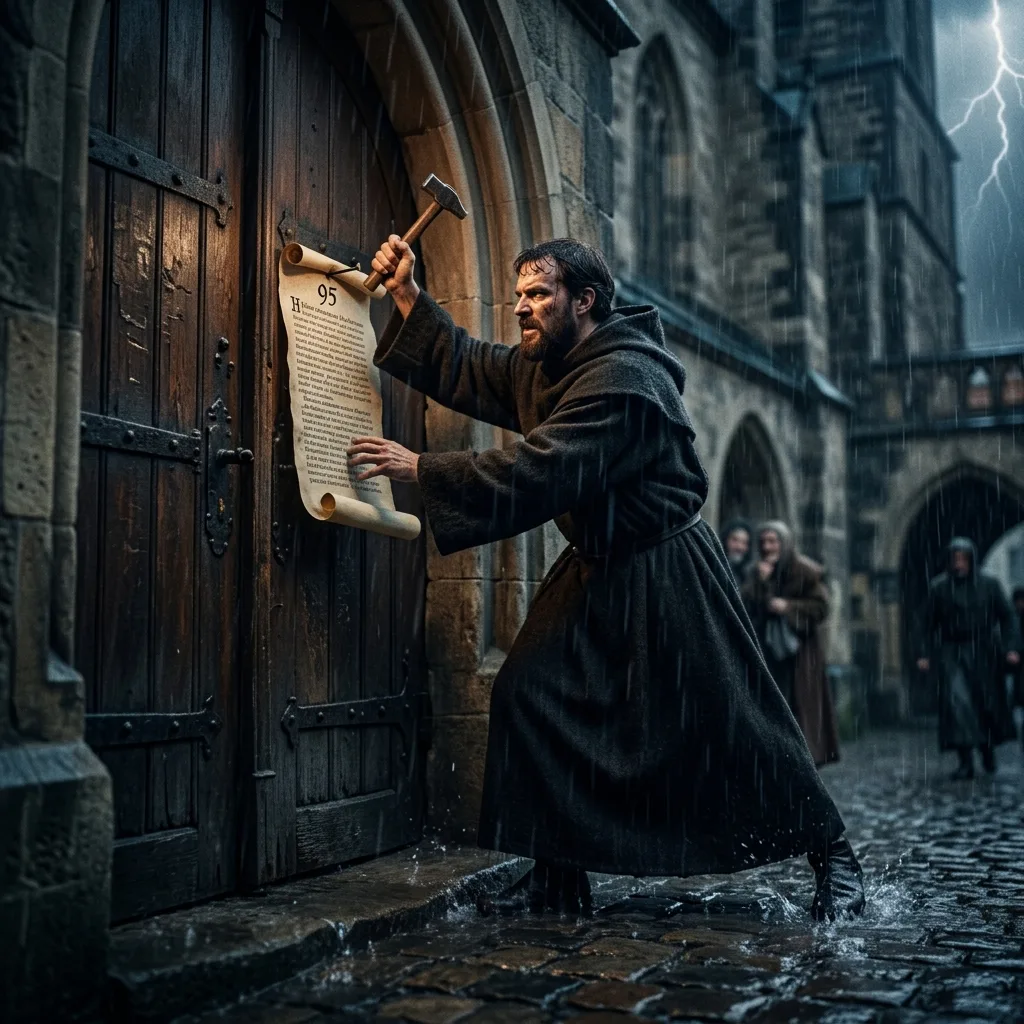
Martin Luther nails his 95 Theses to the door of the Wittenberg Castle church, challenging the sale of indulgences and papal authority. Enabled by the printing press, his ideas spread like wildfire.
Open in interactive timeline →Key Numbers
- Year Reformation began
- 1517
- Theses posted
- 95
- Luther's NT translated in
- <100 days
- Bibles sold by 1530s
- 200,000+
- Peasants' War dead
- ~100,000
Verified Facts
- On October 31, 1517, Martin Luther sent his Ninety-Five Theses, an academic challenge to the sale of indulgences, to the Archbishop of Mainz; the popular image of him dramatically nailing them to the Wittenberg Castle Church door first appears in accounts written over a century later and is doubted by many historians.
- The theses targeted the indulgence campaign of the Dominican friar Johann Tetzel, whose preaching financed the rebuilding of St. Peter's Basilica in Rome; Tetzel is traditionally associated with the jingle that a soul springs from purgatory the moment the coin clinks in the chest.
- Pope Leo X issued the papal bull Exsurge Domine on June 15, 1520, condemning 41 of Luther's propositions and threatening excommunication unless he recanted within 60 days; Luther publicly burned the bull and was formally excommunicated on January 3, 1521, by the bull Decet Romanum Pontificem.
- At the Diet of Worms in April 1521, Luther refused to recant before Emperor Charles V, declaring his conscience captive to the Word of God; the famous closing line 'Here I stand, I can do no other' is likely apocryphal, as the earliest printed reports do not contain it.
- The Edict of Worms (May 1521) declared Luther an outlaw and heretic, banning his writings and making it legal to kill him without consequence; his protector Frederick the Wise of Saxony staged a fake kidnapping and hid him at the Wartburg Castle.
- While in hiding at the Wartburg, Luther translated the entire New Testament from Greek into German in roughly eleven weeks; his 'September Testament' appeared in 1522 in a print run of around 3,000 copies and sold out so fast a revised 'December Testament' followed within months.
- Luther's complete German Bible, a collaborative effort with scholars including Philipp Melanchthon, was published in 1534; by then dozens of editions had appeared and over 200,000 copies of his scripture translations had been sold, profoundly shaping the modern standardized German language.
- Luther became arguably the first best-selling author of the print era: by 1525 his works had sold in the hundreds of thousands, and his short, cheap vernacular pamphlets (Flugschriften) spread rapidly even though German literacy was roughly 5% in rural areas and around 30% in towns, since texts were read aloud to crowds.
- During the German Peasants' War of 1524-1525, rebels invoked Luther's ideas, but he turned sharply against them in his 1525 tract 'Against the Murderous, Thieving Hordes of Peasants,' urging the nobility to crush the revolt; an estimated 100,000 of roughly 300,000 peasant participants were killed.
- In June 1525 Luther, a former Augustinian friar, married Katharina von Bora, a former Cistercian nun who had fled her convent; their household in the Black Cloister at Wittenberg became a model for the Protestant clerical family. Luther was born in Eisleben in 1483 and died there in 1546.
The World at This Moment
When Luther circulated his Ninety-five Theses against indulgences in Wittenberg on 31 October 1517, the wider world was in violent flux. The Ottomans under Selim I had just crushed the Mamluks (1516–17), seizing Egypt and the Levant; Suleiman the Magnificent succeeded him in 1520 and would reach the gates of Vienna by 1529, making the "Turkish threat" a constant pressure on Charles V, the Habsburg emperor elected in 1519 who would confront Luther at Worms. In Mesoamerica, Hernán Cortés landed in 1519 and toppled the Aztec capital Tenochtitlan by 1521. Babur won Panipat in 1526, founding the Mughal Empire; Safavid Persia under Ismail I had recently been checked at Chaldiran (1514). Ming China pursued increasing isolation. Gutenberg's movable type, perfected around 1450, had matured into a continent-wide print industry. Luther's revolt was thus one node in a global age of gunpowder empires, oceanic expansion, and accelerating information flow—uniquely, his was a movement that weaponized the printing press itself.
The Paradigm Shift
Luther shattered the medieval Latin Church's monopoly on salvation and interpretation. His doctrines—justification by faith alone (sola fide), Scripture alone as authority (sola scriptura), and the priesthood of all believers—dissolved the mediating necessity of priest, sacrament, and pope, relocating religious authority in the individual conscience reading a vernacular Bible. His German New Testament (1522) and complete Bible (1534) helped standardize the language and modeled vernacular scripture across Europe. The movement's symbiosis with print was decisive: pamphlets (Flugschriften) made Luther, in Andrew Pettegree's argument, the first mass-media celebrity and Europe's first truly public controversy. Politically, the Reformation fractured Latin Christendom into rival confessions, fueling the Schmalkaldic and Thirty Years' Wars and eventually the 1648 Westphalian settlement. Many scholars trace longer threads—toward literacy, religious toleration, individualism, and the disenchanting habits of mind feeding the Scientific Revolution and Enlightenment—though these consequences were largely unintended and contested. The break was irreversible: Western Christianity would never again be a single institution.
In Their Own Words
"Unless I am convinced by the testimony of the Scriptures or by clear reason (for I do not trust either in the pope or in councils alone, since it is well known that they have often erred and contradicted themselves), I am bound by the Scriptures I have quoted and my conscience is captive to the Word of God. I cannot and will not recant anything, since it is neither safe nor right to go against conscience. God help me. Amen." — Martin Luther, statement before the Diet of Worms, 18 April 1521 (documented portion; the appended "Here I stand, I can do no other" is traditional but apocryphal). Recorded in the Reichstagsakten and Luther's Werke (Weimarer Ausgabe, vol. 7).
Our Lord and Master Jesus Christ, when He said Poenitentiam agite, willed that the whole life of believers should be repentance.
Martin Luther, Thesis 1 of the Ninety-five Theses (Disputatio pro declaratione virtutis indulgentiarum), 1517. English from Works of Martin Luther, trans. Adolph Spaeth et al., A. J. Holman Company, Philadelphia, 1915, vol. 1. — source
Unless I am convinced by the testimony of the Scriptures or by clear reason (for I do not trust either in the pope or in councils alone, since it is well known that they have often erred and contradicted themselves), I am bound by the Scriptures I have quoted and my conscience is captive to the Word of God. I cannot and will not recant anything, since it is neither safe nor right to go against conscience.
Martin Luther's documented reply at the Diet of Worms, April 18, 1521. NOTE: no verbatim transcript survives; this wording is reconstructed from contemporary witness accounts (as in Roland H. Bainton, Here I Stand, 1950, and H. C. Bettenson, Documents of the Christian Church). This is the well-attested core; the popular tag-line 'Here I stand, I can do no other' is a later addition and is excluded. — source
If any one saith, that by faith alone the impious is justified, in such wise as to mean, that nothing else is required to co-operate in order to the obtaining the grace of Justification, and that it is not in any way necessary, that he be prepared and disposed by the movement of his own will: let him be anathema.
Council of Trent, Session VI (Decree on Justification), Canon 9, January 13, 1547 — the Catholic Counter-Reformation's formal condemnation of Luther's sola fide. English from the standard H. J. Schroeder translation / the Canons and Decrees of the Council of Trent. — source
In Depth
The Word Set Loose: How a Monk's Protest Splintered Christendom
When Martin Luther aired his Ninety-Five Theses in Wittenberg on October 31, 1517, he intended a scholarly disputation over the sale of indulgences. He got a continental rupture instead. The event is often told as a story of one man's conscience, but its deeper logic lies in the technologies, ideas, and grievances that had been accumulating for generations. Luther struck a match in a room already filled with gas.
The Preconditions
The single most important precondition was mechanical. Johannes Gutenberg's movable-type press (sv-printing-press), perfected around 1450, meant that a Latin academic broadsheet could become a German-language mass medium within weeks. By the end of 1517, editions of the Theses had been printed in Leipzig, Nuremberg, and Basel. No earlier reformer—not Wycliffe, not Hus—had this amplifier. Luther became, in effect, the first author of the print age, and the Reformation was its first viral phenomenon.
The intellectual soil was prepared by the Italian Renaissance (sv-renaissance) and its humanist scholarship. The cry of ad fontes—back to the sources—sent scholars like Erasmus to the original Greek New Testament, exposing gaps between church practice and scripture. Luther's sola scriptura was humanism turned against the institution that had funded it. Behind that lay the recovery of textual and philosophical rigor that ran from Aristotle (sv-aristotle) through the medieval universities, and ultimately the long Christianizing arc that began when Constantine convened Nicaea (sv-constantine-legal) and Augustine of Hippo (sv-augustine) gave Western Christianity its theology of grace—the very doctrine Luther claimed to be restoring.
There were also raw grievances. Johann Tetzel's indulgence campaign, blessed by Pope Leo X and the Archbishop of Mainz, was nakedly financial: money flowing from German peasants to rebuild St. Peter's in Rome. German resentment of Italian extraction gave Luther's theology a nationalist engine the way the earlier East-West rupture of the Great Schism (sv-great-schism) had fractured Christendom once before.
The Ripple Effects
Summoned to the Diet of Worms in April 1521, Luther refused to recant and was declared an outlaw. Sheltered at the Wartburg, he produced his most consequential weapon: a German New Testament (1522), with the full Bible following in 1534. By rendering scripture in vernacular prose, Luther did more than democratize religion—he helped standardize the German language itself, much as Homer's epics (sv-homer) had once fixed a shared Greek tongue. The "priesthood of all believers" implied that ordinary people should read, and therefore that ordinary people should be literate. The educational impulse rippled outward; Protestant settlers carried it to the New World, founding institutions like Harvard (sv-harvard) within a generation of arriving.
Politically, the Reformation shattered the unity of Latin Christendom into competing confessional states, fueling more than a century of religious war and forcing, eventually, the uneasy invention of toleration. That fracture shaped the Protestant ethos of the 13 Colonies (sv-13-colonies) and the dissenting temper behind the American Revolution (sv-american-revolution).
Perhaps most subtly, Luther's elevation of individual conscience against institutional authority seeded a habit of mind. The same insistence that one could read truth for oneself, against received doctrine, would later embolden Galileo (sv-galileo) before the Inquisition and underwrite the broader scientific challenge to clerical authority. Luther was no proto-modern liberal—he was a fierce, often intolerant medieval mind—yet the principle he unleashed escaped his control. Once the Word was set loose in print and in the vernacular, no single authority could ever fully recapture it. That liberation of information from gatekeepers is a thread that runs all the way to the World Wide Web (sv-www).
Causes & Consequences
What led to it
- Johannes Gutenberg's movable-type printing press, developed around 1440, had been spreading across Europe for roughly eighty years, creating the technological capacity to reproduce texts cheaply and in large numbers.
- Pope Leo X authorized a sale of indulgences (partly to fund the rebuilding of St. Peter's Basilica), and the Dominican friar Johann Tetzel's aggressive marketing of these writs in Germany supplied the specific abuse that Luther's Ninety-five Theses of 1517 attacked.
- Christian humanism, especially Erasmus of Rotterdam's call to return to scripture and his 1516 Greek New Testament, encouraged scholars to read the Bible directly rather than rely on Church interpretation, supplying intellectual tools Luther would use.
- Earlier reform movements led by John Wycliffe at Oxford and Jan Hus in Prague had already challenged papal authority and indulgences; Hus was burned at the stake in 1415, leaving a tradition of dissent that Luther drew upon.
- The Western Schism of 1378-1417, during which rival popes claimed legitimacy, had eroded loyalty to and confidence in the papacy and fed widespread concern over Church corruption.
- Frederick III (the Wise), Elector of Saxony, sympathized with Luther and shielded him politically, including staging a fake kidnapping after the 1521 Diet of Worms to hide him at Wartburg Castle, which kept Luther alive to keep writing.
What it set in motion
- Luther's Ninety-five Theses and subsequent pamphlets were printed without his permission and spread across Germany within weeks and across Europe within months, making him an early mass-media phenomenon and a bestselling author.
- Luther's translation of the Bible into German, much of it done at Wartburg Castle, made scripture directly accessible to ordinary readers and helped standardize the German language.
- Protestant emphasis on lay Bible reading raised pressure for popular education and contributed to rising literacy, including expanded schooling and literacy for women in some Protestant regions.
- The Reformation fractured Western Christianity into competing confessions, with Lutheran, Reformed (Calvinist), and later other Protestant churches emerging alongside a reforming Catholicism.
- The religious division fueled more than a century of conflict, culminating in the Thirty Years' War (1618-1648), one of the most destructive wars in European history.
- The Peace of Westphalia in 1648 ended that war, recognized Calvinism alongside Lutheranism and Catholicism, weakened the Holy Roman Empire, and advanced principles of state sovereignty that helped shape the modern nation-state system.
The Live Academic Debate
Two debates remain live. First, the "theses-posting" itself: Catholic historian Erwin Iserloh argued in 1961 that no contemporary evidence supports the dramatic nailing to the Schlosskirche door—Luther never mentioned it, and it surfaces only via Melanchthon after Luther's death. Some scholars now treat the hammer-and-door scene as legend, though a 2006 note in Luther's hand (discovered by Martin Treu) revived arguments that some posting occurred; Peter Marshall's 1517 (2017) treats the event as substantially mythologized. Second, the Reformation's relation to modernity: Max Weber (1904–05) linked (Calvinist) Protestant asceticism to capitalism's "spirit," a thesis economic historians have heavily qualified or rejected. Brad Gregory's The Unintended Reformation (2012) provocatively roots modern secularism, hyperpluralism, and consumerism in the Reformation's fragmentation of authority—criticized by Mark Lilla and others as teleological. Confessionalization theorists (Heinz Schilling, Wolfgang Reinhardt) reframe the era around parallel Catholic, Lutheran, and Reformed state-building rather than a single Protestant triumph, decentering Luther himself.
How This Event Connects
Martin Luther's Reformation fundamentally fractured the religious and political hegemony of Europe, driven largely by his profound theological challenges and the viral dissemination of his ideas via the Gutenberg Press. The ensuing confessionalization process saw secular princes co-opt these religious movements to centralize absolute political authority, demonstrating how disruptive ideas are often institutionalized to reinforce state power.
This fracturing of epistemological authority profoundly influenced the subsequent Scientific Revolution. By successfully challenging the absolute theological monopoly of the Catholic Church, Luther inadvertently created the intellectual space for figures like Galileo Galilei to assert a new, secular authority to interpret the physical universe. Both movements relied heavily on public rhetoric and the printed word to bypass traditional academic and ecclesiastical gatekeepers.
Furthermore, the Puritan offshoots of the Protestant Reformation carried its profound theological and social imperatives to the New World, leading directly to the founding of Harvard. Established to train a literate clergy capable of interpreting scripture, the institution embodied the Reformation's emphasis on vernacular literacy and rigorous theological training, embedding these values deeply into the foundation of American higher education.
Luther against the peasants — the Reformation's violent underside
The same Luther who defied emperor and pope sided emphatically with the German princes when the peasants who had drawn on his ideas of Christian freedom rose in revolt (1524–25). In his May 1525 pamphlet Against the Robbing and Murdering Hordes of Peasants he wrote: 'Therefore, whosoever can, should smite, strangle, and stab, secretly or publicly, and should remember that there is nothing more poisonous, pernicious, and devilish than a rebellious man.' Tens of thousands of peasants were slaughtered in the suppression that followed, and historians have long treated the tract as evidence that Luther's 'freedom of a Christian' was strictly spiritual, never social or political.
The Counterfactual
Counterfactual reasoning here must be cautious, because the Reformation's preconditions were structural, not merely personal. Pre-Lutheran reform currents—Wycliffe's Lollards, Jan Hus (burned 1415, whose Bohemian church survived), Renaissance humanism's "ad fontes" textual criticism (Erasmus's 1516 Greek New Testament), and widespread anticlericalism—suggest that some rupture was probable even without Luther. Yet the specific form mattered. Without Luther's particular theology, charisma, and protection by Frederick the Wise of Saxony, the indulgence dispute might have been contained like earlier heresies, snuffed out as Hus was. Diarmaid MacCulloch stresses how contingent Luther's survival was; absent Frederick's shelter after Worms, Luther could have been executed, possibly aborting the movement. Conversely, the printing press meant ideas now outran inquisitorial control, so a Reformation deferred might simply have ignited later under another reformer—Zwingli was independently radicalizing Zurich by 1519. The plausible counterfactual is therefore not "no Reformation" but a different, perhaps less German-centered, more gradual, or more Erasmian fracture of the Church.
Myth vs. Reality
Myth: Luther dramatically nailed his 95 Theses to the Wittenberg church door as a bold act of public defiance against Rome.
Reality: Many historians doubt the hammer-and-nails scene ever happened as pictured. The earliest accounts (from the 1540s, after Luther's death) describe him "publicly affixing" the theses but never mention nailing, and the first illustration of the scene dates only to 1697. Reformation scholar Andrew Pettegree of St. Andrews calls the image of Luther striding through Wittenberg with hammer and nails "very, very unlikely." Luther's primary act on 31 October 1517 was mailing the theses to Archbishop Albrecht of Mainz; the castle-church door functioned as the university's ordinary notice board, so posting there (if it occurred) was a routine call for academic debate, not defiance.
Myth: Luther defiantly declared "Here I stand; I can do no other" at the Diet of Worms in 1521.
Reality: Luther did refuse to recant at Worms, but the famous closing line is almost certainly apocryphal. The words do not appear in the eyewitness transcripts of his actual statement; they were inserted into the earliest printed German version of his speech afterward. Scholars and reference works (including Britannica) treat the phrase as a later dramatic embellishment rather than something Luther verifiably said in the hall.
Myth: In 1517 Luther set out to break from the Catholic Church and found a new Protestant denomination.
Reality: The 95 Theses were written in Latin as an invitation to scholarly disputation, primarily attacking the abuse of indulgences, not the papacy or Catholic doctrine wholesale. The word "reformation" originally meant cleansing corruption from within the one church, not schism. Luther remained a Catholic friar and professor; the decisive rupture came years later, after his 1520 writings and the 1521 Edict of Worms. The separate Lutheran and broader Protestant churches emerged from a process driven by escalating conflict, politics, and printing, not from a 1517 plan to leave Rome.
Myth: Luther produced the first translation of the Bible into German, finally giving ordinary people scripture in their own tongue.
Reality: German vernacular Bibles existed well before Luther. Johannes Mentelin printed a complete High German Bible at Strasbourg in 1466 (seventeen years before Luther was born), and roughly eighteen printed German editions appeared between 1466 and 1522. Luther's achievement was not priority but quality and reach: working partly from Erasmus's Greek New Testament rather than only the Latin Vulgate, he rendered scripture in vivid, idiomatic German modeled on common speech, and the printing press spread it on a scale earlier versions never reached, deeply shaping the modern German language.
Myth: Luther's vicious antisemitic writings were just the ravings of a sick old man and don't reflect his real positions.
Reality: His 1543 treatise "On the Jews and Their Lies" (around 65,000 words) urged burning synagogues, schools, and Jewish homes, confiscating property, and expelling Jews. Scholars stress these were deliberate, theologically argued positions, not senile incoherence: Luther advanced similar arguments in other late treatises, and contemporaries including some of his own friends criticized the proposals at the time. His stance hardened over years, shifting from earlier hopes of converting Jews to open hostility, so the writings cannot be honestly dismissed as a momentary aberration.
Frequently Asked Questions
What were Martin Luther's 95 Theses, and did he really nail them to a church door?
The Ninety-Five Theses were a list of propositions Martin Luther wrote in 1517 challenging the Catholic Church's sale of indulgences—payments claimed to reduce punishment for sin. He intended them not as a break with the Church but as an invitation to scholarly debate. Tradition says he nailed them to the door of the Castle Church (Schlosskirche) in Wittenberg on October 31, 1517, though some historians question the nailing detail, since the earliest accounts (including by his colleague Philip Melanchthon) date to the 1540s and the dramatic image of him hammering them up appears only later. Regardless, the posting is conventionally treated as the spark of the Protestant Reformation.
Why was Martin Luther so opposed to indulgences?
Luther objected to indulgences because preachers like the Dominican friar Johann Tetzel were selling them to raise money for rebuilding St. Peter's Basilica in Rome, implying that forgiveness and release from purgatory could be purchased. Tetzel is popularly associated with the slogan, "When the coin in the coffer rings, the soul from purgatory springs." Luther argued that true repentance is a lifelong inward turning toward God, not a one-time financial transaction, and that the practice deceived people about salvation. This grew into his broader conviction that people are justified by faith rather than by works or payments.
What happened at the Diet of Worms in 1521?
The Diet of Worms was an imperial assembly convened by Holy Roman Emperor Charles V, where Luther was summoned in April 1521 to recant his writings. Luther refused, declaring that his conscience was captive to the Word of God and that he could not and would not retract anything—words later condensed into the famous (though possibly embellished) line, "Here I stand; I can do no other." Pope Leo X had already excommunicated him in January 1521 via the bull Decet Romanum Pontificem. The Diet's Edict of Worms then declared Luther an outlaw and heretic, making it legal to kill him, though his protector Frederick the Wise hid him at Wartburg Castle.
How did Luther's translation of the Bible change Germany?
While in hiding at Wartburg Castle, Luther translated the New Testament from Erasmus's Greek text into German in about eleven weeks, publishing the so-called September Testament in 1522; the complete Bible followed in 1534. By putting Scripture in the common tongue, he made his principle of sola scriptura—Scripture alone as authority—accessible to ordinary literate believers. His translation, helped by the printing press, sold widely and is often credited with helping standardize and shape the modern High German language. It also inspired vernacular Bible translations across Europe.
What were the long-term effects of the Protestant Reformation?
The Reformation permanently fractured Western Christianity, giving rise to distinct Protestant traditions including Lutheranism, the Reformed (Calvinist) churches, and Anglicanism. It triggered the Catholic Counter-Reformation, including reforms to the indulgence system, and contributed to decades of religious conflict. The Peace of Augsburg (1555) allowed German princes to choose Lutheranism or Catholicism for their territories, while Calvinism was not legally recognized in the Empire until the Peace of Westphalia (1648). Protestant emphasis on Bible reading also spurred literacy and education, and the era is often described as helping usher in the modern age.
Did Martin Luther intend to start a new church or split from Catholicism?
No—Luther was an Augustinian friar and Catholic priest who initially sought to reform abuses within the Church, not to leave it. His 95 Theses were framed as a call to academic disputation over indulgences, not a declaration of schism. The break came gradually as Rome rejected his arguments, demanded he recant, and ultimately excommunicated him in 1521. The term "Protestant" itself derives from a later "protestation" by reform-minded princes, and the separate Lutheran and other Protestant churches emerged over the following decades.
Sources & Further Reading
- Reformation — Wikipedia
- Diarmaid MacCulloch, The Reformation: A History (2003)
- Andrew Pettegree, Brand Luther: How an Unheralded Monk Turned His Small Town into a Center of Publishing, Made Himself the Most Famous Man in Europe, and Started the Protestant Reformation (2015)
- Peter Marshall, 1517: Martin Luther and the Invention of the Reformation (2017)
- Brad S. Gregory, The Unintended Reformation: How a Religious Revolution Secularized Society (2012)
- Heinz Schilling, Martin Luther: Rebel in an Age of Upheaval (Eng. trans. 2017)
- Wikipedia: Martin Luther
Cite This Page
AskHistoryAI. “Martin Luther & The Reformation.” AskHistoryAI — Interactive Timeline of Everything. Updated 2026-09-11. https://askhistoryai.com/event/sv-martin-luther/
Every fact on this page is checked against the published fact ledger and methodology; sources are listed above.