Göbekli Tepe & The Dawn of Religion
The world's oldest known monumental structures, upending the Neolithic paradigm.
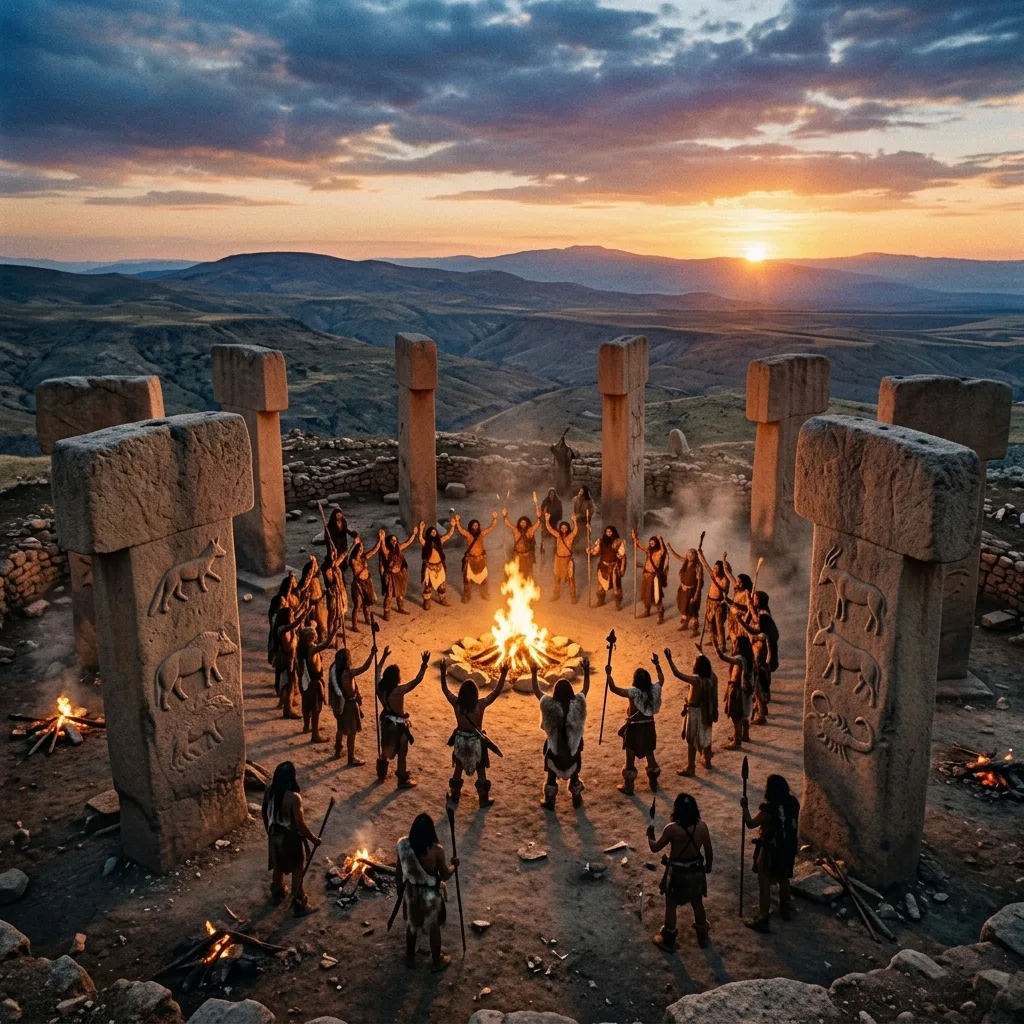
In southeastern Turkey, nomadic hunter-gatherers construct massive stone pillars carved with elaborate animal reliefs — thousands of years before the invention of agriculture, pottery, or even basic permanent settlements. Göbekli Tepe is the oldest known example of monumental architecture on Earth, and its existence shattered the long-held assumption that humans needed farming and civilization before they could organize complex religious practices.
Open in interactive timeline →Key Numbers
- Age
- ~11,500 years (built c. 9500-8000 BCE)
- Older than Stonehenge by
- ~6,000 years
- Buried enclosures
- 20+ (only ~10% excavated)
- T-pillars
- Nearly 200, up to 5.5 m tall
- Heaviest megaliths
- Up to ~50 tons
Verified Facts
- German archaeologist Klaus Schmidt recognized the site's significance in October 1994 after it had been dismissed in a 1963 survey as a medieval cemetery; he launched excavations in 1995 and directed them with the German Archaeological Institute and the Sanliurfa Museum until his death in 2014.
- Radiocarbon dating places the earliest monumental enclosures and their massive T-shaped pillars (the Pre-Pottery Neolithic A 'Layer III') at roughly 9500-9000 BCE, with occupation and construction continuing until about 8000 BCE.
- The site predates Stonehenge by about 6,000 years and the Great Pyramid of Giza by roughly 7,000 years, overturning the long-held assumption that monumental architecture required settled agricultural societies.
- Göbekli Tepe was built by hunter-gatherers before the full development of farming, yet it sits beside Karaca Dag, the mountain whose wild einkorn wheat DNA most closely matches modern domesticated wheat (about 30 km away) - placing the site at the very threshold of the Neolithic agricultural revolution.
- Geophysical surveys of the roughly 15-meter-high, 8-hectare tell revealed at least 20 large circular enclosures; only four have been fully excavated, and surveys indicate around 16 more containing close to 200 pillars in total, meaning only about 10% of the site has been dug.
- The T-shaped limestone pillars are stylized anthropomorphic figures: many bear carved arms bending around to the front, hands with fingers, belts, and fox-pelt loincloths, with the crossbar of the 'T' representing a head - making them among the earliest monumental depictions of the human form.
- The twin central pillars of Enclosure D, designated Pillar 18 and Pillar 31, stand about 5.5 meters tall; the pillars across the site are carved in relief with wild and dangerous animals - foxes, snakes, scorpions, wild boars, vultures, and insects - rather than the prey species the builders actually ate.
- Pillar 43, the famous 'Vulture Stone' in Enclosure D, bears the site's most complex scene: vultures with outstretched wings, a scorpion, a headless human figure, and a disc, fueling debated interpretations ranging from death/excarnation rituals to (more speculatively) a commemorated comet impact.
- A 2020 study by Gil Haklay and Avi Gopher of Tel Aviv University found that the centers of Enclosures B, C, and D form a near-perfect equilateral triangle with sides of about 19.25 meters, suggesting the builders used an abstract geometric plan rather than improvising structures one at a time.
- Schmidt's original interpretation - that the enclosures were deliberately backfilled and buried as ritual acts - has fallen out of favor since his 2014 death, as newer excavations revealed domestic features, water cisterns, and evidence that settled groups may have lived at the site year-round, shifting debate from 'world's first temple' toward a multi-purpose settlement.
- Göbekli Tepe was inscribed as a UNESCO World Heritage Site in 2018, recognized as 'one of the first manifestations of human-made monumental architecture.'
The World at This Moment
Göbekli Tepe's earliest enclosures (Enclosure D radiocarbon-dated to roughly 9600–9500 BCE) rose almost exactly at the close of the Younger Dryas, the abrupt cold snap whose end around 9700 BCE marks the start of the Holocene. This was the Pre-Pottery Neolithic A in the northern Fertile Crescent—the same horizon as PPNA Jericho, with its stone tower and wall, and the recently sedentarizing Natufian and post-Natufian communities of the Levant. Domesticated cereals and animals did not yet exist; einkorn, barley, sheep, and aurochs were still wild. Across the wider world, hunter-gatherers populated every inhabited continent: Jōmon foragers made some of the oldest pottery in Japan, big-game hunters had recently spread through the Americas, and the megafaunal extinctions were ongoing. Mesopotamian cities, writing, and metallurgy lay six millennia in the future. Göbekli Tepe thus belongs to the very threshold of the Neolithic, when foraging bands in the Germuş mountains of southeastern Anatolia—part of a regional culture now including Karahan Tepe and the "Taş Tepeler"—undertook construction on a scale previously thought impossible before farming.
The Paradigm Shift
Göbekli Tepe overturned a foundational assumption of twentieth-century prehistory: V. Gordon Childe's model in which agriculture produced surplus, surplus produced settlement and hierarchy, and only then did monumental religion arise. Here, mobile hunter-gatherers quarried, carved, and erected multi-tonne T-shaped limestone pillars—some over five metres tall, adorned with reliefs of foxes, snakes, scorpions, vultures, and boars—centuries before evidence of domestication. Klaus Schmidt, who began excavating in 1995, argued the inverse causal order: that large-scale ritual gathering and shared symbolism preceded and may have driven sedentism and food production, since feeding the laborers plausibly intensified the exploitation of wild cereals. The site forced archaeologists to grant Pre-Pottery Neolithic foragers a capacity for monumental cooperation, abstract iconography, and ideological complexity once reserved for state societies. It reframed the "Neolithic Revolution" as cognitive and social before it was economic, made "cult" a candidate prime mover of civilization, and anchored southeastern Anatolia—not the southern Levant alone—as a hearth of Neolithic transformation.
In Their Own Words
"This is the first human-built holy place. … We're 6,000 years before the invention of writing here." — Klaus Schmidt, excavation director, quoted in Andrew Curry, "Gobekli Tepe: The World's First Temple?", Smithsonian Magazine (November 2008)
In Depth
The Temple That Came Before the Field
For most of the twentieth century, archaeology told a tidy story: first humans learned to farm, farming produced surplus, surplus freed people to build temples and gods. Göbekli Tepe (sv-gobekli-tepe) broke that story in half. Rising on a limestone ridge in southeastern Anatolia around 9600 BC, its great rings of T-shaped megaliths — some standing over five meters and weighing tons — were quarried, carved with foxes, vultures, scorpions, and snakes, and raised by people who had not yet domesticated a single crop. The monument predates the first known wheat cultivation, just thirty kilometers away in the Karacadağ foothills, by more than a millennium. Here, it seems, the sacred came before the sown.
Deep preconditions
The pillar-builders were the inheritors of a very long lineage. The cognitive machinery that imagines gods and ancestors was assembled over millions of years — through the first primates (sv-first-primates), the rise of the great apes (sv-great-apes), and the human-chimpanzee split (sv-human-chimp-split) that set our branch on its symbolic trajectory. The immediate context, though, was climatic. Göbekli Tepe was built in the warming, unstable centuries at the close of the last ice age and its megafauna extinctions (sv-last-ice-age). As the great game herds thinned and the Younger Dryas relented, dense stands of wild cereals spread across the Fertile Crescent, and the gazelle-hunting bands of the region grew rich enough — and gathered often enough — to attempt something unprecedented.
How it reshaped what came after
The site's excavator Klaus Schmidt argued that ritual was the engine, not the byproduct: pilgrims converging for communal feasts had to be fed, and feeding crowds of laborers intensified the harvesting of wild grasses until cultivation became deliberate. Whether or not one accepts that causal arrow in full — recent excavators under Lee Clare now read the site as a long-term settlement with domestic structures and water installations, not a purely ceremonial sanctuary — the temporal fact stands. Monumentality and organized belief coincide with, and may have helped trigger, the Agricultural Revolution (sv-agriculture) in the same hills. Carved human skulls bearing deliberate incisions hint at a "skull cult" of ancestor veneration, the kind of binding ideology that lets strangers cooperate at scale. That capacity — to organize labor and loyalty around shared symbols — is the seed of everything downstream: the wheel (sv-wheel), the first writing in cuneiform (sv-cuneiform), and the temple-cities of Sumer whose own myths of gods and floods echo in the Epic of Gilgamesh (sv-gilgamesh).
Threads through history
Göbekli Tepe is the hinge where a hunter-gatherer species began building the institutions of civilization. Its descendants are monumental in every sense — from the Great Pyramids of Giza (sv-pyramids), which scaled stone-and-faith logistics to imperial size, to the theogonies that systematized the gods, like Hesiod's (sv-hesiod). The pillars also pose a question that never went away: why do humans pour their surplus into the invisible? The same impulse animates the Bacchae's (sv-bacchae) ecstatic religion and, far downstream, every cathedral and creed. And the deeper provocation — that imagination and organized meaning, not mere material need, drive our great leaps — quietly anticipates the modern claim that intelligence is the prime mover of history, the thesis underwriting projections of accelerating returns toward the dawn of AGI (sv-ai-dawn). Twelve thousand years before silicon, on a hilltop in Anatolia, a band of foragers proved that an idea worth gathering for can move mountains of stone. They built a sanctuary before they built a barn, and in doing so they built us.
Causes & Consequences
What led to it
- The end of the last Ice Age and the abrupt warming after the Younger Dryas (around 9700-9600 BCE) stabilized the climate of the northern Fertile Crescent, allowing wild cereals, nut trees, and game to flourish on the slopes around the Urfa region where Göbekli Tepe was built.
- The 'symbolic revolution' of the Upper Paleolithic and Epipaleolithic gave hunter-gatherers a rich repertoire of representational art and ritual imagery, the cognitive prerequisite that French archaeologist Jacques Cauvin argued preceded and enabled monumental religious construction.
- Natufian culture (roughly 15,000-11,500 years ago) had already produced semi-sedentary villages, intensive harvesting of wild cereals with sickles and grinding stones, and communal social structures, demonstrating that complex society could exist before farming.
- The wild abundance of the surrounding landscape, including dense stands of wild einkorn and emmer wheat and large herds of gazelle and aurochs, provided enough surplus to feed the hundreds of laborers periodically gathered to quarry and erect the pillars.
- The local geology supplied workable limestone bedrock from which the T-shaped pillars, some over 5 meters tall and weighing up to 10 tonnes, could be quarried on site using flint tools.
- Earlier Pre-Pottery Neolithic sites in the same region, such as Nevalı Çori with its own T-shaped pillars, established the architectural and ritual template that Klaus Schmidt recognized when he reassessed Göbekli Tepe in 1994.
What it set in motion
- Göbekli Tepe overturned the long-held 'agriculture first' model of civilization, providing evidence that monumental ritual architecture was built by hunter-gatherers roughly a thousand years before farming, suggesting that shared belief and communal gathering may have helped drive the Neolithic Revolution rather than following it.
- The communal feasting and large labor gatherings the site required are widely argued to have intensified the cultivation of wild grasses in the nearby Karacadağ foothills, where genetic studies (Heun et al., 1997) trace the domestication of einkorn wheat, one of the Neolithic founder crops.
- Large limestone troughs and basins at the site, some holding up to about 160 liters and bearing oxalate residues consistent with grain fermentation, point to some of the earliest evidence for large-scale brewing and ceremonial feasting in human history.
- The site anchored a wider Neolithic ritual landscape across the Taş Tepeler region, including sister sites such as Karahan Tepe and Sayburç, reshaping understanding of how interconnected early communities were across southeastern Anatolia.
- Its UNESCO World Heritage inscription in 2018 and the deliberate backfilling that preserved its carvings made Göbekli Tepe a globally recognized symbol of humanity's deep prehistory and a major focus of modern archaeological research into the origins of religion.
- The discovery has become a touchstone in debates about whether organized religion, social hierarchy, and the first permanent settlements emerged from the cooperative labor and shared cosmology that monuments like Göbekli Tepe demanded.
The Live Academic Debate
The central, still-live debate concerns whether Göbekli Tepe was a purely ritual "temple" inhabited by no one, or a settlement with a domestic dimension. Schmidt's original "mountain sanctuary"/feasting-cult model—popularized as "first the temple, then the city"—has been substantially revised by the German Archaeological Institute team now led by Lee Clare, who report rock-cut cisterns and rainwater channels, abundant ground-stone and lithic domestic debris, and likely sedentary occupation, suggesting Göbekli Tepe was a settled community, not an uninhabited pilgrimage shrine. E.B. Banning argued early (Current Anthropology, 2011) that the "enclosures" could be roofed houses and that the sacred/domestic dichotomy is itself anachronistic. The sharpest critique, Ted Banning and others' "Paradise Found or Common Sense Lost?" (Open Archaeology, 2022), accuses the cult-centre paradigm of romanticism. Disputes also persist over the supposed deliberate burial of enclosures, the function of the T-pillars (anthropomorphic ancestors vs. deities), and fringe astronomical "calendar" claims (e.g., Sweatman) that mainstream Neolithic specialists largely reject.
How This Event Connects
Göbekli Tepe stands as the ultimate paradigm-shattering discovery of the 20th century, completely reversing the causal arrow of The Agricultural Revolution. Under the traditional Gordon Childe model, agricultural surplus was the strict prerequisite for monumental architecture and religious centers. However, Göbekli Tepe demonstrates that the psychological and communal drive to construct sacred spaces—the "temple first" model—actually necessitated the initial cultivation of wild grains to feed the massive labor forces. This profound realization links the ideological superstructure of humanity directly to the bioarchaeological beginnings of protracted domestication, illustrating that human belief systems engineered the natural environment rather than merely reacting to it.
The monumental scale of Göbekli Tepe also provides a crucial evolutionary antecedent to The Great Pyramids of Giza. While separated by millennia, both sites represent the sheer organizational power of communal labor. However, whereas the Pyramids of Giza were a centralized, state-building project driven by corvée labor under a divine monarch, Göbekli Tepe was constructed by egalitarian, mobile hunter-gatherers bound by a shared cosmological vision. Tracing the trajectory from the T-shaped pillars of the Taş Tepeler network to the limestone blocks of Giza reveals the shifting nature of monumentality: from a communal, ritualistic anchor in a transitional world to an apparatus of totalitarian state propaganda.
Finally, the environmental context of Göbekli Tepe is inextricably linked to the climatic aftermath of The Last Ice Age & The Megafauna Extinction. The site's flourishing during the Pre-Pottery Neolithic A was made possible by the unique ecological niches that opened as the glaciers retreated. The complex hunter-gatherer societies that built it were survivors of the profound environmental instability of the Younger Dryas, suggesting that their monumental efforts may have been an ideological response to a changing world. Furthermore, the eventual transition from these early cultic centers to fully urbanized societies ultimately necessitated the bureaucratic tracking of the very surpluses that religion helped create, paving the way for the accounting tokens that would birth The Invention of Cuneiform.
The Counterfactual
Counterfactual reasoning here is constrained because Göbekli Tepe was a discovery, not an event that could have failed to occur; the deeper question is what changes had it not been built, or had it gone unexcavated. Regionally, the Taş Tepeler sites (Karahan Tepe, Nevalı Çori, Sayburç) show the same T-pillar tradition, so monumental symbolism in PPNA Anatolia was a broad cultural phenomenon, not a single-site fluke; Göbekli Tepe's absence would not have erased it. Had Schmidt not recognized the 1994–95 surface scatters as Neolithic rather than Byzantine—an earlier survey had dismissed the mound—the "temple-first" thesis might have emerged decades later or differently framed, leaving Childe's agriculture-first orthodoxy dominant longer. As to the past itself, if such gathering centers had never formed, the testable hypothesis that ritual aggregation accelerated cereal domestication in the Urfa region would lose its type-site, though sedentism clearly arose elsewhere (Jericho, the Levant) without comparable monuments. The wild-resource abundance of the region, not the pillars alone, remains the likely driver.
Myth vs. Reality
Myth: Göbekli Tepe was a purely ceremonial 'temple in the wilderness,' built and visited by people who did not actually live there.
Reality: For decades after Klaus Schmidt's excavations it was framed as the 'world's first temple' with no domestic life, but research since his death in 2014 (led by Lee Clare, with studies by Oliver Dietrich and colleagues) has complicated that picture. Excavators have documented thousands of grinding stones, mortars and pestles, evidence of cereal and plant processing, and a rainwater-harvesting system of carved channels and rock-cut cisterns. Many archaeologists now see the boundary between 'ritual' and 'domestic' space as permeable, and treat Göbekli Tepe as a place of longer-term occupation rather than a building used only for rites.
Myth: Göbekli Tepe is so sophisticated that it must have been built by a lost advanced civilization, by 'Ancient Aliens,' or with knowledge handed down by Ice Age survivors.
Reality: These claims, popularized by writers like Graham Hancock and Andrew Collins, are rejected by the archaeologists who actually excavate the site. There is no material trace of any outside or advanced builders; the toolkit, debris, and construction methods are entirely consistent with local Pre-Pottery Neolithic people working stone with stone. Excavation-team members and skeptical scholars note that attributing the site to aliens or a lost civilization reflects a condescending assumption that prehistoric humans were incapable of monumental organization, which the evidence directly contradicts.
Myth: The carvings on Pillar 43 (the 'Vulture Stone') prove Göbekli Tepe was an astronomical observatory recording a comet impact around 10,950 BC.
Reality: This 'date stamp' reading comes from a 2017 paper by Martin Sweatman and Dimitrios Tsikritsis, and remains a contested fringe hypothesis, not consensus. The excavation team (Jens Notroff, Oliver Dietrich and colleagues) published a detailed rebuttal noting the symbols are cherry-picked to fit constellations, that the proposed date predates the oldest radiocarbon dates for Enclosure D by roughly 700-1000 years, and that the enclosures may have been roofed, which undermines a sky-watching function. Notroff also pointed out the analysis ignored a prominent phallus on the 'death' figure that complicates its catastrophe reading.
Myth: Göbekli Tepe was a unique, isolated wonder with nothing comparable around it.
Reality: It is now understood as one node in a regional network of contemporaneous Pre-Pottery Neolithic sites across the Şanlıurfa region of southeastern Turkey, grouped under the Taş Tepeler ('Stone Hills') project. Related sites with T-shaped pillars and sculpted imagery, including Karahan Tepe, Nevalı Çori, Sayburç, and others, point to a shared culture, regional interaction, and possibly specialized roles among settlements, rather than a single one-off monument.
Myth: Göbekli Tepe proves that organized religion alone caused agriculture, with monument-building hunter-gatherers who knew nothing of farming.
Reality: Schmidt's famous suggestion that ritual gathering preceded and helped drive the Neolithic transition was genuinely influential, inverting the older 'settle first, then build temples' model. But scholars caution against a rigid hunter-gatherer-versus-farmer dichotomy: early Neolithic communities practiced mixed economies blending hunting, gathering, and plant management, and the heavy evidence of plant processing at Göbekli Tepe shows its builders were already intensively exploiting wild cereals. The site illustrates a gradual, entangled relationship between cult, cooperation, and subsistence, not a simple 'religion invented farming' causation.
Frequently Asked Questions
How old is Göbekli Tepe, and is it really the world's oldest temple?
Göbekli Tepe's monumental enclosures date to the Pre-Pottery Neolithic, roughly 9600–8200 BCE, making the earliest structures about 11,500 years old. That is around 6,000 years before Stonehenge and some 7,000 years before the Great Pyramid of Giza. It is frequently called the world's oldest known monumental religious site, though scholars increasingly debate whether 'temple' fully captures its function, since evidence of domestic life has also been found.
Who built Göbekli Tepe, and how did they move 20-ton stones without metal tools?
It was built by Pre-Pottery Neolithic hunter-gatherers who had not yet developed pottery, metal tools, or the wheel. They quarried, carved, and arranged massive T-shaped limestone pillars, some weighing up to about 20 tons, into circular enclosures. This challenged the long-held assumption that only settled agricultural societies could organize the labor for monumental architecture, suggesting complex social cooperation and ritual predated farming.
What is the Vulture Stone (Pillar 43) and what does it depict?
The Vulture Stone is the popular name for Pillar 43, one of Göbekli Tepe's most famous carved pillars. It shows a composition of birds, including vultures, alongside a headless human figure, a scorpion, and disc and handbag-like shapes. The mainstream archaeological reading connects it to death-related ritual and possibly excarnation (exposure of the dead to scavenging birds), while popular claims that it records a specific comet impact are disputed and not accepted by most archaeologists.
Why was Göbekli Tepe deliberately buried?
After roughly 1,500 years of use, the enclosures were backfilled with rubble, including stone tools, animal bones, flint debris, and limestone fragments, until the site was decommissioned. The precise reasons remain unknown. Researchers have proposed intentional ritual burial of older structures as new ones were built on top, though some now view the 'fill' as ordinary settlement debris rather than a single deliberate covering event.
Was Göbekli Tepe only a ritual sanctuary, or did people actually live there?
Excavator Klaus Schmidt argued it was a cult center visited by mobile groups, famously suggesting 'first came the temple, then the city.' Since his death in 2014, work led by Lee Clare and the German Archaeological Institute has uncovered domestic features such as grinding stones, large amounts of household refuse, and water-collection cisterns. Many researchers now see it as a long-term settlement where ritual and daily life were intertwined, rather than a purely ceremonial site, though the question is still actively debated.
Where is Göbekli Tepe, and how much of it has been excavated?
Göbekli Tepe sits on a hilltop in the Germuş mountains near Şanlıurfa in southeastern Turkey. It was inscribed as a UNESCO World Heritage Site in 2018 for its value as one of the first examples of human-made monumental architecture. Despite decades of work, only a small fraction of the site has been excavated, with geophysical surveys indicating many more buried enclosures remain unexplored.
How is Göbekli Tepe connected to the origins of agriculture?
The site lies near the Karacadağ mountain range, whose wild einkorn wheat is genetically among the closest known relatives of domesticated einkorn, one of the Neolithic founder crops. A 1997 genetic study by Manfred Heun and colleagues traced domesticated einkorn's origin to this region. Some scholars hypothesize that the need to feed large gatherings of people working at and visiting Göbekli Tepe may have spurred early cultivation, though a direct causal link remains a hypothesis rather than established fact.
Sources & Further Reading
- Göbekli Tepe — Wikipedia
- Klaus Schmidt, Göbekli Tepe: A Stone Age Sanctuary in South-Eastern Anatolia (2012)
- Andrew Curry, 'Gobekli Tepe: The World's First Temple?', Smithsonian Magazine (Nov. 2008)
- E. B. Banning, 'So Fair a House: Göbekli Tepe and the Identification of Temples in the Pre-Pottery Neolithic of the Near East', Current Anthropology 52 (2011)
- Lee Clare et al., 'Göbekli Tepe: A summary of research at a new World Heritage Site (2015–2019)', e-Forschungsberichte / Neo-Lithics
- 'Paradise Found or Common Sense Lost? Göbekli Tepe's Last Decade as a Pre-Farming Cult Centre', Open Archaeology 8 (2022)
- National Geographic: Göbekli Tepe
Cite This Page
AskHistoryAI. “Göbekli Tepe & The Dawn of Religion.” AskHistoryAI — Interactive Timeline of Everything. Updated 2026-09-11. https://askhistoryai.com/event/sv-gobekli-tepe/
Every fact on this page is checked against the published fact ledger and methodology; sources are listed above.