The Last Ice Age & The Megafauna Extinction
Humans survived a frozen world; its giant beasts then vanished, likely from a mix of human hunting and a warming climate.
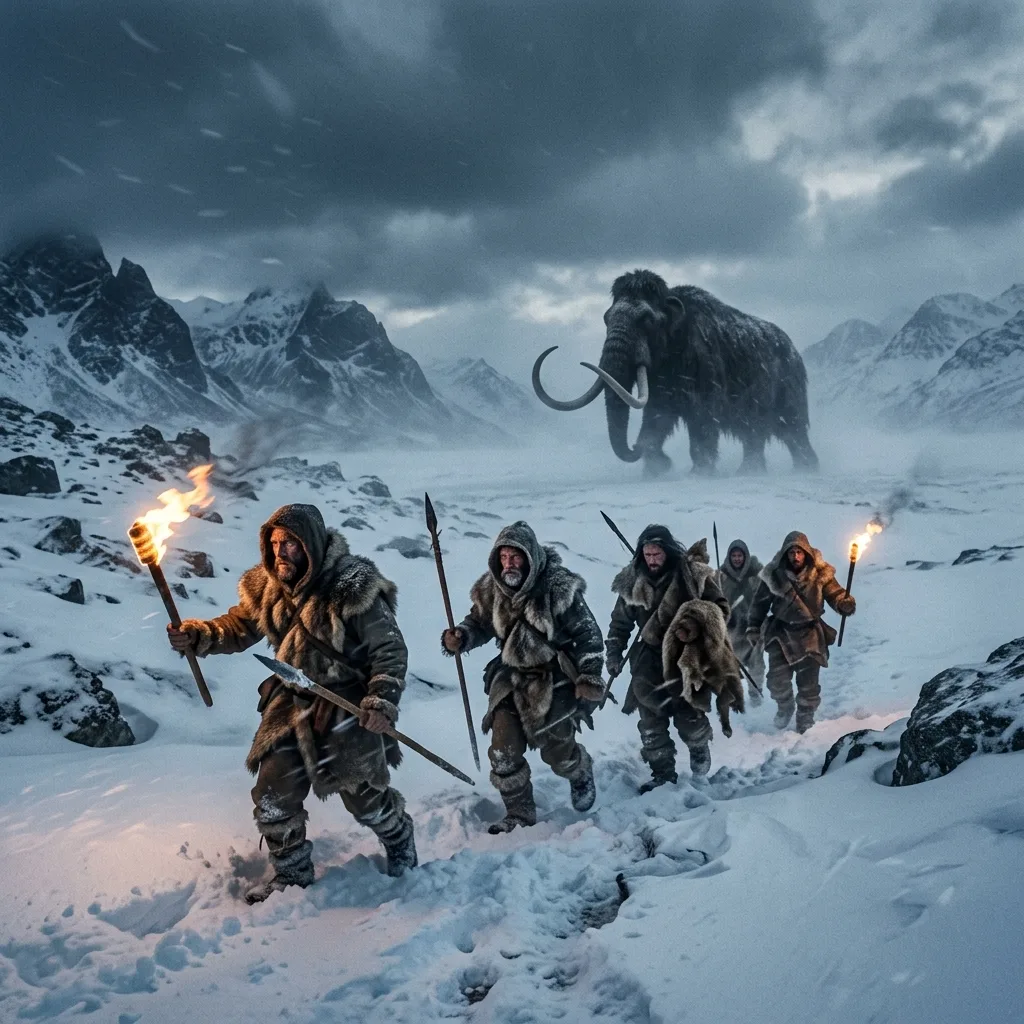
During the Last Glacial Period, massive ice sheets up to 2 miles thick cover much of North America and Europe. Modern humans (Homo sapiens), already fully evolved, live as nomadic hunter-gatherers alongside woolly mammoths, saber-toothed cats, and giant ground sloths.
Open in interactive timeline →Key Numbers
- LGM peak
- ~26,000–20,000 yrs ago
- Sea level lower
- ~125 m (410 ft)
- Global temp vs today
- ~6 deg C colder
- N. American genera lost
- ~35–38 of large mammals
- Last mammoths
- ~4,000 yrs ago (Wrangel I.)
Verified Facts
- At the Last Glacial Maximum (roughly 26,000–20,000 years ago), continental ice sheets covered about 8% of Earth's surface and locked up so much water that global sea level fell to about 125 meters (410 feet) below today's, exposing land bridges such as Beringia between Siberia and Alaska.
- A 2020 study led by Jessica Tierney (University of Arizona), published in Nature, combined marine plankton fossils with climate models to find the LGM's global average temperature was about 6 degrees Celsius (11 F) colder than today, with high-Arctic latitudes running up to roughly 14 C colder.
- The same Tierney analysis estimated the global temperature at the height of the ice age averaged only about 8 C (46 F), and used the data to peg climate sensitivity at about 3.4 C of warming per doubling of atmospheric CO2.
- In North America at the end of the Pleistocene, roughly 35–38 genera of large mammals went extinct, including all mammoths and mastodons, ground sloths, glyptodonts, native horses, and all but two camelid lineages, most within an interval centered around 11,000 radiocarbon years before present.
- Globally the Late Quaternary extinctions eliminated a large fraction of megafauna; roughly two-thirds of large-mammal genera disappeared, with the Americas and Australia hit far harder than Africa, where many large animals survived.
- The 'overkill hypothesis' that human hunters drove these extinctions was advanced by geoscientist Paul S. Martin decades ago, building on radiocarbon evidence that the Clovis culture's arrival (around 13,000 years ago) closely preceded the megafaunal collapse.
- The overkill model remains contested: critics note that of the dozens of extinct North American genera, only a couple (mammoth and mastodon) have clear archaeological evidence of being hunted and butchered, and many researchers now favor mixed causes combining human pressure with abrupt climate change.
- The Younger Dryas, an abrupt cold reversal from about 12,900 to 11,700 years ago, briefly plunged the warming world back toward glacial conditions; it is linked to a slowdown of North Atlantic deep-water formation, likely triggered by a pulse of Arctic meltwater freshening the ocean surface.
- Woolly mammoths did not all vanish at the ice age's end: an isolated population survived on Wrangel Island off Siberia until about 4,000 years ago, persisting for roughly 6,000 years from a founding group of perhaps as few as eight individuals.
- Genomic studies of the Wrangel Island mammoths (including a 2024 analysis in Cell) found the herd was severely inbred with low genetic diversity, yet remained demographically stable up to its sudden disappearance, leaving the ultimate cause of that final extinction unresolved.
The World at This Moment
The Last Glacial Maximum (LGM), when ice sheets reached their greatest extent roughly 26,000–20,000 years ago, was a planet-spanning episode. The Laurentide and Fennoscandian ice sheets buried northern North America and Europe; some 8% of Earth's surface lay under ice, global mean temperature was about 6°C colder, and sea level stood roughly 120–130 m lower, exposing continental shelves and the Beringian land bridge. Anatomically modern humans were already dispersed across Eurasia and Sahul (Australia, reached by c. 50,000 years ago). During and after the LGM, Upper Paleolithic peoples produced the painted caves of Lascaux and Chauvet (France), Altamira (Spain), and figurative art in Borneo and Sulawesi. The Solutrean and Magdalenian toolmaking traditions flourished in glacial-refuge Europe. As ice retreated after about 19,000 years ago, humans crossed Beringia into the Americas (Clovis culture by c. 13,000 years ago, with pre-Clovis sites like Monte Verde earlier). The terminal Pleistocene also encompassed the abrupt Younger Dryas cold snap (c. 12,900–11,700 years ago) and the threshold of agriculture in the Fertile Crescent.
The Paradigm Shift
The terminal-Pleistocene megafauna extinctions permanently reshaped the biosphere humans would inherit. Roughly 82% of North American, 74% of South American, and 71% of Australasian genera over 40 kg vanished—mammoths, mastodons, giant ground sloths, glyptodonts, sabre-toothed cats, the Australian Diprotodon. The losses stripped continents of their largest herbivores and the ecological engineering (grazing, seed dispersal, nutrient cycling) they performed, a transformation underpinning today's "rewilding" and trophic-downgrading ecology. Intellectually, the event made deep-time extinction a scientific problem: Georges Cuvier's early-nineteenth-century demonstration that mammoths and mastodons were genuinely extinct species established extinction as real, refuting notions of an unchanging Creation. In the twentieth century, Paul Martin's overkill hypothesis reframed humanity as a geological and ecological force capable of continent-scale destruction—an idea now central to debates over the Anthropocene and the "sixth mass extinction." The extinctions thus mark both an ecological rupture and the conceptual birth of humans-as-planetary-agents.
In Their Own Words
"Virtually all extinctions of wild animals in the last 50,000 years are anthropogenic, that is, caused by humans." — Paul S. Martin, Twilight of the Mammoths: Ice Age Extinctions and the Rewilding of America (University of California Press, 2005)
In Depth
The Long Winter That Made Us
The Last Ice Age is the hinge on which the human story swings from prehistory into history. Its peak — the Last Glacial Maximum, roughly 26,000 to 20,000 years ago — locked so much water into ice sheets kilometers thick that sea levels fell by more than 100 meters, exposing land bridges and remaking coastlines. When the ice began retreating around 14,700 years ago, the warming stuttered: a sharp, roughly 1,300-year cold snap called the Younger Dryas (c. 12,900–11,700 years ago) intervened before the climate finally stabilized into the warm, unusually placid Holocene. By the end of that transition, a planetary order tens of millions of years in the making had been overturned, and the megafauna were gone.
Deep preconditions
The ice itself was the latest expression of a cooling trend with cosmic roots. The very arrangement of life that the glaciers would prune traces back through the slow accumulation of complexity — the rise of mammals after the K-Pg Extinction Event (sv-dinosaur-extinction) cleared the dinosaurs, the long radiation that produced the First Primates (sv-first-primates) and eventually the Human-Chimpanzee Split (sv-human-chimp-split). The genus Homo was forged in the climatic oscillations of the Pleistocene itself; glacial cycles were the crucible that selected for the big brains, tool use, and behavioral flexibility our ancestors carried into the ice. In the longest view, the carbon, oxygen, and calcium in every mammoth tusk were minted in the First Supernovas (sv-first-supernova) after the Big Bang (sv-big-bang) — the Ice Age was simply the stage on which that ancient stardust briefly assembled itself into woolly giants.
The extinction and its unresolved cause
As the ice withdrew, the great beasts vanished. In North America alone an estimated 33 genera of large mammals — mammoths, mastodons, the giant short-faced bear, saber-toothed cats — disappeared, followed by some 50 genera in South America. Why remains one of the sharpest debates in paleoscience. The "overkill" camp notes that extinction pulses track the spread of Homo sapiens across each landmass far more tightly than they track climate; one global analysis found megafaunal biomass collapsed by 92–95% over 50,000 years in step with human expansion. The climate camp points to the violent whiplash of the Younger Dryas, and a contested minority argues for a cosmic airburst. Most likely it was synergy: a hunting primate finishing off populations already cornered by a shifting world. Either way, this is the first event in the timeline where a single species plausibly reshaped the biosphere — a dark prefiguring of the planetary power humans would later wield, from the Industrial Revolution (sv-industrial-revolution) to Hiroshima & Nagasaki (sv-hiroshima-nagasaki).
The ripple into civilization
The Ice Age's most consequential legacy is what its ending permitted. The Holocene's stable, warm climate was the precondition for everything we call history. Within a few thousand years, humans at Göbekli Tepe (sv-gobekli-tepe) were raising monumental stone enclosures, and the Agricultural Revolution (sv-agriculture) was domesticating the grasses and animals that survived the great die-off. A world stripped of easy megafaunal protein may itself have nudged foragers toward farming. From settled agriculture came cities, surplus, writing in Cuneiform (sv-cuneiform), and the whole accelerating cascade Ray Kurzweil frames as the Law of Accelerating Returns (sv-kurzweil-law). It is no exaggeration to say the receding glaciers wrote the opening line of recorded civilization — and that the species which may have hunted the mammoth to extinction is now building the minds that could carry intelligence into Kurzweil's Epoch 6 (sv-kurzweil-epoch6). The long winter did not end the human story; it cleared the ground for it to begin.
Causes & Consequences
What led to it
- Cyclical variations in Earth's orbit known as Milankovitch cycles, especially in axial tilt (obliquity, ~41,000-year period) and precession (~23,000-year period), reduced Northern Hemisphere summer sunlight and allowed ice sheets to grow, driving the cooling that culminated in the Last Glacial Maximum around 27,000-19,000 years ago.
- Powerful ice-albedo and atmospheric CO2 feedbacks amplified the modest orbital cooling, as expanding bright ice sheets reflected more sunlight and lower greenhouse gas concentrations deepened the cold, locking the planet into a full glacial state.
- Anatomically modern Homo sapiens dispersed out of Africa in major waves around 60,000 years ago, spreading across Eurasia, Australia, and eventually the Americas and arriving as a novel super-predator in ecosystems whose large mammals had never co-evolved with skilled human hunters.
- Humans developed advanced hunting technologies such as composite stone-tipped projectiles, spear-throwers, and the controlled use of fire, giving small bands the ability to kill and process very large prey and to reshape landscapes through burning.
- Late Pleistocene faunas were dominated by cold-adapted, large-bodied megafauna over 44 kg, including woolly mammoths, woolly rhinos, giant ground sloths, and mastodons, whose large size, slow reproduction, and naivety toward humans made them especially vulnerable to combined climatic and hunting pressures.
- At the glacial maximum, sea level stood roughly 120-130 meters lower than today as vast volumes of water were locked in continental ice sheets, exposing land bridges such as Beringia and Doggerland that connected continents and channeled both animal and human migration.
What it set in motion
- The disappearance of more than 170 species of large mammals across the globe between roughly 50,000 and 9,000 years ago permanently reshaped ecosystems, removing keystone grazers and browsers and contributing to the loss of the mammoth-steppe biome of the far north.
- Orbital warming after about 19,000 years ago drove deglaciation that raised global sea level by well over 100 meters, flooding Doggerland and severing Britain from continental Europe and submerging the Bering Land Bridge between roughly 13,000 and 11,000 years ago.
- The retreat of ice sheets and the opening of routes such as the ice-free corridor and Pacific coastline enabled humans to spread into and populate the Americas, completing the human colonization of nearly every habitable continent.
- Around 12,900 years ago a sudden cold snap, the Younger Dryas, abruptly reversed the warming for over a millennium, widely attributed to a surge of glacial meltwater into the North Atlantic that weakened the ocean's overturning circulation.
- The transition into the warm, stable Holocene around 11,700 years ago provided the climatic conditions under which humans independently domesticated plants and animals, with wheat and barley domesticated in the Fertile Crescent roughly 11,000-10,000 years ago in the Neolithic Revolution.
- The shift from mobile hunting and gathering to settled farming villages produced food surpluses that enabled population growth, social hierarchy, and eventually the first cities and states, setting the foundation for recorded human civilization.
The Live Academic Debate
Causation remains genuinely contested. The "overkill" school, originating with Paul S. Martin (Pleistocene Extinctions, 1967; Twilight of the Mammoths, 2005) and his "blitzkrieg" wave-of-advance model (Mosimann and Martin 1975), holds that newly arriving, expanding human hunters drove naïve megafauna extinct. The climate school stresses habitat reorganization across the deglacial and Younger Dryas transitions; recent work by Mathew Stewart, W. Christopher Carleton, and Huw Groucutt (Nature Communications 2021) finds North American megafauna declines correlating with cooling, not human population growth. A third position emphasizes regional and taxon-specific synergy—Christopher Sandom et al. (Proceedings B, 2014) found global extinctions most strongly linked to humans, while others (e.g., Nikos Solounias; David Meltzer 2020 in PNAS) caution that glacial chronology and dating gaps complicate any blitzkrieg claim. The fringe Younger Dryas impact hypothesis (Firestone et al. 2007), invoking a cosmic airburst, is widely rejected though its proponents persist. Most mainstream researchers now favor human-climate synergy over single causes.
How This Event Connects
The Last Glacial Maximum and the subsequent abrupt cooling of the Younger Dryas serve as the profound climatic staging ground for the earliest transitions of human civilization, intrinsically tying `sv-last-ice-age` to the dawn of the Neolithic. The destabilization of Pleistocene environments directly parallels the pressures that incited the broad-spectrum foraging of The Agricultural Revolution. As the ice retreated and environments shifted, the traditional paradigm of the human-nature relationship was irreversibly altered. The intense academic debate surrounding the "Overkill Hypothesis" versus climatic shifts establishes a historiographical throughline concerning humanity's capacity to unconsciously act as a geological and ecological force—a precursor to the massive niche construction seen in early farming.
Furthermore, the climatic volatility of this period provides the essential backdrop for the monumental anomalies like Göbekli Tepe & The Dawn of Religion. The transition out of the Ice Age did not immediately produce sedentary farming; instead, it produced highly complex, resource-rich hunter-gatherer societies capable of marshaling massive labor forces. The social cohesion required to survive the climatic unpredictability of the Younger Dryas likely catalyzed the religious and communal structures that made the "work feasts" of Göbekli Tepe possible, fundamentally flipping the causal arrow between settlement and agriculture.
Finally, the methodological study of the Younger Dryas shares a striking historiographical parallel with the The Bronze Age Collapse. Both epochs force historians and paleoclimatologists to grapple with systemic vulnerabilities to rapid climate change. Just as the Younger Dryas debate relies on cutting-edge proxies—like Sporormiella and sedimentary ancient DNA—to reconstruct ecological collapse, the Bronze Age Collapse utilizes stalagmite oxygen isotopes to track the megadroughts that shattered the Eastern Mediterranean. In both cases, extreme climatic shifts acted as the supreme arbiter of complex macro-historical survival, either violently ending an era of megafauna or obliterating the interconnected palace economies of the Bronze Age.
The Counterfactual
Had the great herbivores survived—as most African megafauna did, where co-evolution with hominins may have bred wariness—the Holocene landscapes humans built civilizations upon would differ profoundly. Megaherbivores maintain open mosaics through grazing and browsing; their absence allowed forest expansion and altered fire regimes (Gill et al. 2009 link Sporormiella dung-fungus decline to vegetation change and increased burning). Surviving proboscideans and large ungulates might have offered additional domestication candidates, though Jared Diamond (Guns, Germs, and Steel, 1997) argued most large mammals resist domestication. Crucially, if climate alone—not humans—drove the losses, then no plausible human restraint would have spared them; but if overkill or synergistic human-climate pressure was decisive (as Sandom et al. 2014 argue globally), earlier or sparser human arrival could have preserved diverse megafaunal ecosystems into the present. The genuine uncertainty here is itself the point: the counterfactual hinges entirely on the unresolved causation debate.
Myth vs. Reality
Myth: During the last Ice Age the entire planet was frozen over, a global snowball of ice from pole to pole.
Reality: At the peak of the last glaciation (the Last Glacial Maximum, about 20,000 years ago) ice sheets covered only roughly a third of Earth's land area. Ice reached as far south as southern Wisconsin and Long Island in North America and northern Germany and Poland in Europe, but the tropics, most of Africa, and large swaths of every continent stayed ice-free. The truly globe-spanning 'Snowball Earth' freezes were entirely separate events hundreds of millions of years earlier, and even those are now thought to have left ice-free 'slushball' refuges.
Myth: The Ice Age was a single, one-time freeze that ended once and for all about 11,700 years ago.
Reality: Geologists use 'ice age' for a long span containing many alternating cold 'glacial' and warmer 'interglacial' phases. Over the past few million years Earth cycled through dozens of these glacial-interglacial swings. The last glacial period ended around 11,700 years ago, but we did not exit the ice age, we entered the current interglacial, the Holocene. By the geological definition Earth is still in an ice age today, because permanent ice sheets remain on Greenland and Antarctica.
Myth: Woolly mammoths all died out at the end of the Ice Age, long before any advanced human civilization existed.
Reality: A relict population of woolly mammoths survived on Wrangel Island in the Arctic Ocean until roughly 4,000 years ago, isolated there after rising seas cut the island off around 10,000 years ago. That means mammoths were still alive well into the Holocene, overlapping with the Bronze Age and the building of the Egyptian pyramids. Recent genome studies indicate the small Wrangel herd was demographically stable up to its end, so the final cause of its extinction remains genuinely unresolved rather than a simple slow decline.
Myth: Megafauna across the world all vanished suddenly and simultaneously in one global extinction event.
Reality: The late-Quaternary extinctions were strongly staggered across regions rather than synchronous. In Australia (Sahul) most large animals were gone by around 40,000 years ago, the Americas lost theirs mainly between roughly 15,000 and 10,000 years ago, and island faunas such as Madagascar's elephant birds and giant lemurs persisted into the last few thousand years. This temporal staggering, with different extinction windows on different landmasses, is a defining and well-documented feature of the event.
Myth: Scientists have proven that human overhunting (the 'overkill' hypothesis) was definitively the sole cause of megafauna extinction.
Reality: The cause is still actively debated and is regionally variable rather than settled. A 2021 Nature Communications study of North American radiocarbon records found megafaunal declines correlated more closely with falling temperatures than with human population growth, while other research, especially on Australia, points to human arrival as the key trigger. Most specialists now favor combined or region-specific explanations, where hunting, rapid climate change, and habitat disruption interacted, rather than a single universal cause.
Frequently Asked Questions
When did the last ice age end?
The last ice age (the Last Glacial Period of the Pleistocene) ended about 11,700 years ago, which marks the beginning of our current geological epoch, the Holocene. The ice sheets had reached their greatest extent during the Last Glacial Maximum, roughly 26,000 to 19,000 years ago, before retreating. The transition was interrupted by the Younger Dryas, a sharp cold snap that ran from about 12,800 to 11,700 years ago before warming resumed for good.
What animals went extinct at the end of the ice age?
Many of the giant Ice Age mammals, collectively called megafauna (typically animals weighing more than about 44 kg or 100 pounds), disappeared. Iconic casualties include the woolly mammoth, the saber-toothed cat (Smilodon), giant ground sloths, the woolly rhinoceros, mastodons, glyptodonts, and dire wolves. In North America alone, around 37 mammal genera vanished, and most of these large-mammal extinctions clustered around 11,000 to 12,000 years ago.
What caused the megafauna extinction?
This is one of the most debated questions in paleontology, and the leading explanations are climate change at the end of the ice age, human hunting and habitat impact, or a combination of the two. Some studies argue warming after the Last Glacial Maximum transformed grasslands into less productive shrubland, starving large grazers; others note that extinctions closely tracked the arrival of humans on each continent. Recent research increasingly suggests the causes varied by region and species, with both climate and humans implicated in different cases rather than a single global cause.
How many large mammal species died out in the Quaternary extinction?
The Late Quaternary extinction event eliminated roughly two-thirds of all mammal genera and about half of all mammal species weighing more than 44 kg, unfolding over tens of thousands of years and intensifying near the end of the ice age. Worldwide, more than 100 genera of large mammals were lost. The toll varied sharply by continent: Australia lost an estimated 82 percent of its megafauna and North America over 70 percent, while Africa was least affected, losing about 21 percent.
When did woolly mammoths actually go extinct?
Most mainland woolly mammoth populations died out around 10,000 to 11,000 years ago, but a small isolated group survived on Wrangel Island off the Siberian coast until roughly 4,000 years ago. Rising seas had cut that island off from the mainland about 10,000 years ago, stranding a herd that persisted for thousands of years at a few hundred individuals. Recent genomic studies suggest inbreeding and low genetic diversity were unlikely to be the sole cause of their final, relatively abrupt disappearance, which remains unexplained.
How cold was the ice age and how low were sea levels?
At the Last Glacial Maximum, around 20,000 years ago, global average temperatures were roughly 6 degrees Celsius (about 11 degrees Fahrenheit) colder than today. Approximately 8 percent of Earth's surface was buried under ice sheets and glaciers, including much of North America and northern Europe. So much water was locked up in ice that global sea level stood about 125 meters (around 410 feet) lower than present, exposing land bridges such as Beringia between Siberia and Alaska.
Sources & Further Reading
- Late Pleistocene extinctions — Wikipedia
- Paul S. Martin, Twilight of the Mammoths: Ice Age Extinctions and the Rewilding of America (University of California Press, 2005)
- Paul S. Martin and Richard G. Klein, eds., Quaternary Extinctions: A Prehistoric Revolution (University of Arizona Press, 1984)
- Christopher Sandom et al., 'Global late Quaternary megafauna extinctions linked to humans, not climate change,' Proceedings of the Royal Society B 281 (2014)
- Mathew Stewart, W. Christopher Carleton, and Huw S. Groucutt, 'Climate change, not human population growth, correlates with Late Quaternary megafauna declines in North America,' Nature Communications 12 (2021)
- Kurt Lambeck et al., 'Sea level and global ice volumes from the Last Glacial Maximum to the Holocene,' PNAS 111 (2014)
- Wikipedia: Last Glacial Period
- Wikipedia: Quaternary extinction event
Cite This Page
AskHistoryAI. “The Last Ice Age & The Megafauna Extinction.” AskHistoryAI — Interactive Timeline of Everything. Updated 2026-09-11. https://askhistoryai.com/event/sv-last-ice-age/
Every fact on this page is checked against the published fact ledger and methodology; sources are listed above.