GPT-1: The Quiet Beginning
A small model reads 7,000 books and learns to think.
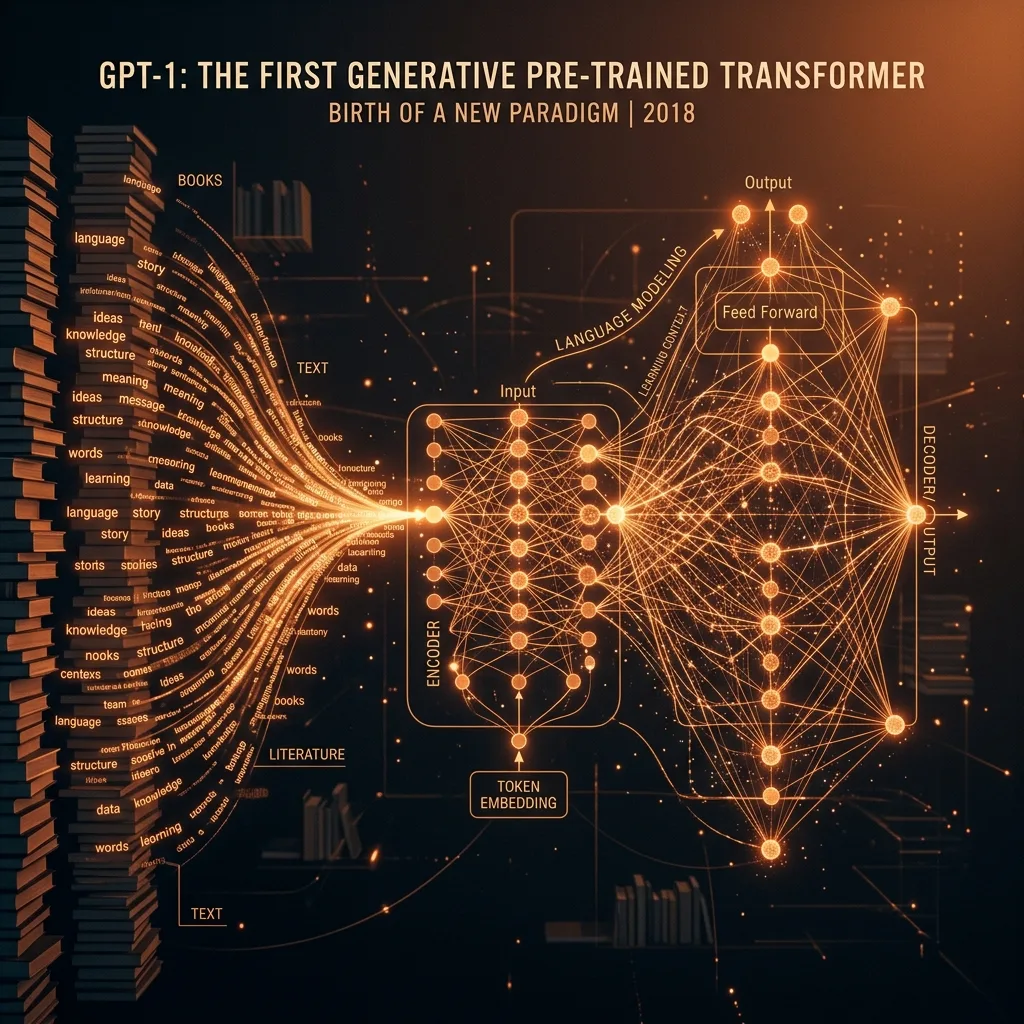
OpenAI publishes "Improving Language Understanding by Generative Pre-Training," introducing GPT-1—a 117-million-parameter Transformer model that learns language by reading over 7,000 unpublished books. It proves that a single model, pre-trained on raw text, can be fine-tuned to perform virtually any language task.
Open in interactive timeline →Key Numbers
- Parameters
- 117 million
- Released
- June 2018
- Training data
- ~7,000 unpublished books (BookCorpus)
- Benchmarks beaten
- 9 of 12 tasks (new SOTA)
- Context window
- 512 tokens
Verified Facts
- GPT-1 was introduced in June 2018 in the OpenAI technical report 'Improving Language Understanding by Generative Pre-Training,' authored by Alec Radford, Karthik Narasimhan, Tim Salimans, and Ilya Sutskever — the paper that first coined the 'generative pre-trained transformer' concept.
- The model was a 12-layer decoder-only transformer with masked self-attention, using 768-dimensional hidden states, 12 attention heads (64 dimensions each), and 3,072-dimensional feed-forward inner layers, totaling roughly 117 million parameters — tiny by later standards but large for its day.
- GPT-1's central thesis was a two-stage 'semi-supervised' recipe: an unsupervised generative pre-training stage that learns language by predicting the next word, followed by a lightweight supervised fine-tuning stage that adapts those weights to specific tasks — the template that still underlies essentially every modern LLM.
- It was pre-trained on the BookCorpus dataset of over 7,000 unpublished books spanning genres like adventure, fantasy, and romance; the authors deliberately chose long-form books so the model could learn long-range dependencies rather than the shuffled sentences in other corpora.
- Despite minimal task-specific architecture changes, GPT-1 improved upon the state of the art on 9 of the 12 NLP tasks studied, demonstrating that a single general pre-trained model could transfer across very different problems.
- Its headline benchmark gains were striking for the era: +8.9% absolute on the Story Cloze commonsense reasoning test, +5.7% on the RACE question-answering benchmark, +1.5% on the MultiNLI textual entailment task, and a 5.5-point jump on the GLUE multi-task suite.
- On GLUE, GPT-1 scored 72.8, beating the strongest prior ELMo-based system (around 66.5) and earlier baselines (63.7); on the CoLA grammatical-acceptability task it scored 45.4 versus the previous best of 35.0.
- GPT-1 was trained with the Adam optimizer over a context of 512 contiguous tokens, with the learning rate warmed up linearly over the first 2,000 updates to a peak of 2.5e-4 and then annealed to zero on a cosine schedule.
- Architecturally GPT-1 broke from the attention-augmented RNNs that preceded it; using the transformer (introduced in 2017's 'Attention Is All You Need') gave the model a more structured, parallelizable memory that proved far more scalable.
- GPT-1 arrived roughly four months before Google's BERT (October 2018), and the two embodied competing bets — GPT's left-to-right decoder-only generation versus BERT's bidirectional encoder; BERT initially dominated understanding benchmarks, but the decoder-only line GPT-1 pioneered ultimately won out in GPT-2, GPT-3, GPT-4, and nearly all later large language models.
The World at This Moment
GPT-1's June 2018 release fell in a remarkable convergence year for natural language processing. Months earlier, Peters et al. published ELMo (deep contextualized word representations); Howard and Ruder released ULMFiT, demonstrating transferable language-model fine-tuning. In October 2018, Google's Devlin et al. unveiled BERT, whose bidirectional pre-training would briefly eclipse GPT on benchmarks like GLUE (BERT 80.2 vs. GPT 72.8 vs. ELMo 66.5). All built on Vaswani et al.'s 2017 "Attention Is All You Need" Transformer. Sebastian Ruder famously called this NLP's "ImageNet moment," echoing computer vision's 2012 inflection. Beyond NLP, DeepMind was extending AlphaZero's 2017 self-play mastery; the deep-learning boom was reshaping industry. The same year surfaced early alarms about misuse and bias in large models. OpenAI itself was barely three years old, still a nonprofit research lab, and GPT-1 attracted modest attention compared to the BERT wave that immediately followed.
The Paradigm Shift
GPT-1 demonstrated that a single, task-agnostic Transformer decoder, pre-trained generatively on unlabeled text (BooksCorpus, ~117 million parameters) and then lightly fine-tuned, could surpass bespoke task-specific architectures across diverse benchmarks. This validated the "pre-train then fine-tune" recipe that, alongside BERT, became NLP's dominant paradigm, displacing the era of hand-engineered, supervised, task-specific models. Crucially, GPT-1 committed to a decoder-only, autoregressive next-token objective and unidirectional generation. While BERT's bidirectional encoder won the immediate benchmark contest, GPT-1's generative architecture proved the scalable lineage: GPT-2 (2019), GPT-3 (2020), and beyond demonstrated that scaling this exact template yielded emergent few-shot and zero-shot abilities. The report's quiet thesis, that generic generative pre-training transfers robustly, seeded the foundation-model and large-language-model era. It reframed progress as a function of compute and data scale on a unified objective rather than architectural ingenuity per task, redirecting both research priorities and industrial investment.
In Their Own Words
"Our general task-agnostic model outperforms discriminatively trained models that use architectures specifically crafted for each task, significantly improving upon the state of the art in 9 out of the 12 tasks studied." — Alec Radford, Karthik Narasimhan, Tim Salimans, and Ilya Sutskever, abstract of "Improving Language Understanding by Generative Pre-Training" (OpenAI technical report, 2018).
In Depth
The Match That Lit Quietly
In June 2018, a small team at OpenAI led by Alec Radford published a technical report with an unassuming title: Improving Language Understanding by Generative Pre-Training. It introduced a 117-million-parameter Transformer decoder trained on roughly 7,000 unpublished books, the BookCorpus. The model improved the state of the art on 9 of 12 language tasks. It made few headlines. Yet GPT-1 was the quiet striking of a match that, within a decade, would burn through the entire premise of what machine intelligence could be.
The Deep Preconditions
GPT-1 was not a beginning so much as a convergence. Its architecture descended directly from the Transformer (sv-transformer-paper), the 2017 attention mechanism that had abolished the sequential bottleneck of recurrent networks. Its faith in scale and data inherited the lesson of AlexNet (sv-alexnet-convnets), which in 2012 proved that deep neural networks, fed enough data and GPU compute, could outperform hand-crafted human cleverness. And its ambition was haunted by AlphaGo (sv-alphago), whose 2016 victory had shown that learned intuition could defeat the best human in a domain once thought to require the ineffable.
But the truly deep precondition is older and stranger. Language itself is a compression of the world, and the world that GPT-1 modeled is the same one that flickered into being at the Big Bang (sv-big-bang) and slowly cooked the carbon, in the first supernovas (sv-first-supernova), from which thinking matter would eventually assemble itself. Every book in the BookCorpus was written by a primate whose lineage split from chimpanzees (sv-human-chimp-split) and whose symbolic mind crystallized when our ancestors first pressed reeds into clay to invent cuneiform (sv-cuneiform). GPT-1 was a mirror held up to that entire inheritance of recorded thought.
The Core Insight
What Radford's paper actually proved was philosophical, not merely technical. Earlier NLP built bespoke architectures for each task; GPT-1 showed that a single model, pre-trained to do nothing but predict the next word, could be lightly fine-tuned to do almost anything. Generality emerged from a stupidly simple objective. This is the conceptual seed of the modern era: intelligence as a side effect of compression, understanding as next-token prediction at sufficient scale. It is an idea Democritus (sv-democritus) might have appreciated — complex order arising from blind, mechanical iteration over simple parts.
The Ripple Forward
GPT-1's children grew with terrifying speed. GPT-2 (sv-gpt2) arrived in 2019 with text so fluent OpenAI hesitated to release it. GPT-3 (sv-gpt3) scaled the same recipe a hundredfold and discovered that capabilities simply appeared with size, vindicating the scaling hypothesis. From that lineage came assistants like Claude 3.5 Sonnet (sv-claude-sonnet) and the broader project of machine reasoning. In this arc, GPT-1 occupies the position that the first true mammals (sv-first-mammals) hold in evolution — small, unremarkable to contemporaries, but carrying the architecture that would inherit the world after the landscape changed.
It also retroactively dignified a prophet. Ray Kurzweil's law of accelerating returns (sv-kurzweil-law) had long forecast exactly this kind of exponential takeoff, and GPT-1's trajectory became Exhibit A for the claim of AGI by 2029 (sv-kurzweil-agi-2029).
A Quiet Place in the Arc
History rarely announces its hinges. The printing press (sv-printing-press) looked like a better way to copy Bibles before it shattered Christendom. GPT-1 looked like a modest benchmark result before it became the template for a technology that may rival the agricultural revolution (sv-agriculture) in its reordering of human life. Its quietness is the point: the most consequential beginnings are legible only in retrospect, once the fire they started has spread.
Sources: OpenAI GPT-1 paper
Causes & Consequences
What led to it
- The 2017 paper 'Attention Is All You Need' by Vaswani et al. introduced the Transformer architecture based purely on self-attention, whose decoder stack GPT-1 directly adopted as a 12-layer masked, decoder-only model with 768-dimensional states and 12 attention heads.
- Earlier semi-supervised work, notably Dai and Le's 2015 'Semi-supervised Sequence Learning' and Howard and Ruder's ULMFiT, established that a language model could be pre-trained on unlabeled text and then fine-tuned on downstream tasks, the exact two-stage recipe GPT-1 generalized to the Transformer.
- The BooksCorpus dataset of roughly 7,000 unpublished books gave OpenAI long stretches of contiguous prose, letting the model learn long-range dependencies that shorter, shuffled-sentence corpora could not provide.
- The broader 2018 shift toward transfer learning in NLP, with contemporaries ELMo (Peters et al., ~94M parameters) and ULMFiT showing pre-trained representations beating task-specific models, created the 'ImageNet moment' climate in which generative pre-training was a natural next step.
- Advances in GPU compute and parallelizable training, which the recurrence-free Transformer exploited far better than LSTMs, made it practical to train a 117-million-parameter language model on a large book corpus.
- OpenAI's institutional bet on unsupervised and generative methods, with authors Alec Radford, Karthik Narasimhan, Tim Salimans, and Ilya Sutskever, provided the research direction and resources to pursue generative pre-training over the then-dominant supervised, task-specific paradigm.
What it set in motion
- GPT-1 established the pre-train-then-fine-tune template for a single decoder-only Transformer that became the standard architecture for nearly all subsequent large language models.
- It directly seeded GPT-2 in 2019 (1.5 billion parameters), which showed that scaling the same approach produced strikingly coherent text and surprising zero-shot ability.
- It led to GPT-3 in 2020 (175 billion parameters), whose in-context and few-shot learning demonstrated that scale alone could unlock new capabilities without task-specific fine-tuning.
- The lineage culminated in instruction-tuned, chat-oriented systems like ChatGPT, bringing generative pre-trained transformers to hundreds of millions of mainstream users and triggering the modern generative-AI boom.
- GPT-1's success helped motivate the empirical study of neural scaling laws, the finding that loss falls predictably as model size, data, and compute grow, which reframed AI progress as substantially an engineering-of-scale problem.
- By proving that one generatively pre-trained model could transfer across many tasks, it accelerated the field's move away from bespoke per-task architectures toward general-purpose foundation models, a paradigm later named and popularized across NLP and beyond.
The Live Academic Debate
A live debate concerns how much credit GPT-1 deserves versus its 2018 contemporaries. Many practitioners and historians (reflected in surveys and Jay Alammar's widely cited explainers) treat BERT, not GPT-1, as the decisive 2018 breakthrough, since BERT's bidirectional pre-training dominated GLUE and downstream tasks; GPT-1 is read as a transitional precursor. A competing framing, advanced retrospectively by the GPT lineage's success, holds that GPT-1's decoder-only autoregressive design was the more consequential bet, vindicated by scaling. A second, methodological debate (e.g., Kabir et al.'s 2023 work on "scientific debt" in pre-training research) questions whether these early comparisons were rigorous, given inconsistent compute, data, and evaluation protocols, complicating clean priority claims. Sebastian Ruder's "ImageNet moment" thesis itself is contested: skeptics argue the analogy overstates a sudden rupture, since transfer learning in NLP had incremental antecedents (word2vec, GloVe, ELMo). Disagreement also persists over whether scale or architecture drove subsequent gains.
How This Event Connects
The introduction of GPT-1 (Improving Language Understanding by Generative Pre-Training) in 2018 marked the historiographical moment the Transformer architecture was recontextualized from a translation tool into a generalized Foundation Model. By stripping away the encoder and relying on a causal, decoder-only mechanism, GPT-1 established the modern semi-supervised pre-training paradigm. This transition from narrow, task-specific supervised models to a broad, unsupervised understanding of language fundamentally mirrored the deep learning transition ignited by AlexNet, shifting the focus of NLP from algorithmic design to data-scale optimization.
Crucially, GPT-1 established the methodological bridge to the zero-shot capabilities of its successor, GPT-2. While GPT-1 still relied on fine-tuning for downstream tasks, its pre-training phase exhibited latent zero-shot competencies, acting as the empirical justification for subsequent massive scaling. The architectural risks identified in GPT-1, such as catastrophic forgetting during fine-tuning, directly necessitated the push toward the prompt-based interaction models.
This trajectory ultimately culminated in GPT-3, which abandoned fine-tuning entirely in favor of in-context learning. Thus, GPT-1 stands as the critical evolutionary missing link in AI history: the foundational proof of concept that language structure could be universally encoded through autoregressive next-token prediction, setting the stage for the era of massively scaled, homogenized artificial intelligence.
The Counterfactual
Had GPT-1 not appeared in mid-2018, the broader transfer-learning shift would likely have proceeded regardless: ELMo, ULMFiT, and especially BERT independently established that pre-trained language models transferred well, and BERT alone dominated benchmarks through 2019. The "pre-train then fine-tune" paradigm was overdetermined. What GPT-1 specifically secured was the credibility and institutional momentum of the decoder-only autoregressive line at OpenAI. Absent it, OpenAI might have pursued bidirectional or encoder-decoder approaches like much of the field, plausibly delaying or reshaping the GPT-2/GPT-3 scaling trajectory that produced in-context few-shot learning. The counterfactual is therefore less about whether transfer learning arrived and more about which lineage scaled into the LLM era and how quickly. It is genuinely uncertain whether another lab would have committed comparable resources to scaling a generative decoder; BERT's benchmark success arguably steered the mainstream toward encoders for years. GPT-1's significance is thus partly retrospective, legible mainly through its descendants.
Myth vs. Reality
Myth: GPT-1 was the first Transformer language model, or invented the Transformer.
Reality: The Transformer architecture was introduced a year earlier in Vaswani et al.'s 2017 paper "Attention Is All You Need" at Google. GPT-1 (June 2018) reused the Transformer decoder rather than inventing it. It was also not even the first 2018 work on language-model pre-training and transfer for NLP: ELMo (Peters et al.) and ULMFiT (Howard and Ruder) appeared the same year, and ULMFiT predated GPT-1. GPT-1's contribution was specifically combining unsupervised generative pre-training of a Transformer decoder with task-specific fine-tuning, not originating the Transformer or transfer learning.
Myth: GPT-1 was trained on the 1 Billion Word Benchmark (or a broad web crawl), like later GPT models.
Reality: GPT-1 was pre-trained on the BooksCorpus, roughly 7,000 unpublished books (about 985 million words) spanning genres like adventure, fantasy, and romance. The paper deliberately chose long, contiguous book text and explicitly declined the similarly sized 1 Billion Word Benchmark (the dataset ELMo used) because it is shuffled at the sentence level, which destroys the long-range structure the model needed to learn. The massive, web-scraped corpora associated with GPT in the public imagination came with GPT-2's WebText (2019) and later models, not GPT-1.
Myth: GPT-1 was a purely unsupervised model.
Reality: The paper frames its method as 'semi-supervised': an unsupervised generative pre-training stage on unlabeled text, followed by a supervised, discriminative fine-tuning stage on each labeled downstream task. The headline results (improving the state of the art on 9 of the 12 tasks studied) came from this supervised fine-tuning step, with task inputs reformatted into ordered token sequences. Describing GPT-1 as entirely unsupervised omits the labeled fine-tuning that produced its benchmark numbers.
Myth: GPT-1 was an immediate sensation that captured the field's attention in 2018.
Reality: GPT-1 was a relatively quiet release and was substantially overshadowed within months by Google's BERT (October 2018), which set new state-of-the-art results on 11 NLP tasks and dominated research attention. BERT's bidirectional masked-language-modeling approach drew far more immediate excitement than GPT-1's left-to-right decoder. GPT-1's lasting importance is mostly seen in hindsight, as the architectural and methodological seed of the GPT line, rather than as a high-profile event at the time.
Myth: GPT-1 was a huge model with billions of parameters and could chat or follow instructions.
Reality: GPT-1 had about 117 million parameters: a 12-layer Transformer decoder with 768-dimensional hidden states, 12 attention heads, and a context window of 512 tokens, tiny by later standards (GPT-2 reached 1.5 billion and GPT-3 reached 175 billion). It was not a conversational assistant; it was a base model evaluated by fine-tuning on classification-style benchmarks such as natural language inference, question answering, semantic similarity, and text classification. Chat-style, instruction-following behavior came years later with models like InstructGPT and ChatGPT, not with GPT-1.
Frequently Asked Questions
What was GPT-1 and when was it released?
GPT-1 (Generative Pre-trained Transformer) was the first model in OpenAI's GPT series, introduced in June 2018 in the paper "Improving Language Understanding by Generative Pre-Training." It was authored by Alec Radford, Karthik Narasimhan, Tim Salimans, and Ilya Sutskever. The work introduced the now-foundational two-stage recipe of unsupervised generative pre-training on large amounts of unlabeled text followed by supervised fine-tuning on specific tasks. OpenAI released the paper and code, but no public product or interface, which is part of why the launch drew relatively little attention at the time.
How big was GPT-1 and what data was it trained on?
GPT-1 was a 12-layer, decoder-only Transformer with a hidden size of 768 and 12 attention heads, totaling about 117 million parameters. It was pre-trained on BookCorpus, a dataset of roughly 7,000 unpublished books (around 985 million words) spanning genres like romance, science fiction, and fantasy. Using long passages of contiguous book text helped the model learn to handle long-range dependencies. By today's standards it is tiny, but it established the template later scaled up dramatically in GPT-2 and GPT-3.
How is GPT-1 different from BERT?
Both GPT-1 and BERT appeared in 2018, used the Transformer introduced in "Attention Is All You Need," and even shared similar base dimensions (12 layers, hidden size 768, 12 heads). The key difference is direction: GPT-1 is a decoder-only model with masked self-attention that reads text left-to-right (unidirectional) and predicts the next word, while BERT is an encoder that is bidirectional, predicting masked words using context from both sides. GPT-1's left-to-right design makes it naturally suited to generating text, whereas BERT was optimized for understanding tasks. BERT, released later in 2018, posted stronger benchmark numbers and initially drew more attention.
What results did GPT-1 achieve?
GPT-1 improved on the prior state of the art in 9 of the 12 NLP tasks the authors evaluated. According to the paper, it delivered absolute gains such as 8.9% on commonsense reasoning (Stories Cloze), 5.7% on question answering (RACE), and 1.5% on textual entailment (MultiNLI). It also showed promising zero-shot behavior on some tasks without any fine-tuning, hinting that a single pre-trained model could transfer broadly. These results supported the core hypothesis that a generative model trained on raw text learns representations useful for many downstream tasks.
Why is GPT-1 called "the quiet beginning"?
GPT-1's release in 2018 generated little public excitement compared with what came later. There was no consumer product, only a research paper and code, and within months Google's BERT eclipsed it in benchmark headlines. It was GPT-2 in 2019, and especially GPT-3 in 2020 and ChatGPT in 2022, that brought the GPT lineage mainstream attention. In hindsight, GPT-1 quietly proved the pre-train-then-fine-tune approach that every later GPT was built on.
How did GPT-1 lead to later models like GPT-2 and GPT-3?
GPT-1 established the architecture and training recipe that OpenAI then scaled up. GPT-2 (2019) used essentially the same decoder-only design but grew from 117 million parameters to 1.5 billion. GPT-3 (2020) pushed this further to 175 billion parameters, and OpenAI explicitly trained models across roughly three orders of magnitude to study scaling laws. This progression reflects the "scaling hypothesis": that making the same kind of model larger, with more data and compute, keeps yielding new capabilities. GPT-1 was the small first step that made that bet possible.
Sources & Further Reading
- GPT-1 — Wikipedia
- Radford, A., Narasimhan, K., Salimans, T., & Sutskever, I. (2018). Improving Language Understanding by Generative Pre-Training. OpenAI Technical Report.
- Vaswani, A. et al. (2017). Attention Is All You Need. NeurIPS.
- Devlin, J., Chang, M.-W., Lee, K., & Toutanova, K. (2019). BERT: Pre-training of Deep Bidirectional Transformers for Language Understanding. NAACL.
- Peters, M. et al. (2018). Deep Contextualized Word Representations (ELMo). NAACL; Howard, J. & Ruder, S. (2018). Universal Language Model Fine-tuning (ULMFiT). ACL.
- Ruder, S. (2018). NLP's ImageNet Moment Has Arrived. The Gradient.
- The Paper: Improving Language Understanding by Generative Pre-Training
- Wikipedia: Generative pre-trained transformer
Cite This Page
AskHistoryAI. “GPT-1: The Quiet Beginning.” AskHistoryAI — Interactive Timeline of Everything. Updated 2026-09-11. https://askhistoryai.com/event/sv-gpt1/
Every fact on this page is checked against the published fact ledger and methodology; sources are listed above.