The Great Schism
The formal divorce of the East and West.
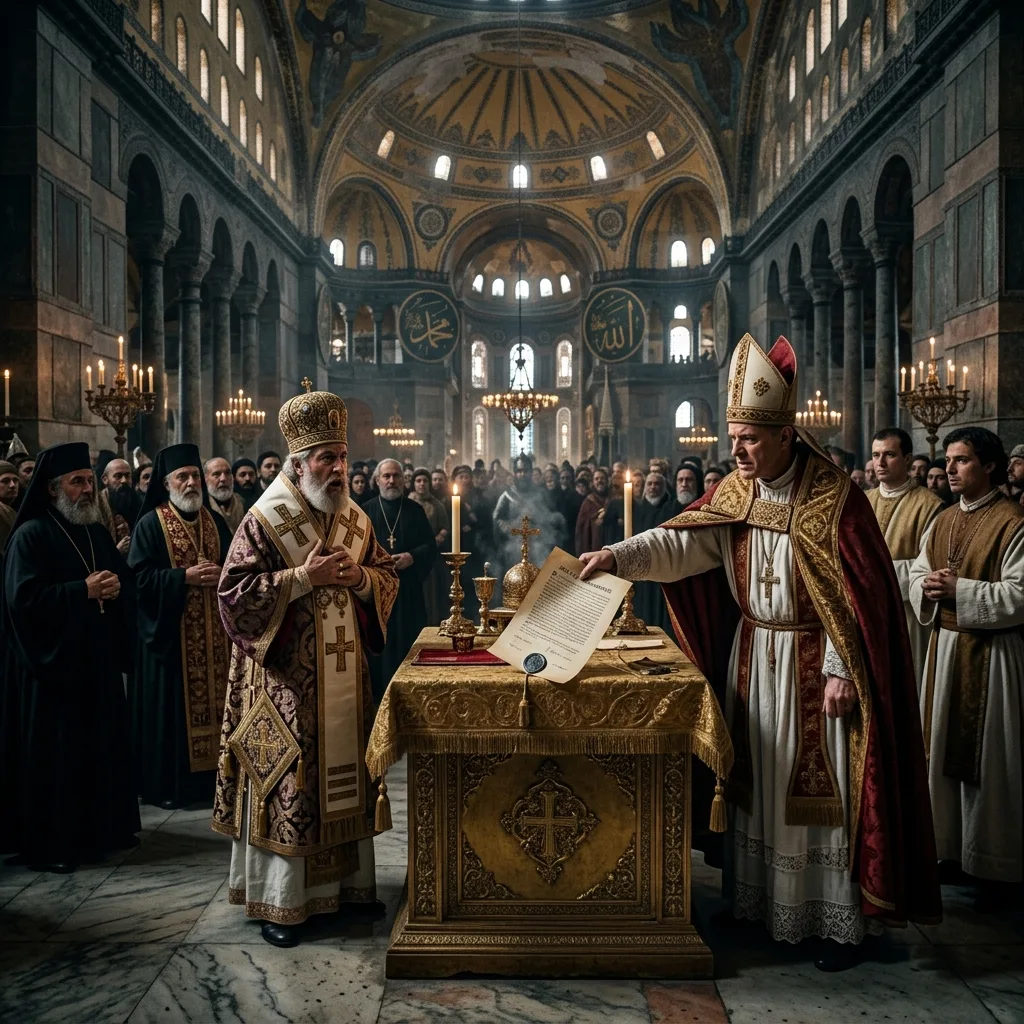
The Catholic Church in Rome and the Eastern Orthodox Church in Constantinople formally excommunicate each other, solidifying a cultural and theological divide that persists to this day.
Open in interactive timeline →Key Numbers
- Date of the rupture
- July 16, 1054
- Papal legates sent
- 3 (led by Cardinal Humbert)
- Days until counter-anathema
- 4 (synod of July 20)
- Years until mutual excommunications lifted
- 911 (Dec 7, 1965)
- Churches divided
- Roman Catholic vs. Eastern Orthodox
Verified Facts
- On July 16, 1054, Cardinal Humbert of Silva Candida, leading a delegation of three papal legates, strode into the Hagia Sophia in Constantinople during the liturgy and laid a bull of excommunication against Patriarch Michael Cerularius upon the high altar.
- As the legates departed, Humbert shook the dust from his feet and reportedly cried 'Videat Deus et judicet!' ('Let God look and judge!'); four days later, on July 20, 1054, Cerularius convened a synod that excommunicated the legates in return.
- The excommunication was arguably legally void: Pope Leo IX, who had dispatched the legation, had already died on April 19, 1054, months before Humbert acted, so the legates technically had no living pontiff's authority behind them.
- Crucially, the 1054 bull and its counter-anathema were aimed at specific individuals, not the entire churches: Humbert excommunicated Cerularius and his associates personally, and Cerularius anathematized the legates, not the Pope or the Western Church as a whole.
- The crisis was triggered around 1053 when Cerularius, reacting to Latin practices, ordered the Latin-rite churches in Constantinople closed, and Leo of Ohrid wrote a letter attacking Western customs such as the use of 'azymes' (unleavened bread) in the Eucharist and Saturday fasting.
- Core disputes were both theological and political: the 'Filioque' clause unilaterally added by the West to the Nicene Creed ('proceeds from the Father and the Son'), the leavened-versus-unleavened-bread controversy, and above all the Roman claim to universal papal primacy versus the Eastern view of Rome's primacy as merely honorary among equals.
- Modern scholars overwhelmingly reject 1054 as the true 'start' of the schism; the estrangement was a centuries-long drift, and contemporaries did not regard the events of 1054 as a definitive or final rupture between the churches.
- Historians generally identify the Fourth Crusade's brutal sack of Constantinople in 1204, when Latin Crusaders pillaged the city and desecrated Orthodox churches during Holy Week, as the event that truly hardened the schism into a lasting and bitter division.
- On December 7, 1965, one day before the close of the Second Vatican Council, Pope Paul VI and Ecumenical Patriarch Athenagoras I issued a Joint Declaration, read simultaneously in Rome and Istanbul, expressing regret for the 1054 excommunications and committing them 'to oblivion.'
- The 1965 declaration did not end the schism or restore full communion; it was a symbolic act of reconciliation removing the mutual anathemas from the memory of the Church, and the two communions remain formally separated to this day.
The World at This Moment
The summer of 1054 sat within the eleventh-century reconfiguration of Christendom. In the West, the reform movement later called Gregorian was gathering force; Leo IX (reigned 1049–1054) championed papal authority but died on 19 April 1054, weeks before his legates acted in Constantinople. Norman armies were conquering Byzantine southern Italy—Leo himself had been captured at Civitate in 1053—pressuring both Rome and Constantinople. The Byzantine Empire under Constantine IX Monomachos faced Pecheneg and emerging Seljuk threats; the Turks would crush Byzantium at Manzikert in 1071. Across Eurasia, the Song dynasty governed a commercially sophisticated China, the Fatimid Caliphate ruled Egypt, and Islamic Spain's taifa kingdoms had fragmented after the Umayyad collapse of 1031. In northern Europe, England stood twelve years before the Norman Conquest. The "schism" of 1054 was thus a localized diplomatic rupture amid larger geopolitical strains, not the cataclysm later tradition imagined; contemporaries scarcely noticed it.
The Paradigm Shift
The events of July 1054 crystallized—rather than created—a divergence between Latin and Greek Christianity that reshaped Eurasian religious geography for a millennium. The substantive issues were the Filioque (the West's unilateral insertion of "and the Son" into the Nicene Creed), Western use of unleavened bread (azymes) in the Eucharist, and, most enduringly, the claim of universal Roman papal primacy versus the Eastern conciliar model of autocephalous patriarchates. By hardening these contrasts into mutual anathema, 1054 became the symbolic origin of two distinct civilizational trajectories: a Latin West oriented toward a centralized papal monarchy, scholasticism, and eventually the Reformation's reaction against it; and a Greek and Slavic Orthodox East organized around Byzantine and later Russian imperial-ecclesial synthesis. The split foreclosed a unified Christian response to Islam, conditioned the Crusades' ambivalence toward Byzantium, and left a fault line still visible in modern Europe's confessional and geopolitical divisions.
In Their Own Words
"Let Michael the neophyte, wrongly called patriarch... together with all who follow them in their aforesaid errors and presumptions, be Anathema Maranatha, with the Simoniacs, Valesians, Arians, Donatists, Nicolaitans... and with all heretics, indeed with the devil and his angels, unless perchance they should repent. Amen, Amen, Amen." — Cardinal Humbert of Silva Candida, the Bull of Excommunication laid upon the altar of Hagia Sophia, 16 July 1054 (preserved in Humbert's account; trans. in C. Will, Acta et scripta quae de controversiis ecclesiae graecae et latinae, 1861)
In Depth
The Crack That Ran Through Christendom
The Great Schism of 1054 is the rare historical event whose fame outruns its facts. The traditional story is crisp: on 16 July 1054, Cardinal Humbert of Silva Candida, a legate of the recently deceased Pope Leo IX, strode into the Hagia Sophia and laid a bull of excommunication upon the altar, condemning Patriarch Michael Cerularius of Constantinople; days later a synod returned the favor, excommunicating the legates. Yet no serious historian now treats this as the moment Christianity split. The mutual anathemas were personal, not institutional, and contemporaries did not experience them as a permanent rupture. The schism was a slow geological fault, and 1054 was merely the tremor we chose to name.
Deep Preconditions
The fault line was laid centuries earlier. When Constantine convened the bishops at Nicaea (sv-constantine-legal) and when Theodosius made Christianity the empire's sole legal faith (sv-theodosius), they bound the Church to the Roman state. The collapse of the Western half of that empire left two Christian worlds drifting apart: a Greek-speaking East centered on the surviving Byzantine emperor, and a Latin-speaking West where the Bishop of Rome inherited imperial prestige by default. Augustine of Hippo (sv-augustine) shaped a Latin theology of grace and original sin that the Greek fathers never fully shared. Two doctrinal irritants festered: the Filioque—the Western addition declaring the Spirit proceeds from Father "and the Son"—and the escalating claim of papal supremacy over all Christendom, which the Eastern patriarchates, governing by council, flatly rejected. The rise of Islam (sv-rise-of-islam) had already amputated Antioch, Jerusalem, and Alexandria from the conversation, leaving Rome and Constantinople as rival poles with no one to mediate between them.
The Rupture That Came Later
The true wound was inflicted 150 years after Humbert's gesture. In 1204 the soldiers of the Fourth Crusade, nominally bound for the Holy Land, instead sacked Constantinople, looted Hagia Sophia, and installed a Latin emperor on the Bosporus. That betrayal—Latin Christians plundering the Christian East—made reconciliation emotionally impossible in a way theology alone never had. From that point the two churches were not merely divided but estranged. The schism hardened into the permanent division between Roman Catholicism and Eastern Orthodoxy we know today.
Ripples Across the Arc
The consequences ran for a millennium. With the East severed, the Western Church turned inward and upward, building an increasingly centralized, juridical papacy whose authority would eventually provoke its own fracture: Martin Luther's revolt (sv-martin-luther) was, in part, a second protest against the very papal absolutism that 1054 had crystallized. Meanwhile the East, cut off from the Latin scholastic ferment that fed the Renaissance (sv-renaissance), preserved a more mystical and conciliar tradition—and Byzantine scholars fleeing the dying empire later carried Greek manuscripts west, helping ignite that very rebirth. The weakened, isolated Byzantium that emerged from 1204 was easier prey for Genghis Khan's heirs (sv-genghis-khan) and the Ottoman armies wielding the new firearms (sv-firearms) that finally took Constantinople in 1453.
The schism's deepest lesson is about how institutions diverge: not through a single decree but through accumulated linguistic, political, and theological drift, ratified at last by a symbolic act. The mutual excommunications of 1054 stood for nine centuries until Pope Paul VI and Patriarch Athenagoras lifted them together in 1965—a reconciliation of memory, not of union. Christendom's two great halves remain apart, a reminder that the most consequential divisions in history are rarely the loud ruptures we remember, but the quiet differences we let calcify until someone finally names them.
Causes & Consequences
What led to it
- The Photian Schism of 863-867, in which Patriarch Photius of Constantinople and Pope Nicholas I traded condemnations over the legitimacy of Photius's appointment and over Rome's jurisdiction in Bulgaria, established the pattern of mutual excommunication and aired the very Filioque and authority disputes that would resurface in 1054.
- The Western Church's gradual insertion of the Filioque clause ('and the Son') into the Nicene Creed created a doctrinal flashpoint, since the East regarded altering the wording of an ecumenical creed as illegitimate and held that the Holy Spirit proceeds from the Father alone.
- The escalating papal claim to universal jurisdiction over all five patriarchates collided with the Eastern view that the Bishop of Rome held only a primacy of honor, leaving no agreed mechanism to resolve disputes between Rome and Constantinople.
- The divergence in liturgical practice over the Eucharistic bread, with the West mandating unleavened bread (azymes) and the East insisting exclusively on leavened bread, became a concrete and emotionally charged marker of separation that one Eastern writer called the chief cause of division.
- The Norman conquest of Byzantine southern Italy from 1016 onward led to the forcible imposition of Latin rites on Greek churches there, prompting Patriarch Michael Cerularius to retaliate in 1052 by closing the Latin churches in Constantinople.
- Pope Leo IX's dispatch of a legation led by the combative Cardinal Humbert of Silva Candida in 1054, sent ostensibly to negotiate an anti-Norman alliance, brought to Constantinople a representative far more intent on pressing Latin doctrinal claims than on reconciliation.
What it set in motion
- On 16 July 1054 Cardinal Humbert laid a bull of excommunication against Michael Cerularius on the altar of Hagia Sophia, and the patriarch responded by anathematizing the legates, formalizing a rupture between the Sees of Rome and Constantinople that has never been fully healed.
- The split hardened the institutional separation of Christendom into Western (Roman Catholic) and Eastern (Orthodox) churches, which thereafter developed largely independent theologies, liturgies, canon law, and ecclesiastical structures.
- The Fourth Crusade's sack of Constantinople in 1204 and the installation of a Latin patriarch turned a clerical dispute into a deep popular enmity, an act of betrayal widely regarded as sealing the schism in the minds of Eastern Christians.
- The failure of the reunion councils of Lyon (1274) and Florence (1438-1439), whose negotiated unions were repudiated by the Orthodox clergy and faithful, demonstrated how durable the division had become despite repeated attempts at reconciliation.
- The two traditions expanded into different parts of the world, with Catholicism spreading through Western Europe and the Americas (and later fracturing further in the Protestant Reformation) while Orthodoxy spread north into the Balkans and Russia, shaping distinct religious cultures across the globe.
- In a joint declaration read simultaneously in Rome and Istanbul on 7 December 1965, Pope Paul VI and Ecumenical Patriarch Athenagoras I expressed regret for and lifted the mutual anathemas of 1054, a landmark gesture that opened sustained Catholic-Orthodox ecumenical dialogue without ending the schism itself.
The Live Academic Debate
The central debate concerns when, and whether, a "schism" actually occurred in 1054. Steven Runciman (The Eastern Schism, 1955) and Henry Chadwick (East and West, 2003) argued there was no single rupture but a centuries-long drift of language, liturgy, and ecclesiology, with 1054 merely one episode. A strong current, articulated by scholars such as Brett Edward Whiting and synthesized in recent revisionist work (e.g., Eugene Webb), holds that 1054 is essentially a "medieval myth": the excommunications bound only named individuals, Humbert's legatine authority arguably lapsed at Leo IX's death, and contemporaries did not register a permanent break. These revisionists relocate the decisive breach either earlier, to the Carolingian Filioque disputes around 800 and the Photian controversy of the 860s, or—more commonly—to 1204, when the Fourth Crusade's sack of Constantinople made reconciliation psychologically impossible. Confessional historiography complicates matters: Catholic accounts often stress papal primacy as the irreducible issue, while Orthodox writers (e.g., John Meyendorff) emphasize Rome's unilateral innovations.
How This Event Connects
The "Great Schism" of 1054 is recognized by modern historiography not as a sudden theological rupture, but as the culmination of centuries of slow-moving geopolitical, linguistic, and administrative divergence between East and West. The initial structural fault lines were inadvertently laid during the era of Constantine & Nicaea, which established a conciliar model of Church governance in the East that profoundly clashed with the West's developing ideology of absolute Papal Primacy.
Theological alienation heavily compounded this administrative friction. The Latin West's reliance on the intensely pessimistic, grace-focused theology of Augustine of Hippo led to linguistic and metaphysical innovations (such as the Filioque clause) that were utterly incompatible with Greek Orthodox formulations. Because the two halves of the Church literally stopped understanding each other's legal and philosophical languages, localized diplomatic failures quickly escalated into mutual excommunications.
Geopolitically, this gradual estrangement was severely exacerbated by the Early Muslim Conquests, which effectively isolated the Byzantine Empire and forced the Papacy to pivot northward to forge alliances with the Franks and Normans. The ultimate point of no return was not theological debate, but visceral bloodshed—most notably the horrific sack of Constantinople by Western Crusaders in 1204, which permanently shattered any possibility of ecclesiastical reconciliation.
The Counterfactual
Had Pope Leo IX lived, the legation's authority would not have lapsed, and a chastened, negotiated outcome was plausible: Humbert's bull was arguably void once his commissioning pope died, a point Eastern apologists have pressed. Yet most scholars (Runciman, Chadwick) insist the underlying estrangement—ecclesiological, linguistic, liturgical—was structural, so even a tactful 1054 would likely have only deferred rupture. The decisive counterfactual lies in 1204: absent the Fourth Crusade's sack of Constantinople, lingering communion and repeated reunion attempts (Lyons 1274, Florence 1439) might have succeeded, since the 1054 excommunications targeted individuals, not churches, and contact continued for generations. A surviving, undivided Christendom could have mounted a more coordinated front against Seljuk and later Ottoman expansion, possibly altering the fall of Constantinople in 1453. Conversely, the Western theological independence that fed the Renaissance papacy and the Reformation presupposed a self-contained Latin Church; a permanently Greek-tethered West is hard to imagine producing the same intellectual trajectory.
Myth vs. Reality
Myth: In 1054 the Pope excommunicated the entire Eastern Orthodox Church (and the Patriarch excommunicated the whole Western Church), formally splitting Christianity in two.
Reality: The bulls were narrowly targeted at named individuals, not whole churches. Cardinal Humbert's bull excommunicated Patriarch Michael Cerularius and 'those who support his folly'; Cerularius in turn anathematized only the papal legates. Modern medievalists and Byzantinists stress that the censures were deliberately restricted in scope to the direct participants, not the institutional separation of East from West.
Myth: The Great Schism was a single, decisive, permanent break that happened in the year 1054.
Reality: Few professional historians today treat 1054 as the moment the churches definitively split. The estrangement was a long process; East and West continued to communicate and often worshiped together for generations afterward. Many scholars point instead to the Fourth Crusade's sack of Constantinople in 1204, and the installation of a Latin Patriarch in Hagia Sophia, as the real hardening of the divide.
Myth: Contemporaries immediately recognized 1054 as the dramatic, momentous rupture of Christendom.
Reality: The events drew little notice at the time. The emperor largely ignored the excommunication, the wider populace in Constantinople was not inflamed, and the episode went largely unrecorded by chroniclers of the era and was soon forgotten. When Pope Urban II launched the First Crusade in 1095, Eastern and Western Christians still cooperated, indicating no widely felt formal schism four decades later.
Myth: The 1054 excommunication was a fully valid, formal papal act of separation.
Reality: There is a notable technical irony: Pope Leo IX, in whose name the legates acted, had died on 19 April 1054, while Humbert laid the bull on the altar of Hagia Sophia on 16 July 1054. An excommunication issued in the name of a pope already dead for months raised real questions about its legal force, since a legation's authority normally lapses with the death of the pontiff who commissioned it.
Myth: The schism was caused mainly by one issue, usually the Filioque clause or the dispute over leavened versus unleavened bread.
Reality: Historians describe a tangle of causes with no single trigger. Theological disputes (the Filioque addition to the Nicene Creed; azymes/unleavened bread) mattered, but so did the clash over papal primacy and universal jurisdiction, the Greek-Latin language barrier, divergent liturgical customs, and the political-cultural drift between the Byzantine East and the Latin West. The bread and creed controversies were as much symbols of deeper division as causes in themselves.
Frequently Asked Questions
What was the Great Schism of 1054?
The Great Schism (also called the East-West Schism) was the break in communion between the Latin (Western/Roman Catholic) Church centered on Rome and the Greek (Eastern/Orthodox) Church centered on Constantinople. It is conventionally dated to 1054, when papal legates and the Patriarch of Constantinople exchanged mutual excommunications. The split divided Christianity into the bodies that became the Roman Catholic Church and the Eastern Orthodox Church, a division that endures to this day.
What caused the Great Schism?
The split grew out of centuries of theological, political, and cultural estrangement rather than a single cause. Major issues included the Western addition of the 'Filioque' clause to the Nicene Creed (asserting the Holy Spirit proceeds from the Father 'and the Son'), the dispute over papal authority (Rome claimed jurisdiction over the whole Church, while the East regarded the pope's primacy as one of honor only), and the growing cultural and linguistic gap between Latin Rome and Greek Constantinople. Lesser disputes over liturgical customs, clerical celibacy, and the use of unleavened bread (azymes) in the Eucharist sharpened the conflict.
Who excommunicated whom in 1054?
On 16 July 1054, Cardinal Humbert of Silva Candida, leading a papal delegation, laid a bull of excommunication on the altar of Hagia Sophia targeting Patriarch Michael Cerularius and his supporters. Days later, Cerularius convened a synod that excommunicated Humbert and the other legates in return. Notably, neither side formally condemned the other's entire church; the censures were directed at specific individuals.
Was the 1054 excommunication even valid?
Its legal validity is doubtful. Pope Leo IX, who had dispatched the legates, had died in April 1054, months before Humbert acted in July, which arguably meant the legates' authority had lapsed and the bull was technically invalid. Some historians also note that the bull excommunicated Cerularius personally rather than the Eastern Church as a whole, and that the dramatic events were barely recorded by contemporary chroniclers and were soon largely forgotten.
Was 1054 really the moment the churches split, or is that a myth?
Many modern historians regard 1054 as a convenient but misleading date, arguing the schism was a gradual estrangement spanning centuries rather than a single decisive rupture. East and West had exchanged excommunications before without permanently dividing, and the breach hardened only over time. Numerous scholars point to the Fourth Crusade's sack of Constantinople in 1204, which inflicted a deeper and more lasting wound on Catholic-Orthodox relations, as the point after which reunion became practically impossible.
Have the Catholic and Orthodox churches ever reconciled?
There has been significant symbolic reconciliation but not full reunion. After Pope Paul VI and Ecumenical Patriarch Athenagoras I met in Jerusalem in 1964, they issued a Joint Declaration on 7 December 1965 that 'lifted' the mutual excommunications of 1054 and expressed regret for them, stating the censures were not intended to break ecclesiastical communion between the sees of Rome and Constantinople. The declaration did not end the schism itself; the two churches remain out of full communion, though ecumenical dialogue continues.
Sources & Further Reading
- East–West Schism — Wikipedia
- Steven Runciman, The Eastern Schism: A Study of the Papacy and the Eastern Churches during the XIth and XIIth Centuries (Oxford: Clarendon Press, 1955)
- Henry Chadwick, East and West: The Making of a Rift in the Church from Apostolic Times until the Council of Florence (Oxford University Press, 2003)
- John Meyendorff, Byzantine Theology: Historical Trends and Doctrinal Themes (Fordham University Press, 1974)
- A. Edward Siecienski, The Filioque: History of a Doctrinal Controversy (Oxford University Press, 2010)
- Cornelius Will (ed.), Acta et scripta quae de controversiis ecclesiae graecae et latinae saeculo undecimo composita extant (Leipzig/Marburg, 1861)
- Wikipedia: Filioque
Cite This Page
AskHistoryAI. “The Great Schism.” AskHistoryAI — Interactive Timeline of Everything. Updated 2026-09-11. https://askhistoryai.com/event/sv-great-schism/
Every fact on this page is checked against the published fact ledger and methodology; sources are listed above.