The Invention of Firearms
The end of the armored knight and the dawn of modern warfare.
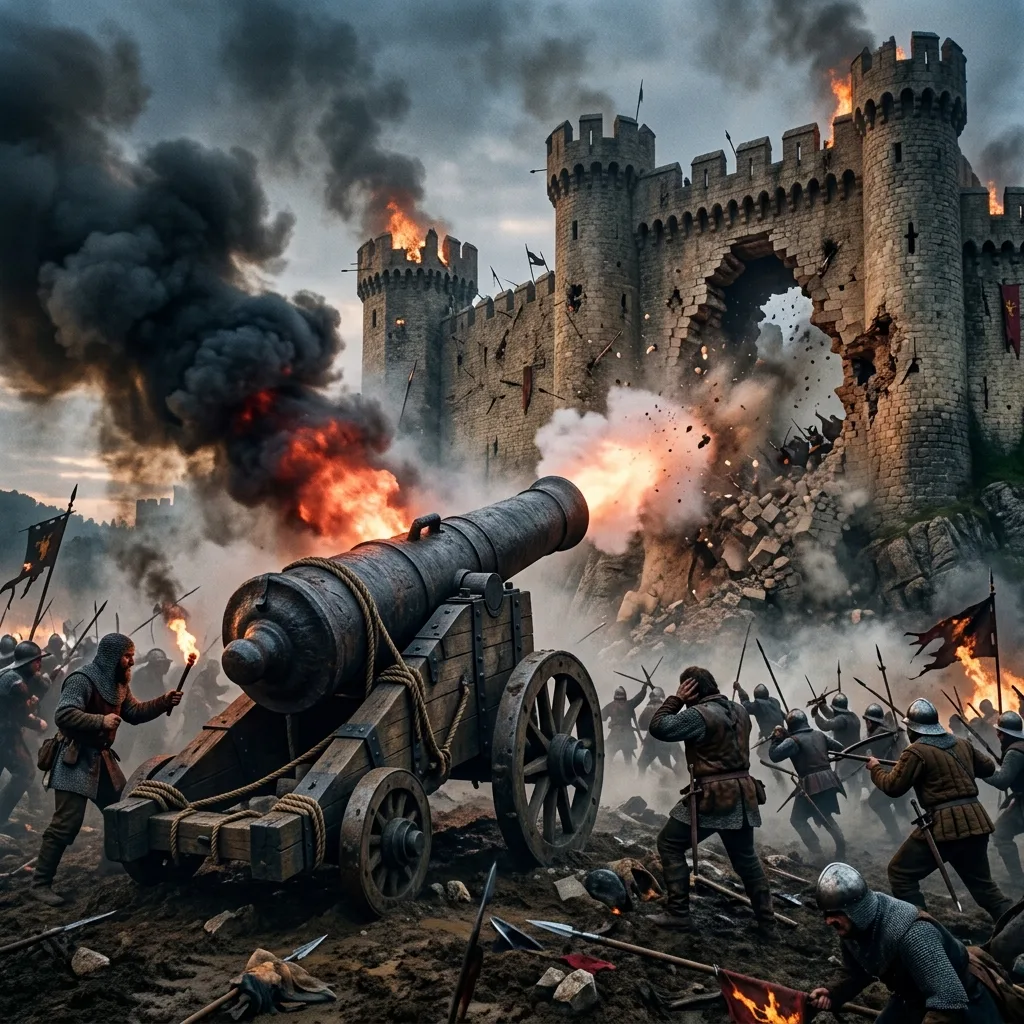
Following the earlier invention of gunpowder (black powder) during the Tang Dynasty, the first true firearms—metal hand cannons—were deployed by the Chinese during the 13th century, rapidly spreading across Eurasia via the Mongol conquests.
Open in interactive timeline →Key Numbers
- Gunpowder first recorded
- ~850 CE (Tang China)
- Oldest surviving gun
- 1288 (Heilongjiang)
- Spread to Europe
- by 1326 (Milemete)
- Earliest gun weight
- 3.55 kg / 7.8 lb
- China-to-Europe lag
- ~40-60 years
Verified Facts
- Gunpowder was discovered in China by Tang-dynasty alchemists seeking an elixir of immortality; the mid-9th-century Taoist text Zhenyuan miaodao yaolue warns that mixing saltpeter, sulfur, and charcoal could singe beards and burn down buildings, the earliest known reference to the formula.
- The Wujing Zongyao, a Song-dynasty military compendium compiled around 1040-1044 under Emperor Renzong by Zeng Gongliang and others, records the world's first written gunpowder formulas (roughly 50% saltpeter), making it the earliest surviving recipe for an explosive mixture.
- The direct ancestor of the gun was the Chinese 'fire lance' (huo qiang): a bamboo or paper tube of gunpowder lashed to a spear that shot flame and shrapnel, first depicted around 950 CE and documented in combat at the Song siege of De'an in 1132.
- By the late 13th century, Chinese smiths replaced fragile bamboo tubes with cast metal barrels and dropped the spear point, producing the hand cannon (huochong), the first true handheld gunpowder firearm.
- The Heilongjiang hand cannon, a bronze piece excavated in the 1970s at Banlachengzi in Manchuria, is the world's oldest surviving firearm, dated to no later than 1288; it weighs 3.55 kg (7.8 lb) and measures 34 cm (13.4 in) long.
- The 1288 date is anchored to a real battle: Yuan-dynasty forces are recorded using hand cannons against the rebel prince Nayan near where the gun was found, with the earliest textual mention of a hand cannon dating to about 1230.
- Gunpowder knowledge spread west along the Silk Road and via the Mongol conquests; the Franciscan friar Roger Bacon recorded Europe's first reference to the gunpowder mixture in his Opus Majus of 1267, likely after seeing Chinese firecrackers.
- The earliest European image of a gun appears in Walter de Milemete's 1326 treatise De nobilitatibus, written for the young Edward III, showing a soldier firing a vase-shaped 'pot-de-fer' that launches a large arrow; a Florentine document from the same year (1326) is the first to authorize manufacture of metal cannon and iron shot.
- Cannon made an early battlefield appearance at Crecy in 1346, where Edward III's small guns are reported to have helped terrify the French and their horses, though their tactical effect was minor compared with the English longbow.
- The handheld gun matured in 15th-century Europe with the matchlock mechanism (c. 1450-1470), which gave the arquebus a trigger-fired serpentine holding a lit match; heavier versions developed to pierce plate armor became known as muskets around 1521.
The World at This Moment
The metal hand cannon crystallized in late-13th-century China under the Mongol Yuan dynasty, which Kublai Khan had proclaimed in 1271 and consolidated by destroying the Southern Song in 1279. The Heilongjiang hand cannon, datable to battles near its findspot in 1287-1288, belongs precisely to this moment of intra-Mongol civil war in Manchuria (the revolt of Nayan). It was a connected Eurasian world: Marco Polo served at Kublai's court roughly 1275-1292, and the Mongol Pax facilitated unprecedented east-west exchange. In the same years, the Mamluks under Qalawun and al-Ashraf Khalil were extinguishing the Crusader Levant, taking Tripoli in 1289 and Acre in 1291. In western Europe, Roger Bacon had already recorded a saltpetre formula around 1267. Edward I ruled England; the Habsburgs were rising in the Empire. Gunpowder weapons were thus emerging at one node of a militarily dynamic, commercially integrated Old World, not in isolation, even as the precise channels of westward transmission remain disputed.
The Paradigm Shift
Firearms severed the link between physical prowess, lengthy martial training, and battlefield lethality. The fire lance and then the metal-barrelled hand cannon harnessed gunpowder's chemical energy to propel projectiles, inaugurating what Tonio Andrade calls the "Gunpowder Age." Over subsequent centuries this redirected the trajectory of warfare, statecraft, and technology: bombards and cannon rendered the high medieval castle obsolete, prompting the costly trace italienne artillery fortress; massed handgunners and later musket volleys displaced the armoured knight and the longbowman. Geoffrey Parker argued these changes drove a "Military Revolution" that enlarged armies, fiscal-military states, and ultimately European global expansion. Beyond war, gunpowder ballistics seeded early modern science—interior and exterior ballistics informed Tartaglia, Galileo, and Newtonian mechanics—and demanded metallurgical, chemical, and manufacturing advances that fed proto-industrial precision. Firearms also democratized killing power downward and concentrated coercive power upward in centralizing states, reshaping the social contract between rulers, soldiers, and subjects across Eurasia.
In Their Own Words
"From the violence of that salt called saltpetre [together with sulphur and charcoal] so horrible a sound is produced by the bursting of a thing so small, no bigger than a thumb, that we find [it] exceeds the roar of strong thunder, and a flash brighter than the most brilliant lightning." — Roger Bacon, on a gunpowder mixture, in his works of c. 1267 (Opus Majus / Opus Tertium corpus addressed to Pope Clement IV); widely cited as the earliest extant Western description of gunpowder's explosive effect.
In Depth
Fire in a Tube: How Firearms Rewired Power
Every gun is a small inheritance from the stars. The carbon in its powder, the iron in its barrel, the sulfur in its charge — all were forged in the cores of dying suns and scattered by the first supernovas (sv-first-supernova) that seeded the gas clouds from which Earth (sv-earth-formation) eventually condensed. A firearm is simply a human-built vessel for releasing chemical energy with violent suddenness. What makes it pivotal is not the physics but what the physics did to the architecture of human power.
The Deep Preconditions
Firearms required a long stack of prior inventions. They needed agriculture (sv-agriculture) to create surplus, cities, and standing states worth defending; metallurgy descended from the same Bronze and Iron Age know-how that armed the chariots at Kadesh (sv-battle-kadesh); and, crucially, gunpowder — a Chinese discovery. Taoist alchemists seeking elixirs of immortality stumbled onto an explosive mixture of saltpeter, charcoal, and sulfur by the 9th century. The first true gun, the fire lance, appears around 950 and is recorded in warfare by 1132 during Song-dynasty sieges. By the late 1200s, China was casting metal hand cannons; the Heilongjiang hand cannon survives from roughly 1288. The technology rode westward along trade and conquest routes — the same Eurasian arteries that Genghis Khan (sv-genghis-khan) and his successors had violently knit together.
The Reordering of Power
In Europe, firearms detonated a slow-motion revolution in who could rule. The medieval order rested on the armored knight and the stone castle — expensive, hereditary, locally rooted forms of power. Cannon dissolved both. When Ottoman bombards cast by the engineer Orbán battered down the walls of Constantinople in 1453, they did more than end the last fragment of the Roman world that Augustus (sv-augustus) had founded; they announced that no wall was forever. Castles that had stood for centuries now fell in days. The knight, master of the battlefield since antiquity, was made obsolete by a peasant with an arquebus and a few weeks of training.
This had a profound political logic. Cannon foundries, powder mills, and professional gun-armies were ruinously expensive — affordable only to centralized monarchies with taxation and bureaucracy, not to scattered nobles. Firearms thus pumped power upward, helping forge the modern nation-state. The same era's other great leveling engine, the Gutenberg press (sv-printing-press), spread ideas as guns spread death, and together they midwifed the world of the Italian Renaissance (sv-renaissance).
The Long Echo
The gun's most consequential thread runs across the Atlantic. When Europeans reached the Americas (sv-new-world), firearms — alongside steel, horses, and disease — produced a catastrophic military asymmetry, enabling tiny expeditions to topple empires. Historian Jared Diamond folded this into his "guns, germs, and steel" thesis, locating the roots of that imbalance not in any people's genius but in the geographic accidents of where agriculture and metallurgy first took hold.
From the matchlock flows an unbroken line: the muskets of the American Revolution (sv-american-revolution), the rifled and mass-produced arms of the American Civil War (sv-american-civil-war) and the Industrial Revolution (sv-industrial-revolution), and ultimately the convergence of physics and firepower at Hiroshima and Nagasaki (sv-hiroshima-nagasaki), where the energy released was no longer chemical but nuclear. The firearm was humanity's first portable, reproducible machine for converting stored energy into death at a distance — a template that scaled, century by century, until it threatened the species itself. In the long arc from the Big Bang (sv-big-bang) to whatever intelligence we build next, the gun marks the moment that destructive power decoupled from physical strength and became, instead, a matter of engineering.
Causes & Consequences
What led to it
- Chinese Taoist alchemists of the Tang dynasty, while searching for an elixir of immortality, discovered around the 9th century that a mixture of saltpeter, sulfur, and charcoal burned violently, a substance recorded as huoyao or 'fire medicine.'
- The earliest known written gunpowder formula appeared in the Taoist text Zhenyuan miaodao yaolüe (c. 850 CE), which explicitly warned readers against combining the three ingredients because of the danger of fire, establishing the chemistry on which all firearms depend.
- The development of methods for purifying saltpeter (potassium nitrate) into a usable oxidizer was essential, with the Mamluk chemist Hasan al-Rammah authoring one of the earliest surviving texts on its purification.
- Advances in metallurgy and bronze and iron casting allowed gunmakers to build barrels strong enough to contain the explosive pressure of detonating gunpowder, making the metal-barreled hand cannon possible.
- Song dynasty forces fighting the Jin-Song Wars developed the fire lance, a spear fitted with a bamboo or paper tube that projected flames and shrapnel, a transitional weapon that pioneered the idea of a gunpowder-propelled projectile from a tube.
- The trade routes and conquests of the Mongol Empire transmitted gunpowder knowledge westward from China into the Islamic world and Europe, where Roger Bacon recorded a gunpowder formula in the 1260s.
What it set in motion
- By the late 13th century the fire lance had evolved into the metal hand cannon, with surviving examples such as the Heilongjiang hand cannon (dated to no later than 1288) and the Xanadu hand cannon (1298) ranking among the world's oldest firearms.
- Siege artillery rendered the high stone walls of medieval castles obsolete within decades of the 15th century, dramatically demonstrated when Mehmed II's massive Ottoman bombards battered down the walls of Constantinople in 1453.
- The threat of cannon fire drove a revolution in fortification design, producing the low, thick, angled bastions of the trace italienne built to absorb and deflect heavy cannonballs.
- Firearms helped erode feudalism by making expensively trained armored knights vulnerable to comparatively cheap gunners, shifting power toward centralized monarchies that could fund professional, gun-equipped armies.
- Drill-based infantry firearm tactics, such as the volley-fire countermarch systematized by Maurice of Nassau in the 1590s, demanded constantly trained standing armies, whose permanent funding spurred new taxes and the growth of state bureaucracies, a process Geoffrey Parker influentially termed the 'Military Revolution.'
- Gunpowder weaponry gave European powers a decisive military edge that underwrote overseas conquest and colonial empire-building from the 16th century onward, while firearms remain central to modern warfare and to enduring debates over gun violence today.
The Live Academic Debate
A live debate concerns gunpowder weaponry and the "Great Divergence." Geoffrey Parker's "Military Revolution" (1988) credits gunpowder, the trace italienne, and the broadside warship with propelling European global dominance; Jeremy Black counters that Parker overstates technology and mis-sequences cause and effect, arguing state development enabled larger armies rather than the reverse, and charging "technological determinism." Tonio Andrade's The Gunpowder Age (2016) complicates both, showing China led in gunpowder weapons through roughly 1450 and remained at rough parity until the late eighteenth century, locating real divergence only around 1775-1900 and tying it partly to Europe's incessant warfare and experimental science. A second debate concerns transmission: did the gun's knowledge pass westward via the Mongols and the Silk Road (the position surveyed in the historiography of gunpowder transmission, associated with Joseph Needham's diffusionist framework), or did Europeans independently develop the cannon? Dating disputes persist too—whether textual references like the 1132 fire lance or 1230 hand-cannon notices, and artifacts like the Heilongjiang and Xanadu guns, are correctly interpreted and dated.
How This Event Connects
The invention of firearms dramatically reshaped political and social structures across the globe, creating a historiographical paradigm shift from technological determinism to a "Gunpowder Age" model. This disruption has deep parallels with the Bronze Age Collapse, where shifts in military technology (such as early iron weapons and new infantry tactics) eroded the hegemony of chariot-based empires, much as firearms later destabilized the heavy cavalry of European medieval elites. Both periods illustrate how localized military adaptations fundamentally restructure the sociopolitical hierarchy by democratizing the battlefield.
Furthermore, the metallurgical and chemical innovations required for corning and cannon casting laid essential foundations for the Industrial Revolution. The necessity of precision manufacturing and standardized parts for firearms directly fueled early industrial models, ultimately leading to the mass production mechanisms that defined 19th-century warfare.
These dynamics fully materialized during the American Civil War, where industrialized firearms, such as rifled muskets, encountered outdated tactical doctrines, resulting in unprecedented casualties. The evolution from early hand cannons to the industrialized slaughter of the 1860s demonstrates a continuous trajectory where hyper-competitive "crucibles" of conflict dictate the pace of technological and societal transformation.
The Counterfactual
Had gunpowder never been weaponized into projectile arms, the most defensible counterfactual is institutional continuity rather than technological stasis. Stone fortifications and armoured cavalry would have retained their dominance far longer, since it was the cannon that breached the tall medieval wall and the handgun that pierced plate. Kenneth Chase's argument that firearms matured where infantry-heavy, settled societies faced gunpowder-using foes implies that absent guns, the steppe horse-archer's military edge—already formidable under the Mongols—might have persisted longer, plausibly delaying the sedentary world's eventual mastery over nomadic cavalry that gunpowder later secured. Geoffrey Parker's thesis suggests that without the artillery fortress and volley fire, the fiscal-military state and Europe's disproportionate global expansion would have lacked a key driver. Yet Jeremy Black's critique cautions against technological determinism: state formation had independent causes, so centralization might have proceeded by other means. The strong claim—that without firearms there is no "rise of the West"—is contested, but the weaker claim, that the timing and texture of early modern warfare would have differed profoundly, is well supported.
Myth vs. Reality
Myth: The Chinese invented gunpowder but only ever used it for fireworks; it took Europeans to weaponize it.
Reality: The military uses came first and were extensive. Gunpowder appears in a Chinese alchemical text (the Zhenyuan miaodao yaolue, c. 850 CE) warning of its fire danger, and by 919 it was used as an igniter for flamethrowers. Historian Tonio Andrade (The Gunpowder Age, 2016) shows the Song dynasty, hemmed in by the Xi Xia, Jin, and Mongols, developed bombs, fire lances, and early guns centuries before the technology reached the West. China's festive pyrotechnic tradition is real and ancient, but the idea that gunpowder was a peaceful Chinese toy 'weaponized' only in Europe is, in Andrade's words, simply wrong.
Myth: The first firearm was the cannon, a tube that fired a ball with gunpowder.
Reality: The earliest gunpowder firearm was the Chinese fire lance, which emerged in the 10th-12th centuries: a spear with a tube of gunpowder lashed to it that shot flame and, later, shrapnel-like pellets and pottery shards. Only when smiths replaced the paper or bamboo tube with a durable metal barrel (the 'eruptor,' mid-13th century) did the barrel detach from the spear to become the hand cannon. The true gun is a descendant of the fire lance, not a sudden invention.
Myth: Guns and gunpowder were invented in medieval Europe, often credited to Roger Bacon or the monk Berthold Schwarz.
Reality: Gunpowder was developed in China as early as the 9th century, and no European invented it. Roger Bacon (c. 1219-1292) recorded one of the earliest Western descriptions of a gunpowder-like mixture in the 1260s, but he described, he did not originate it. 'Berthold Schwarz,' the German monk long credited as gunpowder's inventor, is regarded by scholars as legendary or likely fictional; his name probably derives from Schwarzpulver ('black powder') itself rather than a real person.
Myth: Once firearms appeared, plate armor was instantly obsolete and knights vanished from the battlefield.
Reality: Firearms and plate armor coexisted for roughly three centuries. Guns were in European use by the 1320s-1330s, yet armor was not in marked decline until the latter half of the 17th century, as the Metropolitan Museum of Art notes. Armor frequently saved lives against gunfire; Francis I was reportedly struck several times at Pavia in 1525 and survived. The knight's decline owed as much to changing tactics and the rise of mobile, gun-bearing infantry as to any single weapon punching through steel.
Myth: The word 'bulletproof' is a modern, mostly marketing exaggeration.
Reality: 'Bulletproof' has a concrete origin in Renaissance armor-proofing. As muskets and arquebuses grew powerful enough to pierce plate, armorers would fire a shot at a finished cuirass to 'prove' its quality, leaving a deliberate dent as a guarantee mark, the 'proof.' Buyers looked for that dent as evidence of a genuinely shot-resistant piece. Documented cases include Maximilian II testing his armor against gunfire in 1561 and Sir Henry Lee expecting his Greenwich armor to be 'pistol proof' in 1590.
Frequently Asked Questions
Who invented firearms and where?
Firearms originated in China, growing out of the Chinese invention of gunpowder by Daoist (Taoist) alchemists during the Tang dynasty around the 9th century CE. The first true guns, hand cannons, appeared in China in the late 13th century. No single individual is credited as the inventor; firearms emerged gradually from centuries of Chinese experimentation with gunpowder weapons rather than from one moment of discovery.
When was gunpowder first invented?
Gunpowder was invented in China during the Tang dynasty, with the earliest written gunpowder formulas appearing in Daoist alchemical texts in the 9th century CE. Alchemists searching for an elixir of immortality accidentally created the explosive mixture of saltpeter (potassium nitrate), sulfur, and charcoal. One early reference appears in the mid-9th-century text Zhenyuan miaodao yaolue, which warned of the formula's dangerous, fire-prone properties.
What was the first gun ever made?
The earliest true firearms were Chinese hand cannons, simple metal tubes that fired a projectile using a gunpowder charge, appearing around 1280 CE. The oldest securely dated surviving example is the bronze Heilongjiang hand cannon, discovered in 1970 and dated to no later than 1288 CE. These weapons were preceded by the 'fire lance,' a bamboo or metal tube packed with gunpowder and attached to a spear, which is considered an ancestor of the gun rather than a true firearm.
What is a fire lance?
The fire lance was an early Chinese gunpowder weapon that bridged the gap between incendiary devices and true firearms. It consisted of a tube, originally bamboo, filled with gunpowder and attached near the end of a spear, which shot out flames and sometimes small projectiles when ignited. Fire lances are documented in Chinese warfare by 1132, when Song dynasty defenders reportedly used them during the Siege of De'an, and they are widely regarded as the direct ancestor of the hand cannon and later guns.
How did firearms spread from China to Europe?
After hand cannons developed in China in the late 13th century, gunpowder weapons spread westward across Eurasia, reaching Europe by the early-to-mid 14th century, likely facilitated by Mongol expansion and overland trade. Europeans developed their own early hand cannon, the vase-shaped pot-de-fer, in the 14th century. By the late 14th and 15th centuries European gunsmiths advanced the technology with the matchlock mechanism and the arquebus, the first shoulder firearm with a trigger-operated ignition system.
How did firearms change warfare and society?
Firearms gradually ended the battlefield dominance of armored knights, since guns like the arquebus and musket could pierce plate armor and required far less training than mastering the longbow or lance. Their rise contributed to the decline of feudalism, because the enormous cost of cannons, artillery, and large gun-equipped armies could only be borne by centralized monarchies with tax revenue, not individual feudal lords. Historians often link these changes to the 'Military Revolution,' a theory introduced by Michael Roberts in the 1950s describing how 16th- and 17th-century gunpowder warfare reshaped European states and societies.
Sources & Further Reading
- Heilongjiang hand cannon — Wikipedia
- Tonio Andrade, The Gunpowder Age: China, Military Innovation, and the Rise of the West in World History (Princeton University Press, 2016)
- Geoffrey Parker, The Military Revolution: Military Innovation and the Rise of the West, 1500-1800 (Cambridge University Press, 1988; 2nd ed. 1996)
- Kenneth Chase, Firearms: A Global History to 1700 (Cambridge University Press, 2003)
- Joseph Needham, Science and Civilisation in China, Vol. 5, Part 7: Military Technology; The Gunpowder Epic (Cambridge University Press, 1986)
- Jeremy Black, A Military Revolution? Military Change and European Society, 1550-1800 (Macmillan, 1991)
- Wikipedia: History of firearms
- World History: Gunpowder
Cite This Page
AskHistoryAI. “The Invention of Firearms.” AskHistoryAI — Interactive Timeline of Everything. Updated 2026-09-11. https://askhistoryai.com/event/sv-firearms/
Every fact on this page is checked against the published fact ledger and methodology; sources are listed above.