Hesiod's Theogony
Structuring the divine universe.
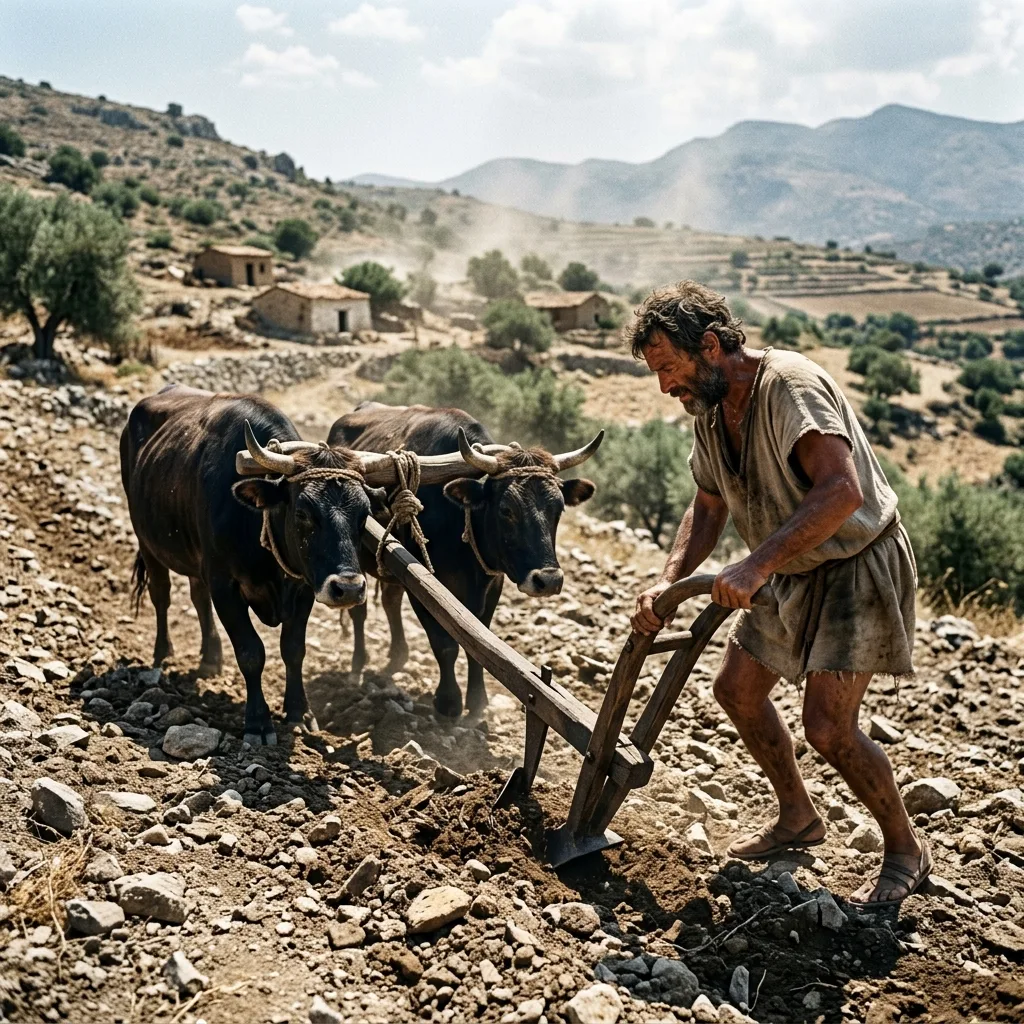
Hesiod writes the Theogony and Works and Days, organizing the chaotic pantheon of Greek gods into a structured genealogy and establishing a moral framework for human labor.
Open in interactive timeline →Key Numbers
- Composed
- c. 730-700 BCE
- Length
- 1,022 lines of dactylic hexameter
- Divine generations
- 3 (Ouranos → Kronos → Zeus)
- Primordial first beings
- Chaos, Gaia, Eros
- Hesiod's home
- Ascra, Boeotia
Verified Facts
- The Theogony was composed around 730-700 BCE, near the end of the eighth century, in roughly 1,022 lines of dactylic hexameter; scholars place it within a generation either side of 700 BCE, making it among the very oldest surviving works of Greek literature alongside Homer.
- It is the first known Greek mythical cosmogony, tracing the emergence of the universe from Chaos (better rendered 'Chasm' or 'gap' than the modern English 'chaos') and naming Gaia (Earth) and Eros (sexual desire) as the other primal beings from which the entire genealogy of gods unfolds.
- The poem's spine is the 'succession myth,' a violent three-generation transfer of cosmic kingship: Ouranos (Sky) is castrated by his son Kronos with a sickle, and Kronos in turn is overthrown by his son Zeus, who establishes the final ordered reign of the Olympians.
- Hesiod is widely regarded as the first true 'author' in Western literature because he names himself in his poetry (Theogony line 22) and supplies autobiographical detail, unlike the anonymous Homer; West and others describe him as the first written poet in the Western tradition to present himself as an individual persona.
- The famous proem describes Hesiod's 'Dichterweihe' (poetic consecration): while shepherding flocks on Mount Helicon in Boeotia, the Muses appear and breathe a divine voice into him, transforming a humble herdsman into a poet of pan-Hellenic authority.
- In that same passage the Muses make a startling admission about poetry's reliability, declaring they know how to speak 'many false things as though they were true,' but also know, when they wish, to utter true things, an early Greek reflection on the ambiguity of inspired speech.
- Hesiod's father emigrated from Cyme in Aeolis (Anatolia) and, driven by poverty, settled the family at Ascra near Mount Helicon; the poet's bitter inheritance dispute with his brother Perses, who allegedly bribed corrupt lords to seize an unfair share, is a recurring grievance in his companion poem Works and Days.
- The Theogony's succession myth closely parallels the Hurrian-Hittite Kumarbi cycle (the 'Song of Going Forth/Emergence,' CTH 344), recovered from the Hittite archives at Hattusa, where the kingship passes Alalu → Anu → Kumarbi with the sky-god Anu likewise castrated, evidence most scholars read as Near Eastern myth transmitted to Greece via Anatolian or Phoenician intermediaries.
- Hesiod records the one sea voyage of his life in Works and Days (lines 650-662): a short crossing from Aulis to Chalcis to compete at the funeral games of the nobleman Amphidamas, where he won a bronze tripod and dedicated it to the Muses on Helicon, a real prize that later spawned the legendary 'Contest of Homer and Hesiod.'
- The Theogony culminates in Zeus's war against the Titans (the Titanomachy) and his defeat of the monstrous Typhoeus, after which Zeus distributes honors among the gods and the catalogue of his divine consorts and offspring secures the cosmic and moral order the poem was written to legitimate.
The World at This Moment
Hesiod composed the Theogony around 730–700 BCE, at the dawn of the Greek Archaic period, contemporary with or just after the Homeric epics and the Greek adoption of the Phoenician-derived alphabet (eighth century). This was the height of the "Orientalizing" period, when Near Eastern art, craft, and myth flooded the Aegean through trade and Phoenician intermediaries. To the east, the Neo-Assyrian Empire under Tiglath-Pileser III and Sargon II dominated the ancient Near East, and the Pax Assyriaca was beginning; Mesopotamian, Hurro-Hittite, and Ugaritic theogonic traditions—the Enūma Eliš, the Song of Kumarbi, the Baal Cycle—were centuries old. In the Levant, the Hebrew prophets Amos and Hosea were active; Rome, by tradition, was newly founded (753 BCE). Greek city-states were colonizing the Mediterranean and Black Sea coasts. Hesiod, a Boeotian farmer near Mount Helicon, wrote at the moment when oral epic met literacy, a hinge between a preliterate heroic age and the textual culture that would produce archaic lyric and, eventually, Ionian natural philosophy.
The Paradigm Shift
The Theogony performed two enduring transformations. First, it imposed systematic order on a sprawling polytheism: Hesiod organized hundreds of divine figures into a coherent genealogy descending from Chaos, Gaia, and Eros to the Olympian order under Zeus, giving Greeks a canonical, panhellenic theological architecture. Herodotus (Histories 2.53) later credited Hesiod and Homer with having "given the Greeks their gods," fixing names, honors, and functions. Second, the proem marks a watershed in authorship: where Homer effaces himself, Hesiod names himself (Theogony 22), recounts his own Dichterweihe—the Muses meeting a shepherd on Helicon—and thereby becomes arguably the first self-naming, biographically present poet in the Western tradition. The poem's drive toward genealogical taxonomy, causation, and the ordering of the cosmos from primordial elements is widely read as a conceptual precursor to Ionian cosmogony; Aristotle himself (Metaphysics 983b–984b) treated Hesiod alongside the early physicists. The succession myth also encoded a theology of justice culminating in Zeus's stable sovereignty.
In Their Own Words
"Shepherds of the wilderness, wretched things of shame, mere bellies, we know how to speak many false things as though they were true; but we know, when we will, to utter true things." — The Muses addressing Hesiod, Hesiod, Theogony 26–28 (trans. Hugh G. Evelyn-White, Loeb)
In Depth
The Bookkeeper of the Cosmos: Hesiod and the First Systematic Universe
Around 700 BC, a Boeotian farmer from the hamlet of Ascra, near Mount Helicon, did something quietly revolutionary: he tried to put the entire universe in order. Where his near-contemporary Homer (sv-homer) sang of heroes and a single furious week at Troy, Hesiod (sv-hesiod) attempted in the Theogony to catalogue the gods themselves — how Chaos gave way to Gaia, how Sky and Earth begot Titans, and how, through three generations of cosmic violence, Zeus came to rule. It is the first surviving Greek attempt at a complete, genealogical account of where everything came from. In a deep sense, it is the West's first cosmology — a distant ancestor of every later effort to narrate origins, from Genesis to the Big Bang (sv-big-bang) itself.
A Mind Shaped by the Bronze Age's Ruins
Hesiod did not invent his cosmos from nothing. His "Succession Myth" — Ouranos castrated by Kronos, Kronos devouring his children only to be overthrown by Zeus — maps with startling precision onto older Near Eastern texts: the Hurrian-Hittite Song of Kumarbi (Anu, Kumarbi, Tessub) and the Babylonian Enuma Elish (Anu, Ea, Marduk). Scholars such as Carolina López-Ruiz argue these traditions reached Greece through Phoenician intermediaries — the same eastern contact that had earlier given Greece its alphabet, the descendant of the cuneiform world (sv-cuneiform) and the older epic impulse behind Gilgamesh (sv-gilgamesh). Hesiod thus stands downstream of the Late Bronze Age Collapse (sv-bronze-collapse): a poet of the recovering Iron Age, reassembling fragments of a shattered older world into a new Greek synthesis.
From Genealogy to Physics
The Theogony's true descendants were not poets but philosophers. When Hesiod began with Chaos as the first thing to "come to be," he had already framed the question the Pre-Socratics (sv-presocratics) would seize upon: what is the arche, the origin? Thales (sv-thales) answered "water," Heraclitus (sv-heraclitus) "fire and flux," Democritus (sv-democritus) "atoms and void" — each replacing Hesiod's begetting gods with impersonal first principles, but each still answering Hesiod's question. Aristotle (sv-aristotle) explicitly named Hesiod among the earliest to ask why things move and cohere. The line from a farmer's genealogy of gods to a physicist's genealogy of matter is direct: Hesiod made "where did it all come from?" a question one could systematically answer.
The Other Hesiod: Justice on a Hard Farm
His second poem, Works and Days, opens a different and equally consequential vein. Addressed to his cheating brother Perses amid a property dispute, it is a farmer's almanac braided with fierce moral instruction: work is honorable, justice (dike) is divinely guaranteed, and the gods watch how men treat one another. This is the voice of the ordinary cultivator, heir to the Agricultural Revolution (sv-agriculture), insisting that cosmic order implies social order. That conviction — that a just structure underwrites the universe — echoes the law-codes of Hammurabi (sv-hammurabi) and anticipates the civic ethics that would later flower in Athenian democracy (sv-athenian-democracy). Hesiod's myth of the Five Ages, his Pandora, his Prometheus: these became the shared furniture of Greek moral imagination, dramatized centuries later on the tragic stage in works like Euripides' Bacchae (sv-bacchae).
The Long Shadow
The Theogony fixed the canonical family tree of the Olympians that Plato (sv-plato) would both quote and quarrel with, that the Library of Alexandria (sv-library-alexandria) would catalogue and edit, and that Roman poets would inherit wholesale. By insisting the universe has a knowable structure with a beginning, an order, and a logic, Hesiod planted a seed that runs through every subsequent attempt to map reality — through Newton's Principia (sv-newton), through Darwin's tree of life (sv-charles-darwin), and into our own age of cosmological history. He was, in the most literal sense, the first to try to write the timeline of everything.
Causes & Consequences
What led to it
- A centuries-old tradition of oral hexameter poetry, transmitted by formula and sung by bards, supplied Hesiod with the inherited stock of divine genealogies and the dactylic-hexameter verse form he reworked into the Theogony around 700 BCE.
- The adoption and adaptation of the Phoenician consonantal alphabet by Greeks in the early 8th century BCE, made distinctive by the Greek innovation of adding vowel signs, gave Hesiod the writing technology that allowed the Theogony to be fixed and preserved rather than left to oral flux.
- Intensified contact between Greeks and the Near East during the orientalizing period transmitted succession-myth material whose pattern survives in Hesiod's account of Ouranos, Kronos, and Zeus, echoing the Hurrian-Hittite 'Kingship in Heaven' (Kumarbi/Teshub) cycle and the Babylonian Enuma Elish.
- A diffuse body of local Greek cults, festivals, and regional deities created the raw plurality of gods that Hesiod needed to organize, motivating the genealogical project of giving every divinity a parentage and place.
- The same poetic and cultural moment that produced the Homeric epics, conventionally dated to the 8th century BCE, established the panhellenic appetite for large-scale hexameter narrative that the Theogony was composed to satisfy.
- The convention of invoking the Muses as sources of poetic authority gave Hesiod the framework for his proem, in which he claims the goddesses appeared to him while shepherding on Mount Helicon and breathed divine song into him.
What it set in motion
- The Theogony became the standard reference for Greek divine genealogy, systematizing a scattered array of local cults and deities into a single ordered pantheon culminating in the reign of Zeus.
- In its proem Hesiod names himself as the poet, providing the first attested authorial self-identification in Greek literature and helping inaugurate the Western idea of the poet as a distinct individual persona.
- By presenting Zeus's kingship as the triumph of intelligence (metis) and as cosmic justice emerging from primordial chaos through successive generations, the poem supplied later Greek thought with a model of order arising out of disorder.
- Presocratic philosophers engaged with the work critically, with Xenophanes attacking its anthropomorphic gods and thinkers such as Anaximander offering naturalistic cosmogonies that responded to and departed from Hesiod's mythic account of origins.
- Later poets across antiquity drew on the Theogony's succession myths and genealogies, from Greek tragedians like Aeschylus to Roman poets such as Virgil and Ovid, making it a foundational reference for classical mythological literature.
- The poem's structuring of the Olympian gods and their domains contributed to the shared panhellenic religious imagination expressed in major sanctuaries and festivals like Olympia and the cult of Zeus.
The Live Academic Debate
A central, still-live debate concerns the proem's "lies" passage (Theogony 27–28), where the Muses tell Hesiod they "know how to speak many false things resembling true things" (pseudea... etumoisin homoia) but also, when they wish, to "proclaim truths." Interpretations diverge sharply: some read it as a polemic against Homeric epic (Hesiod claiming superior truth), following Pietro Pucci's and others' poetological readings; others, with West, take it as a more general statement about poetic fiction and inspiration. A second debate concerns the "Hesiodic question"—whether a single historical Hesiod authored both the Theogony and Works and Days, with Gregory Nagy and the oral-traditional school treating "Hesiod" partly as a panhellenic, performative persona rather than a straightforward biographical author. Third, the extent and mechanism of Near Eastern influence remains contested: West and Walter Burkert (The Orientalizing Revolution) argued for substantial, direct dependence, while others caution against over-reading parallels and stress independent Greek development and the role of itinerant craftsmen and seers.
How This Event Connects
While Homer codified the heroic ethos of Ancient Greece, Hesiod's Theogony and Works and Days (c. 750–650 BCE) provided its foundational ontological and moral framework. Historiographically, Hesiod represents a crucial transition from purely oral, mythic storytelling to a systematized, quasi-rational ordering of the cosmos. The Theogony is not merely a genealogy of gods; it is an early attempt to explain the causal emergence of order (Zeus) out of chaos, anticipating the metaphysical inquiries of the Pre-Socratics.
Furthermore, Works and Days introduces a profound shift toward human-centric morality, focusing on the dignity of agrarian labor and the concept of Dike (Justice) as an objective cosmic principle, rather than the arbitrary whim of the gods. This democratization of virtue laid the psychological groundwork for the later development of the polis and the classical Athenian legal framework.
The Counterfactual
Had no Theogony survived—or had Hesiod never systematized the inherited material—Greek religion would still have functioned, since cult preceded and outlasted any text. But the panhellenic synthesis that gave later Greeks a shared divine genealogy might have remained fragmented across local traditions. M. L. West argued the Theogony is not a free invention but a Greek reworking of a deeply rooted Near Eastern succession pattern (Anu–Kumarbi–Teshub; Anu–Ea–Marduk; Ouranos–Kronos–Zeus); on this view, some Hellenized form of the storm-god's triumph would likely have reached Greece regardless, through the same Orientalizing channels. What is harder to replace is the specific Hesiodic achievement: the canonical genealogical "map" that Aeschylus, the mythographers, Apollodorus, and Ovid presupposed, and the model of the named, morally engaged poetic "I." Without it, later Greek cosmological abstraction would lack one documented bridge from myth to systematic explanation, and our reconstruction of how Near Eastern theogony entered Greece would rest on far thinner evidence.
Myth vs. Reality
Myth: "Chaos" in Hesiod means primordial disorder or a chaotic, jumbled mess.
Reality: Hesiod's Chaos (Greek chaos) does not mean disorder. The word derives from the verbs chaino/chasko, "to gape" or "yawn" (from a Proto-Indo-European root meaning "gape," cognate with English "yawn"), and means a chasm, gap, or yawning void. The Greek word for "disorder" was tarache, a different term entirely. The modern English sense of "chaos" as a confused, disordered mass is a later development and badly misrepresents Hesiod's primeval gap from which the cosmos unfolds.
Myth: The Theogony describes the universe being created out of nothing (ex nihilo), like the biblical creation.
Reality: Hesiod offers no creation from nothing. His cosmos begins with Chaos already in existence as a yawning gap, out of which (and alongside which) Earth, Tartaros, and Eros come into being. Scholars describe this as a coming-to-be out of a pre-existing void (ex vacuo) rather than ex nihilo. Nor is it a deliberate act of a creator: the primal entities simply "come into being," and the poem is structured as genealogy and succession, not as the willed fabrication of a maker.
Myth: Hesiod's Theogony was a wholly original Greek invention with no outside sources.
Reality: The Theogony's central "succession myth" closely parallels older Near Eastern texts, especially the Hurrian-Hittite Kumarbi cycle (the "Song of Going Forth"), where successive sky-gods (Alalu, Anu, Kumarbi) are violently overthrown, echoing Ouranos-Kronos-Zeus. Shared motifs include castration of the sky-god and a god swallowing offspring, with broader resonances in the Babylonian Enuma Elish. Scholars such as M. L. West have documented these connections; Hesiod synthesized and reworked an inherited eastern Mediterranean mythological tradition rather than inventing it from scratch.
Myth: Hesiod's Theogony was the official, authoritative "Greek Bible" — a fixed scripture all Greeks accepted.
Reality: Greek religion had no canonical scripture and no central authority to enforce one. Although Hesiod's version became the most widely known and was often treated as a standard reference, it always competed with rival accounts, most notably the Orphic theogonies (Derveni, Eudemian, Hieronyman, Rhapsodic), which introduced figures like Phanes and a cosmic egg absent from Hesiod, plus many local cult variants. Hesiod organized a synthesis of diverse traditions; he did not produce binding dogma.
Myth: Hesiod and Homer were contemporaries who held a famous live poetry contest.
Reality: The relative dating of Hesiod and Homer was already disputed in antiquity and remains unsettled; both are placed roughly in the late 8th to 7th century BCE, but which came first is unknown. The popular "Contest of Homer and Hesiod" is a much later literary fiction, elaborated from a passage in Works and Days where Hesiod mentions winning a prize at funeral games for Amphidamas at Chalcis. Modern scholars treat the staged duel between the two poets as legend, not historical fact.
Frequently Asked Questions
When was Hesiod's Theogony written?
Most scholars date the Theogony to roughly 730-700 BCE, in the late 8th or early 7th century BCE, with c. 700 BCE the single most commonly cited date. This places its composition during the Archaic period, around the time the Greek alphabet was coming into use and oral epic tradition was being committed to writing. There is still scholarly debate about exactly when Hesiod lived and even whether a single poet named Hesiod authored the work.
Who was Hesiod?
Hesiod was an ancient Greek poet active in the late 8th century BCE, traditionally associated with the Boeotian village of Ascra near Mount Helicon. According to his own poetry, his father had emigrated from Cyme in Asia Minor, and Hesiod worked as a shepherd before, as he describes it, the Muses on Mount Helicon initiated him into the craft of poetry. Besides the Theogony, he is credited with the Works and Days, a didactic poem addressed to his brother Perses that mixes farming advice and ethical teaching with myths such as Prometheus, Pandora, and the five ages of humankind.
What is the Theogony about?
The Theogony is a poem of roughly 1,022 lines of dactylic hexameter that gives a systematic genealogy of the Greek gods, organizing many local myths into a single narrative of how the cosmos and its deities came to be. It traces creation from Chaos and the primordial beings through the violent succession of divine rulers, Ouranos (Sky), Kronos, and finally Zeus. The poem culminates in the Titanomachy, the war in which Zeus and the Olympians defeat the Titans and establish Zeus's ordered reign over the universe.
What does "Chaos" mean in Hesiod's Theogony?
In Hesiod, Chaos is the first thing that came into being, and the word is best translated as "chasm," "gap," "void," or "abyss," derived from a Greek root meaning to gape or yawn open. This is quite different from the modern English sense of "chaos" as jumbled disorder. After Chaos came Gaia (Earth), Tartarus (the Abyss), and Eros (Desire), with Chaos and Gaia each beginning separate genealogical lines of gods.
How is the Theogony connected to Near Eastern myths?
Scholars widely regard the poem's central "Succession Myth" as an adaptation of older Near Eastern traditions about a cosmic struggle between generations of gods ending in the victory of a storm-god. Close parallels appear in the Mesopotamian Enuma Elish (Anu, Ea, Marduk) and the Hurro-Hittite Song of Kumarbi (Anu, Kumarbi, Tessub), each mirroring Hesiod's sequence of Ouranos, Kronos, and Zeus, with shared motifs such as castration of the sky-god and swallowing of offspring. How these traditions reached Greece is uncertain, though many scholars suspect transmission through Phoenician or other Near Eastern contacts, the same broad route by which the Greeks adopted their alphabet.
Was Hesiod a contemporary of Homer, and why does the Theogony matter?
Hesiod is traditionally treated as roughly a contemporary of Homer, active in the late 8th to early 7th century BCE, and is often thought to have worked slightly later, though the relative dating is debated and ancient legends of a contest between them are not historical. The Theogony matters as the first known systematic Greek cosmogony, a large-scale synthesis of scattered local traditions into one coherent account of the world's origins. Its framework proved highly influential, helping shape later Greek mythology and informing the cosmological thinking of early philosophers.
Sources & Further Reading
- Theogony — Wikipedia
- M. L. West, Hesiod: Theogony, edited with prolegomena and commentary (Oxford: Clarendon Press, 1966)
- M. L. West, The East Face of Helicon: West Asiatic Elements in Greek Poetry and Myth (Oxford: Clarendon Press, 1997)
- Walter Burkert, The Orientalizing Revolution: Near Eastern Influence on Greek Culture in the Early Archaic Age (Harvard University Press, 1992)
- Gregory Nagy, Greek Mythology and Poetics (Cornell University Press, 1990)
- Pietro Pucci, Hesiod and the Language of Poetry (Johns Hopkins University Press, 1977)
- Wikipedia: Hesiod
- Read: Theogony
Cite This Page
AskHistoryAI. “Hesiod's Theogony.” AskHistoryAI — Interactive Timeline of Everything. Updated 2026-09-11. https://askhistoryai.com/event/sv-hesiod/
Every fact on this page is checked against the published fact ledger and methodology; sources are listed above.