Homer & The Epic Tradition
The codification of Greek mythos and the hero's journey.
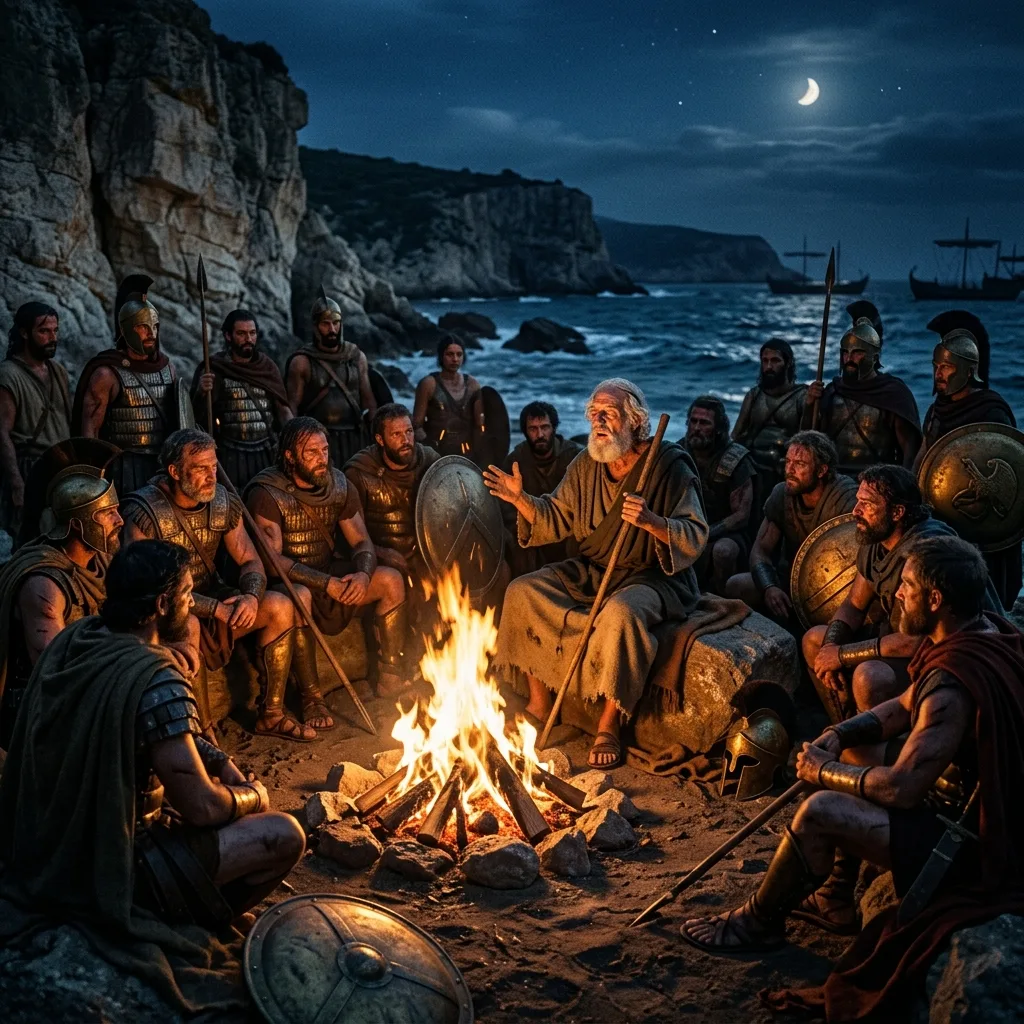
The Iliad and the Odyssey are formally composed, marking the transition from oral storytelling to foundational literature for Western civilization.
Open in interactive timeline →Key Numbers
- Iliad length
- 15,693 lines
- Odyssey length
- 12,109 lines
- Books per epic
- 24 each
- Traditional date
- c. 8th century BCE
- Oldest complete Iliad MS
- Venetus A, 10th c. CE
Verified Facts
- The Iliad runs to 15,693 lines and the Odyssey to 12,109 lines in the standard vulgate text, both composed in dactylic hexameter — a meter of six feet, each a long syllable followed by two shorts or a substituted long.
- Most classicists date the poems to roughly the 8th century BCE, near the very dawn of Greek literacy after the alphabet was adapted from Phoenician, though a vocal minority argues for a mid-7th-century date; whether a single poet named Homer existed at all remains genuinely contested.
- The 'Homeric Question' — whether one author wrote both epics, and when, where, and how they were composed — emerged in the 18th century and dominated classical scholarship for over 200 years.
- Milman Parry (1902-1935) revolutionized the field by demonstrating that Homer's 'stock epithets' (like 'swift-footed Achilles' and 'wine-dark sea') were not decorative but functional oral formulae, prefabricated phrases sized to fit specific metrical slots in the hexameter line.
- To test the oral-composition theory on living singers, Parry and his assistant Albert Lord (1912-1991) ran fieldwork in Yugoslavia from 1933 to 1935, collecting over 12,500 texts from illiterate 'guslari' bards, a recorded archive now housed in Harvard's Milman Parry Collection.
- The Bosniak singer Avdo Međedović, an illiterate butcher, dictated a version of 'The Wedding of Smailagić Meho' that ran to roughly 12,300 lines — about the length of the Odyssey itself — proving that a non-literate oral poet could sustain a Homer-scale composition.
- Athenian tradition credits the 6th-century tyrant Peisistratos (died 528/527 BCE) with a 'recension' standardizing Homer for performance at the Panathenaic festival under a rule requiring rhapsodes to recite the epics in sequence, one taking up where the last left off — though scholars like T. W. Allen (1924) disputed how real this editorial act was.
- Scholars at the Library of Alexandria, above all Aristarchus of Samothrace (2nd century BCE) and his predecessor Zenodotus of Ephesus (3rd century BCE), produced critical editions of Homer; the division of each epic into 24 books is generally credited to these Alexandrians, and editors marked verses they doubted with an 'obelos' (skewer) rather than deleting them.
- The Venetus A (Marciana 454), copied in Constantinople in the late 10th century CE and now in Venice's Biblioteca Marciana, is the oldest complete manuscript of the Iliad; its dense marginal scholia preserve editorial comments traceable back to the Alexandrian scholars centuries earlier.
- Parry and Lord's work seeded the entire interdisciplinary field of oral-formulaic theory, later codified in Lord's 1960 book 'The Singer of Tales,' which extended the model to other oral epic traditions such as Old English 'Beowulf' and medieval South Slavic song.
The World at This Moment
The monumental composition of the Iliad and Odyssey belongs to the late eighth and seventh centuries BCE, as Archaic Greece emerged from the post-Mycenaean "Dark Age." This was a moment of dense innovation: Greeks adapted the Phoenician consonantal script into the first true alphabet with vowels (c. 800–750 BCE); the first Olympiad was traditionally fixed at 776 BCE; and overseas colonization scattered city-states across the Mediterranean and Black Sea. Tradition placed the founding of Rome at 753 BCE. Eastward, the Neo-Assyrian Empire under Tiglath-Pileser III and Sargon II reached its zenith, destroying the northern Kingdom of Israel (722 BCE)—the very period to which scholars assign portions of the Hebrew prophets (Amos, Isaiah). In China, the Western Zhou collapsed in 771 BCE, inaugurating the Spring and Autumn period. The polis, hoplite warfare, and panhellenic sanctuaries were taking shape. Homeric epic thus crystallized precisely as Greek literate, civic, and religious institutions were being born, lending the poems their foundational cultural weight.
The Paradigm Shift
Homeric epic became the cornerstone of Greek—and ultimately Western—literary, educational, and ethical culture. The Iliad and Odyssey functioned as the Greeks' paideia: Plato could call Homer "the educator of Hellas" precisely because the poems supplied a shared canon of heroic conduct, divine machinery, and rhetorical models studied across the Greek-speaking world. They fixed dactylic hexameter as the epic meter and established narrative conventions—the invocation of the Muse, in-medias-res openings, epic similes, the catalogue—that Virgil, Dante, Milton, and beyond would inherit. By stabilizing a fluid oral tradition into monumental, eventually textual form, the poems also helped catalyze the very idea of authorship and the literary canon. As Gregory Nagy argues, the gradual textualization of "Homer" tracks the emergence of panhellenic identity. The poems shaped Greek religion, historiography (Herodotus and Thucydides defined themselves against epic), tragedy, and philosophy, becoming the bedrock against which classical literature continually measured and defined itself.
In Their Own Words
"μῆνιν ἄειδε θεὰ Πηληϊάδεω Ἀχιλῆος / οὐλομένην — "Sing, goddess, the wrath of Achilles son of Peleus, / that destructive wrath..." — Homer, Iliad 1.1–2 (the proem), in the original Greek; English rendering after standard scholarly translation.
In Depth
The Memory Engine: How Homer Turned a Dark Age into a Civilization
Homer is not a discovery but a crystallization. The Iliad and Odyssey were not invented from nothing in the late 8th century BC; they were the moment a centuries-deep river of oral song finally pooled into fixed form. To place Homer in the arc of history is to watch a culture invent a way to remember itself across catastrophe—and then build everything that followed on top of that memory.
Born from Collapse
The deepest precondition for Homer is ruin. The poems remember a vanished world of bronze-armored kings and walled citadels that had been destroyed in the Late Bronze Age Collapse (sv-bronze-collapse) around 1177 BC, when the Mycenaean palaces burned and Linear B writing was lost entirely. For roughly four centuries—the Greek Dark Age—Greece had no script at all. What survived the fire was not stone or ledger but song: illiterate bards transmitting tales of Troy generation to generation. Milman Parry and Albert Lord's fieldwork in the 20th century revealed how this worked, showing that singers composed afresh each performance using a vast stock of metrical formulas. The recurring epithets—"swift-footed Achilles," "wine-dark sea"—are not poetic decoration but the load-bearing architecture of a memory technology that let an oral civilization preserve a Bronze Age it could no longer otherwise reach.
The Alphabet and the Freezing of Song
Homer sits exactly at a hinge. Around 800 BC the Greeks adapted the Phoenician alphabet—descendants of the same Near Eastern scribal lineage that gave the world cuneiform (sv-cuneiform) and the Epic of Gilgamesh (sv-gilgamesh), whose flood narratives and quests for mortal meaning echo unmistakably in Greek epic. The new alphabet arrived just as the Homeric tradition reached its peak, and writing fixed the flowing oral poems into the monumental texts we read. This was the marriage of the two great human inventions for defeating time: the spoken formula and the written sign.
Seeding the Greek Mind
What Homer froze, Greece built upon relentlessly. His near-contemporary Hesiod (sv-hesiod) systematized the gods into the Theogony; the same questioning impulse soon turned skeptical in the Pre-Socratic philosophers (sv-presocratics), who began explaining the cosmos without the Homeric gods at all. The poems became the shared curriculum of Hellas—the text every educated Greek memorized—so that when Plato (sv-plato) built his Academy, he framed philosophy partly as a quarrel with the poets, famously proposing to exile Homer from his ideal city precisely because Homer's authority was total. Aristotle (sv-aristotle) instead mined the Iliad for his theory of tragedy. When Alexander the Great (sv-alexander) marched east, he reportedly slept with a copy of the Iliad annotated by Aristotle beneath his pillow, modeling himself on Achilles and carrying Greek epic across three continents.
The Long Echo
The ripples never stopped. The Great Library of Alexandria (sv-library-alexandria) produced the first critical editions of Homer, inventing textual scholarship itself in the process—our chapter divisions and much of our philology descend from those Alexandrian editors. Rome answered Greece with Virgil's Aeneid, a deliberate fusion of both Homeric poems serving the new order of Augustus (sv-augustus). From there the epic form passes through Dante and Milton into the bloodstream of the Italian Renaissance (sv-renaissance), which recovered Greek antiquity wholesale. Homer's deeper gift, though, is structural: he demonstrated that a civilization could outlast its own collapse by encoding itself in shared narrative. Every later culture that survived dark ages by carrying stories forward—and every modern attempt to compress vast human knowledge into transmissible form—works in the long shadow of the blind bard who turned four lost centuries into the founding poem of the West.
Causes & Consequences
What led to it
- The Mycenaean palace civilization of Late Bronze Age Greece (c. 1600–1200 BC) supplied the heroic-age setting, place-names, and warrior society that the epics remembered, preserving names of Mycenaean heroes and citadels across the roughly four centuries before the poems were written down.
- A continuous oral poetic tradition carried these stories through the Greek Dark Age, with singers (aoidoi) passing tales from bard to bard, embellishing and preserving bodies of legendary material long before writing returned to Greece.
- The oral-formulaic technique—reusable phrases, epithets, and type-scenes fitted to the dactylic hexameter—gave singers a system for composing long narratives in performance, the mechanism Milman Parry and Albert Lord later reconstructed from Homeric diction and Balkan field recordings.
- A large stock of inherited mythological material, above all the Trojan War cycle centered on Troy and figures like Achilles, Agamemnon, and Odysseus, provided the narrative subject matter the epics selected and shaped.
- The Greeks' adoption and adaptation of the Phoenician consonantal script around the eighth century BC—adding signs for vowels to make the first full alphabet—created, for the first time, a tool capable of recording the full sound of long poems.
- The festival and aristocratic-court culture of early Archaic Greece created audiences and performance occasions for epic recitation, sustaining demand for singers and giving the monumental poems a social setting in which to take shape.
What it set in motion
- The fixing of the Iliad and Odyssey in writing in the eighth–seventh centuries BC turned a fluid oral repertoire into stable monumental texts that became the foundational works of Greek—and later Western—literature.
- Homer became the bedrock of Greek paideia: the epics were memorized and recited in schooling across the Classical age, making Homeric verse the shared moral and cultural curriculum of the educated Greek world.
- The poems helped forge a panhellenic Greek identity, giving scattered city-states a common heritage of heroes, gods, and language that made them conscious of belonging to one Hellenic culture.
- Homer set the template for the Western epic, directly inspiring Virgil's Aeneid—which mirrors the Odyssey's wanderings and the Iliad's warfare—and through it Dante's Divine Comedy and later epics down to James Joyce's Ulysses.
- The conviction that the epics rested on real events drove the birth of Aegean archaeology, with Heinrich Schliemann excavating Hisarlik (Troy) and the Mycenae shaft graves in the 1870s in pursuit of Homer's world.
- The Homeric Question and the study of the poems' oral origins founded a whole scholarly discipline, as Parry and Lord's oral-formulaic theory grew into a field touching more than a hundred ancient, medieval, and modern oral traditions worldwide.
The Live Academic Debate
The "Homeric Question" remains genuinely unresolved. Nineteenth-century Analysts (after F. A. Wolf's Prolegomena ad Homerum, 1795) dissected the poems into earlier lays stitched together, treating repetition as evidence of multiple hands; Unitarians defended single, artful authorship. Milman Parry and Albert Lord transformed the debate by proving the poems are oral-formulaic, composed in performance from inherited diction—shifting the question from "who wrote Homer?" to how oral tradition became text. Today the principal axis runs between an "evolutionary" model, championed by Gregory Nagy, in which "Homer" names a gradually crystallizing tradition fixed only by the Classical period, and a "dictation" or single-author model, defended by figures like Richard Janko and, in revived analytical form, Martin West, who attributes the Iliad to one literate poet ("P," active c. 680–640 BCE) using writing. Barry Powell ties the alphabet's invention directly to recording Homer. Dating, unity, and the oral-literate threshold all remain contested.
How This Event Connects
The historiographical linkage between the Homeric epics and the Epic of Gilgamesh demonstrates a continuous subterranean transmission of oral-formulaic narrative structures across the Near East and the Aegean. Both traditions functioned not merely as entertainment, but as encyclopedic repositories of cultural paradigms, encoding aristocratic ethos, theological cosmology, and socio-political norms before the advent of widespread literacy. Homer's codification of the Greek pantheon and heroic ideal acts as a phenomenological anchor for Hellenic identity in much the same way Gilgamesh grounded Mesopotamian existentialism.
Crucially, the translation of these oral traditions into fixed textual forms relies entirely upon parallel phonetic recording technologies, most notably the antecedent Cuneiform script and the later Greek alphabet. The Homeric texts reflect a profound cultural memory of the Late Bronze Age Collapse, functioning as an eschatological mythologization of the Mycenaean civilization's cataclysmic ruin. The transition from the oral "Age of Heroes" to the Iron Age necessitates a mechanism of cultural preservation, which Homer provides.
Finally, the epistemology of Homeric myth stands in dialectical opposition to the rationalized, empirical inquiry of Herodotus. Where Homer relies on divine invocation and the Muse as the guarantor of truth, Herodotus institutes historiê (inquiry), shifting the paradigm from poetic revelation to human investigation. Thus, Homer serves as the necessary mythopoetic thesis against which classical historiography and rationalism would subsequently rebel.
The Counterfactual
Had the hexameter tradition not produced monumental, eventually fixed poems at this juncture, Greek culture would likely have lost its oral epic heritage as other societies lost theirs—surviving, if at all, only in fragmentary, mutable form. Milman Parry and Albert Lord demonstrated that oral-formulaic traditions are inherently fluid: each performance recreates the song anew. Without the convergence of the new alphabet and a context (panhellenic festivals, perhaps a sponsoring polis or tyrant) favoring large-scale fixation, no canonical "Homer" need have emerged. Greek education, which centered on memorizing and interpreting Homer, would have rested on a different foundation; tragedy, which mined the epic cycle, and historiography, which defined itself against epic, would have developed along altered lines. The Roman epic tradition—Virgil's Aeneid is a deliberate response to Homer—presupposes the existence of a stabilized model. The counterfactual is necessarily speculative, but the contingency is real: the survival of monumental epic was not inevitable but the product of specific historical conditions converging once.
Myth vs. Reality
Myth: Homer was a single, blind poet who personally sat down and wrote the Iliad and the Odyssey.
Reality: Scholars have no reliable evidence that Homer was blind; the tradition likely arose from the blind bard Demodocus in the Odyssey and from a Greek reading of "Homeros" as "hostage" or "blind." The poems' vivid visual imagery cuts against literal blindness. More fundamentally, since the work of Milman Parry and Albert Lord (The Singer of Tales, 1960), most classicists hold that the epics emerged from a generations-old oral-formulaic tradition of singer-poets composing in performance, not from one author writing privately. The figure of "Homer" may be a name attached to the culmination of that tradition rather than a documented individual.
Myth: The famous Trojan Horse and the fall of Troy are described in the Iliad.
Reality: The Iliad covers only a few weeks in the tenth year of the war and ends with the funeral of Hector, before the city falls; the Trojan Horse never appears in it. The stratagem and the sack of Troy were told in other, now largely lost poems of the Epic Cycle (such as the Little Iliad and the Iliou Persis), survive only in fragments and summaries, are referred to briefly in the Odyssey, and were later elaborated by the Roman poet Virgil in the Aeneid.
Myth: The Iliad is a reliable historical record of a real Trojan War, proven by Heinrich Schliemann's excavations.
Reality: Excavations at Hisarlik did reveal a real city, and the Hittite name "Wilusa" plus a destruction layer (Troy VIIa, around 1180 BCE) make a historical kernel plausible. But Schliemann misdated his finds: the treasures he linked to the war belong to Troy II, roughly a thousand years too early. There is no independent evidence for figures like Agamemnon or Helen, and scholars treat Homer's narrative as oral tradition shaped over centuries rather than documentary history.
Myth: Homer composed the epics in the form we read them at a single fixed moment, and that text was stable from the start.
Reality: Linguistic and formulaic evidence points to the poems reaching their shape in the oral tradition around the 8th century BCE, roughly when the Greek alphabet (adapted from Phoenician) became available to record them, likely by dictation. The text was not standardized for centuries afterward, with major editorial stabilization associated with later periods (often linked to 6th-century Athens and Hellenistic Alexandrian scholars), and the oldest complete surviving manuscripts date only to the medieval era.
Myth: Homer's repeated epithets, like "swift-footed Achilles" or "rosy-fingered Dawn," were just stock filler the poet repeated out of laziness.
Reality: Milman Parry showed these formulas form an economical system tuned to the dactylic hexameter: a noun-epithet phrase exists to fit a particular metrical slot, enabling rapid composition in live performance. This is a sophisticated feature of oral craft, not carelessness. While Parry emphasized metrical convenience over context-specific meaning, later scholars debate how far epithets also carry thematic resonance, but all agree the formulaic system is a hallmark of skilled oral poetics.
Frequently Asked Questions
Did Homer really exist, or did one person write the Iliad and the Odyssey?
This is the heart of the so-called "Homeric Question," debated since antiquity and intensively since the late 1700s. Although the ancient Greeks attributed both epics to a single poet named Homer, there is no contemporary evidence that such an individual existed, and careful analysis has long raised doubts about single authorship. Most classicists today hold that, whether or not a poet called Homer ever lived, the Iliad and Odyssey grew out of a generations-old oral tradition shared among many singer-poets rather than being invented by one author from scratch.
When were the Iliad and the Odyssey composed?
Scholars generally date the composition of the Homeric epics to roughly the 8th century BCE, with archaeological and linguistic evidence placing them broadly between about 750 and 650 BCE. Many scholars argue the Iliad is somewhat older, perhaps around the middle of that century, with the Odyssey following closer to its end. The stories themselves, however, are thought to be far older, circulating for centuries in oral form among wandering bards before they were ever fixed in text.
What is the difference between the Iliad and the Odyssey?
The Iliad is set during the tenth year of the Trojan War and centers on the wrath of the Greek warrior Achilles after he quarrels with King Agamemnon, dwelling on themes of honor, glory, and death in battle. The Odyssey takes place after the war and follows Odysseus on his long, perilous journey home to Ithaca, emphasizing cunning, endurance, and the longing for family. In broad terms the Iliad is a tragic war poem of the battlefield, while the Odyssey is a wide-ranging adventure that prizes wit and resourcefulness over brute force.
Was the Trojan War real, and did Troy actually exist?
Most scholars accept that the city Homer called Troy corresponds to the archaeological site of Hisarlik in northwestern Turkey, excavated by Heinrich Schliemann beginning in the 1870s, which revealed many layered cities built atop one another. The layers dated roughly between 1700 and 1190 BCE are the candidates for a Bronze Age Troy, near the traditional date of the war around 1200 BCE. Whether a single historical Trojan War occurred as Homer describes remains debated; the treasure Schliemann attributed to King Priam was later shown to be about a thousand years too early for that era.
What was Milman Parry's discovery about Homer?
Milman Parry, an American scholar working in the 1920s and 1930s, demonstrated that the Iliad and Odyssey bear the hallmarks of oral-formulaic composition rather than purely literate authorship. In his Sorbonne thesis he showed that Homer's fixed epithet-and-noun phrases form a system too economical and far-reaching to be the invention of one writing poet, pointing instead to a traditional oral medium. To test this, Parry and his assistant Albert Lord traveled to Yugoslavia in the 1930s and recorded living South Slavic bards (guslari), whose techniques of composing epic verse in performance closely paralleled the patterns embedded in Homer.
How were the Homeric poems written down if they began as oral poetry?
The leading view is that the Iliad and Odyssey were orally composed for performance and then committed to writing, possibly by dictation, in the second half of the 8th century BCE, after the Greeks adapted the alphabet. Later, in 6th-century Athens, the tyrant Peisistratos is associated with regulating the recitation of Homer at the Panathenaic festival, which some ancient sources link to standardizing the text. The rolls produced in this period are thought to underlie the manuscript tradition that Alexandrian scholars studied from the 3rd century BCE onward, though the precise details of this process remain debated.
Sources & Further Reading
- Homer — Wikipedia
- Milman Parry, The Making of Homeric Verse: The Collected Papers of Milman Parry, ed. Adam Parry (Oxford, 1971)
- Albert B. Lord, The Singer of Tales (Harvard University Press, 1960)
- Gregory Nagy, Homer the Preclassic (University of California Press, 2010)
- M. L. West, The Making of the Iliad: Disquisition and Analytical Commentary (Oxford University Press, 2011)
- Barry B. Powell, Homer and the Origin of the Greek Alphabet (Cambridge University Press, 1991)
- Wikipedia: Homeric Question
Cite This Page
AskHistoryAI. “Homer & The Epic Tradition.” AskHistoryAI — Interactive Timeline of Everything. Updated 2026-09-11. https://askhistoryai.com/event/sv-homer/
Every fact on this page is checked against the published fact ledger and methodology; sources are listed above.