Julian the Apostate
The last gasp of Roman Paganism.
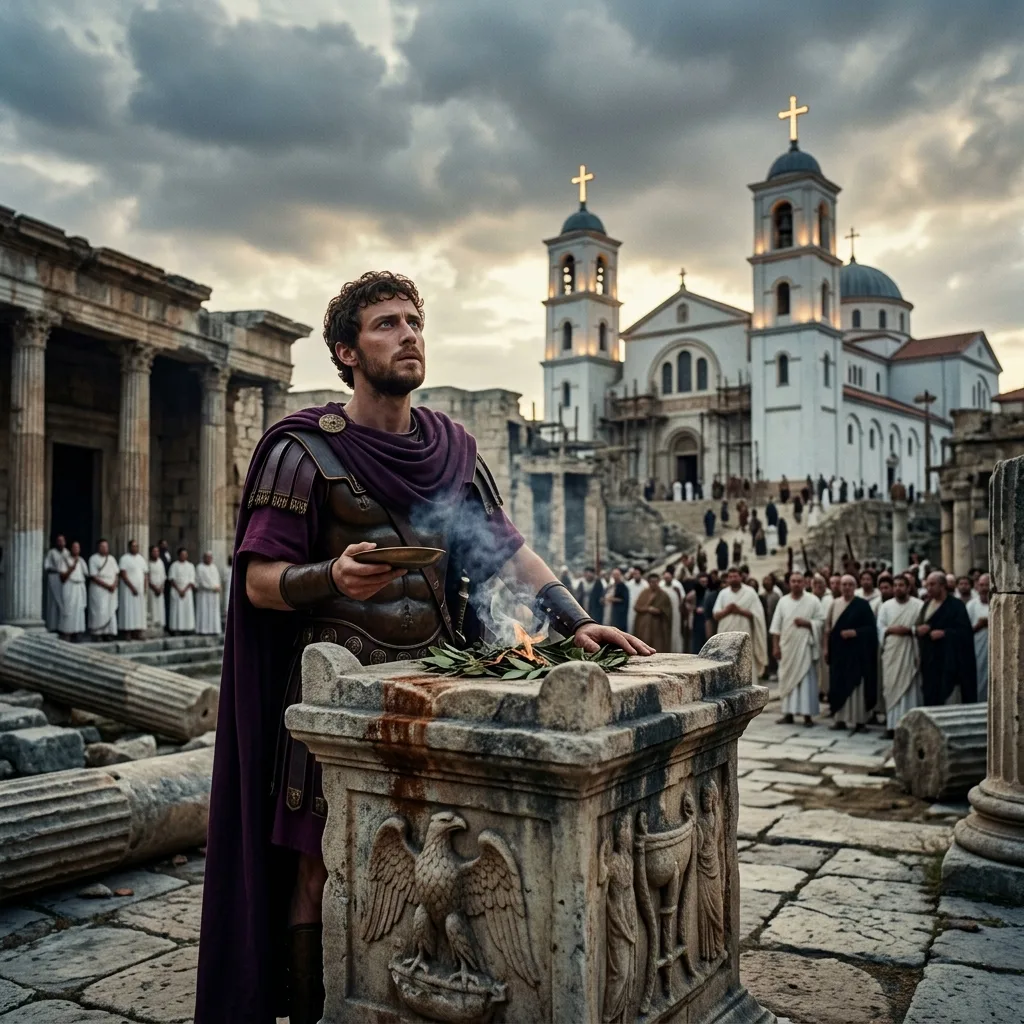
The last non-Christian Roman Emperor. Raised Christian, he secretly converted to Neoplatonism and attempted to revive traditional Roman religious practices and strip the Church of its privileges.
Open in interactive timeline →Key Numbers
- Reign as sole emperor
- Nov 361 – Jun 363 (~19 months)
- Age at death
- ~31 (born 331/332)
- Strasbourg, 357
- 13,000 Romans beat ~35,000 Alemanni
- Persian invasion force
- ~65,000+ men (363)
- Status
- Last non-Christian Roman emperor
Verified Facts
- Flavius Claudius Julianus, a nephew of Constantine the Great, was raised Christian but secretly converted to Hellenic paganism and Neoplatonism; on becoming sole emperor in 361 he openly restored the old gods, reopened temples and revived animal sacrifice, earning the later Christian epithet 'the Apostate.'
- Julian survived the 'massacre of 337,' in which soldiers (acting on behalf of Constantine's sons, chiefly Constantius II) killed much of the imperial family, including Julian's own father Julius Constantius; Julian and his half-brother Gallus were spared only because they were young children.
- As a junior Caesar in Gaul, Julian won the Battle of Strasbourg (Argentoratum) in 357, where his roughly 13,000 Romans routed an Alemanni confederation of about 35,000 under King Chnodomar, who was captured; ancient figures put Alemanni losses around 6,000 against only a few hundred Roman dead.
- In June 362 Julian issued his notorious School Edict (Rescript on Christian Teachers), effectively barring Christians from teaching grammar, rhetoric and philosophy on the logic that they should not teach Greek classics whose gods they disbelieved; even the sympathetic pagan historian Ammianus Marcellinus condemned it as a harsh act that ought to be 'buried in lasting oblivion.'
- Julian authorized rebuilding the Jewish Temple in Jerusalem around 363, partly to undercut Christian claims; the project collapsed amid reported fireballs/explosions at the foundations (per Ammianus Marcellinus), variously attributed by modern scholars to the 363 Galilee earthquake, an accidental fire, sabotage, or Jewish ambivalence, and Christians read it as divine intervention.
- He launched a massive invasion of Sasanian Persia on 5 March 363 with a force ancient and modern estimates place at roughly 65,000 or more; after failing to take the capital Ctesiphon, he burned his own supply fleet on the Tigris, leaving the army with only about 20 days' provisions as Shapur II harried it with scorched-earth tactics.
- Julian was mortally wounded by a spear/lance during a skirmish near Samarra (in modern Iraq) on 26 June 363 and died that night; he fought without armor, and the identity of who threw the fatal weapon was never established, fueling speculation it came from his own side.
- The famous dying words 'You have conquered, Galilean' (Vicisti, Galilaee) are almost certainly apocryphal: they first appear in the hostile Christian historian Theodoret's Ecclesiastical History around 429, decades after Julian's death, and no earlier source — even his enemies — records such a confession.
- A prolific writer, Julian authored 'Against the Galileans,' a treatise attacking Christianity that survives only through quotations in Cyril of Alexandria's later rebuttal 'Contra Julianum.'
- Wintering at Antioch in 362–363, Julian was mocked by the citizens for his philosopher's beard and austere manner; he responded with the self-deprecating satire 'Misopogon' ('Beard-Hater'), blaming the Antiochenes for valuing appearance over virtue.
- Julian's death ended the Constantinian dynasty's male line and the last serious pagan revival; his successor Jovian, hastily proclaimed, signed a humiliating 363 peace with Persia that surrendered territory and key fortresses including Nisibis and Singara.
The World at This Moment
Julian's sole reign (361–363) falls a generation after Constantine's conversion and the Council of Nicaea (325), in an empire where Christianity was ascendant but not yet dominant. In the East he confronted the Sasanian Persia of Shapur II, against whom he launched his fatal 363 invasion toward Ctesiphon. Theological strife consumed the church: the Arian controversy still raged, and Julian cynically recalled exiled bishops—including Athanasius of Alexandria—to deepen Christian division. Contemporaries included the orator Libanius and historian Ammianus Marcellinus in Antioch, the Cappadocian Fathers Basil and Gregory of Nazianzus (Julian's fellow Athens student), and the Neoplatonist Maximus of Ephesus. Beyond Rome's frontiers, the Gupta empire flourished in India under Samudragupta and Chandragupta II; Sasanian Zoroastrianism was consolidating; and Germanic and steppe pressures—Goths along the Danube, the looming Huns—presaged the crises of the next century. Julian thus stood at a hinge between classical antiquity and the Christianized late-antique world.
The Paradigm Shift
Julian's brief reign marked the last serious state-backed bid to reverse Christianization and reinstate Hellenic polytheism as imperial ideology. Raised Christian yet privately converted to Iamblichan Neoplatonism, he attempted not a mere revival but a reformed paganism modeled partly on Christian institutions—an organized pagan "church" with a hierarchy, moral teaching, and systematic charity, since he conceded the Galileans' philanthropy had won converts. His most consequential act was the school edict of 362 barring Christians from teaching classical literature, an attempt to wall the cultural inheritance of Homer and Plato off from the church. His treatise Against the Galileans furnished the most learned pagan critique of scripture before Porphyry's was suppressed. His failure, sealed by his death in Persia, demonstrated that the Christianization Constantine began was effectively irreversible; subsequent emperors (Gratian, Theodosius I) moved decisively to disestablish paganism, culminating in the 391–392 anti-pagan laws. Julian became Christianity's archetypal "apostate" and, paradoxically, a recurring symbol for later secular and Romantic critics of the church.
In Their Own Words
"Whilst Alypius was pressing forward the work with vigour, and the governor of the province was assisting him, terrifying balls of flame kept bursting forth near the foundations of the temple, and made the place inaccessible to the workmen, some of whom were burned to death; and since in this way the element persistently repelled them, the enterprise halted." — Ammianus Marcellinus, Res Gestae 23.1.3, describing Julian's attempt to rebuild the Jewish Temple in Jerusalem (trans. J. C. Rolfe, Loeb Classical Library)
In Depth
The Last Pagan Emperor: Julian and the Road Not Taken
Julian the Apostate (reigned 361–363) is history's great counterfactual — the moment when the Roman Empire's lurch toward Christianity briefly reversed, then snapped forward again. Born at Constantinople in 331, Julian was a nephew of Constantine the Great, and his life was shaped by the same dynasty that had legalized and championed the new faith at Constantine & Nicaea (sv-constantine-legal). That inheritance was poisoned: in the dynastic massacre of 337, Julian's Arian Christian cousin Constantius II slaughtered most of his kinsmen. A boy raised Christian, surrounded by eunuchs and tutors, learned to associate the cross with the murder of his family — and learned to love instead the old books that promised a different world.
Preconditions: a half-converted empire
Julian's apostasy was possible only because the empire he inherited was still spiritually unsettled. Constantine had blessed Christianity but had not yet made paganism illegal; temples still stood, and the educated classes still read Homer & the Epic Tradition (sv-homer) and Plato & the Academy (sv-plato) as scripture of a kind. Secretly tutored by the crypto-pagan philosopher Nicocles and later steeped in the theurgic Neoplatonism of Iamblichus through Maximus of Ephesus, Julian fused mystery religion, Hellenic philosophy, and Homeric devotion into a personal faith. He concealed it until, proclaimed Augustus by his troops in Gaul and made sole emperor by the death of Constantius in 361, he could declare it openly.
What he tried to do
Julian moved fast. His edict of tolerance in 362 reopened temples, restored confiscated properties, and recalled exiled bishops — cynically, to set Christian factions tearing at each other. His School Edict barred Christians who rejected the gods of Homer and Plato from teaching the classics, a shrewd attempt to sever the new faith from the prestige of Greek learning. He drafted a polemic, Against the Galileans, attacking Christian dogma as superstition. Most strikingly, he funded a project to rebuild the Jewish Temple destroyed at the Fall of the Second Temple (sv-second-temple) in 70 AD — a deliberate provocation meant to falsify Jesus' prophecy of its ruin and embarrass the Church. The project collapsed amid fire and earthquake, which Christians read as divine veto.
Why it failed, and what followed
Julian's revival died with him. On 26 June 363, campaigning deep in Persia against the Sasanians — the same eastern frontier Rome had contested since the days of the Seleucid Empire (sv-seleucid) — he was struck by a spear at Maranga and died at thirty-one. He left no heir and no institution to carry the work. Christianity, now entrenched in the bureaucracy and the army, simply resumed its advance. Within a generation, Theodosius Outlaws Paganism (sv-theodosius) in the 390s, closing the temples Julian had reopened and making his life's project legally unthinkable. The historian Eusebius of Caesarea (sv-eusebius) and his successors framed Julian as a cautionary villain, the "Apostate" whose failure proved the faith's destiny.
Yet Julian endures as the great pivot that did not turn. His reign tested whether the classical order built across the long arc from Athenian Democracy (sv-athenian-democracy) and Aristotle & the Lyceum (sv-aristotle) could absorb and reverse the Christian tide. It could not — the demographic and institutional momentum was already too great. In failing, Julian inadvertently demonstrated the irreversibility of the transformation Constantine began, clearing the conceptual path to Augustine of Hippo (sv-augustine) and the Christian Middle Ages. He remains the emperor whom Renaissance humanists and Enlightenment skeptics alike would resurrect as a symbol: the philosopher-king who chose the losing gods, and lost.
Causes & Consequences
What led to it
- The dynastic massacre of 337, in which the family of Constantine the Great was largely killed off by soldiers acting in the interest of Constantius II, left the young Julian an orphan raised under suspicion and confinement, seeding his lifelong alienation from the Christian court.
- Constantius II imposed a strict Arian Christian upbringing on Julian, including tutelage under Eusebius, the Arian bishop of Nicomedia, and isolation at the Cappadocian estate of Macellum, an oppressive religious formation Julian came to resent.
- Julian's education exposed him to pagan teachers such as the rhetorician Libanius and the Neoplatonist philosopher Maximus of Ephesus, whose theurgy and Iamblichan Neoplatonism led to Julian's secret apostasy from Christianity around 351.
- The patronage of Empress Eusebia, wife of Constantius II, secured permission for Julian to continue his studies in Greece, giving him direct contact with the Hellenic philosophical culture that shaped his religious vision.
- Julian's military successes as Caesar in Gaul, including victory over the Alamanni at the Battle of Strasbourg in 357, won him the loyalty of the western legions and the prestige needed to claim power.
- When the Gallic troops were ordered east by Constantius II in 360, they instead proclaimed Julian Augustus at Paris, and the sudden death of Constantius II in 361 cleared his path to sole rule without civil war.
What it set in motion
- As sole emperor from 361 to 363, Julian issued an edict of religious toleration, reopened pagan temples, restored temple lands, and tried to reorganize paganism into a structured priesthood modeled partly on Christian charity, mounting the last serious state-backed effort to reverse Christianity's rise.
- Julian's School Edict of 362 barred Christians from teaching classical literature such as Homer, an attempt to sever Christians from the cultural prestige of Greek paideia that provoked lasting Christian resentment and debate over the relationship between faith and classical learning.
- Julian ordered the rebuilding of the Jewish Temple in Jerusalem in 363, a project that collapsed amid fires and the Galilee earthquake of that year, an outcome later Christian writers seized upon as miraculous confirmation of the Gospel prophecy that no stone would be left upon another.
- Julian's death from a spear wound during his Persian campaign near Ctesiphon on 26 June 363, possibly from his own side, ended the Constantinian dynasty and led the army to elect the Christian officer Jovian, who promptly restored Christianity's favored status and let Julian's reforms dissolve.
- Julian became fixed in cultural memory as 'the last pagan emperor' and 'the Apostate,' a symbol of the road not taken whose favorable treatment by Edward Gibbon in the Decline and Fall made him a touchstone for Enlightenment freethinkers questioning Christian orthodoxy.
- On a public history site that traces a long arc toward a technological future, Julian stands as an early case study in how an entrenched belief system resists reversal, a theme the site projects forward through documented forecasts such as Ray Kurzweil's predicted 2029 AGI and 2045 Singularity, anticipated humanoid-robot capability parity, and speculative 'Claude Mythos' AGI scenarios, all of which the site frames as projections rather than established fact.
The Live Academic Debate
The central modern debate concerns the coherence and sincerity of Julian's religious program. Glen Bowersock (Julian the Apostate, 1978) presents a politically calculating, somewhat fanatical figure whose paganism was reactive and ultimately impractical, stressing the gap between Julian's ambitions and Antiochene reality. Polymnia Athanassiadi (Julian and Hellenism: An Intellectual Biography, 1981) emphasizes instead a genuine, philosophically grounded Neoplatonic spirituality rooted in Iamblichus, treating his theurgy and "Hellenism" as a serious religious system rather than mere policy—though she later (1992) tempered earlier claims about his Mithraism. Rowland Smith (Julian's Gods, 1995) situates his beliefs within mainstream contemporary thought, resisting caricatures of eccentricity. Scholars also dispute whether his measures were genuinely tolerant or covertly persecutory: the school edict, defended by Julian as principled, was condemned even by the sympathetic Ammianus Marcellinus as harsh and worthy of "everlasting silence." Further contention surrounds the Jerusalem Temple project's motives—anti-Christian polemic, philo-Judaism, or eschatological one-upmanship—and the cause of its collapse (earthquake, fire, or sabotage).
How This Event Connects
Julian's brief reign (361–363 CE) represents the last systemic effort to reverse the profound religious and political transformations initiated by Constantine & Nicaea. Historiographically, Julian's "pagan revival" was not a return to traditional, decentralized Roman polytheism, but rather a top-down bureaucratic invention designed to compete with the institutional strength of the Christian Church. By attempting to construct a unified pagan hierarchy equipped with state-mandated welfare programs, Julian inadvertently validated the administrative genius of the very faith he sought to destroy.
Ideologically, Julian was heavily influenced by the mystic theurgy of Plato and the later Neoplatonists. He sought to intellectualize the chaotic mystery cults of Late Antiquity into a cohesive metaphysical system capable of rivaling Christian theology. This epistemological battle reached its zenith in his infamous "School Edict," which attempted to systematically exclude Christians from classical education, thereby rendering them culturally and intellectually irrelevant in the imperial bureaucracy.
In his most audacious theological strike, Julian authorized the rebuilding of the Jewish Temple in Jerusalem, directly engaging with the legacy of the Fall of the Second Temple. This was a calculated ideological weapon aimed at falsifying Christ's prophecy of the Temple's permanent destruction. The failure of this project, coupled with Julian's death on the Persian frontier, abruptly terminated the last serious challenge to the Christianization of the Roman world.
The Counterfactual
Had Julian survived Persia and reigned for decades, would paganism have endured? Most scholars (Bowersock, Cameron) judge a durable reversal improbable: Christianity's institutional density, episcopal networks, and demographic momentum were already structurally entrenched, and Julian's "Hellenism" was an intellectual's artificial construct with shallow popular roots—Antioch's citizens mocked rather than embraced it, as his own satire Misopogon records. Yet a longer reign could plausibly have altered the tempo and texture of change: sustained legal disfavor and the teaching ban might have impoverished a Christian intellectual elite, delaying the synthesis of classical paideia with Christianity that the Cappadocians achieved. A successful Persian campaign would have lent his program immense prestige; his death, by contrast, discredited it instantly and handed the throne to the Christian Jovian within days. Counterfactually, the likeliest outcome is not a pagan empire but a slower, more contested Christianization and perhaps a more pluralistic fourth century—rather than the accelerated Theodosian establishment that actually followed. The deep trend toward a Christian Rome appears robust against Julian's intervention.
Myth vs. Reality
Myth: Julian's dying words were "Vicisti, Galilaee" — "Thou hast conquered, Galilean!" — admitting Christianity's triumph.
Reality: This famous line is almost certainly a Christian invention. It first appears in Theodoret's Ecclesiastical History (c. 429/450 CE), decades after Julian died in 363. No earlier source records it — not even the hostile Christian writers nearest his lifetime, nor the eyewitness account of the pagan officer Ammianus Marcellinus, who instead describes Julian dying while calmly discussing the soul with philosophers. Historians treat the quote as apocryphal propaganda symbolizing the Church's victory, not a record of his actual last words.
Myth: Julian was a lifelong pagan who never had any real connection to Christianity.
Reality: Julian was born and raised a Christian. He was baptized and even ordained a lector (reader) in the church, schooled in Christian literature under Arian clergy such as Eusebius of Nicomedia. His later embrace of Neoplatonic Hellenism — influenced by the theurgist Maximus of Ephesus — was a deliberate adult apostasy from the faith he was raised in. This is precisely why later Christians branded him 'the Apostate': you cannot apostatize from a religion you never held.
Myth: Julian launched a violent persecution of Christians, creating martyrs like earlier emperors such as Diocletian.
Reality: Julian deliberately avoided creating martyrs, understanding that persecution had strengthened the Church. He issued no general edict outlawing Christianity and even proclaimed religious toleration. His campaign was attritional rather than bloody: he stripped Christian clergy of privileges and subsidies, barred Christians from certain offices, and — most pointedly — issued his June 362 school edict forbidding Christian teachers from teaching the pagan classics, aiming to cut Christians off from the elite education needed for public success. Scattered local violence occurred, but systematic state martyrdom was not his policy.
Myth: Julian's attempt to rebuild the Jewish Temple in Jerusalem was halted by a miraculous divine fire sent to vindicate Christianity.
Reality: Julian did commission the rebuilding around 363, entrusting it to Alypius of Antioch, partly to discredit Jesus's prophecy of the Temple's destruction. The pagan eyewitness historian Ammianus Marcellinus reports that 'terrifying balls of flame' burst near the foundations and stopped the work. Modern scholars offer naturalistic explanations: the documented Galilee earthquake of 363, ignition of trapped gases or stored materials in the old substructures, an accidental fire, or possible sabotage. Christian writers framed it as divine intervention, but the project mainly collapsed because Julian himself died in Persia weeks later, ending imperial backing.
Myth: Julian was an enlightened, tolerant philosopher-king — a champion of religious freedom ahead of his time.
Reality: This flattering image, popular since the Enlightenment, oversimplifies him. Julian's 'tolerance' was substantially strategic: he recalled exiled heretics and permitted rival Christian sects partly to inflame their mutual hostility and fracture Church unity — Ammianus wryly noted Julian had learned no wild beasts are as dangerous to people as Christians are to one another. Julian was himself a fervent, polemical anti-Christian author whose treatise 'Against the Galileans' attacked Christianity directly, and his policies grew more openly hostile over his short reign. His goal was a Hellenic revival that marginalized Christianity, not neutral pluralism.
Frequently Asked Questions
Who was Julian the Apostate?
Julian (Flavius Claudius Julianus) was Roman emperor from 361 to 363 CE and the last non-Christian emperor of Rome. A nephew of Constantine the Great, he was raised as a Christian but renounced the faith in favor of traditional Greco-Roman paganism and Neoplatonic philosophy. As emperor he tried to reverse the Christianization begun under Constantine, earning the hostile nickname "the Apostate" from later Christian writers. He died of a battle wound during a campaign against the Sasanian Persians in June 363.
Why is Julian called "the Apostate"?
"Apostate" comes from the Greek apostasia, meaning abandonment of one's faith, and was applied to Julian because he renounced the Christianity in which he had been raised. After being forced into Christian instruction in childhood by his cousin Constantius II, he secretly embraced Greek paganism and theurgic Neoplatonism, then promoted it openly once he became emperor. The label was coined and popularized by later Christian authors as a term of condemnation, not something Julian called himself.
What did Julian do to try to restore paganism?
In 362 Julian issued edicts reopening pagan temples, restoring confiscated temple properties, and reviving public sacrifices to the traditional gods. He recalled Christian bishops who had been exiled (partly to stir internal Christian disputes) and removed many of the privileges Christianity had gained under Constantine. He also tried to reorganize paganism into a structured, charitable institution modeled in part on the Christian church. His efforts had limited lasting success and were largely undone after his death.
Did Julian try to rebuild the Jewish Temple in Jerusalem?
Yes. Around 363 Julian authorized rebuilding the Temple in Jerusalem, entrusting the project to his official Alypius of Antioch, in part to undermine Christian claims that the Temple's destruction was permanent. Ancient sources, including the contemporary pagan historian Ammianus Marcellinus, report that the work was halted when fireballs or flames burst out near the foundations and prevented the laborers from continuing. Modern scholars have linked the disruption to the 363 Galilee earthquake, an accidental fire, or Jewish ambivalence, while Christian writers of the time saw it as divine intervention; Julian's death ended the project.
What was Julian's edict on Christian teachers?
On June 17, 362, Julian issued an edict on education that effectively barred Christians from teaching classical Greek and Latin literature. His argument was that teachers should not instruct in authors like Homer and Plato while disbelieving in the gods those authors honored. Christian instructors were thus pressured to either acknowledge the traditional gods or give up their posts. Even the pagan historian Ammianus Marcellinus criticized the measure as harsh and intolerant.
How did Julian the Apostate die?
Julian died on June 26, 363, from a spear wound suffered during the retreat of his Roman army from Sasanian Persia near Ctesiphon. Having rushed into the fighting without full armor, he was struck in the side; the wound reportedly pierced his liver and intestines, and he died that night in camp. The identity of who threw the spear was never established, with ancient sources speculating it could have been a Persian or even a Roman soldier.
Did Julian really say "You have won, Galilean" as he died?
The famous dying words "Vicisti, Galilaee" ("You have conquered, Galilean"), supposedly addressed to Christ, are almost certainly a later Christian legend rather than history. The story appears in the fifth-century church historian Theodoret of Cyrus, written decades after Julian's death, and was meant to portray his death as divine retribution. The contemporary eyewitness historian Ammianus Marcellinus, who was on the campaign, records no such statement and instead describes Julian dying with a calm philosophical speech.
Sources & Further Reading
- Julian (emperor) — Wikipedia
- Glen W. Bowersock, Julian the Apostate (Harvard University Press, 1978)
- Polymnia Athanassiadi, Julian: An Intellectual Biography (Routledge, 1992; orig. Julian and Hellenism, Oxford, 1981)
- Rowland Smith, Julian's Gods: Religion and Philosophy in the Thought and Action of Julian the Apostate (Routledge, 1995)
- Ammianus Marcellinus, Res Gestae (Books 16–25), trans. J. C. Rolfe, Loeb Classical Library
- The Works of the Emperor Julian, trans. Wilmer Cave Wright, 3 vols., Loeb Classical Library (1913–1923)
- Wikipedia: Neoplatonism
Cite This Page
AskHistoryAI. “Julian the Apostate.” AskHistoryAI — Interactive Timeline of Everything. Updated 2026-09-11. https://askhistoryai.com/event/sv-julian/
Every fact on this page is checked against the published fact ledger and methodology; sources are listed above.